


.avif)






Recent Blogs
Stay updated with our latest blog posts.


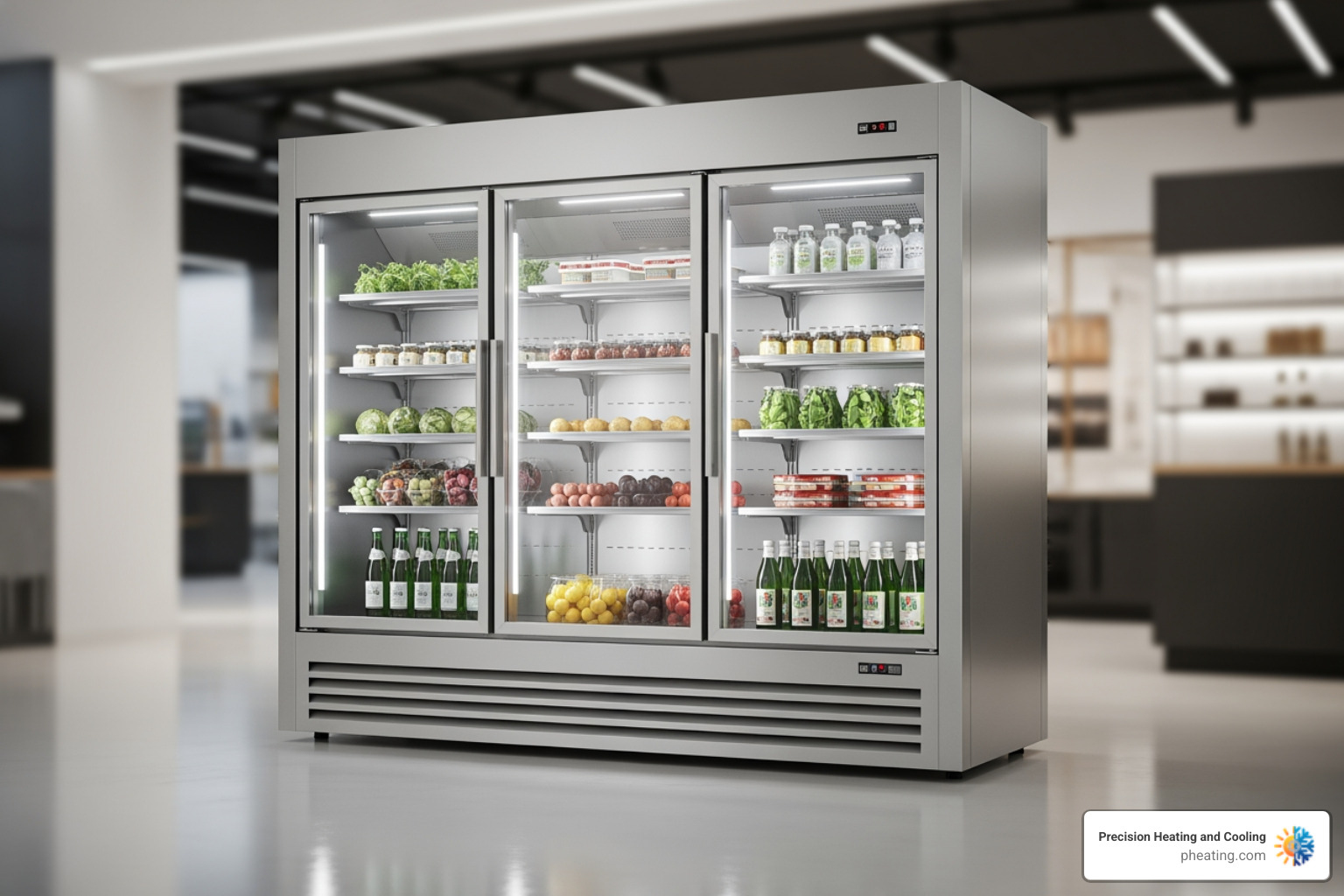
A commercial refrigeration upgrade can transform how your business operates. If you're wondering whether it's time to modernize your cooling systems, here's what you need to know:
For businesses in the San Jose Bay Area and Central Valley, outdated refrigeration equipment isn't just inefficient—it's a liability. Whether you run a restaurant, grocery store, or any business that depends on reliable cooling, your refrigeration system accounts for 40-60% of your total electricity consumption. When these systems use obsolete refrigerants, waste energy through dirty coils, or struggle to maintain consistent temperatures, they drain your budget while putting your inventory at risk.
Learn more about commercial refrigeration services or contact us for expert commercial refrigeration repair.
I'm Tony Lara, and I've spent years in the HVAC field helping businesses tackle complex refrigeration challenges, including tracking down hard-to-find parts for commercial refrigeration upgrade projects. My hands-on experience has shown me that the right upgrade at the right time can save businesses thousands while improving their day-to-day operations.
Similar topics to commercial refrigeration upgrade:
The decision to pursue a commercial refrigeration upgrade rarely happens overnight. It's usually the result of mounting pressures that affect your daily operations, your budget, and sometimes even your ability to stay in business. For companies throughout the San Jose Bay Area and Central Valley—from Cupertino to Clovis—understanding what's driving the need for an upgrade is the first step toward making a smart investment.
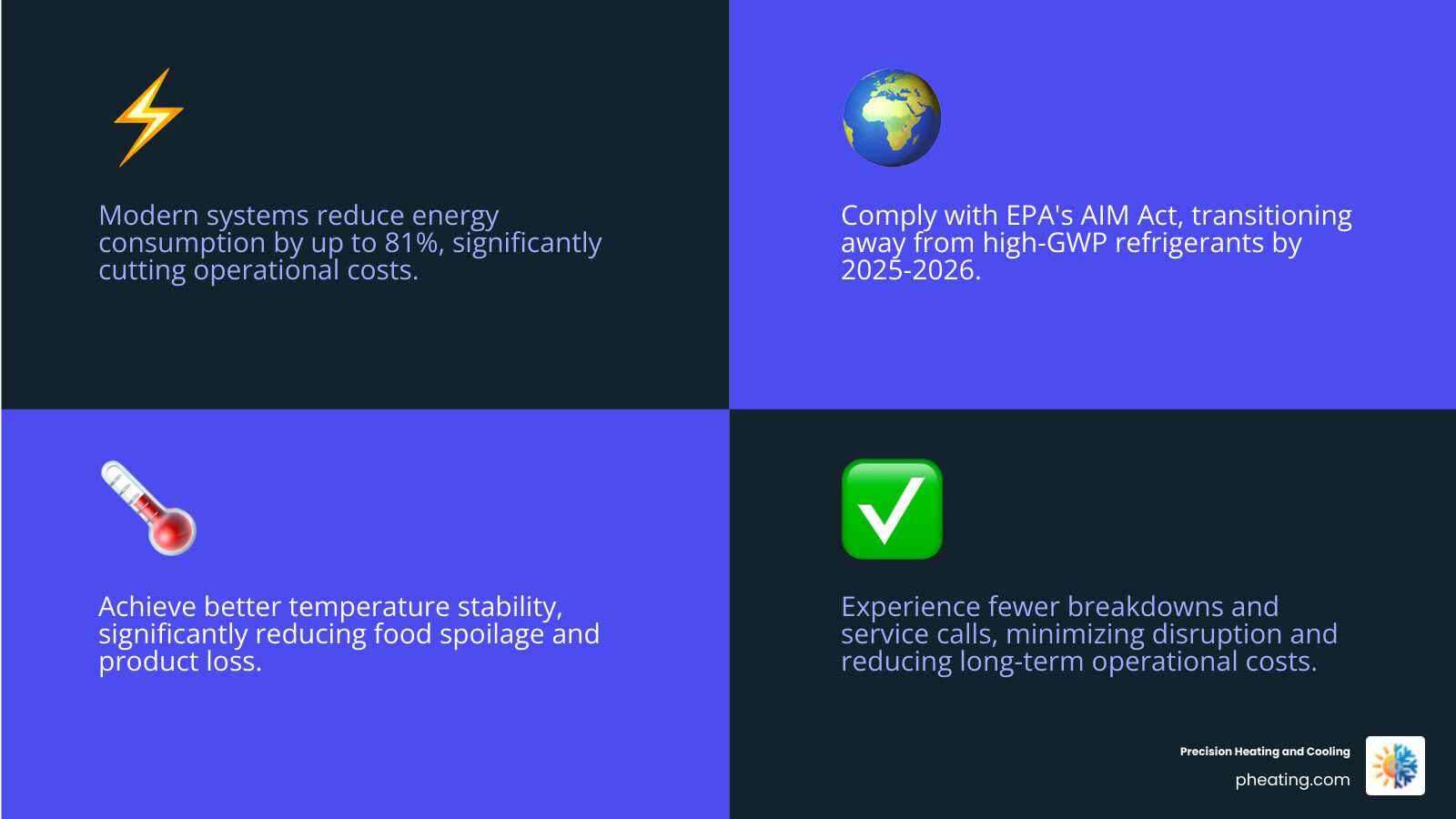
Let's start with the big one: energy efficiency and cost savings. If you've noticed your utility bills creeping higher each month, your refrigeration system is likely the culprit. Commercial refrigeration systems account for roughly 20% of all energy used globally, and within your facility, these units can easily consume 40% to 60% of your total electricity. That's a massive chunk of your operating budget disappearing every month.
Here's something that might surprise you: studies show that about 30% of the energy used in commercial buildings is simply wasted. Old, inefficient refrigeration equipment is often the main offender. Even something as seemingly minor as a thin layer of dust on your condenser coils can cause serious problems. Just 0.042 inches of dirt—barely visible to the naked eye—can drop efficiency by 21% and increase energy consumption by 35%. We've seen cases where dirty equipment leads to a 5% jump in energy costs and 50% more service calls. When you upgrade, you're not just getting new equipment—you're plugging a leak in your budget. For more details on spotting these issues, check out our guide on Energy Loss Signs in Commercial Refrigeration.
Regulatory compliance is another major driver that you simply can't ignore. The refrigerant landscape has changed dramatically in recent years, and the rules are only getting stricter. The 2020 American Innovation and Manufacturing (AIM) Act directed the EPA to phase down the production and consumption of high Global Warming Potential (GWP) refrigerants—specifically hydrofluorocarbons (HFCs). These older refrigerants, like R-404A with its eye-watering GWP of over 3,900, are on their way out.
The EPA has proposed rules that will prohibit the manufacture of equipment containing these high-GWP refrigerants by January 1, 2025, and their sale by January 1, 2026. If your system still uses these older refrigerants, you're on borrowed time. And the penalties for non-compliance aren't trivial—the EPA requires strict record-keeping for any loss of 50 pounds or more of ozone-depleting refrigerant. One national retailer recently paid $2.5 million in fines for violations. That's a costly wake-up call that could put a serious dent in any business.
Beyond staying legal, a commercial refrigeration upgrade delivers real improvements in performance and product quality. Temperature stability matters more than you might think. Older systems struggle to maintain consistent temperatures, and even small fluctuations can compromise your products. For restaurants, grocery stores, and any business handling perishables, this means increased food spoilage, unhappy customers, and money literally thrown in the trash.
Modern refrigeration systems are engineered for precision. They maintain tighter temperature control, which keeps your products fresher longer and reduces waste. When your customers can count on consistently high-quality products, they keep coming back—and that's good for business.
Finally, let's talk about reduced maintenance. If it feels like you're calling for repairs more often lately, you're not imagining it. As refrigeration systems age, they become less reliable and more expensive to keep running. More breakdowns mean more downtime, more emergency service calls, and more risk of losing inventory to spoilage.
Upgraded systems with modern components and advanced diagnostics are simply more dependable. They require fewer interventions, which translates to lower long-term maintenance costs and less stress for you and your team. If you're already dealing with frequent issues, our article on Signs Commercial Refrigeration Requires Repair can help you identify whether it's time to stop patching problems and start fresh with an upgrade.
Once you've decided a commercial refrigeration upgrade is in order, the next big question is: do you retrofit your existing system, or do you replace it entirely? Both options have their merits, and the best choice for your business in the San Jose Bay Area & Central Valley depends on several factors, including the age and condition of your current equipment, your budget, and your long-term goals.
Retrofitting involves making targeted upgrades to your existing refrigeration system. Think of it as giving your old workhorse a significant tune-up and some modern improvements, rather than buying a brand new vehicle. This could mean replacing specific components like compressors, controls, or refrigerants, without tearing out the entire infrastructure. The goal is to keep the system operating safely, efficiently, and in compliance, extending its usable life.
On the other hand, full system replacement means removing your old refrigeration unit(s) entirely and installing brand new ones. This is akin to getting a completely new vehicle, often designed with the latest technology from the ground up. This option is typically considered when the existing system is very old, extensively damaged, or simply can't meet modern demands even with significant upgrades.
To help you weigh your options, here's a comparison:
| Factor | Retrofit | Replacement |
|---|---|---|
| Initial Investment | Generally lower upfront costs, as you're working with existing infrastructure | Higher initial investment for new equipment and installation |
| Operational Disruption | Minimal downtime with careful planning; work can often happen during off-peak hours | May require more substantial downtime or extensive scheduling |
| Long-Term Efficiency | Can significantly improve efficiency—up to 81% energy savings with upgrades like ECMs | Typically offers the highest long-term efficiency with cutting-edge technology |
| Project Scope | Focused on specific component replacements or system improvements | Comprehensive overhaul with entirely new systems |
Understanding when each path makes the most sense will help you make a confident decision. For more guidance on timing, check out our article on Time for Commercial Refrigeration Replacement.
Choosing to retrofit your commercial refrigeration upgrade offers several attractive advantages. The most immediate benefit is the lower initial investment. Because you're leveraging your existing infrastructure and only replacing or upgrading specific components, you're not paying for an entirely new system. This makes retrofitting an excellent choice for businesses working within tighter budget constraints or those who need to spread capital expenses over time.
Another major plus is minimized operational disruption. Your business can't afford extended downtime—every hour your refrigeration is offline means potential product loss and revenue impact. Retrofits can often be completed in phases, allowing you to maintain operations while improvements are made. Many upgrades can be scheduled during off-peak hours, so your customers never know the work is happening.
Retrofitting also excels at extending equipment lifespan. If your refrigeration system has good bones but is showing its age, strategic upgrades can breathe new life into it. Replacing worn compressors, upgrading to modern controls, or converting to low-GWP refrigerants can add years of reliable service without the expense of starting from scratch.
Finally, retrofitting helps you achieve compliance without full replacement. With the EPA's refrigerant phase-down requirements looming, you might only need a refrigerant conversion and a few component upgrades to meet regulations—no need to rip everything out and start over. This targeted approach gets you compliant while keeping your business running smoothly.
While retrofitting offers plenty of benefits, there are situations where a full system replacement is simply the smarter move. If you're dealing with end-of-life equipment, no amount of upgrades will give you the reliability and efficiency you need. Systems that have been in service for 15-20 years or more often have multiple failing components, outdated technology, and inefficiencies built into their very design. At that point, you're better off investing in new equipment rather than throwing good money after bad on endless repairs.
A major facility remodel is another perfect opportunity for full replacement. If you're already tearing walls down, reconfiguring your space, or expanding your operations, it makes sense to install brand new refrigeration that's properly sized and positioned for your updated layout. You'll avoid the headache of trying to make old equipment fit new spaces.
When you have a desire for maximum efficiency, replacement wins hands down. The latest refrigeration systems incorporate technological advances that simply weren't available even five years ago. We're talking about smart controls, variable-speed compressors, advanced defrost systems, and refrigerants with minimal environmental impact. These systems can deliver energy savings that quickly offset their higher upfront costs.
Finally, choosing replacement gives you access to the latest technology. Modern systems offer remote monitoring capabilities, predictive maintenance features, and integration with building management systems. These aren't just nice-to-have features—they're tools that help you catch problems before they become emergencies, optimize performance automatically, and reduce your long-term operating costs. If staying competitive and future-proofing your operation matters to you, a full replacement might be worth the investment.

Leslie was amazing for her outstanding customer service skills with me the other day. Thanks to her help my air conditioner is now all set up. She answered all my questions and took away all my problems. Leslie broke it down step by step to set it up easier. Now thanks to her my air conditioner is working perfectly. I really appreciate it Leslie and I’ll be sure to ask for you if I ever come back.
I contacted Precision Heating and Cooling for my home's AC repair. They were punctual and very professional. Guillermo was very kind and thorough. I would highly recommend them!
I am writing to express my sincere appreciation for the excellent work performed by Pablo and Alejandro from Precision Heating and Cooling. Their commitment to quality and customer satisfaction is truly commendable. Awesome job guys!
I would like to extend my sincere gratitude to Alejandro for his exceptional hard work. His passion for helping others is evident, and he consistently goes above and beyond in his service. Alejandro's thorough cleaning of my fireplace has truly made a significant difference. His dedication and professionalism are greatly appreciated.
I was very impressed. Came at night (after 9pm) to fix our AC during the middle of a heat wave the day before a national holiday! Technician was very courteous and efficient, got the job done quickly. Will definitely call them again for any AC servicing I need!
Fast and efficient, arrived when scheduled for repairs and replacement parts were ordered and installed quickly. Techs were very friendly and professional. AC system works great now! I highly recommend their services if you need repairs. Tim


.avif)
