When Your Furnace Stops Working: Understanding the Problem
A furnace not heating your home properly can turn a comfortable winter evening into a stressful situation, especially here in the San Jose Bay Area when temperatures drop unexpectedly. While our winters are milder than most places, a malfunctioning furnace still means cold bedrooms, uncomfortable mornings, and potential safety concerns for your family.
Quick Fixes for a Furnace Not Heating:
- Check your thermostat - Verify it's set to "Heat" mode and the temperature is set higher than the current room temperature
- Inspect the air filter - A clogged filter is the most common cause of furnace problems and should be replaced monthly
- Verify power supply - Check that the circuit breaker hasn't tripped and the furnace power switch is on
- Ensure gas supply - Confirm the gas valve is open (parallel to the pipe) if you have a gas furnace
- Clear blocked vents - Make sure all registers are open and not obstructed by furniture or rugs
If you're looking for expert heating services in the Bay Area or need immediate assistance, you can schedule a heating repair consultation with our certified technicians.
The good news is that many furnace issues can be resolved with simple troubleshooting steps you can do yourself before calling a professional. A dirty air filter, incorrect thermostat settings, or a tripped breaker are often the culprits behind a furnace not heating properly. However, some problems—like ignition system failures, gas leaks, or cracked heat exchangers—require immediate professional attention for your safety.
I'm Tony Lara, and I've spent years in the HVAC field helping homeowners diagnose and resolve furnace not heating issues throughout the Bay Area. My experience has taught me that understanding the basics of your heating system can save you time, money, and stress when problems arise.
In this guide, we'll walk you through a systematic approach to diagnosing why your furnace isn't heating, from the simplest checks you can perform in minutes to the more complex issues that require professional expertise. We'll also cover essential safety warnings, maintenance tips to prevent future problems, and clear indicators of when it's time to repair versus replace your system.
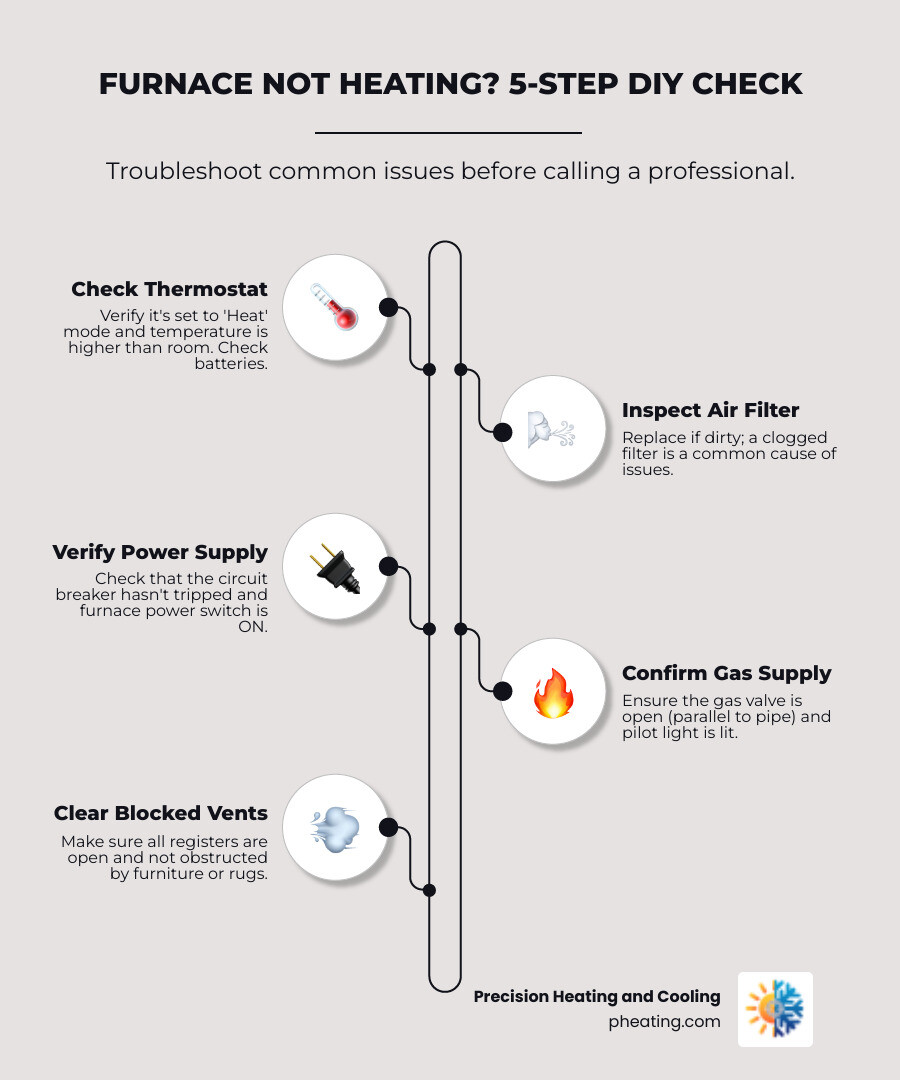
Simple guide to furnace not heating:
Why Your Furnace is Not Heating: Simple DIY Checks
When your home feels more like a walk-in freezer than a cozy haven, it's natural to panic. But before you dial for help, there are several simple checks you can perform to identify why your furnace not heating might be happening. These basic troubleshooting steps can often resolve the issue quickly, saving you the hassle of a service call. Let's explore the most common culprits.
Troubleshooting a Furnace Not Heating Due to Power Issues
No power, no heat – it's as simple as that. If your furnace isn't turning on at all, or if it suddenly went silent, a power interruption is a likely suspect.
- Circuit Breaker: Your furnace has a dedicated circuit breaker in your home's electrical panel. Sometimes, an electrical surge or a minor fault can cause this breaker to "trip," cutting off power to your furnace. Head to your electrical panel, locate the breaker labeled for your HVAC system (it might be labeled "Furnace" or "HVAC"). If it's in the middle position, it has tripped. Firmly push it to the "Off" position first, then back to "On." If it trips again immediately, this indicates a more serious electrical issue that requires professional attention. For future reference, we recommend labeling your furnace breaker for easy identification!
- Furnace Disconnect Switch: Near the furnace unit itself, you'll usually find a standard light switch. This is your furnace's dedicated power switch. It's often accidentally flipped off, perhaps by a curious child, during a cleaning, or by someone working nearby. Ensure this switch is in the "On" position.
- Blower Motor Panel Switch: Many modern furnaces have a safety switch built into the access panel for the blower motor. If this panel isn't securely closed, the switch won't engage, and the furnace won't operate. Double-check that all furnace panels are tightly shut. It's a simple safety feature that can sometimes be overlooked.
One of the most common, yet frequently overlooked, reasons for a furnace not heating effectively is a dirty air filter. It's like trying to breathe with a hand over your mouth – your furnace struggles!
- Restricted Airflow: A clean air filter allows air to flow freely into your furnace, where it's heated and then circulated throughout your home. A dirty or clogged filter, however, acts as a barrier. Dust, dirt, pet dander, and other debris accumulate in the filter over time, severely restricting this crucial airflow. This forces your furnace to work much harder to pull air, leading to reduced efficiency and increased wear and tear on components.
- Overheating and Safety Shutdowns: When airflow is restricted, your furnace can't dissipate heat properly. This can cause the heat exchanger to overheat. To prevent damage to the system and ensure your safety, modern furnaces are equipped with safety features, such as a high-limit switch, that will automatically shut down the burners if overheating is detected. Your furnace might run for a short period, blow cold air, or simply not turn on at all if it's in a safety lockout due to a clogged filter.
- Replacement Frequency: We can't stress this enough: regularly replacing or cleaning your furnace filter is paramount. Most air filters should be replaced every 30 to 90 days. If you have pets, allergies, or a lot of foot traffic in your home in areas like Cupertino, Los Gatos, or Clovis, you might need to change them even more frequently – sometimes as often as monthly for inexpensive flat filters. At a minimum, we recommend replacing your furnace filter twice annually: once at the beginning of the cold season and again at the end. Always make sure the arrow on the filter points towards the furnace when you install it!
- How to Change a Filter: Changing your filter is a quick and easy task. First, turn off the power to your furnace at the disconnect switch. Locate the filter slot (usually on the return air duct next to the furnace or inside the furnace itself). Slide out the old filter, noting the direction of the airflow arrow. Insert the new filter, ensuring its arrow points in the same direction. Close the slot and restore power.
Checking Your Thermostat and Vents
Your thermostat is the brain of your heating system, and your vents are its arteries. If either isn't functioning correctly, your furnace not heating issue could be right there.
- Heat Mode vs. Cool Mode: This sounds elementary, but it's a common mistake! Ensure your thermostat's system selector switch is set to "Heat" and not "Cool" or "Off." We've all been there – accidentally bumping a switch or forgetting to adjust it after a warm spell in Palo Alto or Santa Clara.
- Temperature Settings: Is your desired temperature set higher than the current room temperature? Your furnace won't kick on if it thinks your home is already warm enough. Try raising the temperature by at least three degrees to see if the furnace responds. If you have a programmable thermostat, check its schedule to ensure it's not set to a lower temperature during the times you expect heat.
- Dead Batteries: Many digital thermostats run on batteries. If the display is blank or flickering, or if the thermostat isn't responding, try replacing the batteries. It’s a simple fix that often gets overlooked. For smart thermostats, if you notice strange glitches, a manual reboot might solve the problem, or it could be an indication of power draw issues if your system lacks a "C" wire.
- Obstructed Air Vents: Take a walk around your home and inspect all air vents and registers. Are they open? Are they blocked by furniture, rugs, or drapes? Obstructed vents prevent heated air from circulating properly, leading to cold spots and making your furnace work harder. Ensure all interior vents are clear. Also, check any external intake and exhaust vents for your furnace (usually on the side of your house). These can become blocked by leaves, snow, or debris, especially after a storm.
- Open Registers: Just like vents, registers need to be open for proper airflow. Sometimes, they get closed to try and "zone" heating, but this can actually create pressure imbalances in your ductwork and hinder overall system performance. Make sure all registers are open.
Deeper Diagnostics: When to Call for Professional Repair
You've checked the basics, but your furnace not heating persists. This is often the point where the problem moves beyond simple DIY fixes and requires the expertise of a professional HVAC technician. These issues can involve intricate components, and attempting to fix them yourself could lead to further damage or, more importantly, create dangerous situations.
Pilot Light and Ignition System Issues
For your furnace to produce heat, it needs to ignite fuel. This process relies on either a pilot light or an electronic ignition system, and problems with either can stop your furnace in its tracks.
- Electronic Ignition vs. Pilot Light: Furnaces manufactured before 2010 typically use a standing pilot light – a small, continuous flame that ignites the main burners when heat is called for. Newer, more energy-efficient furnaces use an electronic ignition system (like a hot surface igniter or an intermittent pilot) that only sparks to life when needed. If your furnace is an older model, check if the pilot light is out. Relighting it might be a simple fix, but always follow your owner's manual instructions carefully. If it repeatedly goes out, there's an underlying issue.
- Dirty Flame Sensor: The flame sensor is a critical safety device in modern furnaces. After the igniter sparks and the burners light, the flame sensor detects the presence of the flame. If it's dirty or faulty, it won't sense the flame, and the furnace's control board will shut off the gas supply as a safety precaution, preventing unburnt gas from accumulating. This often results in your furnace attempting to ignite, running for a moment, and then shutting off – a frustrating cycle known as "short-cycling."
- Faulty Igniter: In electronic ignition systems, a faulty igniter means no spark, and thus, no flame. Signs of an igniter problem often include your furnace repeatedly turning on and off (short-cycling) or failing to ignite the burners altogether. This is a component that requires professional diagnosis and replacement.
- Gas Valve Problems: Even if your main gas supply is on, an internal gas valve within the furnace could be malfunctioning, preventing fuel from reaching the burners. This is an issue that definitely calls for a professional.
Understanding Overheating and Safety Shutdowns
Your furnace is designed with multiple safety features to protect both the unit and your home. If these features detect a problem, they will shut down the furnace, resulting in a furnace not heating condition.
- High-Limit Switch: As mentioned, a high-limit switch monitors the temperature inside the furnace's heat exchanger. If the temperature exceeds a safe threshold (often due to restricted airflow from a dirty filter or blocked vents), this switch will cut power to the burners to prevent overheating. While a dirty filter is a common cause, a faulty limit switch itself can also be the problem, requiring professional diagnosis.
- Clogged Condensate Drain: High-efficiency furnaces (common in many homes in Sunnyvale and Hanford) produce moisture during the heating process, which is collected and drained away through a condensate drain line. These drains can become clogged with sediment, algae, or mold growth. If the drain backs up, a safety switch will trip, shutting down the furnace to prevent water damage. Clearing this drain often restores operation, but if it's a recurring issue, or you're unsure how to clear it, it's best to call a professional.
- Cracked Heat Exchanger Danger: This is perhaps the most serious safety concern. The heat exchanger separates the combustion gases from the air circulating in your home. If it cracks, toxic combustion gases – including carbon monoxide – can leak into your living space. This is incredibly dangerous and requires immediate attention. Signs can include a strong, unusual smell, soot buildup, or a yellow flame instead of a steady blue one.
- Carbon Monoxide Risk: Carbon monoxide (CO) is an odorless, colorless gas produced during incomplete combustion. A cracked heat exchanger is a primary source of CO leaks from a furnace. If your carbon monoxide detector alarms, evacuate your home immediately and call emergency services. Never ignore a CO alarm.
What to Do When Your Furnace is Not Heating After Basic Checks
If you've gone through all the DIY troubleshooting steps and your furnace not heating problem persists, it's time to call in the experts. Here are clear signs that you need a professional HVAC technician from Precision Heating and Cooling:
- Banging or Grinding Noises: Unusual sounds like banging, grinding, squealing, or whistling coming from your furnace often indicate a worn-out or damaged mechanical part, such as a motor bearing, blower fan, or belt. These issues need professional repair to prevent further damage.
- Rotten Egg Smell (Gas Leak): If you detect a smell like rotten eggs, especially near your furnace, it could indicate a gas leak. Natural gas has an odorizer (mercaptan) added specifically for this purpose. Immediately leave your home, do not use any electrical switches or phones inside, and call your gas provider and us from a safe location. This is a critical safety hazard.
- Persistent Cycling Issues: If your furnace is constantly turning on and off (short-cycling) or running continuously without reaching the set temperature, it's a sign of an underlying problem with the ignition system, thermostat, or internal components.
- No Power After Breaker Reset: If you reset the circuit breaker for your furnace and it immediately trips again, there's an electrical short or serious component failure that requires immediate professional diagnosis.
- Water Leaks: If you notice water pooling around your furnace, especially if it's a high-efficiency model, it could be a clogged condensate drain or another internal leak.
- Soot or Yellow Flame: For gas furnaces, the flame should be a steady blue. If you see yellow, flickering flames, or notice soot buildup around the burners, it could indicate incomplete combustion, which is a carbon monoxide risk.
- Thermostat Malfunctions: If your thermostat is blank, unresponsive after battery replacement, or if you suspect it's inaccurately reading the temperature despite your checks.
- Any lingering doubt: If you're unsure about the cause or solution, or simply don't feel comfortable investigating further, it's always best to call a professional. Your safety and comfort are our top priorities.
Beyond Repair: The Importance of Maintenance and When to Replace
Sometimes, the question isn't just "Why is my furnace not heating?" but "Is it time for a new furnace?" Understanding your furnace's lifespan and the benefits of regular maintenance can help you make an informed decision between repair and replacement.
- Furnace Lifespan: Furnaces typically last between 15 to 20 years. As they age, their efficiency naturally declines, and they become more prone to breakdowns.
- Energy Efficiency: A new, high-efficiency furnace can significantly reduce your energy bills. Older furnaces can be costly to operate, especially if they are frequently breaking down. A steady increase in heating bills, despite consistent usage, can indicate an inefficient furnace that's struggling.
- Regular Maintenance Benefits: Regular furnace maintenance isn't just about preventing breakdowns; it's an investment in your home's comfort, safety, and efficiency. An annual tune-up ensures your system is clean, calibrated, and operating at peak performance. This proactive approach can extend your furnace's lifespan, reduce utility costs, and significantly lower the chance of an unexpected furnace not heating emergency.
Key Indicators That It's Time for a New Furnace
While repairs can extend the life of your furnace, there comes a point when replacement is the more cost-effective and beneficial option. Here are the key indicators that it might be time to consider a new heating system for your home in Los Gatos, Clovis, or anywhere in our service area:
- Age Over 15-20 Years: If your furnace is approaching or has exceeded its typical lifespan of 15 to 20 years, it's likely nearing the end of its useful service.
- Rising Energy Bills: Are your heating bills steadily climbing, even though your usage habits haven't changed? An aging, inefficient furnace has to work harder to heat your home, consuming more energy in the process.
- Frequent and Costly Repairs: If you find yourself calling for repairs every winter, and the cost of these repairs is adding up, it might be more economical to invest in a new, reliable unit. Frequent emergency furnace repairs can quickly surpass the cost-benefit of keeping an old system.
- Uneven Heating: Do you have cold spots in certain rooms while others are too warm? This could indicate a furnace that's losing its ability to distribute heat effectively, or it might be struggling to keep up with your home's heating demands.
- Strange Noises and Odors: While some noises can be repaired, persistent banging, squealing, grinding, or rattling could signal major internal issues. Similarly, a persistent dusty, burning, or metallic odor, even if not a gas leak, can indicate an aging system.
- Excessive Dust or Dry Air: An aging furnace can contribute to poor indoor air quality, leading to excessive dust or unusually dry air that irritates skin and throats.
The Benefits of Regular Furnace Maintenance
Regular furnace maintenance is truly a game-changer for homeowners. It's not just a recommendation; it's an essential practice that offers numerous advantages:
- Improved Efficiency: A well-maintained furnace operates more efficiently, consuming less energy to produce the same amount of heat. This means lower utility bills for you.
- Improved Safety: During a maintenance check, our technicians inspect for potential hazards like gas leaks, carbon monoxide emissions, or a cracked heat exchanger. This proactive approach significantly improves the safety of your home and family.
- Extended Equipment Lifespan: Just like a car, a furnace that receives regular tune-ups will last longer. Maintenance helps prevent minor issues from escalating into major, system-damaging problems.
- Lower Utility Costs: By ensuring your furnace runs efficiently, maintenance directly contributes to reduced energy consumption and, consequently, lower heating costs.
- Fewer Emergency Repairs: Regular checks allow us to identify and address potential problems before they lead to a complete breakdown. This means fewer unexpected furnace not heating emergencies on the coldest nights.
Frequently Asked Questions about Furnace Problems
We get a lot of questions about furnaces, especially when they stop working. Here are some of the most common inquiries we receive from homeowners in Cupertino, Palo Alto, and beyond.
What should I do if I smell gas from my furnace?
If you smell a distinct odor of rotten eggs near your furnace, it strongly indicates a natural gas leak. This is a very serious and dangerous situation.
- Immediately leave your home. Do not try to locate the source of the leak, and do not use any electronics (like light switches, cell phones, or appliances) while inside, as a spark could ignite the gas.
- Once you are in a safe location away from your home, call your gas company's emergency line and then contact Precision Heating and Cooling for an emergency repair. We're here to help ensure your safety and restore your heating system.
Why is my furnace blowing cold air?
A furnace blowing cold air is a common and frustrating issue. Here are some of the most frequent reasons:
- Incorrect Thermostat Settings: The fan might be set to "ON" instead of "AUTO," causing the blower to run continuously even when the furnace isn't actively heating. Or, the system might be set to "Cool" mode by mistake.
- Clogged Air Filter: As we discussed, a severely dirty filter restricts airflow, causing the furnace to overheat and its burners to shut off as a safety measure. The blower might continue to run, circulating unheated air.
- Extinguished Pilot Light or Failed Ignition System: If the pilot light is out (for older models) or the electronic igniter isn't working, the furnace won't be able to ignite the gas to produce heat, leading to cold air circulation.
- Gas Supply Issues: If your gas furnace isn't getting fuel due to a closed gas valve or a problem with your gas line, it won't be able to produce heat.
- Overheating Safety Shutoff: Other issues like a blocked exhaust flue or a malfunctioning high-limit switch can cause the furnace to shut down heating, leaving only the fan running.
How often should I change my furnace filter?
The frequency of changing your furnace filter largely depends on the type of filter, your home environment, and personal factors:
- Inexpensive Flat Filters: These should be changed at least once a month.
- Pleated Filters: Higher-quality pleated filters can last up to 90 days. However, we recommend checking them monthly, especially if you have pets, allergies, or a lot of dust in your home.
- Minimum Recommendation: At a bare minimum, replace your furnace filter twice annually – once at the beginning and once at the end of the cold weather season. Regular filter changes are the simplest and most effective way to maintain furnace efficiency and prevent many common problems.
Conclusion
Facing a furnace not heating situation can be daunting, but with the right knowledge, you can often diagnose and even resolve many common issues yourself. We've walked you through checking your thermostat, power supply, air filter, gas supply, and vents – the first line of defense against a cold home. These simple checks are designed to empower you, but they are not a substitute for professional expertise.
When the problem goes beyond a quick fix, or if you encounter any safety concerns like a gas smell or carbon monoxide alarm, it's crucial to call in the professionals. Your family's safety and comfort are paramount. A reliable furnace is more than just an appliance; it's a cornerstone of a warm, healthy home, especially during those chilly nights in the San Jose Bay Area & Central Valley.
With over two decades of experience, Precision Heating and Cooling is dedicated to providing reliable service and ensuring your home stays cozy and safe. Whether you need a quick repair, routine maintenance, or are considering a new furnace, we're here to help with competitive pricing and flexible payment options. Don't let a malfunctioning furnace leave you in the cold.
Contact us for professional heating repair in San Jose, CA


.avif)






.avif)
