


.avif)






Recent Blogs
Stay updated with our latest blog posts.


When considering an energy-efficient upgrade, one of the first questions homeowners ask is how much is a heat pump water heater. While the initial investment is higher than for traditional models, the long-term value is compelling.
Heat pump water heaters represent a significant shift in home water heating. Unlike traditional electric or gas heaters that generate heat directly, these systems extract warmth from the surrounding air and transfer it to the water—much like a refrigerator working in reverse. This makes them two to four times more energy-efficient, leading to substantial savings on your utility bills.
For homeowners in the San Jose Bay Area, the decision involves weighing the upfront investment against long-term energy savings, available incentives, and environmental benefits. California's energy standards and generous incentive programs make this technology particularly attractive in our region.
The good news is that multiple federal, state, and local incentives can significantly reduce your out-of-pocket costs. The Inflation Reduction Act provides a generous federal tax credit, while California utility companies offer attractive rebates. Stacking these incentives shortens the payback period and makes the investment more accessible.
I'm Tony Lara, and through my work in the HVAC field, I've helped countless Bay Area families understand the real value of a heat pump water heater. My hands-on experience has given me insight into the technical requirements and financial considerations that matter most to homeowners.
Glossary for how much is a heat pump water heater:
While the unit itself is a big part of the picture, the total upfront cost for a heat pump water heater involves the appliance, expert installation labor, and any necessary upgrades to your home's existing setup.
The unit's cost can vary based on a few key factors. Tank size plays a role, with capacities ranging from smaller 40-gallon units to larger 80-gallon models for bigger families. Brand and features also influence the price; well-known brands may come at a premium but offer reliability and advanced options like Wi-Fi connectivity. Opting for an ENERGY STAR-certified unit is always a smart move, as it ensures high efficiency and eligibility for financial incentives.
Beyond the unit, the installation process contributes to the upfront investment. These costs can vary based on your home's unique situation. For a clearer picture of how we handle these projects, visit our dedicated page on Precision Heating and Cooling Water Heater Services.
Installing a heat pump water heater can be more involved than a standard unit swap, which affects the overall investment. Several factors determine what the installation will entail:
First, labor for a heat pump water heater requires specialized expertise in sizing, electrical work, plumbing, and ensuring proper airflow for maximum efficiency. Then there's your existing infrastructure, which is often the biggest variable. These units typically need a dedicated 240-volt, 30-amp electrical circuit. If you're switching from gas, significant electrical upgrades will likely be needed.
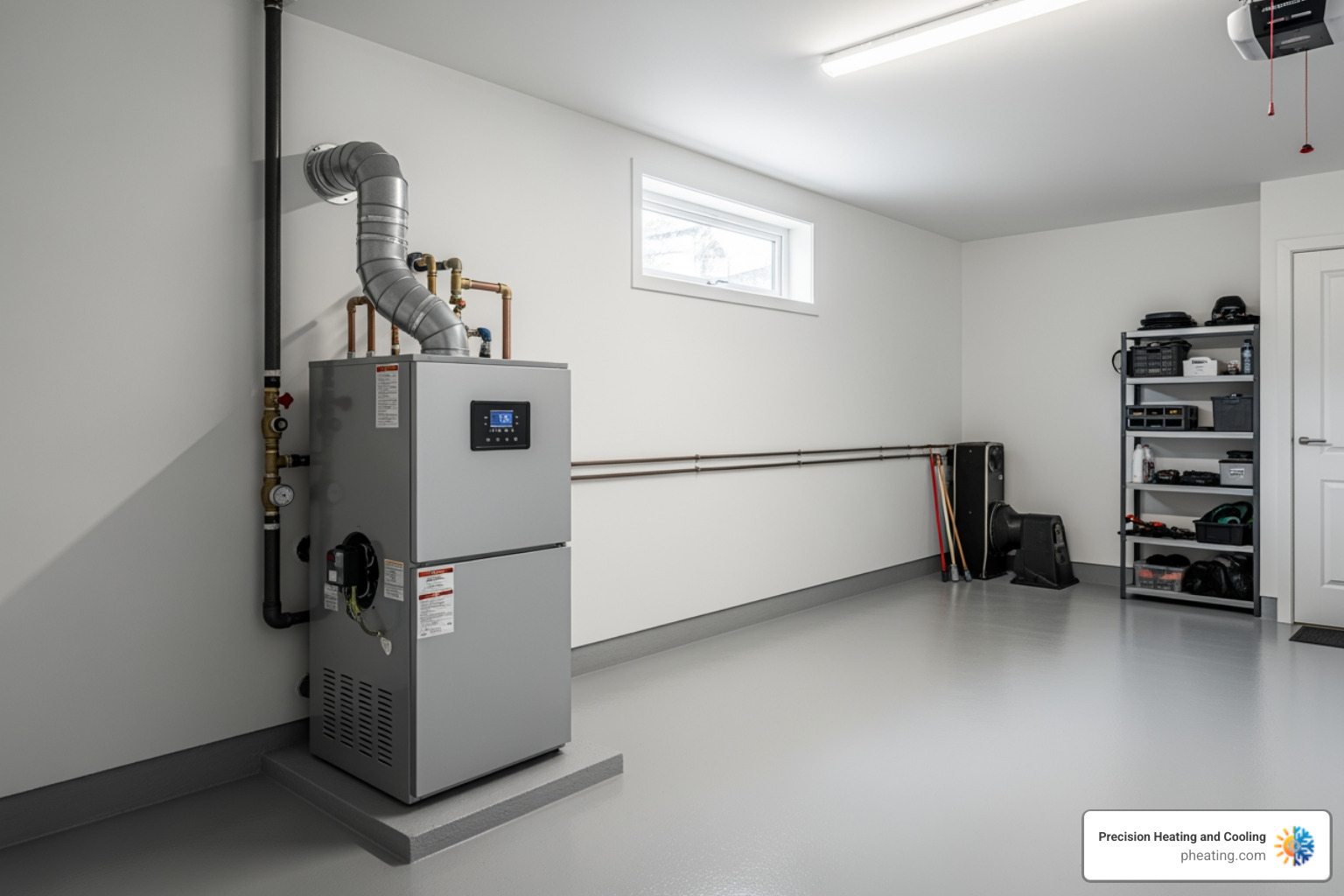
Space requirements are also crucial. The units need about 450-700 cubic feet of surrounding air to operate efficiently, so a small closet may require modifications like a louvered door. As the unit works, it produces cool, dry exhaust air, which may require ventilation ductwork. It also creates condensate, so a condensate drain to a nearby floor drain or sink is necessary; if one isn't available, a small pump can be installed. Finally, permit costs may apply depending on your location and the extent of the work.
Choosing an ENERGY STAR-certified unit means it meets specific performance and installation standards. You can learn more from ENERGY STAR. Our team is ready to assess your home's needs for a professional installation; just check out our heat pump installation services.
The complexity of installing a heat pump water heater differs from that of a traditional model, especially when changing fuel types.
Replacing an existing electric resistance water heater is generally the most straightforward swap, as the electrical hookups are often already in place. The main considerations are ensuring adequate space and condensate drainage.
Switching from a gas water heater, however, is more complex. This transition involves safely capping the gas line, running a new dedicated 240-volt electrical circuit, and possibly an electrical panel upgrade. The old vent penetrations must be sealed, and we often recommend sizing up the new heat pump unit to ensure ample hot water supply. While these steps can mean a higher initial investment, the long-term energy savings often make it a worthwhile decision. For more details on replacement options, explore our heat pump replacement services.
While the initial price tag might give you pause, the monthly savings on your utility bills tell a different story. Your heat pump water heater works more efficiently than a traditional model, and your wallet will notice.
Compared to standard electric and even gas water heaters, the annual operating cost of a heat pump water heater is significantly lower. A typical family can see substantial annual savings, especially when replacing an old standard electric model. Over the 10-15 year lifespan of the unit, the potential savings can easily exceed the initial investment.
This is what we mean by how much is a heat pump water heater in terms of true value. It's not just about the sticker price; it's about the return on investment that builds month after month. The efficiency gains translate directly into financial benefits that make the upfront cost look increasingly reasonable over time. ENERGY STAR provides additional details on the cost-effectiveness of these systems.
Regular professional care through our heat pump tune-up services keeps your unit running at peak performance, maximizing those savings year after year.
Your personal savings depend on a few main factors. Household size matters significantly—a large family uses more hot water than a couple, so their savings potential is greater. Hot water usage patterns, such as daily dishwasher use, long showers, and frequent laundry, also create more opportunities for an efficient unit to save energy.
For Bay Area homeowners, local electricity rates are a key factor. California's energy costs are among the highest in the nation, which means every kilowatt-hour you save with an efficient appliance translates into more money in your pocket. You can explore current electricity rate data to see how rates in your area impact potential savings. Many manufacturers also offer a free savings calculator for a personalized estimate.
The payback period is how long it takes for your energy savings to equal the extra amount you spent on a heat pump water heater over a traditional model. It's the moment your investment officially pays for itself.
For many homeowners, the average payback period is just a few years. After that, you're essentially getting paid to have made the smart choice.
Factors like your hot water usage, local electricity rates, and initial installation complexity all play a role. Households that use more hot water or live in areas with higher electricity rates generally see faster payback periods.
However, the real game-changer is the availability of federal tax credits and state rebates. These incentives dramatically accelerate your payback by reducing your out-of-pocket expense from day one. We'll dive into these money-saving opportunities next.
Keeping your unit properly maintained ensures you reap these savings for its entire lifespan. Our heat pump maintenance services help protect your investment.
Investing in a heat pump water heater is a great step towards an energy-efficient home, and a fantastic array of financial incentives can help. These programs are designed to make this technology more affordable, directly impacting how much a heat pump water heater will cost you out of pocket. By stacking these incentives, homeowners can significantly reduce their initial expenses.
Think of it as combining discounts. You can often use federal tax credits with state and local rebates, making your journey to energy-efficient hot water much more affordable than you might first imagine.
Thanks to the Inflation Reduction Act (IRA), homeowners can save on a new heat pump water heater through the 25C Residential Energy Efficiency Tax Credit.
This allows you to claim a federal tax credit covering a significant percentage of the total project cost, up to a generous annual limit. To qualify, your new heat pump water heater must be an ENERGY STAR-certified model, your assurance that it meets strict efficiency standards. This valuable program is currently scheduled to expire at the end of 2025, so acting sooner rather than later is a smart move.
For our customers in California, the savings don't stop at the federal level. Our state is a leader in promoting energy-efficient home upgrades. You'll find a variety of programs designed to lower your costs even further.
California often offers substantial instant rebates, which are typically applied at the time of sale or through your utility provider. You can find more about these opportunities through resources like Golden State Rebates. Beyond state-wide programs, many utility companies in California provide their own unique incentives. It's always a good idea to check directly with your energy provider. To uncover all available programs in your area, we recommend the Database of State Incentives for Renewables & Efficiency (DSIRE). This database can help you find additional local rebates that might apply, whether you're in Cupertino, Los Gatos, Clovis, Palo Alto, Santa Clara, Sunnyvale, or Hanford.
By combining these federal tax credits with California's robust rebate programs, the true cost of a heat pump water heater becomes significantly more affordable. Our team at Precision Heating and Cooling is ready to help you steer these opportunities during your heat pump installation planning.
When you invest in a heat pump water heater, you're getting more than just lower monthly bills. These units are built for longevity and help protect the planet.
Traditional storage water heaters typically last 10-12 years. In contrast, heat pump models are designed for the long haul, with a lifespan of 13-15 years. Many manufacturers back this up with generous 10-year warranties, signaling their confidence in the product. That extra longevity means fewer replacements and less hassle over time.
Beyond your own home, your choice makes a genuine difference. Heat pump water heaters are environmental champions. By moving heat rather than generating it, a heat pump water heater can reduce emissions by roughly 85% compared to traditional water heaters. That's a transformative improvement.
Even when compared to gas tankless water heaters, heat pump models come out ahead. Gas units still emit a puff of methane when they fire up. According to the NRDC, these emissions mean gas tankless models offer a smaller environmental benefit than often claimed. Heat pump water heaters sidestep these emissions entirely, making them a cleaner choice for California's air quality and the climate.
Our heat pump service team ensures your system continues to deliver these environmental and efficiency benefits year after year.
Heat pump water heaters love warmth. The warmer the air around them, the more efficiently they operate. This is great news for installations in a garage or basement here in California, where our mild climate plays to their strengths.
In places like Cupertino, Los Gatos, and Sunnyvale, these units thrive. An EPRI demonstration showed about 50% energy savings compared to traditional electric models. As a bonus, the unit exhausts cool, dry air, which can provide a pleasant dehumidifying effect during California's warmer months.
In colder conditions (below about 40°F), their efficiency dips, and the unit relies more on its backup electric resistance elements. This temporarily uses more energy but is still generally more efficient than a standard electric water heater.
This is where hybrid mode comes in. Most units operate this way automatically, prioritizing the heat pump for efficiency but kicking in the backup elements to meet high demand or combat cold temperatures. You get efficiency when conditions are right and reliability when you need it most. For our California climate, heat pump water heaters are a natural fit, operating at peak efficiency most of the year.
When considering a heat pump water heater, certain questions come up again and again. Understanding these details helps you make the best decision for your home.
The installation is more involved due to several key factors. Electrical requirements are a primary consideration, as these units need a dedicated 240-volt circuit, which may require new wiring if you're converting from gas. Space and airflow are also critical; they need a significant volume of air to function efficiently, so a small closet might need a louvered door or ducting. Finally, they produce condensate that must be drained to a sink or floor drain, and the old gas vent must be sealed if you're making that switch. These factors underscore the need for professional installation.
Heat pump water heaters offer impressive longevity. They typically last between 13 and 15 years, which is noticeably longer than the 10 to 12-year lifespan of most traditional electric and gas models. This extended life is due to their high-quality design and is often backed by 10-year manufacturer warranties. A longer lifespan means more years of energy savings and fewer replacement hassles.
A heat pump water heater is a smart investment in several common scenarios. It's an excellent choice if you're focused on long-term energy savings, especially for families with high hot water usage. It's also an ideal upgrade when replacing an aging water heater, allowing you to lock in efficiency for the next decade-plus. For those concerned with their environmental impact, these units offer a substantial reduction in carbon emissions.
Furthermore, the current financial incentives have never been better. Generous federal tax credits and state rebates can dramatically lower the upfront cost and shorten the payback period to just a few years. If your home has a suitable location (like a garage or basement) and your electrical system can support the unit, you're in a great position to benefit. For those in our service areas like Cupertino, Palo Alto, or Clovis, our mild climate makes this technology even more effective.
If you're ready to explore whether a water heater replacement in San Jose with a heat pump model makes sense for your home, we're here to help you figure it out.
When you ask, "how much is a heat pump water heater?", it's clear the answer goes beyond the price tag. It's about the whole picture: initial costs, long-term savings, available incentives, and the positive impact on our planet. For homeowners in the San Jose Bay Area and Central Valley, the benefits often make it a smart choice.
These units are incredibly energy-efficient, which means tangible savings on your monthly utility bills. Add to that the generous federal tax credits and California rebates, and your out-of-pocket cost drops significantly. This can shorten the time it takes for the investment to pay for itself to just a few years. Plus, with a longer lifespan than traditional units, you'll enjoy these benefits for over a decade—that's true long-term value.
Choosing a heat pump water heater is also a powerful way to help the environment. By drastically cutting greenhouse gas emissions, you're actively helping create a cleaner, healthier future. It's a feel-good decision that makes a real difference.
At Precision Heating and Cooling, we're all about giving our customers the best information and reliable service. With decades of experience, we understand how these systems perform in our local climate. We're ready to help you determine your needs, check if your home is a good fit, and guide you every step of the way.
Ready to uncover the long-term value of a heat pump water heater for your home? Let's explore your options for a water heater replacement in San Jose together!

Leslie was amazing for her outstanding customer service skills with me the other day. Thanks to her help my air conditioner is now all set up. She answered all my questions and took away all my problems. Leslie broke it down step by step to set it up easier. Now thanks to her my air conditioner is working perfectly. I really appreciate it Leslie and I’ll be sure to ask for you if I ever come back.
I contacted Precision Heating and Cooling for my home's AC repair. They were punctual and very professional. Guillermo was very kind and thorough. I would highly recommend them!
I am writing to express my sincere appreciation for the excellent work performed by Pablo and Alejandro from Precision Heating and Cooling. Their commitment to quality and customer satisfaction is truly commendable. Awesome job guys!
I would like to extend my sincere gratitude to Alejandro for his exceptional hard work. His passion for helping others is evident, and he consistently goes above and beyond in his service. Alejandro's thorough cleaning of my fireplace has truly made a significant difference. His dedication and professionalism are greatly appreciated.
I was very impressed. Came at night (after 9pm) to fix our AC during the middle of a heat wave the day before a national holiday! Technician was very courteous and efficient, got the job done quickly. Will definitely call them again for any AC servicing I need!
Fast and efficient, arrived when scheduled for repairs and replacement parts were ordered and installed quickly. Techs were very friendly and professional. AC system works great now! I highly recommend their services if you need repairs. Tim


.avif)
