


.avif)






Recent Blogs
Stay updated with our latest blog posts.


Your thermostat has been set to 72 degrees since noon, but as the afternoon sun bakes your living room, the indoor temperature stubbornly hovers at 78 degrees. Why San Jose AC units struggle to keep up during mid-July heatwaves is a question that leads many frustrated homeowners straight to the phone to book an emergency repair. The air coming from the vents feels somewhat cool, but the system simply cannot push the temperature down any further, no matter how low you set the dial. Before you panic and pay a premium for a technician to rush out to your home, you need to know whether your cooling system is actually failing or simply operating exactly as it was engineered to perform at its absolute maximum design capacity.
It is incredibly frustrating to sit in a warm house when the air conditioner has been running continuously for hours. The immediate assumption is usually that a critical component has broken, refrigerant has leaked, or the compressor is dying. However, the reality of residential cooling physics often tells a different story. Understanding the fundamental limits of your HVAC equipment can save you from paying an emergency service fee for a system that is fundamentally healthy but temporarily overwhelmed by extreme weather. Our team at Precision Heating & Cooling has spent over two decades providing comprehensive air conditioning services across the region, and a pattern we see often is homeowners panicking over a perfectly functional unit. We believe in honest, transparent assessments. In many cases, investing in a routine AC maintenance plan to keep the unit clean and efficient is all a healthy but struggling system actually needs to survive the summer.
To understand why your home feels warm on the hottest days of the year, you have to look at how residential air conditioners are engineered. The industry standard for residential split systems revolves around a concept known as the 20-degree temperature differential rule. This engineering guideline, established by organizations like the American Society of Heating, Refrigerating and Air-Conditioning Engineers (ASHRAE) and supported by the U.S. Department of Energy, dictates the maximum cooling capacity of standard home equipment.
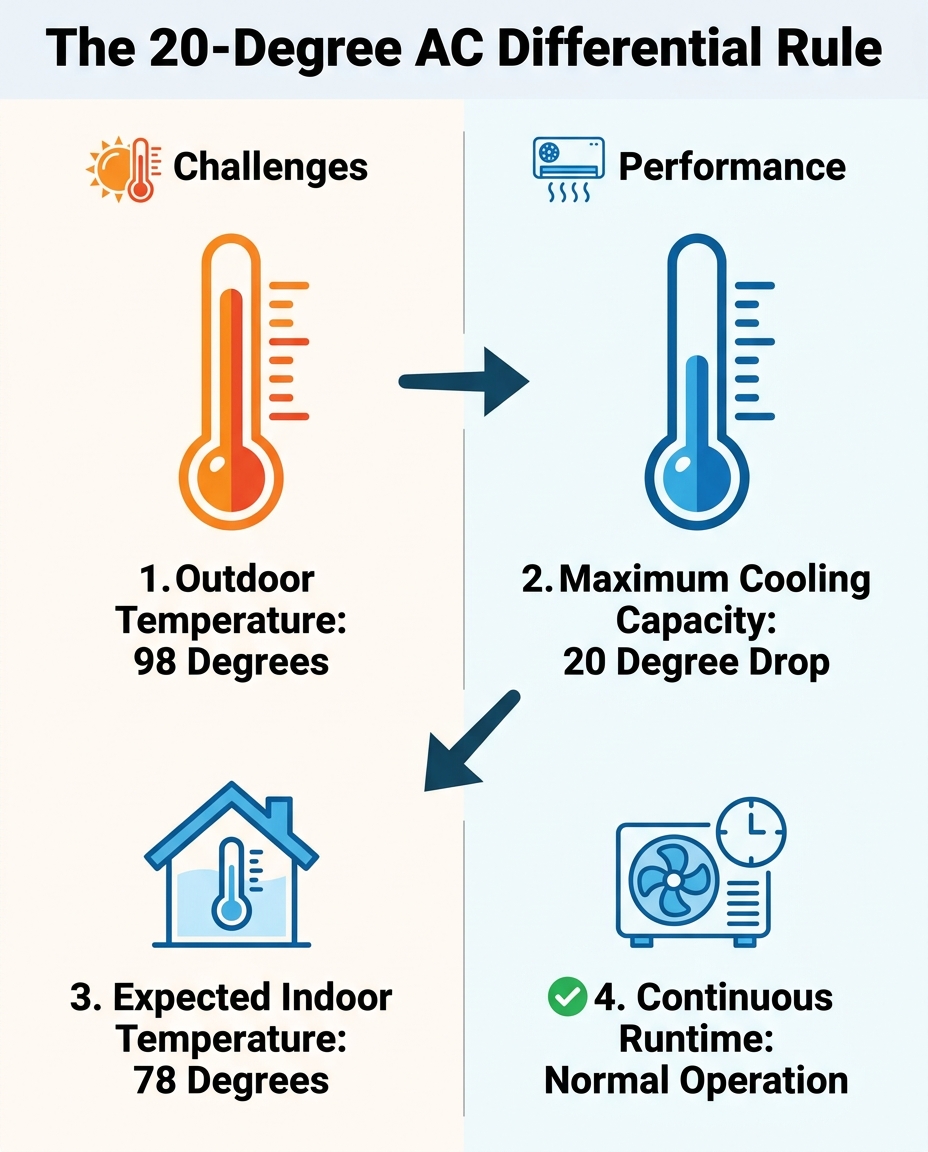
The core principle is simple: A properly sized, fully functioning residential air conditioner is designed to maintain an indoor temperature that is roughly 20 degrees cooler than the outdoor ambient air. This means that during a stretch of 95+ degree days, an indoor temperature of 75 to 78 degrees means your system is functioning perfectly. The evaporator coil inside your ductwork can only extract a specific amount of heat energy from the air as it passes through. Once the outdoor temperature pushes past the system's design limits, the unit reaches its maximum heat-removal capacity.
Our technicians constantly hear from homeowners who mistakenly believe that turning the thermostat down to 65 degrees during a heatwave will force the air conditioner to blow colder air. In reality, the temperature of the air coming out of your vents remains relatively constant. Lowering the thermostat setting only tells the system to run continuously until it reaches that target number. If the outdoor temperature makes that target mathematically impossible due to the 20-degree rule, the system will simply run non-stop, consuming massive amounts of electricity without making the room any colder.

As local HVAC professionals, we know the climate plays a massive role in how your air conditioner performs, and the South Bay / San Jose area presents a unique set of challenges for residential cooling systems. Our regional heatwaves are notably dry and intense, characterized by a specific daily weather pattern that places sudden, immense strain on HVAC equipment just as families are returning home from work and school.
During the summer months, the morning often starts with a protective layer of coastal marine fog that keeps temperatures relatively mild. However, as this fog cover burns off rapidly by mid-day, the ambient temperature skyrockets. The most critical window for your air conditioner occurs between 3 PM and 6 PM. During this three-hour block, the rapid loss of cloud cover accelerates solar heat gain against the walls and roof of your house. The thermal mass of your home's structure absorbs this intense afternoon radiation and begins transferring it indoors, right as the outdoor air temperature reaches its daily peak.
This rapid temperature spike creates a compounding effect. Not only is the outdoor condenser unit fighting to reject heat into an environment that is already hovering near 100 degrees, but the electrical grid is also experiencing peak load, which can sometimes cause minor voltage fluctuations that make compressor motors work slightly harder. Because this afternoon heat gain happens so quickly, a cooling system that was easily maintaining 72 degrees at noon can suddenly find itself completely overwhelmed by 4 PM. It is important to recognize that this afternoon struggle is a predictable regional phenomenon native to our specific microclimate, rather than a sudden mechanical failure of your equipment.
When the house is uncomfortably warm, the line between a system operating at maximum capacity and a system experiencing a genuine mechanical failure can seem blurred. However, there are clear diagnostic signs you can look for before calling a professional. Precision Heating & Cooling prioritizes honest assessments to save customers from unnecessary emergency calls. Drawing on our 20 years as a Day and Night Elite Dealer, our team typically sees a clear difference between a system operating at its design limit and one that is broken, allowing us to provide accurate, technically sound evaluations.
If your system is simply maxed out due to the 20-degree rule, it will exhibit consistent, predictable behavior. The most obvious sign is continuous runtime during peak heat hours. The unit will not shut off because it is constantly trying to reach a thermostat setting it cannot achieve. If you place your hand over the supply vents, the air blowing out should still feel distinctly cold. Finally, if you check your thermostat and the indoor temperature is hovering exactly 18 to 20 degrees below the outdoor temperature, your unit is successfully doing everything it was designed to do.
True mechanical failures look and sound very different from a maxed-out system. If the air coming from your vents feels warm, room-temperature, or humid, the cooling process has stopped entirely. If the system is short-cycling—turning on for three minutes, shutting off, and immediately turning back on—this indicates a safety switch is tripping due to pressure or electrical issues. Additionally, any unusual grinding, squealing, or rattling sounds from the outdoor unit require immediate attention. During a recent stretch of 95+ degree days, one San Jose homeowner reached out to us for an urgent service call because their AC unit was completely non-operational—no air was blowing at all. One of our lead technicians quickly diagnosed the electrical failure and repaired the unit, getting the system up and running in no time. That is a scenario where emergency service is absolutely necessary.
• Vent Airflow — Maxed-Out (Normal Operation): Strong and distinctly cold — True System Failure (Call for Repair): Weak, warm, or completely absent
• System Runtime — Maxed-Out (Normal Operation): Running continuously without stopping — True System Failure (Call for Repair): Rapidly turning on and off (short-cycling)
• Indoor Temperature — Maxed-Out (Normal Operation): Stuck exactly 20 degrees below outside temp — True System Failure (Call for Repair): Rising rapidly, matching outdoor temperature
• System Noises — Maxed-Out (Normal Operation): Steady, even humming from the compressor — True System Failure (Call for Repair): Grinding, squealing, or violent shuddering
Even if your central air conditioner is functioning perfectly within its 20-degree design limit, you may still have specific rooms in your South Bay / San Jose home that become unbearably hot. Second-story bedrooms, converted garages, and sunrooms with large west-facing windows naturally exceed the 20-degree limit much faster than the rest of the house. This happens because heat naturally rises, and spaces directly beneath the roof absorb massive amounts of radiant heat from the attic.
When a single central thermostat is located in a cool downstairs hallway, it cannot accurately read or respond to the sweltering temperatures in an upstairs bedroom. Forcing your primary AC unit to run longer just to cool one stubborn room will only freeze out the rest of the house and dramatically inflate your utility bills. Instead, the most effective approach is to implement supplemental cooling strategies that take the localized load off your main system.
Based on our years of retrofitting two-story South Bay homes, we recommend addressing these stubborn hot spots by exploring ductless AC systems over unnecessarily upsizing your central unit. These localized units operate independently of your central ductwork, allowing you to create targeted cooling zones in the exact rooms that need it most. By handling the heavy lifting in a sun-baked upstairs bedroom, a ductless unit allows your main central system to operate much more efficiently, maintaining a comfortable temperature throughout the rest of the house without constantly running at maximum capacity.
When a mid-July heatwave settles over the valley, your air conditioner needs all the help it can get to maintain that 20-degree differential. While you cannot change the outdoor temperature or the engineering limits of your equipment, you can take proactive steps to reduce the thermal load on your home. By managing how much heat enters your living space, you allow your cooling system to run more efficiently and keep the indoor temperature more comfortable.
Our technicians recommend implementing a few basic, non-DIY maintenance and household management strategies to make a significant difference in your daily comfort:
• Pre-cool your home: Take advantage of the cooler morning hours. Set your thermostat a few degrees lower than normal between 6 AM and 11 AM to build up a reserve of cold air in your home's thermal mass before the afternoon heat spike hits.
• Block solar heat gain: Keep blinds, shades, and heavy curtains tightly closed on all south and west-facing windows starting at noon. Sunlight passing through glass acts like a greenhouse, rapidly raising the indoor temperature and forcing your AC to work harder.
• Maintain clean airflow: Check and replace your HVAC air filters. A clogged filter restricts the volume of air moving over the evaporator coil, severely crippling your system's cooling capacity and increasing the risk of the coil freezing over entirely.
• Manage internal heat sources: Avoid using heat-generating appliances like ovens, dryers, and dishwashers during the peak hours of 3 PM to 6 PM. Delay these chores until the sun goes down.
• Optimize air circulation: Ensure ceiling fans are spinning counter-clockwise to create a wind-chill effect on your skin, and consider exploring indoor air quality solutions that help manage indoor humidity, making the air feel cooler and more comfortable at higher temperatures.
Before diving into the specific answers below, it is helpful to understand the broader context of cooling system behavior. If you want to explore more about how continuous operation impacts your equipment over the long term, reading about AC runtime issues during heat waves can provide additional technical background. When our dispatch phones ring off the hook during a mid-July heatwave, here are the most common questions our team hears from local homeowners.
If your AC is running constantly but the house isn't getting colder, it has likely reached its maximum design capacity. During extreme heat, the system can only lower the indoor temperature by about 20 degrees compared to outside. If it is 100 degrees outdoors, a continuous runtime that maintains 80 degrees indoors means the system is working exactly as intended, even if it feels warm to you.
Standard residential air conditioning systems are engineered to handle a maximum temperature difference of 20 degrees between the outdoor air and the indoor air. This limit is based on the physical properties of the refrigerant and the size of the evaporator coil. Pushing the system beyond this differential is mathematically impossible for standard residential equipment.
The 20-degree rule is an HVAC industry standard stating that a healthy air conditioner can cool a home to roughly 20 degrees below the peak outdoor temperature. On a 95-degree day, the lowest sustainable indoor temperature is 75 degrees. Understanding this rule helps homeowners set realistic expectations and avoid unnecessary repair calls during summer heatwaves.
Air conditioners do not necessarily stop working at a specific temperature, but their efficiency drops significantly once outdoor temperatures exceed 95+ degree days. As the ambient heat rises, the outdoor condenser struggles to release the heat it absorbed from your house. The system will continue to run, but the indoor temperature will slowly rise in tandem with the outdoor heat.
You should immediately turn off your AC if the air coming from the vents is warm, if you hear grinding noises, or if you see ice forming on the indoor coil or outdoor refrigerant lines. Continuing to run a truly broken system can destroy the compressor. However, if the vent air is cold but the house is just hovering at 78 degrees on a hot day, leave the system running—it is doing its best.
Between 3 PM and 6 PM, your home experiences the compounding effects of maximum outdoor air temperatures and intense solar radiation on west-facing walls. Additionally, the thermal mass of your roof and attic has been absorbing heat all day and begins radiating it down into your living spaces, creating a sudden spike in indoor temperature that overwhelms the AC.
Running continuously during a heatwave will not inherently damage a well-maintained air conditioner. These systems are designed for heavy use. However, continuous operation does accelerate wear and tear on moving parts like fan motors and capacitors, which is why routine preventative maintenance is critical to ensure the system can handle the strain without breaking down.
Navigating a brutal summer afternoon in the South Bay / San Jose area can test the patience of any homeowner. When the temperatures spike and your cooling system seems to be losing ground, it is easy to assume the worst. However, remembering the 20-degree rule can provide peace of mind. A struggling air conditioner on a 100-degree day might just be doing its absolute best to protect your home from the extreme outdoor environment.
That being said, you should never have to guess whether your equipment is healthy or quietly failing. If you have checked the vent temperatures, monitored the runtime, and still suspect that your system is suffering from a true mechanical malfunction rather than just fighting the design limits, it is time to consult a local expert. At Precision Heating & Cooling, we are committed to providing honest, scientifically grounded evaluations, ensuring you only pay for the repairs you truly need. Reach out today for a thorough assessment of your cooling system, and let us help you stay comfortable all summer long.

Leslie was amazing for her outstanding customer service skills with me the other day. Thanks to her help my air conditioner is now all set up. She answered all my questions and took away all my problems. Leslie broke it down step by step to set it up easier. Now thanks to her my air conditioner is working perfectly. I really appreciate it Leslie and I’ll be sure to ask for you if I ever come back.
I contacted Precision Heating and Cooling for my home's AC repair. They were punctual and very professional. Guillermo was very kind and thorough. I would highly recommend them!
I am writing to express my sincere appreciation for the excellent work performed by Pablo and Alejandro from Precision Heating and Cooling. Their commitment to quality and customer satisfaction is truly commendable. Awesome job guys!
I would like to extend my sincere gratitude to Alejandro for his exceptional hard work. His passion for helping others is evident, and he consistently goes above and beyond in his service. Alejandro's thorough cleaning of my fireplace has truly made a significant difference. His dedication and professionalism are greatly appreciated.
I was very impressed. Came at night (after 9pm) to fix our AC during the middle of a heat wave the day before a national holiday! Technician was very courteous and efficient, got the job done quickly. Will definitely call them again for any AC servicing I need!
Fast and efficient, arrived when scheduled for repairs and replacement parts were ordered and installed quickly. Techs were very friendly and professional. AC system works great now! I highly recommend their services if you need repairs. Tim


.avif)
