


.avif)






Recent Blogs
Stay updated with our latest blog posts.


central air vs mini split for the silicon valley homes is one of the most common HVAC questions we hear from Bay Area homeowners — and the answer is not the same for every house. Here is a quick breakdown to help you decide:
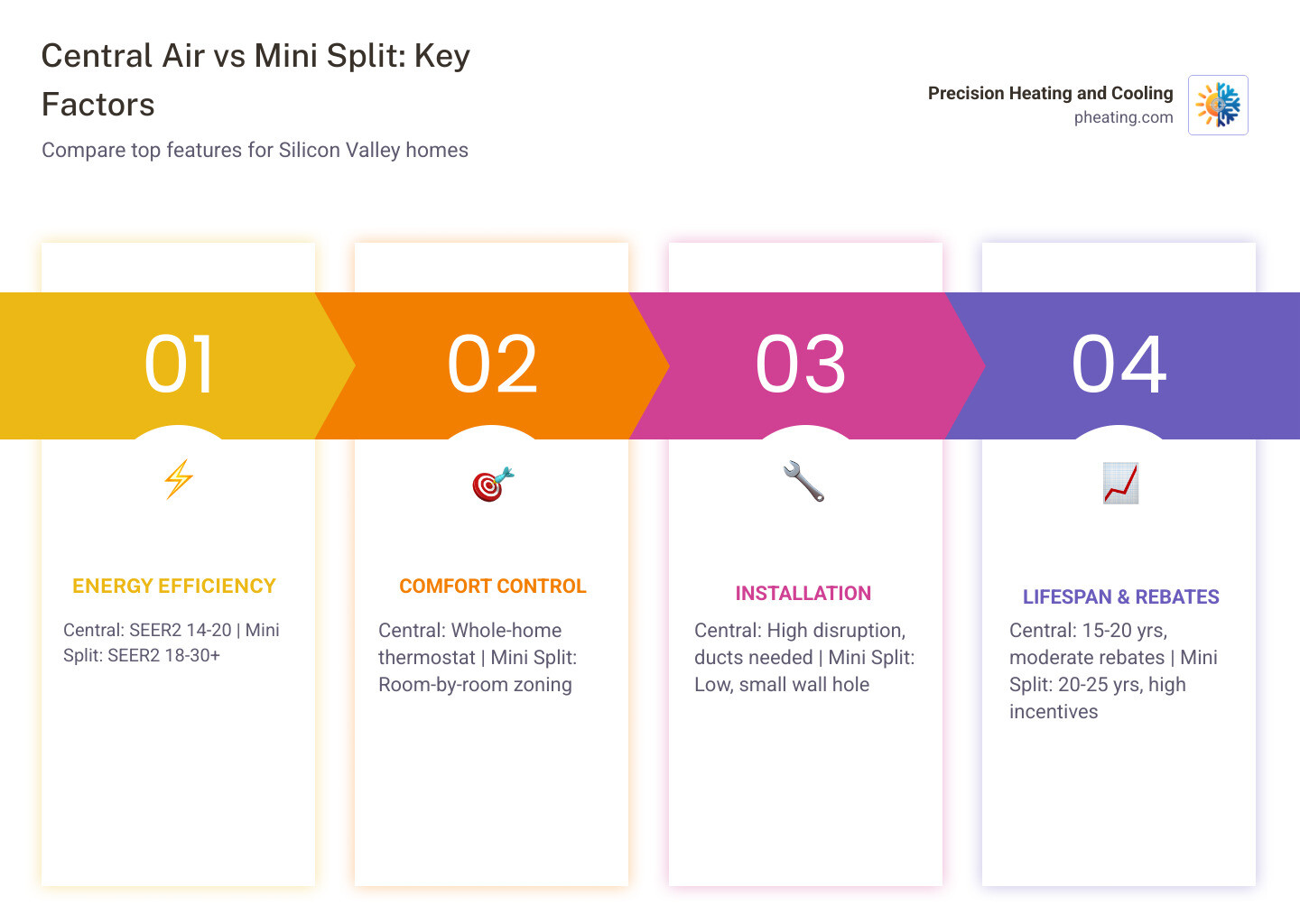
| Factor | Central Air | Mini Split |
|---|---|---|
| Best for | Homes with existing ductwork | Homes without ducts, ADUs, additions |
| Energy efficiency | Good (SEER2 14-20) | Excellent (SEER2 18-30+) |
| Comfort control | Whole-home, single thermostat | Room-by-room zoning |
| Installation disruption | Higher (ductwork required if absent) | Low (small wall penetration only) |
| Ideal Silicon Valley use | Larger homes, uniform cooling | Older homes, microclimates, retrofits |
| Lifespan | 15-20 years | 20-25 years |
| Rebate potential | Moderate | High (heat pump incentives) |
Silicon Valley's Mediterranean climate — hot, dry summers, mild wet winters, and coastal fog rolling through the Santa Clara Valley — creates a unique set of demands on home comfort systems. A home in Willow Glen can hit 95°F on the same afternoon that a property near the foothills sits comfortably in the low 70s. That kind of microclimate variation means a one-size-fits-all HVAC approach rarely works here. Whether you have an older Eichler without ductwork, a two-story home with uneven temperatures, or a new ADU that needs its own climate control, the choice between central air and a ductless mini split has real consequences for your comfort, energy bills, and long-term home value.
I'm Tony Lara, an HVAC technician with hands-on experience helping Bay Area homeowners navigate exactly these kinds of decisions, including the nuances of central air vs mini split for the silicon valley homes. In the sections ahead, I'll walk you through everything you need to make a confident, informed choice for your specific home and situation.
When you are ready to modernize your home’s climate control, the sheer number of options can feel overwhelming. In the heart of the Bay Area, from the tech hubs of Palo Alto to the suburban reaches of San Jose, homeowners are increasingly looking for systems that don't just "work," but work efficiently. At Precision Heating and Cooling, we specialize in helping you weigh the merits of central air vs mini split for the silicon valley homes.
The decision often hinges on your existing infrastructure. If your home already has a robust network of ducts in good condition, a high-efficiency central split system (pairing a furnace with an A/C unit or a ducted heat pump) is a traditional and effective choice. However, for those seeking the pinnacle of energy efficiency and specialized control, the ductless mini-split has become the "go-to" solution in 2026.
In our mild Mediterranean climate, efficiency isn't just a buzzword—it’s a major contributor to your monthly savings. Traditional central systems often suffer from "duct loss." Research from the Department of Energy shows that typical ducted systems can lose up to 30% of their energy through leaks or poor insulation in the attic or crawlspace.
Ductless systems eliminate this problem entirely. By delivering air directly into the living space, they ensure that every bit of energy you pay for actually cools or heats your room. Furthermore, mini-splits utilize advanced inverter technology and variable-speed compressors. Unlike older central units that are either "all on" or "all off," these systems adjust their output in real-time to match the exact needs of the room.
The statistics are compelling. Field studies conducted by organizations like the Pacific Northwest National Laboratory (PNNL) have shown that ductless heat pumps can save up to 77% of heating energy over electric resistance heat. In actual homes, installing these systems in central living zones saved an average of over 4,400 kWh per year. For a Silicon Valley home, where electricity rates can be high, those numbers represent significant annual relief on your utility bill.
Comfort in a Silicon Valley home is often a tale of two stories. Many homes in Cupertino or Sunnyvale feature multi-story layouts or open floor plans where heat rises and stays trapped upstairs. A central system controlled by a single thermostat often leaves the downstairs freezing while the upstairs remains stuffy.
This is where Mini Split Service San Jose CA shines. Because each indoor air handler operates independently, you can set the bedroom to a crisp 68°F for sleeping while keeping the downstairs living area at a more energy-efficient 74°F. As a premier HVAC Company San Jose CA, we often recommend this "zoned" approach for families with varying schedules or homes with large windows that create localized "hot spots" during the afternoon sun.
One of the most fascinating aspects of living in the Santa Clara Valley is the microclimate diversity. In April 2026, we are seeing even more pronounced shifts in weather patterns. If you live in the foothills of Los Gatos, you might experience cooler, breezier evenings compared to the dense, dry heat of downtown San Jose.
Our team providing Mini Split Service Sunnyvale CA and Mini Split Service Santa Clara CA often points out that low humidity in our region is a secret weapon for mini-splits. Because these systems don't have to work overtime to remove moisture from the air, they can focus entirely on temperature regulation, reaching peak efficiency much faster than they would in a humid climate.
Furthermore, the "marine layer" or coastal fog that rolls in during the summer evenings can cause rapid temperature drops. Inverter-driven mini-splits handle these swings seamlessly, adjusting their output gradually rather than cycling on and off abruptly, which preserves the lifespan of the equipment and maintains a steady indoor environment.
Silicon Valley is famous for its mid-century modern architecture, including the iconic Eichler homes. These beautiful structures, along with many historic bungalows in Los Gatos and San Jose, were often built with radiant floor heat and no ductwork. For decades, homeowners thought central cooling was impossible without destroying their ceilings.
Modern mini-splits have changed the game for Mini Split Service Los Gatos CA. An AC Installation Los Gatos CA using ductless technology requires only a small, three-inch hole in the wall to connect the indoor unit to the outdoor compressor. This minimal disruption preserves the architectural integrity of historic homes while providing world-class cooling.
This technology is also the gold standard for the Accessory Dwelling Unit (ADU) boom. Whether you are converting a garage into a home office or building a backyard cottage for family, a mini-split provides dedicated climate control without the massive expense of extending your main home’s ductwork—which often isn't even sized to handle the extra load anyway.
The trend toward "electrification" is no longer a future concept—it is the current standard in Silicon Valley. With local initiatives like Silicon Valley Clean Energy (SVCE) promoting carbon reduction, many homeowners are trading in gas furnaces for all-electric heat pump systems.
Whether you choose a central heat pump or a ductless system, you are choosing a safer, more sustainable future. Heat pumps eliminate the risk of carbon monoxide leaks and natural gas fires—a particularly important consideration in our earthquake-prone region.
Our experts in HVAC Installation Cupertino CA and Ductless Mini Split AC Cupertino CA often utilize PNNL research to help homeowners maximize their savings. For example, if you decide to keep your central furnace as a backup, we can implement "central offset control." By setting the mini-split as the primary heat source and the furnace as a backup (offset by about 5°F), you can achieve 35% to 43% energy savings while maintaining perfect thermal comfort during our chilly winter nights.
Regardless of which system you choose, regular maintenance is the key to protecting your investment. A well-maintained mini-split can last 20 to 25 years, while a central system typically serves a home for 15 to 20 years.
For mini-splits, the most important task is filter cleaning. Because these units move air directly within the room, we recommend a quick five-minute filter rinse every 2-4 weeks. For central systems, HVAC Installation Sunnyvale CA includes ensuring your ducts are sealed. Leaky ducts don't just waste energy; they pull in dust and allergens from your attic, compromising your indoor air quality.
Annual professional inspections for systems in Palo Alto and Santa Clara ensure that refrigerant levels are correct and electrical components are functioning safely. Our Mini Split Service Cupertino CA includes a deep clean of the indoor coils to prevent the buildup of mold or debris, ensuring the air you breathe is as fresh as a coastal breeze.
Both systems offer excellent filtration, but they work differently. Central systems are great for whole-home air purification and can be fitted with HEPA filters or UV lights. However, mini-splits prevent "cross-contamination" between rooms because each zone has its own independent filter. This is a major benefit for families where one person has severe allergies. Our Mini Split Service Clovis CA team highlights that modern units often include multi-stage filtration to capture dust, pollen, and even wildfire smoke.
Absolutely. This "hybrid" approach is very popular in Santa Clara. Many homeowners keep their central gas furnace for the coldest nights but use a mini-split for cooling and primary heating. This allows you to target the rooms you use most—like a home office or master bedroom—without paying to heat or cool the entire house.
The fog brings cool, damp air, but because Silicon Valley remains relatively low-humidity compared to the East Coast, it actually helps. Inverter-driven compressors thrive in these "part-load" conditions. Instead of blasting at full power, they sip electricity to maintain a steady temperature as the fog rolls in and out, making them incredibly efficient for our specific Bay Area microclimates.
Choosing between central air vs mini split for the silicon valley homes is about more than just picking a machine; it's about designing a lifestyle of comfort and efficiency. Whether you are looking to slash your energy bills, provide perfect cooling for a new ADU, or finally bring air conditioning to a historic home without ducts, there is a solution that fits your needs.
At Precision Heating and Cooling, we bring over two decades of experience to every home in San Jose, Cupertino, Los Gatos, and beyond. We pride ourselves on reliable service, competitive pricing, and flexible payment options that make upgrading your home easy.
Ready to find the perfect fit for your home? Contact us today for an expert consultation and let us help you build a more comfortable, energy-efficient future. Whether you need a traditional setup or a modern Ductless solution, we are here to ensure your Silicon Valley home stays perfect in every season.

Leslie was amazing for her outstanding customer service skills with me the other day. Thanks to her help my air conditioner is now all set up. She answered all my questions and took away all my problems. Leslie broke it down step by step to set it up easier. Now thanks to her my air conditioner is working perfectly. I really appreciate it Leslie and I’ll be sure to ask for you if I ever come back.
I contacted Precision Heating and Cooling for my home's AC repair. They were punctual and very professional. Guillermo was very kind and thorough. I would highly recommend them!
I am writing to express my sincere appreciation for the excellent work performed by Pablo and Alejandro from Precision Heating and Cooling. Their commitment to quality and customer satisfaction is truly commendable. Awesome job guys!
I would like to extend my sincere gratitude to Alejandro for his exceptional hard work. His passion for helping others is evident, and he consistently goes above and beyond in his service. Alejandro's thorough cleaning of my fireplace has truly made a significant difference. His dedication and professionalism are greatly appreciated.
I was very impressed. Came at night (after 9pm) to fix our AC during the middle of a heat wave the day before a national holiday! Technician was very courteous and efficient, got the job done quickly. Will definitely call them again for any AC servicing I need!
Fast and efficient, arrived when scheduled for repairs and replacement parts were ordered and installed quickly. Techs were very friendly and professional. AC system works great now! I highly recommend their services if you need repairs. Tim


.avif)
