


.avif)






Recent Blogs
Stay updated with our latest blog posts.


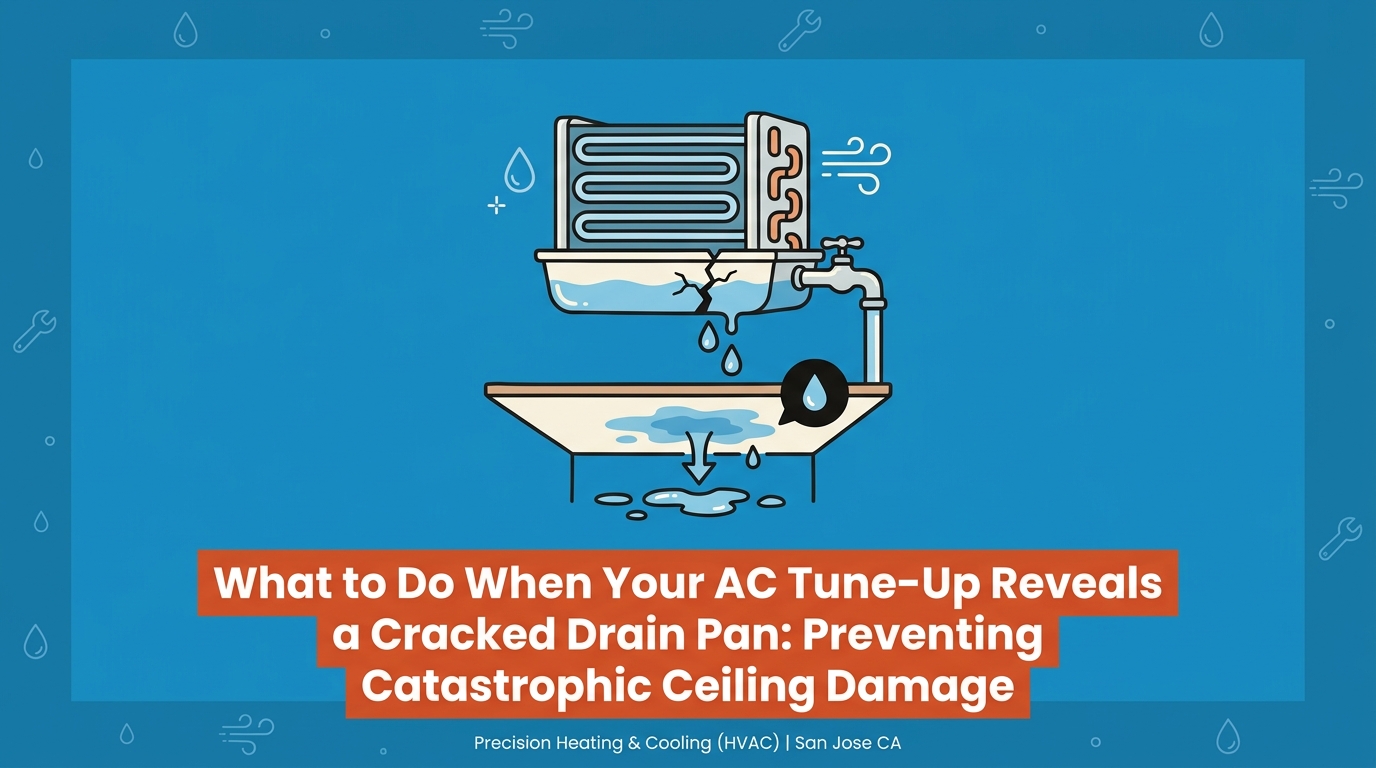
Did your technician recently hand you some alarming news during a routine system check? Knowing exactly what to do when your AC tune-up reveals a cracked drain pan can be the difference between a simple component swap and a devastating home disaster. Our team at Precision Heating & Cooling frequently sees homeowners feel a surge of frustration when a broken part is discovered, especially during the sweltering August and late-summer cooling season as kids head back to school and your system is running non-stop. However, finding this specific vulnerability before it completely fails is actually a massive stroke of luck.
When you need reliable air conditioning services, a proactive approach is always your best defense against unexpected breakdowns.
Catching a compromised drain pan before a catastrophic failure is exactly why we stress the importance of proactive check-ups. Precision Heating & Cooling's meticulous maintenance plans are specifically engineered to catch hidden vulnerabilities—like hairline micro-fissures in plastic components—before they result in devastating home water damage. The decision point you face now is straightforward: taking immediate action to address the compromised pan before the cooling season ends. Ignoring our technician's warning means gambling with the structural integrity of your home, while prompt replacement secures your property and restores your peace of mind.
To understand why a cracked drain pan is such an urgent threat, you have to look at the sheer volume of water your air conditioner processes. According to Department of Energy data, a typical residential AC unit produces anywhere from 5 to 20 gallons of condensation per day during peak operation. As local San Jose HVAC experts, we know that our region's dry but intensely hot late-summer afternoons require extended cooling cycles. This maximizes condensation output precisely when the physical components of your HVAC system are under the most stress. Your drain pan is not just catching a few random drips; it is actively managing a high-volume flow of water.
When that pan cracks, we often see the water bypass the designated drain line completely. Secondary drain systems, which are designed to catch occasional overflows, can easily become overwhelmed if the primary pan's structural integrity completely fails. The resulting flood doesn't just damage the air conditioning unit itself; it attacks the surrounding building materials.
Many of the properties our technicians service throughout San Jose feature attic installations. If your indoor air handler is located in the attic, a cracked drain pan elevates from a nuisance to a structural emergency. Gravity pulls the overflowing water directly downward, where it meets your home's insulation and drywall.
• Rapid saturation: Drywall acts like a sponge, absorbing gallons of water in a matter of hours and losing its structural strength.
• Insulation compression: Fiberglass and cellulose insulation compress when wet, permanently ruining their thermal resistance and requiring full replacement.
• Hidden accumulation: Visual detection is almost impossible from inside the living space until the ceiling is already heavily stained, bowing, or actively caving in.
• Catastrophic collapse: Once the drywall reaches its weight limit, the ceiling can collapse entirely, destroying furniture, flooring, and electronics below.
The bottom line: A compromised pan in an attic installation means a high-volume flood risk is suspended directly over your living room.
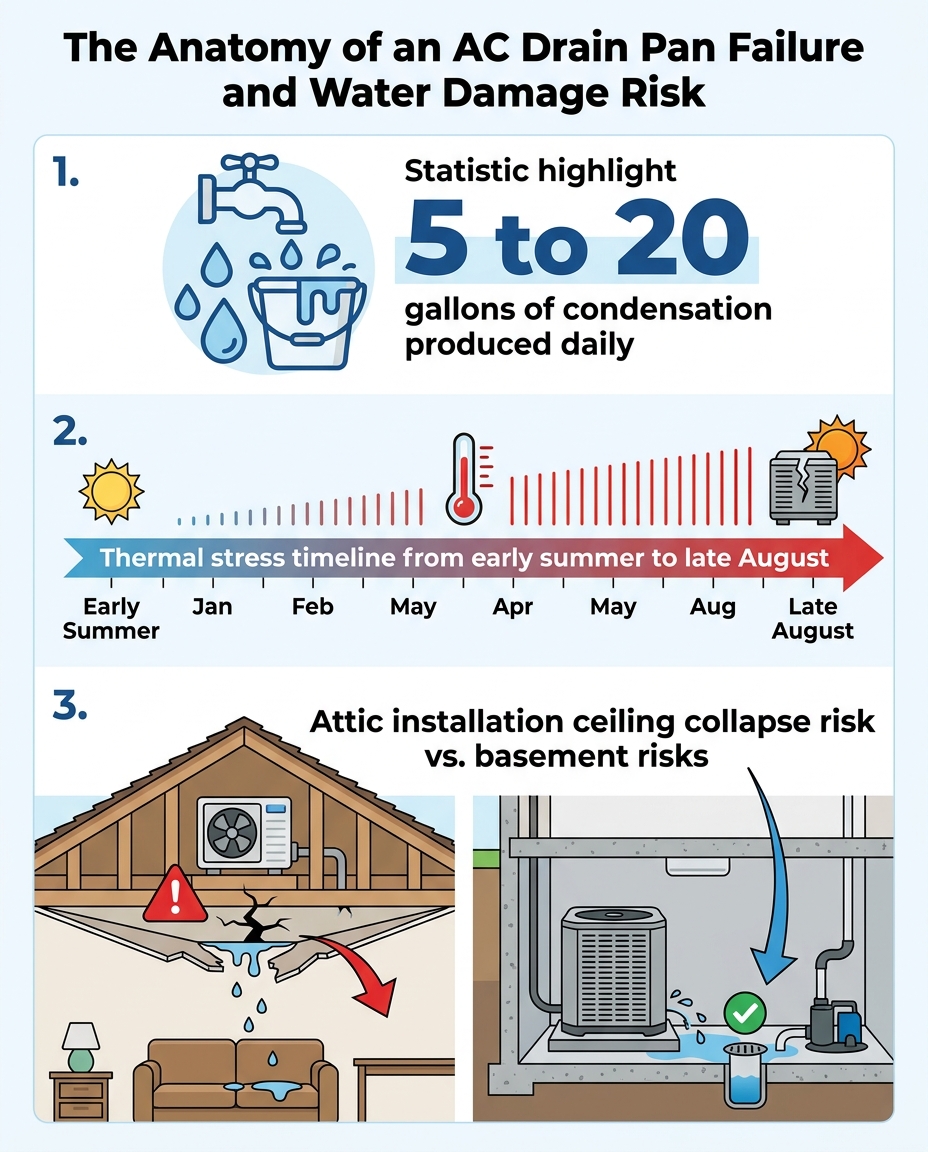

During our August service calls, we often have to explain to surprised homeowners that drain pans don't usually break from physical impact; they fail due to environmental exhaustion. The mechanics behind a fractured drain pan are deeply tied to the extreme temperature fluctuations inside your HVAC cabinet. During the late-summer cooling season, your system cycles on and off dozens of times a day. The evaporator coil gets freezing cold, generating condensation, while the ambient attic air surrounding the unit remains blisteringly hot.
This continuous heavy cycling over months causes significant thermal expansion and contraction. The materials expand slightly in the heat and contract rapidly when the cold refrigerant flows. Over time, older plastic pans lose their plasticizers, becoming stiff and brittle. Metal pans, on the other hand, eventually succumb to rust and corrosion caused by constant standing water. The peak stress point almost always hits right at the end of the cooling season, which is why our late-summer tune-ups so frequently uncover these hidden fractures.
Furthermore, these pan fractures are often connected to other related drainage issues that compound the stress on the system. For instance, if you have a history of AC drain line blockages, the standing water left behind in the pan accelerates the degradation of the material. The added weight of the backed-up water, combined with the thermal shock, pushes an aging pan past its breaking point.
In our experience, the timeline of a typical drain pan failure looks like this:
1. Early Summer: The pan handles normal condensation loads, but microscopic stress fractures begin forming near the drain port.
2. Mid-Summer: Continuous cycling and extreme attic heat cause the material to expand and contract, deepening the micro-fissures.
3. Late Summer (August): The brittle plastic finally snaps under the thermal load, opening a visible crack that allows gallons of water to escape.
If a cracked pan goes unnoticed—perhaps because a routine tune-up was skipped—the cascading effects on the home become impossible to ignore. By the time you see the signs of a condensation leak inside your living space, the water has already traveled through your building materials. In the San Jose homes our team services, where the climate is generally dry, sudden influxes of indoor moisture are highly disruptive to the home's ecosystem.
One of the most common telltale signs we encounter is a sudden, musty odor circulating through the vents. When water leaks from the pan into the dark, warm crevices of your HVAC cabinet or ductwork, it creates the perfect breeding ground for organic growth. Every time the blower motor kicks on, it pushes those musty, damp smells directly into your living areas, severely impacting your indoor air quality.
You should also be on the lookout for faint brown water rings on ceilings or high walls beneath the attic unit. These rings indicate that water has saturated the drywall and is evaporating on the visible side, leaving behind mineral deposits and stains. Excess unmanaged moisture directly impacts the home's overall breathability and comfort, making the indoor air feel heavy and clammy even when the AC is running. Emphasize to everyone in your household that waiting for these visual or olfactory signs means the structural damage has already occurred.
• Musty odors from vents — What It Indicates: Standing water or organic growth inside the unit housing. — Urgency Level: Moderate - Requires prompt inspection.
• Clammy indoor air — What It Indicates: Unmanaged moisture bypassing the drain system. — Urgency Level: Moderate - System is losing dehumidification efficiency.
• Brown rings on ceiling — What It Indicates: Water has fully saturated the attic drywall. — Urgency Level: High - Structural compromise is beginning.
• Bowing or sagging drywall — What It Indicates: Drywall is holding gallons of water and near collapse. — Urgency Level: Critical - Turn off AC immediately and call a professional.
When faced with a cracked component, it is incredibly tempting to look for a quick, inexpensive fix. Hardware stores are full of marine epoxies, waterproof tapes, and rubberized sealants that promise to stop leaks in their tracks. However, applying a DIY patch to an AC drain pan is one of the most dangerous gambles a homeowner can take with their HVAC system.
The environment inside an air handler is brutal. The constant vibration of the blower motor, combined with the extreme thermal expansion and contraction we see during the August and late-summer cooling season, will quickly break the seal on any DIY patch. Epoxy becomes brittle and flakes away, while adhesive tapes lose their grip due to the constant presence of cold condensation. When a patch fails, it rarely fails slowly; it typically gives way all at once, leading to a sudden, unexpected flood.
Our Precision Heating & Cooling technicians see the value of doing things the right way in our daily service calls. Just this past summer, our team responded to a customer whose older HVAC system stopped working completely after a makeshift repair. Our technicians were able to properly fix the system with the correct protocols, and later returned to service it again fully covered under our guarantees. That scenario proves a critical point: professional, warranty-backed work provides a safety net that DIY stopgaps simply cannot offer. If you patch a drain pan yourself and it fails, you are entirely on the hook for the consequences.
The massive financial liability of a failed patch resulting in a collapsed ceiling cannot be overstated. Water damage mitigation, professional drying equipment, drywall replacement, and repainting vastly outweigh the cost of a professional HVAC service call to replace the pan correctly. Furthermore, improper fixes and unauthorized modifications can void manufacturer warranties on the broader AC system, leaving you unprotected if the compressor or coil fails later.
Resolving a compromised drain pan requires strict adherence to safety and engineering standards, which is why it must be handled by a licensed professional. When one of our expert technicians arrives at your San Jose home to address the issue, they do far more than just swap out a plastic tray. The process begins with a comprehensive diagnostic check to ensure secondary pans and drain lines aren't also compromised or clogged with debris.
Efficiency and accuracy are the hallmarks of a proper repair. For example, during a recent late-summer service call, a customer experienced a severe AC drainage issue that needed urgent attention. Our technician Anthony immediately diagnosed the cracked pan and had the unit properly repaired within the hour. That same level of decisive, expert action applies to all our drain pan replacements. We source the exact OEM (Original Equipment Manufacturer) or a strictly compatible replacement pan designed specifically for your unit's dimensions and airflow requirements.
Here is how our certified technicians handle the replacement process safely:
1. Safe System Shutdown: Our technician completely isolates the power and ensures the refrigerant lines are stable before beginning work.
2. Coil Lifting and Support: The heavy evaporator coil is carefully lifted and supported without kinking or stressing the pressurized copper refrigerant lines.
3. Pan Extraction: The compromised pan is safely removed, and the surrounding housing is inspected for rust, mold, or collateral water damage.
4. Calibration and Sloping: The new pan is installed and meticulously leveled. A drain pan must have a precise, slight slope toward the drain port so that water flows out continuously rather than pooling.
5. Drain Line Reconnection: The primary and secondary drain lines are secured, sealed, and tested with water to confirm perfect flow dynamics.
This professional intervention restores your peace of mind and permanently secures your home against preventable leaks.
When an AC drain pan cracks, water from condensation bypasses the designated drain line and leaks directly into the unit housing or the home's structure. Instead of safely exiting your home, up to 20 gallons of water a day can begin pooling where it doesn't belong. Over time, this leads to severe rusting of internal HVAC components and inevitable water damage to the building materials below the unit.
Yes, especially in attic units, where leaking water quickly saturates insulation and drywall, leading to structural collapse. Because gravity pulls the overflowing condensation directly downward, the ceiling acts as a sponge until it can no longer hold the weight. By the time you notice a brown water stain on your ceiling, significant damage has already occurred above it.
Continuous usage causes heavy condensation and constant thermal expansion, stressing older, brittle materials to the breaking point. During the August and late-summer cooling season, the extreme temperature difference between the freezing evaporator coil and the hot attic air forces the pan to expand and contract repeatedly. Eventually, this thermal fatigue causes plastic to snap and metal to fracture.
No. In our professional experience, DIY patching with epoxy or tape is highly unreliable due to temperature fluctuations and will eventually fail, risking severe water damage. The constant vibration of the HVAC system, combined with perpetual moisture, breaks down adhesives rapidly. Replacing the pan entirely through a licensed professional is the only permanent, safe solution.
A standard residential unit can produce between 5 and 20 gallons of water per day during peak cooling operations. The exact amount depends on the humidity levels inside the home and how long the system runs. This massive volume of water highlights exactly why a secure, crack-free drain pan is essential for protecting your property.
Yes, if the unit is actively running, it is an emergency that requires immediate professional intervention to prevent imminent property damage. Every hour the AC runs with a cracked pan, more water is pumped directly into your home's structure. You should turn the system off immediately and call a technician to resolve the issue before turning the cooling back on.
Finding a cracked drain pan during a routine tune-up might feel like bad news at first, but it is actually a tremendous relief. Catching this vulnerability before it causes a catastrophic ceiling collapse saves you from immense stress, property loss, and structural repairs. As the late-summer San Jose heat continues to push your system to its limits, our team at Precision Heating & Cooling wants to ensure your condensation management is flawless.
Do not gamble with temporary patches or ignore the warning signs. Rely on expert technicians for a permanent, safe replacement that protects your home. Whether you need an immediate drain pan swap or it is time to schedule your routine AC maintenance, securing your system now guarantees a dry, comfortable, and stress-free end to the cooling season.

Leslie was amazing for her outstanding customer service skills with me the other day. Thanks to her help my air conditioner is now all set up. She answered all my questions and took away all my problems. Leslie broke it down step by step to set it up easier. Now thanks to her my air conditioner is working perfectly. I really appreciate it Leslie and I’ll be sure to ask for you if I ever come back.
I contacted Precision Heating and Cooling for my home's AC repair. They were punctual and very professional. Guillermo was very kind and thorough. I would highly recommend them!
I am writing to express my sincere appreciation for the excellent work performed by Pablo and Alejandro from Precision Heating and Cooling. Their commitment to quality and customer satisfaction is truly commendable. Awesome job guys!
I would like to extend my sincere gratitude to Alejandro for his exceptional hard work. His passion for helping others is evident, and he consistently goes above and beyond in his service. Alejandro's thorough cleaning of my fireplace has truly made a significant difference. His dedication and professionalism are greatly appreciated.
I was very impressed. Came at night (after 9pm) to fix our AC during the middle of a heat wave the day before a national holiday! Technician was very courteous and efficient, got the job done quickly. Will definitely call them again for any AC servicing I need!
Fast and efficient, arrived when scheduled for repairs and replacement parts were ordered and installed quickly. Techs were very friendly and professional. AC system works great now! I highly recommend their services if you need repairs. Tim


.avif)
