Recent Blogs
Stay updated with our latest blog posts.


Is your aging gas furnace ready for another winter, or is it time to evaluate a completely different approach to warming your property? At Precision Heating & Cooling, we know that navigating the technical details of modern HVAC systems can feel overwhelming, but looking at clear options comparisons for homeowners is the best way to ensure long-term comfort and efficiency. As temperatures slowly begin to shift this October, making a proactive decision about your home's infrastructure helps you avoid the stress of an unexpected breakdown in the middle of a cold night.
To get started on the right foot, it helps to understand your core sistemas HVAC so you can make a confident decision before the cold weather sets in. Mid-fall is the optimal window for this evaluation. Scheduling a mid-fall heating startup and assessment gives our team ample time to research, consult with you, and schedule an installation without fighting the inevitable winter rush. When it comes to a full system replacement, the two primary contenders dominating the market are traditional gas furnaces and modern air-source heat pumps. Both systems have distinct operational profiles, and setting a neutral, objective baseline is the first step toward finding the perfect fit for your home.
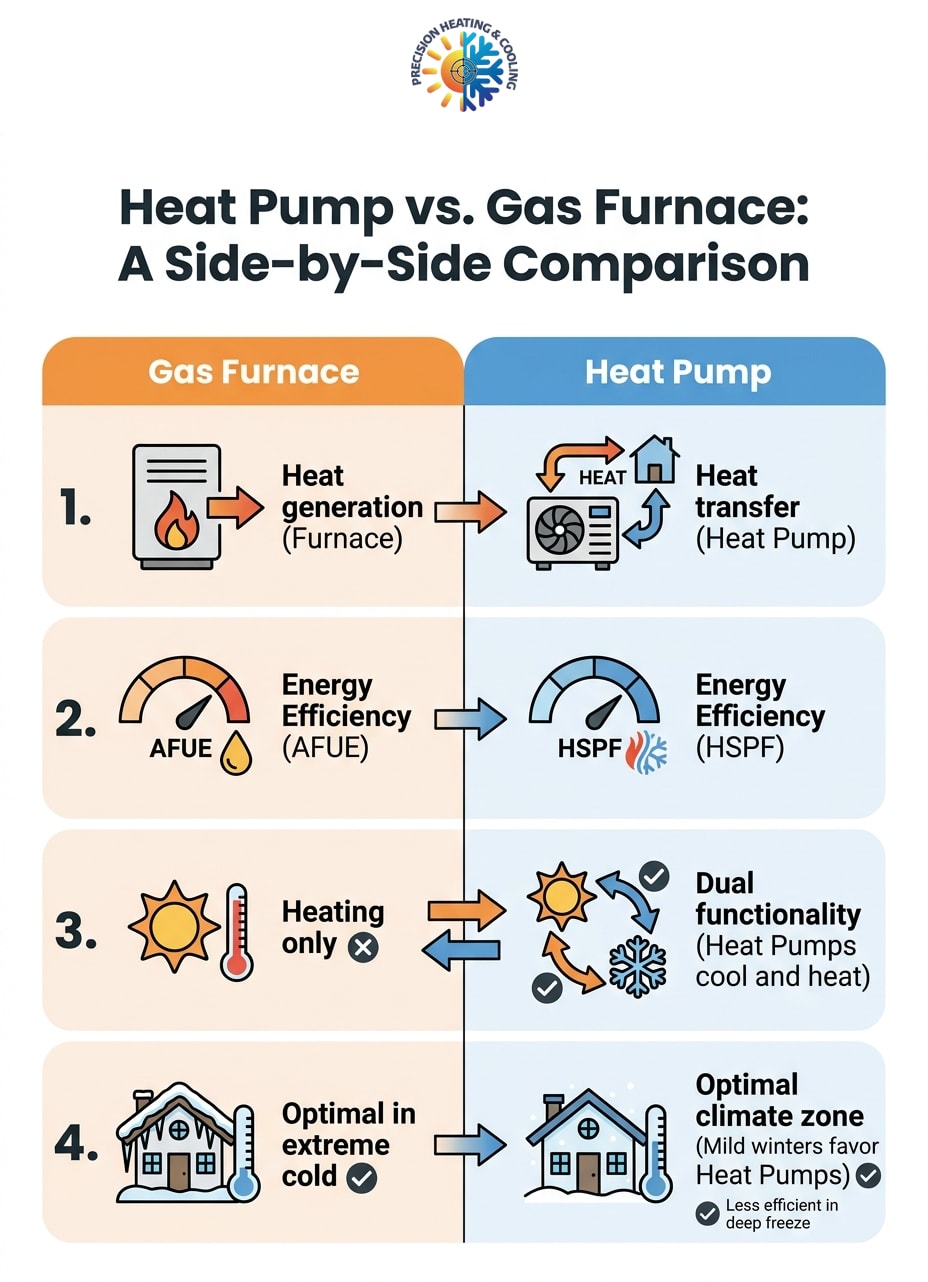
The most fundamental difference between a gas furnace and an air-source heat pump lies in how they source their warmth. A traditional gas furnace relies on heat generation. It consumes a combustible fuel—typically natural gas—igniting it within a sealed combustion chamber. The resulting thermal energy transfers to a heat exchanger, and a blower motor forces air over that hot metal, distributing the freshly heated air through your home's ductwork. Because they rely on combustion, gas furnaces require proper exhaust venting to safely remove byproducts from your home.
In contrast, a heat pump relies on heat transfer. It does not burn fuel to generate heat. Instead, it utilizes a closed-loop refrigerant cycle to extract ambient heat energy from the outside air, compress that heat to a higher temperature, and transfer it indoors. This process is essentially an air conditioner running in reverse. In fact, one of the greatest advantages our customers appreciate about a heat pump is its dual functionality. By utilizing a reversing valve, the system switches directions in the summer, pulling heat out of your home to provide full servicios de aire acondicionado from the exact same unit.
When comparing these systems, you must also look at how the industry measures their energy efficiency. Gas furnaces are rated by Annual Fuel Utilization Efficiency (AFUE), which represents the percentage of fuel converted directly into usable heat. Heat pumps are measured by Heating Seasonal Performance Factor (HSPF), which calculates the ratio of heat output to electricity consumed over an entire heating season.
• Heating Method — Gas Furnace: Heat generation via combustion — Air-Source Heat Pump: Heat transfer via refrigerant cycle
• Primary Energy Source — Gas Furnace: Natural gas or propane — Air-Source Heat Pump: Electricity
• Efficiency Metric — Gas Furnace: AFUE (Percentage) — Air-Source Heat Pump: HSPF (Ratio)
• Summer Functionality — Gas Furnace: None (Requires separate AC) — Air-Source Heat Pump: Full cooling capabilities
A common misconception we hear from homeowners is that heat pumps perform poorly during the winter, blowing lukewarm air and struggling to keep a house comfortable. While older models did struggle in sub-zero climates, modern heat pump technology has advanced significantly. More importantly, this concern is largely irrelevant in a mild climate. Because ambient heat energy is always present in the air—even when it feels cold to the human skin—heat pumps remain highly efficient as long as outside temperatures stay above freezing.
In our years serving the local community, we've found that San Jose's winter low temperatures, which average in the low 40s (Fahrenheit), place the region in an ideal climate zone for maximum air-source heat pump efficiency year-round. Standard gas furnaces operate identically whether it is 10 degrees or 50 degrees outside, burning the same amount of fuel to achieve the desired indoor temperature. Heat pumps, however, scale in efficiency based on the outdoor ambient temperature.
In regions with harsh, freezing winters, heat pumps often rely on energy-heavy electric auxiliary heat strips to supplement their output when the ambient heat drops too low. Because San Jose rarely experiences prolonged freezing temperatures, the systems we install locally almost never need to activate these backup strips. This allows the heat pump to operate purely on its highly efficient compressor cycle. Furthermore, avoiding fossil fuel combustion entirely can have a positive impact on your home's overall calidad del aire interior, as there is zero risk of carbon monoxide leaks or exhaust backdrafts. In this ideal mild climate, a heat pump can deliver up to three times more heat energy to your living space than the electrical energy it consumes to run the compressor.
Both heating options require dedicated upkeep to ensure they reach their maximum expected lifespan, but the nature of that maintenance differs significantly based on how the systems operate. Preparing for a mid-fall heating startup means scheduling preventative care tailored to your specific equipment, a process our technicians manage for countless homes every October.
• Gas Furnace Safety Checks: Because furnaces utilize live flames and combustible gases, annual maintenance is heavily focused on safety. Technicians must inspect the heat exchanger for microscopic cracks, test the burner ignition sequence, and verify that the flue pipe is safely venting hazardous gases outdoors.
• Heat Pump Bi-Annual Wear: A furnace only runs for a few months out of the year. A heat pump operates year-round, handling both your winter heating and your summer cooling. This continuous duty cycle means the internal components experience more wear and tear, making bi-annual maintenance (once in the spring, once in the fall) critical for inspecting the reversing valve, defrost controls, and refrigerant charge.
• Airflow and Filter Replacements: Both systems share a strict requirement for clean airflow. Regularly replacing your air filters prevents the blower motor from overworking, protects the internal coils from dust buildup, and extends the overall longevity of the equipment.
• Preventing Mid-Season Breakdowns: Routine check-ups catch minor friction issues, loose electrical connections, and failing capacitors before they cause total system failure during a cold snap.
Staying ahead of these requirements is much easier when you enroll in a comprehensive plan de mantenimiento preventivo, ensuring your system is professionally evaluated by our experts before the heavy usage season begins.
The HVAC industry is currently undergoing a massive shift toward residential electrification. This trend is driven by broader goals to reduce residential carbon footprints and decrease reliance on fossil fuels. As power grids transition toward renewable energy sources, electrifying your home's heating infrastructure ensures your property aligns with future energy standards.
Modern heat pumps are at the forefront of this movement because they eliminate on-site fossil fuel combustion entirely. For homeowners in San Jose, transitioning to a heat pump represents a significant step toward future-proofing their property. Policymakers and utility companies recognize this environmental benefit, which is why various incentive programs exist to encourage the switch.
General energy rebates and federal tax credits may apply to qualifying high-efficiency heat pump installations. These programs are designed to help offset the initial investment of upgrading your infrastructure. Because these incentives frequently update and vary based on equipment efficiency ratings, we always advise our customers to consult directly with their local utility providers or a qualified tax professional to verify the current incentive programs available. Making the switch to electric heating not only supports broader environmental goals but can also position your home to take advantage of these ongoing electrification initiatives.
Transitioning from a traditional gas setup to a fully electric heat pump is not a simple plug-and-play process. It requires a thorough evaluation of your home's existing infrastructure to ensure the new system will operate safely and efficiently.
1. Evaluate Electrical Panel Capacity: Gas furnaces require very little electricity—just enough to run the blower motor and the control board. Heat pumps require a dedicated 220-volt circuit and draw significantly more amperage. You must verify that your home's main electrical panel has the physical space and the total amperage capacity to handle this increased load without tripping breakers.
2. Assess Existing Ductwork: Heat pumps typically produce a higher volume of air at a slightly lower temperature compared to the intense, low-volume heat blast of a gas furnace. Your existing ductwork must be inspected to ensure it can handle the specific airflow volumes required by a heat pump without creating static pressure issues or whistling vents.
3. Perform Professional Load Calculations: Proper sizing is non-negotiable. A system that is too large will short-cycle, while a system that is too small will run constantly without ever heating the home.
4. Determine Repair vs. Replacement: Dealing with older, out-of-production HVAC equipment often forces a decision. Patchwork repairs on obsolete units quickly become a sunk cost, making a full infrastructure transition a smarter long-term investment.
The consequences of skipping these steps can be frustrating. Recently, our team at Precision Heating & Cooling helped a San Jose homeowner who experienced this firsthand after another contractor installed a new furnace and cooling system. Just three months after the installation, the equipment developed persistent operational problems. Because the previous installer failed to account for proper sizing and airflow dynamics, the system simply could not function correctly. Our technicians were called out to thoroughly troubleshoot the setup, ultimately resolving the extensive issues left behind by the initial contractor. This highlights why working with an established team—leveraging our 20 years of local experience and status as a Day and Night Elite Dealer—is critical for accurate diagnostic load calculations. Proper planning is just as important as lo que revisamos primero en San José cuando el AC no enfría; precision matters at every step.
In our experience, California's generally mild climate makes heat pumps highly efficient and often the preferred choice for modern homes. Because they do not have to fight against sub-zero temperatures, they operate at peak performance throughout the winter. Additionally, they provide both heating and cooling, offering year-round utility from a single piece of equipment, which is highly practical for the state's varied seasons.
Standard heat pumps begin to lose efficiency below freezing (32 degrees Fahrenheit), as there is less ambient heat available in the air to extract. However, in mild climates like ours, outdoor temperatures rarely drop to levels that require the system to rely on energy-heavy auxiliary heating strips. Advanced cold-climate heat pumps can operate efficiently in even lower temperatures, though we rarely find them necessary in standard coastal or valley environments.
Yes, mild winters are the absolute optimal environment for air-source heat pumps. They operate at peak efficiency without straining the compressor or requiring supplemental heat. Because the temperature differential between the outside air and your desired indoor temperature is relatively small, the system uses minimal electricity to keep your home perfectly comfortable.
They can transfer up to 300% more energy than they consume in electricity. This incredible ratio makes them significantly more efficient than combustion furnaces in the right climate. While a top-tier gas furnace might max out at 98% efficiency (meaning 2% of the energy is lost as exhaust), a heat pump multiplies the energy it uses by moving existing heat rather than creating it from scratch.
Often yes, but our professionals must inspect the ducts for proper sizing and insulation before making the switch. Airflow requirements differ slightly between the two systems; heat pumps push a larger volume of air at a slightly lower temperature than a gas furnace. If your ducts are undersized, poorly sealed, or improperly insulated, the new system will struggle to distribute air efficiently, leading to uneven temperatures and higher energy bills.
Both traditional gas furnaces and modern air-source heat pumps offer distinct advantages depending on your home's existing infrastructure, your electrical capacity, and your long-term energy goals. However, living in a mild climate heavily favors the incredible efficiency and dual-functionality of modern heat pumps. As you prepare for a mid-fall heating startup, taking the time to weigh these options ensures you invest in a system that will serve your household reliably for years to come.
Because every property is unique, our team at Precision Heating & Cooling believes the best way to determine which system will perform optimally in your space is to seek a professional assessment. Accurate load calculations and infrastructure checks are the foundation of a successful installation. Schedule a comprehensive pre-winter inspection and consultation with us today to evaluate your current equipment, explore your upgrade options, and make an informed decision before the cold weather truly arrives.

Leslie was amazing for her outstanding customer service skills with me the other day. Thanks to her help my air conditioner is now all set up. She answered all my questions and took away all my problems. Leslie broke it down step by step to set it up easier. Now thanks to her my air conditioner is working perfectly. I really appreciate it Leslie and I’ll be sure to ask for you if I ever come back.
I contacted Precision Heating and Cooling for my home's AC repair. They were punctual and very professional. Guillermo was very kind and thorough. I would highly recommend them!
I am writing to express my sincere appreciation for the excellent work performed by Pablo and Alejandro from Precision Heating and Cooling. Their commitment to quality and customer satisfaction is truly commendable. Awesome job guys!
I would like to extend my sincere gratitude to Alejandro for his exceptional hard work. His passion for helping others is evident, and he consistently goes above and beyond in his service. Alejandro's thorough cleaning of my fireplace has truly made a significant difference. His dedication and professionalism are greatly appreciated.
I was very impressed. Came at night (after 9pm) to fix our AC during the middle of a heat wave the day before a national holiday! Technician was very courteous and efficient, got the job done quickly. Will definitely call them again for any AC servicing I need!
Fast and efficient, arrived when scheduled for repairs and replacement parts were ordered and installed quickly. Techs were very friendly and professional. AC system works great now! I highly recommend their services if you need repairs. Tim