


.avif)





Recent Blogs
Stay updated with our latest blog posts.


How Bay Area climate affects your HVAC system is one of the most misunderstood topics among local homeowners — and getting it wrong can mean higher energy bills, early equipment failure, and uncomfortable rooms year-round. Here is a quick look at the key ways the Bay Area's unique climate puts stress on your system:
The bottom line: the Bay Area is not one climate. It is dozens of microclimates, each placing different and specific demands on your heating and cooling equipment.
I'm Tony Lara, an HVAC professional with hands-on experience helping Bay Area homeowners navigate exactly these kinds of climate-driven system challenges — from tracking down hard-to-find parts for salt-corroded coastal units to diagnosing short-cycling compressors in the inland valleys. In this guide, I'll walk you through everything you need to know about how Bay Area climate affects your HVAC system so you can make smarter decisions about maintenance, upgrades, and system selection for your specific neighborhood.
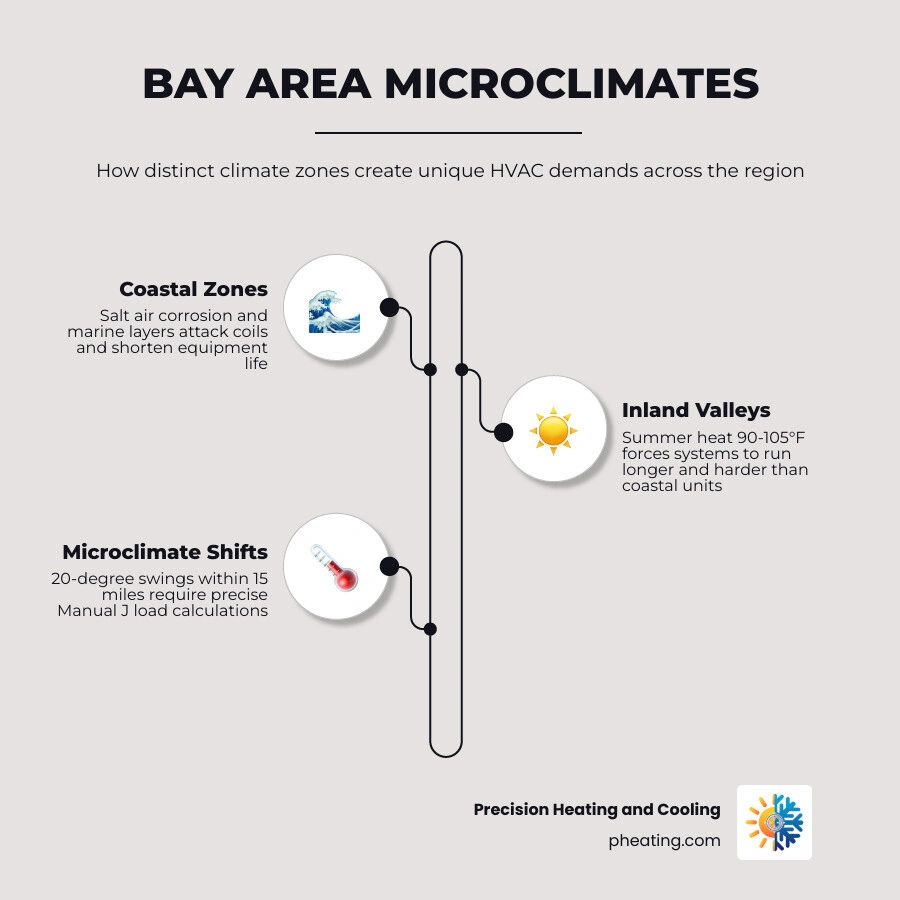
In the Bay Area, we often joke that if you don't like the weather, you should just drive 15 miles. However, this diversity is no laughing matter for your air conditioner or furnace. How Bay Area climate affects your HVAC system is largely a story of these microclimates. A home in the hills of Los Gatos faces different environmental stressors than a property in the flatlands of Santa Clara or the foggy streets of Palo Alto.
One of the most striking statistics we see is that driving just 15 miles across the East Bay can result in a 20-degree temperature difference. This means that while one homeowner is enjoying a cool 70-degree breeze, another just a few zip codes away is dealing with 90-degree heat. This variance makes Bay Area Heating and cooling a highly localized science.
To ensure performance, we rely on Manual J calculations. This is the industry-standard method for determining the exact heating and cooling load of a home based on its specific microclimate, orientation, and insulation. Without this, you risk installing a system that is either underpowered for inland heatwaves or oversized for coastal fog. Furthermore, many older homes in areas like Sunnyvale or Cupertino suffer from uneven temperatures between rooms. This is where air balancing comes in—the process of adjusting your ductwork and vents to ensure that every room receives the correct amount of airflow, regardless of how the sun hits the house. Working with an Expert HVAC Contractor is the only way to ensure these technical steps are handled correctly.
The "Microclimate Divide" is most visible when comparing the coastal marine layer to the inland valleys. In coastal zones, the primary enemy is salt air corrosion. The salt in the air is highly corrosive to the copper and aluminum coils found in your outdoor condensing unit. We have seen units near the coast where the aluminum fins literally crumble to dust after only five to seven years.
In contrast, inland areas like Walnut Creek or parts of the South Bay deal with extreme heat. While Berkeley might only see 15 days over 85 degrees today (up from just 5 days in the 1970s), inland valleys can experience 60 to 90 days of cooling demand. This creates a massive workload for the compressor. If you are planning a new system, checking a San Jose HVAC Installation Guide can help you understand why high SEER2 ratings are much more critical for inland homes than for those in the foggy coastal reaches.
You might assume that because our weather is "mild," our HVAC systems last forever. Paradoxically, this isn't always true. While a furnace in Chicago runs constantly for six months, a Bay Area furnace might only run for a few hours a day. This infrequent use leads to neglect.
When a system sits idle, seals can dry out, and internal corrosion can set in without the homeowner noticing. A well-maintained Bay Area furnace can last 18–22 years, but without regular check-ups, that lifespan often drops to just 12–15 years. There are significant Benefits of Choosing a 25-Year Local HVAC Company when assessing these issues; local experts know exactly which components are likely to wear out first under our specific seasonal transitions.
Beyond just temperature, how Bay Area climate affects your HVAC system involves air quality and humidity. In recent years, wildfire smoke has become a major factor in local home comfort. When the AQI (Air Quality Index) spikes, your HVAC system becomes your home's primary defense system.
Wildfire smoke is composed of fine particulate matter that can travel hundreds of miles. These particulates don't just affect your lungs; they saturate your HVAC filters. A filter that usually lasts three months might clog in three days during a heavy smoke event. This creates immense blower motor strain as the system struggles to pull air through a blocked filter.
We recommend upgrading to MERV 13 filtration or higher during these periods to catch the smallest smoke particles. When smoke is present, you should always run your system in recirculation mode to avoid pulling in outside air. This proactive approach to San Jose HVAC Maintenance is essential for protecting both your equipment and your health. Interestingly, even your other home systems are involved; for example, maintaining Bay Area Water Heaters and ensuring proper venting can prevent combustion issues when a home is "sealed up" during smoky days. If you are installing new equipment, consult a Bay Area Water Heater Installation Guide to see how modern, sealed-combustion units provide better safety during air quality events.
How do you know if the local weather is winning the battle against your HVAC? Watch for these red flags:
Choosing the right technology is the most important step in future-proofing your home. The Bay Area's push toward electrification means that the Bay Area Heat Pump is becoming the gold standard for many neighborhoods.
| Feature | Heat Pump | Dual-Fuel System | Gas Furnace + AC |
|---|---|---|---|
| Best For | Coastal/Peninsula (Mild) | Inland Valleys (Extreme) | Older homes with existing gas |
| Efficiency | Highest (up to 350% COP) | High (Optimizes fuel) | Standard (80-95% AFUE) |
| Climate Fit | Perfect for 40-60°F winters | Handles 30°F cold snaps | Best for very old insulation |
| Incentives | High Rebates Available | Moderate Rebates | Limited Rebates |
Variable-speed technology is particularly effective for our region. Unlike traditional "on/off" systems, variable-speed compressors can ramp up or down slowly. This is perfect for handling a day that starts at 50 degrees and ends at 90 degrees, as it prevents the wear and tear associated with constant cycling.
While our weather is less "violent" than a Midwestern blizzard, the inland valley stressors are real. Furnaces in areas like Hanford or Clovis often wear out two to three years earlier than those in coastal zones simply because they work harder during the winter nights and summer peaks.
On the coast, fin rot (the corrosion of the heat exchanger fins) is the primary killer. To combat this, we recommend a proactive service calendar that includes rinsing salt from outdoor coils and checking for electrical corrosion. Furthermore, don't forget the financial side: many Bay Area homeowners are eligible for significant rebates when switching to high-efficiency heat pumps, which can offset the initial investment while lowering long-term energy costs.
Inland areas experience much wider temperature extremes. While a coastal home might stay between 55 and 75 degrees most of the year, an inland home might swing from 35 degrees at night to 105 degrees during a summer day. This heavier workload means the components—especially the compressor and the heat exchanger—accrue "mileage" much faster, typically shortening the lifespan by 2 to 3 years compared to a coastal unit.
Wildfire smoke carries microscopic ash and "sticky" carbon particles. These don't just sit on the surface of a standard filter; they embed themselves deep in the fibers, causing the filter to become "blinded" or fully saturated very quickly. This restricts airflow, which can cause your evaporator coil to freeze in the summer or your furnace to overheat and shut down in the winter. We recommend checking your filters every two weeks during fire season and using MERV 13 rated filters to protect your indoor air quality.
For most of the East Bay, a heat pump is excellent because our winters rarely stay below freezing for long. However, in the Tri-Valley area where you might see 40-degree daily temperature swings and occasional nights in the 20s, a dual-fuel system (a heat pump paired with a gas furnace) offers the best of both worlds. It uses the electric heat pump for mild days and switches to gas only during those rare, extreme cold snaps, ensuring maximum efficiency and comfort.
At Precision Heating and Cooling, we understand that your home in San Jose, Santa Clara, or Los Gatos is subject to a very specific set of environmental rules. How Bay Area climate affects your HVAC system is a complex puzzle involving salt air, wildfire smoke, and dramatic temperature shifts across short distances.
With over two decades of local experience, we specialize in tailoring HVAC solutions to these exact microclimates. Whether you need a salt-resistant coating for a coastal unit, high-efficiency filtration for smoke season, or a modern heat pump to handle Silicon Valley's daily temperature swings, our team is here to provide reliable service and expert guidance. Don't let the "mild" climate fool you into neglecting your system. Schedule your professional HVAC services today and ensure your home stays comfortable, no matter what the Bay Area weather throws your way.

Leslie was amazing for her outstanding customer service skills with me the other day. Thanks to her help my air conditioner is now all set up. She answered all my questions and took away all my problems. Leslie broke it down step by step to set it up easier. Now thanks to her my air conditioner is working perfectly. I really appreciate it Leslie and I’ll be sure to ask for you if I ever come back.
I contacted Precision Heating and Cooling for my home's AC repair. They were punctual and very professional. Guillermo was very kind and thorough. I would highly recommend them!
I am writing to express my sincere appreciation for the excellent work performed by Pablo and Alejandro from Precision Heating and Cooling. Their commitment to quality and customer satisfaction is truly commendable. Awesome job guys!
I would like to extend my sincere gratitude to Alejandro for his exceptional hard work. His passion for helping others is evident, and he consistently goes above and beyond in his service. Alejandro's thorough cleaning of my fireplace has truly made a significant difference. His dedication and professionalism are greatly appreciated.
I was very impressed. Came at night (after 9pm) to fix our AC during the middle of a heat wave the day before a national holiday! Technician was very courteous and efficient, got the job done quickly. Will definitely call them again for any AC servicing I need!
Fast and efficient, arrived when scheduled for repairs and replacement parts were ordered and installed quickly. Techs were very friendly and professional. AC system works great now! I highly recommend their services if you need repairs. Tim


.avif)
