


.avif)






Recent Blogs
Stay updated with our latest blog posts.


Understanding how mini splits solve hot and cold spots starts with recognizing why those spots exist in the first place. If you've ever walked from a stuffy upstairs bedroom into a cool living room — or baked in your home office while the hallway felt perfectly comfortable — you already know the frustration. Traditional central HVAC systems push conditioned air through a single network of ducts, treating your entire home as one zone. But every room is different. Sun exposure, ceiling height, insulation quality, and distance from the air handler all affect how warm or cool a space actually gets.
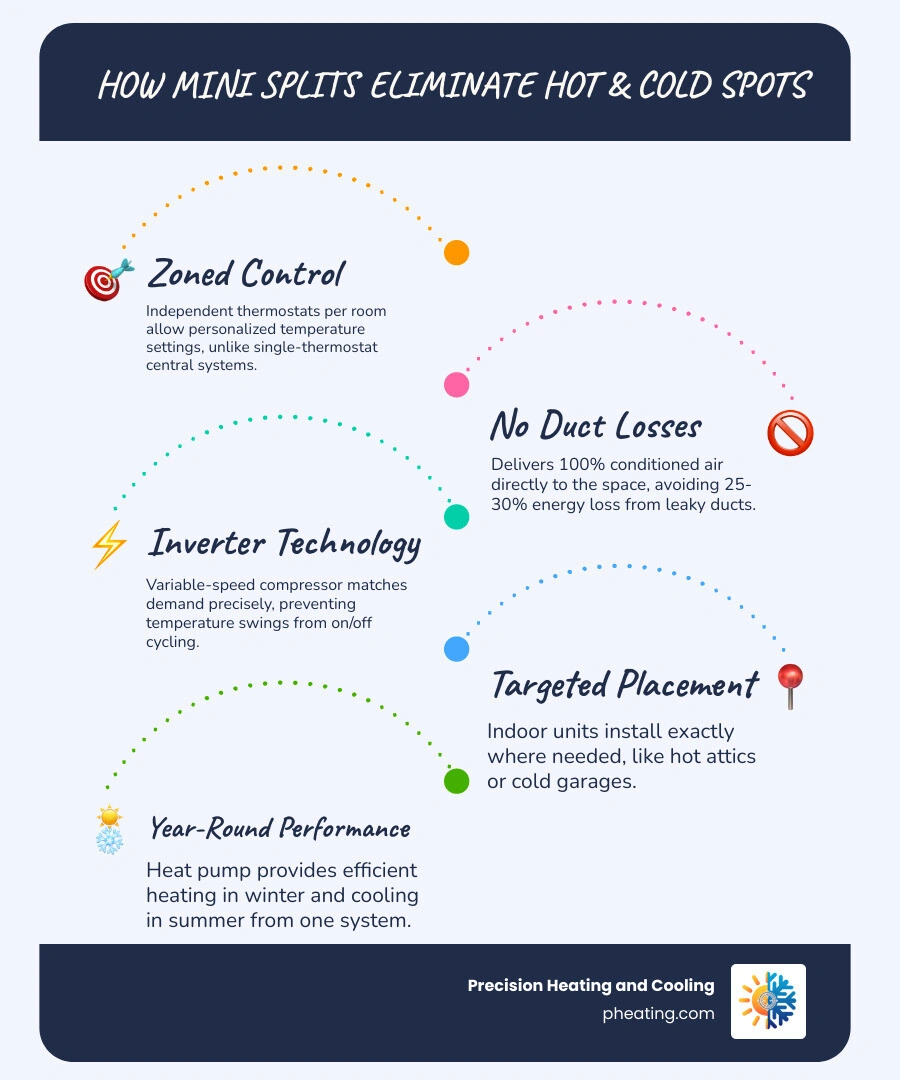
Here is a quick look at how mini splits fix that problem:
These five factors work together to eliminate the temperature inconsistencies that a single-thermostat central system simply cannot address.
In San Jose and across the Bay Area, the problem is especially common in older homes — bungalows, ranch-style houses, and multi-story properties where the original HVAC was never designed to handle today's comfort expectations. An attic bedroom that turns into a sauna by mid-afternoon, a back room that never gets enough airflow, a garage converted into a home office that sits outside the reach of the main system — these are everyday situations that mini splits are built to fix.
My name is Tony Lara, and I have spent my career in the HVAC field tracking down exactly these kinds of comfort problems, which is why I understand how mini splits solve hot and cold spots in real homes with real layouts. In the sections below, I will walk you through the specific causes, the right solutions, and what to look for when choosing a system for your Bay Area home.
In our experience serving the San Jose Bay Area and Central Valley, we’ve seen that room temperature differences at home are rarely a mystery once you look under the hood of the house. Whether you’re living in a classic Willow Glen bungalow or a 1960s Cambrian ranch home, several architectural factors conspire against your central HVAC system.
First, consider sun exposure. A south-facing room with large windows will naturally absorb significantly more heat than a shaded room on the north side. Traditional systems, controlled by a single thermostat usually located in a neutral hallway, have no way of knowing that your office is currently 82 degrees while the hallway is 72.
Then there is the issue of infrastructure. Many older homes suffer from poor insulation or leaky ducts. According to industry statistics, traditional ducted systems lose 25-30% of conditioned air through leaks before it even reaches your living space. When you combine that with long duct runs—where the air has to travel 40 feet from the furnace to a back bedroom—the air simply loses its "punch" by the time it arrives.

Furthermore, modern design features like vaulted ceilings create massive air volumes that central systems struggle to circulate evenly. Heat naturally rises, leaving the floor level chilly in the winter while the ceiling area stays toasty. If your central AC is undersized for these challenges, it will run constantly without ever achieving a balanced temperature across every room.
If you’re wondering exactly how mini splits solve hot and cold spots, the secret lies in "zoning." Unlike a central furnace that is either "all on" or "all off" for the whole house, a ductless system allows for independent control. This is a core part of our expert guide to ductless HVAC: what to expect.
The technology behind this is fascinating. Modern mini splits use inverter technology. Think of a standard HVAC system like a light switch—it’s either 0% or 100%. An inverter-driven system is more like a dimmer switch. It modulates the compressor speed to provide exactly the amount of cooling or heating needed to maintain a steady temperature. This eliminates the "blast of cold followed by a warm lull" cycle that defines older systems.
| Feature | Traditional Ducted System | Ductless Mini Split |
|---|---|---|
| Energy Loss | 25-30% via leaky/uninsulated ducts | 0% (Ductless) |
| Control | Single Thermostat (Whole House) | Independent Thermostats (Per Room) |
| Noise Level | 50-60 decibels (Indoor) | 19-32 decibels (Whisper Quiet) |
| Technology | Fixed Speed (On/Off) | Variable Speed Inverter |
By following a guide to ductless heating and cooling systems, you'll see that these units aren't just for cooling. They are high-efficiency heat pumps that provide year-round comfort. Because they don't require bulky ductwork, they offer incredible aesthetic flexibility—units can be wall-mounted, floor-mounted, or even recessed into the ceiling.
Multi-story homes are notorious for "upstairs stuffiness." Because heat rises, the second floor often stays 5 to 10 degrees warmer than the first floor in the summer. By installing independent air handlers in upstairs bedrooms, you can create personalized settings. If one family member likes a freezing 68-degree room for sleep while another prefers 74, both can be happy simultaneously without affecting the rest of the house.
Absolutely. Many of our neighbors in Hanford or Clovis convert garages into gyms, workshops, or ADUs. These spaces are often built on concrete slabs with minimal insulation, making them literal iceboxes in winter and ovens in summer. A single-zone mini split provides targeted, high-performance cooling and heating that bypasses the main home system entirely, making the space usable 365 days a year.
Every home layout presents unique challenges. We often find that how room layout affects ductless AC performance dictates where we place the units for maximum efficiency. For example, in an open-concept living area, a higher BTU unit might be needed to push air across the entire space, whereas a small bedroom in Santa Clara might only need a compact 6,000 BTU air handler.
When we look at solutions for inconsistent cooling from ductless AC, we always start with a Manual J load calculation. This is a professional assessment that considers your window types, insulation levels, and local San Jose microclimates to ensure the system is sized perfectly.
If you have multiple problem rooms, a multi-head system is often the best choice. This explains why multi-head ductless AC improves home comfort—you can power up to five indoor units from a single outdoor condenser. Following best practices for multi-zone ductless AC installation ensures that refrigerant lines are properly insulated and units are placed to avoid "short-cycling," which happens if a unit is tucked too close to a corner or a ceiling fan.
Beyond temperature, these systems offer significant health benefits. They feature advanced air filtration that captures dust and allergens. Since there are no ducts to collect mold or pet dander, the air stays cleaner. To keep it that way, routine maintenance is simple: just pop open the front panel and wash the filters every few weeks.
Because mini splits don't use ducts, they don't circulate the dust, pollen, and debris that often settle in traditional HVAC channels. Most units feature multi-stage filtration systems that actively clean the air in the specific room where the unit is located. This provides localized air cleaning that is far more effective than a single filter at the central furnace.
A single-zone system consists of one indoor unit and one outdoor condenser, perfect for a specific problem area like a sunroom or attic. A multi-zone system uses a larger outdoor unit that can connect to multiple indoor air handlers throughout the house. This allows for whole-home coverage and independent temperature control in every major living space.
One of the best things about going ductless is the minimal disruption. Unlike traditional HVAC retrofits that require tearing into walls to run ducts, a mini split only requires a small three-inch hole for the conduit. In most cases, our team can complete a single-zone installation in just one day. It is incredibly retrofit-friendly for those beautiful older homes in Palo Alto or Sunnyvale.
At Precision Heating and Cooling, we’ve spent over two decades helping homeowners across the San Jose Bay Area and Central Valley reclaim their comfort. Whether you are dealing with a sweltering attic in Los Gatos or a chilly guest room in Cupertino, we have the expertise to design a system that works for your specific layout. We pride ourselves on reliable service, competitive pricing, and flexible payment options that make upgrading your home easier than ever.
Don't let hot and cold spots dictate which rooms you can use. Learn more about our ductless mini-split services and see how we can bring balanced, energy-efficient comfort to your home today. By April 2026, the global demand for these systems is expected to reach record highs—now is the perfect time to join the thousands of Bay Area residents who have already made the switch to a more comfortable, zoned lifestyle.

Leslie was amazing for her outstanding customer service skills with me the other day. Thanks to her help my air conditioner is now all set up. She answered all my questions and took away all my problems. Leslie broke it down step by step to set it up easier. Now thanks to her my air conditioner is working perfectly. I really appreciate it Leslie and I’ll be sure to ask for you if I ever come back.
I contacted Precision Heating and Cooling for my home's AC repair. They were punctual and very professional. Guillermo was very kind and thorough. I would highly recommend them!
I am writing to express my sincere appreciation for the excellent work performed by Pablo and Alejandro from Precision Heating and Cooling. Their commitment to quality and customer satisfaction is truly commendable. Awesome job guys!
I would like to extend my sincere gratitude to Alejandro for his exceptional hard work. His passion for helping others is evident, and he consistently goes above and beyond in his service. Alejandro's thorough cleaning of my fireplace has truly made a significant difference. His dedication and professionalism are greatly appreciated.
I was very impressed. Came at night (after 9pm) to fix our AC during the middle of a heat wave the day before a national holiday! Technician was very courteous and efficient, got the job done quickly. Will definitely call them again for any AC servicing I need!
Fast and efficient, arrived when scheduled for repairs and replacement parts were ordered and installed quickly. Techs were very friendly and professional. AC system works great now! I highly recommend their services if you need repairs. Tim





.avif)
