


.avif)






Recent Blogs
Stay updated with our latest blog posts.


Knowing how old is too old for an HVAC system could be the difference between a planned upgrade and a panic call on the hottest day of the year. Most systems don't quit all at once — they slow down, cost more to run, and break more often, long before they stop working completely. In fact, nearly one in three homeowners faces a major HVAC breakdown before their system even reaches the end of its expected lifespan.
Here's a quick answer by system type:
| HVAC System Type | Typical Lifespan | Consider Replacing At |
|---|---|---|
| Central Air Conditioner | 15-20 years | 12-15 years |
| Gas Furnace | 15-30 years | 15-20 years |
| Heat Pump | 10-15 years | 10-12 years |
| Ductless Mini-Split | 10-15 years | 10-15 years |
| Boiler | 20-35 years | 20-25 years |
As a general rule:
For San Jose Bay Area homeowners, those timelines can shift even earlier depending on usage intensity and local environmental conditions — something we'll cover in detail below.
I'm Tony Lara, an HVAC professional with hands-on experience helping homeowners navigate exactly the question of how old is too old for an HVAC system — from tracking down hard-to-find parts on aging units to advising when a repair simply no longer makes financial sense. Read on for a complete breakdown of what the numbers, warning signs, and decision rules actually mean for your home.
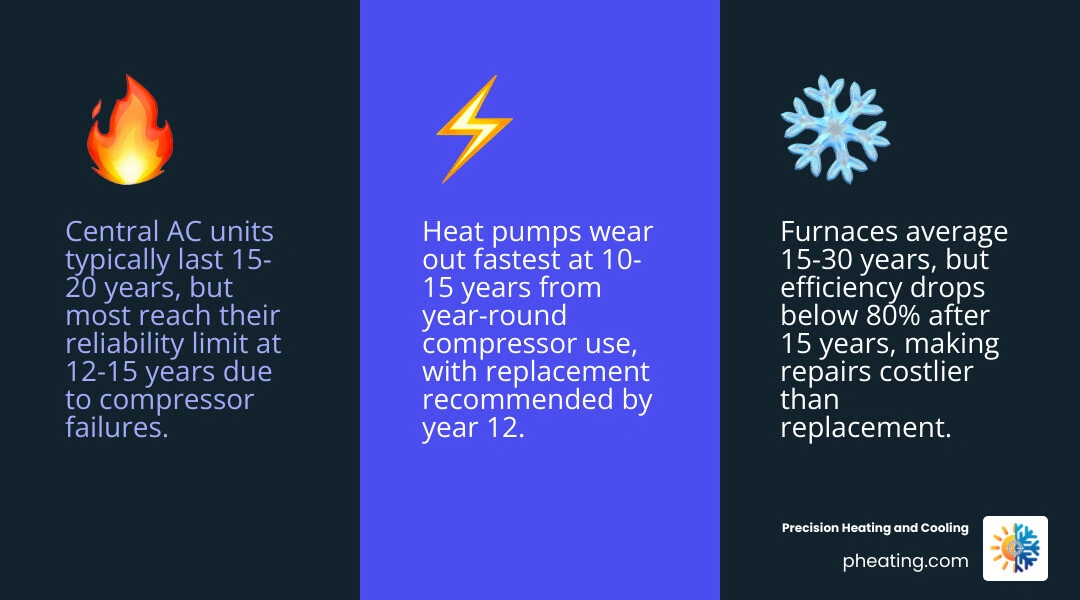
When we talk about the longevity of your heating and cooling equipment, we usually look at three different numbers: the design life, the expected life, and the average service life. The "design life" is what the engineers intended in a perfect world (often 20–25 years), while the "expected life" is what you can realistically hope for with decent care. However, the median service life for many residential air conditioners is actually closer to 12–15 years.
Determining how old is too old for an HVAC system isn't just about the year it was manufactured; it’s about the "reliability inflection point." Around year 12, the risk of a major component failure—like a compressor or a blower motor—skyrockets. By this time, most central air systems are operating at only 80–85% of their original efficiency. If you find yourself on a first-name basis with your repair technician, your system has likely crossed the threshold from "reliable asset" to "financial liability." For expert guidance on your specific unit, our HVAC Service can provide a comprehensive health check.
In the San Jose Bay Area and Silicon Valley, our climate is relatively mild compared to the extreme humidity of the East Coast or the blistering heat of the desert. This can be a double-edged sword. While our systems don't have to work as hard during "shoulder seasons," the long, dry summers still put significant strain on cooling components.
Furthermore, if you live in coastal areas like Palo Alto or parts of Santa Clara, salt air can accelerate corrosion on your outdoor condenser coils. In coastal or highly humid environments, an AC’s lifespan can drop to as little as 8–14 years due to this "formarytic corrosion." If you aren't staying on top of AC Maintenance Santa Clara CA, the dust and salt can choke your system, making it "old" well before its 15th birthday.
One of the most objective ways to decide if a system is "too old" is to look at the type of refrigerant it uses. If your AC was installed before 2010, there is a high probability it uses R-22 (often called Freon). As of January 1, 2020, the EPA officially banned the production and import of R-22. This means that if an older unit develops a leak, the cost to recharge it is astronomical because the supply is finite.
Even the current standard, R-410A, is undergoing a phasedown as of 2026. This is driving up the cost of repairs for middle-aged systems. If you have an R-22 system that needs a major repair, we almost always recommend replacement. Investing thousands into a refrigerant that is being phased out is like trying to find leaded gasoline for an old car—it’s a losing game. Keeping your system modern with a Heat Pump Tune-up Cupertino CA ensures you stay ahead of these environmental regulations.
Age is just a number, but performance is a reality. If you aren't sure how old is too old for an HVAC system in your specific case, look for these five warning signs:
While a failing AC is an inconvenience, a failing furnace can be a genuine safety hazard. Gas furnaces are the "marathon runners" of the HVAC world, often lasting 20 years or more, but they aren't invincible. The primary concern with an aging furnace is a cracked heat exchanger.
Over decades of heating and cooling, the metal in the heat exchanger expands and contracts. Eventually, stress cracks can form, allowing carbon monoxide to leak into your home’s air supply. If you notice a yellow, flickering burner flame (instead of a crisp blue one) or soot buildup around the registers, shut the system down immediately. Regular Furnace Maintenance Palo Alto CA is essential for catching these "silent killer" issues before they become emergencies.
By the time an AC unit hits the 12-year mark, it has typically completed over 4,000 full cooling cycles. This mechanical wear leads to "efficiency slippage." A unit that was rated at 13 SEER (Seasonal Energy Efficiency Ratio) at the time of installation may only be functioning at a 9 or 10 SEER level today due to dirty coils, worn compressors, and leaky ductwork.
In fact, leaky or poorly installed ducts can waste 20% to 30% of a system’s energy regardless of the unit's age. When you combine duct loss with a 15-year-old compressor, you are essentially paying for comfort you aren't receiving. Scheduling a professional HVAC Tune-up San Jose CA can help identify exactly how much energy your aging system is wasting.
We know that choosing to replace a system is a big decision. To take the emotion out of it, we use two industry-standard mathematical formulas to determine if your unit is "too old."
The $5,000 Rule:Multiply the age of your system by the cost of the repair. If the result is more than $5,000, you should replace the unit.Example: A 12-year-old system needs a $500 repair. 12 x 500 = 6,000. Since 6,000 is greater than 5,000, replacement is the better investment.
The 50% Rule:If the cost of a single repair is 50% or more of the value of a new system (including installation), it is time to upgrade. Patching a "sinking ship" only delays the inevitable and costs you more in the long run.
Following an HVAC Maintenance Plan San Jose CA can help you avoid these high-cost repair scenarios by catching small issues before they trigger the $5,000 rule.
If you decide your system is indeed "too old," the good news is that modern technology has come a long way in the last 15 years. Today’s entry-level units must meet SEER2 standards, which are significantly stricter than the ratings of the early 2010s.
Upgrading to a new system offers:
If your heating system is struggling, our Furnace Service Los Gatos CA can help you transition to a modern, high-efficiency unit.
Not sure when your system was installed? You don't have to guess. Every HVAC unit carries its "birth certificate" on its sleeve—the manufacturer's nameplate. This is usually a metal or plastic sticker located on the outdoor condenser or the indoor furnace cabinet.
To find the age:
If your nameplate is faded or missing, a professional Furnace Tune-up Los Gatos CA can help identify the equipment and its approximate age.
The answer to how old is too old for an HVAC system depends heavily on how it was treated. We have seen well-maintained 20-year-old furnaces that run like new, and neglected 8-year-old AC units that are ready for the scrap heap.
Maintenance is the single most important factor in extending your system's life. Regular tasks like:
A well-maintained system can last 20% to 30% longer than a neglected one. Our HVAC Maintenance Santa Clara CA service is designed to keep your equipment running at peak performance for as many years as possible.
While it is rare, it is possible for high-quality gas furnaces or cast-iron boilers to last 30 years if they receive meticulous annual maintenance and live in a mild climate. However, even if it can run for 30 years, it usually isn't economical. A 30-year-old furnace likely operates at only 60–70% efficiency, meaning you are essentially throwing away 30 cents of every dollar you spend on gas.
Generally, no. A central AC only runs during the summer. A heat pump, however, provides both heating and cooling, meaning it works year-round. Because the compressor accumulates double the run-hours, a heat pump's lifespan is typically 25–30% shorter than a dedicated AC, usually landing between 10 and 15 years.
If your system is over 12 years old, you should schedule a professional inspection annually. The best time is during the "shoulder seasons"—spring for your AC and fall for your furnace. This allows you to catch potential failures before the peak demand of July or January, when technician schedules are packed and parts may be backordered.
Determining how old is too old for an HVAC system is about balancing comfort, safety, and your checkbook. While we all want our appliances to last forever, there comes a point where an old unit becomes a "financial drain" rather than a cost-saving measure. Whether you are living in Cupertino, Los Gatos, or Palo Alto, staying proactive about your home's climate control is the best way to avoid a mid-summer disaster.
At Precision Heating and Cooling, we bring over two decades of experience to the San Jose Bay Area and Central Valley. We pride ourselves on providing reliable service, competitive pricing, and flexible payment options to ensure your home remains a sanctuary of comfort. Don't wait until your system stops working—schedule your HVAC Service today for a professional evaluation and peace of mind.

Leslie was amazing for her outstanding customer service skills with me the other day. Thanks to her help my air conditioner is now all set up. She answered all my questions and took away all my problems. Leslie broke it down step by step to set it up easier. Now thanks to her my air conditioner is working perfectly. I really appreciate it Leslie and I’ll be sure to ask for you if I ever come back.
I contacted Precision Heating and Cooling for my home's AC repair. They were punctual and very professional. Guillermo was very kind and thorough. I would highly recommend them!
I am writing to express my sincere appreciation for the excellent work performed by Pablo and Alejandro from Precision Heating and Cooling. Their commitment to quality and customer satisfaction is truly commendable. Awesome job guys!
I would like to extend my sincere gratitude to Alejandro for his exceptional hard work. His passion for helping others is evident, and he consistently goes above and beyond in his service. Alejandro's thorough cleaning of my fireplace has truly made a significant difference. His dedication and professionalism are greatly appreciated.
I was very impressed. Came at night (after 9pm) to fix our AC during the middle of a heat wave the day before a national holiday! Technician was very courteous and efficient, got the job done quickly. Will definitely call them again for any AC servicing I need!
Fast and efficient, arrived when scheduled for repairs and replacement parts were ordered and installed quickly. Techs were very friendly and professional. AC system works great now! I highly recommend their services if you need repairs. Tim



.avif)
