


.avif)






Recent Blogs
Stay updated with our latest blog posts.


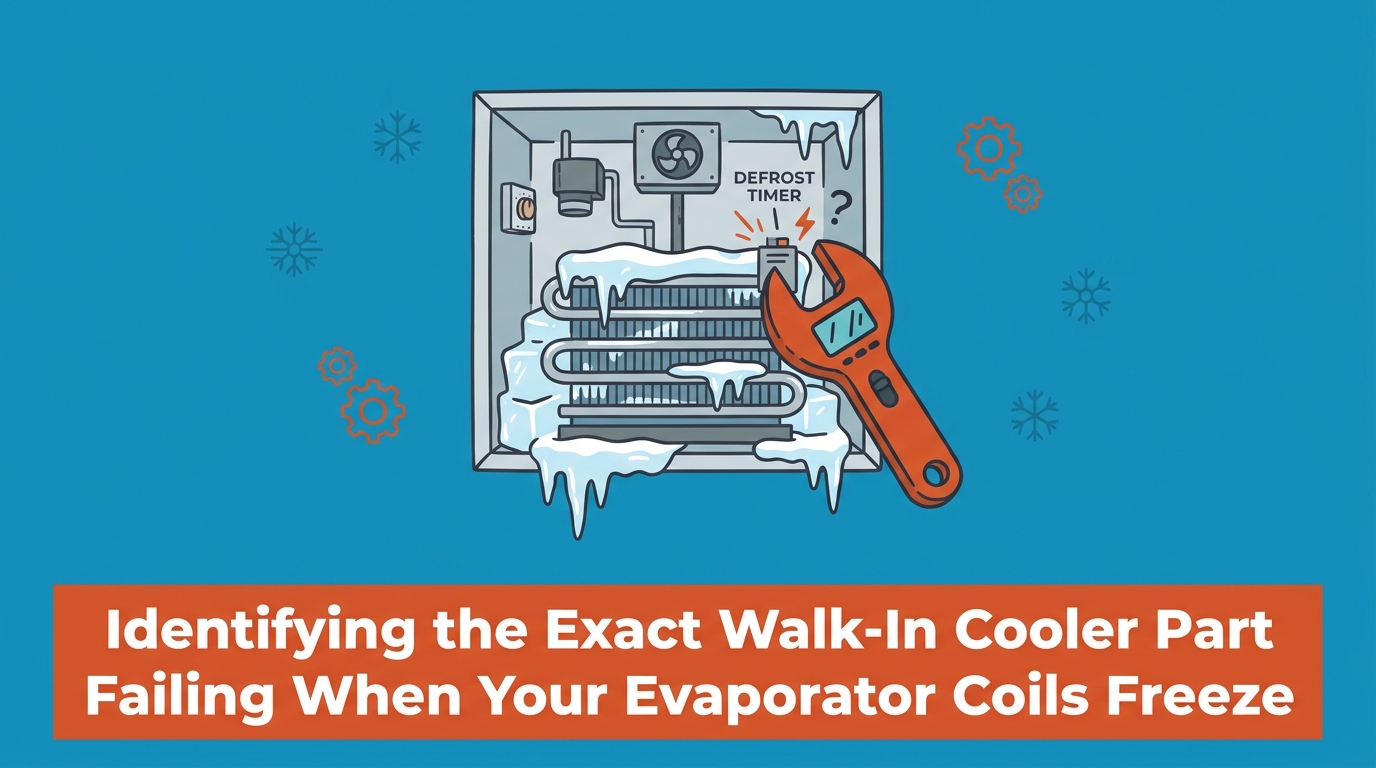
You pull open the heavy door to your restaurant's walk-in cooler during a July peak summer heatwave, expecting a blast of frigid air. Instead, the temperature feels suspiciously mild, and a quick glance upward reveals a nightmare: the evaporator coils are completely encased in a solid block of ice. Identifying the exact walk-in cooler part failing when your evaporator coils freeze is the first crucial step in preventing massive inventory loss. While panic is a completely natural reaction when thousands of dollars of perishable goods are on the line, knowing exactly what you are looking at helps you communicate the crisis effectively to emergency technicians.
For urgent issues with your commercial refrigeration system, reaching out for professional help immediately is the safest move.
The immediate crisis of a frozen coil is that your system can no longer absorb heat. The ice acts as a thick layer of insulation, trapping the cold inside the metal tubing and preventing it from cooling the ambient air in your walk-in box. The compressor continues to run, burning excess energy, while your food slowly warms to unsafe temperatures.
The two most common failures under heavy summer loads trace back to either airflow issues or defrost cycle malfunctions. When a walk-in cooler is pushed to its absolute limits, these mechanical components bear the brunt of the stress. Setting the expectation early is critical: understanding these parts prevents catastrophic DIY mistakes while you wait for professional help to arrive. You do not need to fix the cooler yourself, but you do need to know how to accurately report the symptoms.
To accurately diagnose what is going wrong, you first need a basic understanding of the specific parts of a walk in cooler that manage temperature and moisture. A commercial walk-in cooler operates through a delicate, continuous balance of cooling and defrosting. When these components fail under pressure, commercial repair calls surge as businesses race to save their stock.
San Jose's continuous peak summer heat puts extreme, unrelenting loads on commercial refrigeration. Every time an employee opens the cooler door, a wave of hot, humid ambient air rushes into the cold box. This forces the system to run almost continuously, exponentially accelerating the rate at which coils freeze when a component weakens.
The baseline function of evaporator coils is to naturally operate below freezing. Cold liquid refrigerant flows through the copper tubing inside the coils. As the relatively warmer air from your cooler box blows across these tubes, the refrigerant absorbs the heat and boils into a gas. Because the surface of the coil is below freezing, any humidity in the air naturally condenses and freezes on the metal fins. This is a normal part of the refrigeration process.
Under normal conditions, a walk-in cooler handles this frost through a structured defrost cycle. However, extreme summer loads leave almost no natural downtime for ice to melt. High ambient humidity and frequent door openings introduce massive amounts of moisture. Without the right mechanical interventions, that moisture quickly compounds into a solid block of ice.
Here is a step-by-step breakdown of the components that regulate this balance:
1. The Evaporator Coil: The primary heat exchanger where cold refrigerant absorbs heat from the cooler box.
2. The Evaporator Fan Motor: The blower that forces warm box air over the cold coils, facilitating heat transfer and preventing localized freezing.
3. The Defrost Timer: The mechanical or digital clock that periodically shuts off the cooling cycle and initiates the heating phase.
4. The Defrost Heater: The electrical element that actively melts the accumulated frost off the coils during the defrost cycle.
5. The Defrost Termination Switch: A temperature sensor that tells the system when the ice has melted so it can safely resume cooling.
When a walk-in cooler freezes into a solid, uniform block of ice, the defrost cycle is usually the primary suspect. A walk-in cooler cannot operate indefinitely without pausing to melt the frost that naturally accumulates on its coils.
The defrost timer acts as the brain of the defrost cycle. Depending on the specific system, this timer is programmed to shut down the compressor and turn on the defrost heater for a set duration (typically 20 to 45 minutes) several times a day. This regulates the crucial cooling-to-defrost ratio. However, mechanical timer motors are prone to wear and tear, especially after years of continuous operation.
If the timer motor burns out and gets stuck in the "cooling" position, the system will run endlessly. The frost will build up indefinitely until airflow is completely choked off. Conversely, if the timer gets stuck in the "defrost" position, the cooler will stop cooling entirely and the internal temperature of the box will rise rapidly.
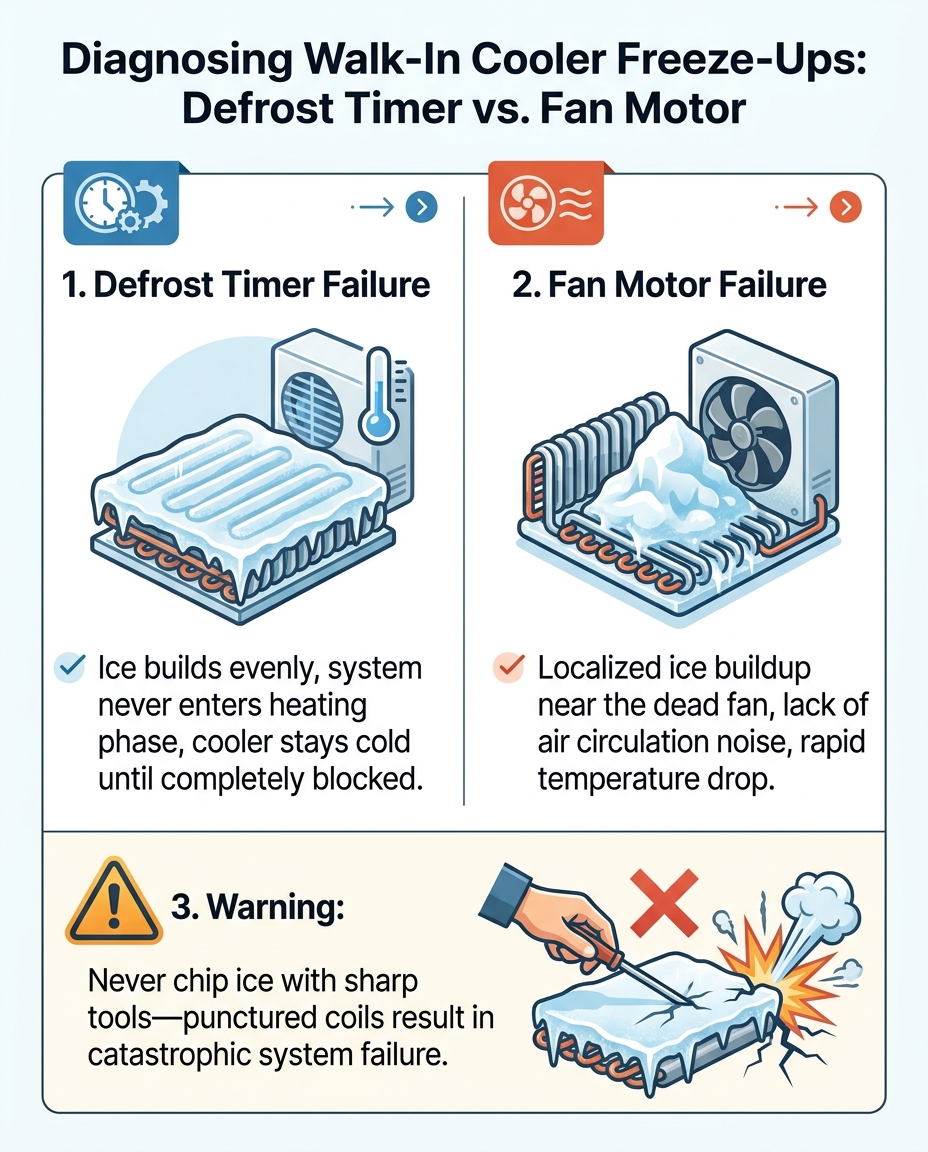
Identifying a defrost failure comes down to observing the pattern of the ice. When a defrost timer or defrost heater fails, you will typically see ice building up evenly across the entire surface of the evaporator coil. The system will sound like it is running continuously, but it never enters that quiet, distinct heating phase.
• Thick, even ice block across the entire coil face. — Probable Defrost Cause: Defrost timer stuck in cooling mode. — Professional Solution: Technician replaces the mechanical timer or control board.
• Timer advances, but ice still builds evenly. — Probable Defrost Cause: Burned out defrost heater element. — Professional Solution: Electrical testing and replacement of the heating element.
• System runs, but the defrost cycle never ends (box gets warm). — Probable Defrost Cause: Defrost termination switch failure. — Professional Solution: Technician replaces the faulty temperature sensor.
While the defrost cycle is critical, continuous airflow is equally vital to keeping your walk-in cooler ice-free. The evaporator fan motor bears the brunt of continuous operation during heatwaves and is a highly common point of failure.
During a recent summer heatwave, one commercial building manager noticed their HVAC and refrigeration systems struggling to maintain temperature. They reached out for help, and a technician provided fast, reliable, and knowledgeable service to get the commercial building's systems back on track. In many of these urgent, high-stress scenarios, a dead evaporator fan motor is the primary culprit behind the rapid temperature drop.
The physics of heat exchange rely entirely on continuous air movement. The evaporator fan motor forces relatively warm air from the walk-in box over the freezing cold coils. This constant flow of warmer air actually prevents the natural condensation on the coils from freezing solid during the cooling cycle.
If the fan motor dies, the compressor continues to pump liquid refrigerant into the coils. Because there is no warm air blowing across the metal to absorb the cold, the temperature of the coil drops rapidly. Any ambient moisture in the stagnant air instantly freezes to the fins. It is also worth noting that boxes stacked too high—blocking the fan grilles—can perfectly mimic a fan motor failure by choking off the airflow.
Contrasting a dead fan motor with a defrost timer failure is relatively straightforward. You can often identify a dead fan motor by listening for the distinct absence of fan noise inside the cooler. Instead of the loud, rushing sound of moving air, you might only hear a low hum. Furthermore, the ice formation will look different. Instead of a uniform block of ice, you will typically see localized freezing starting immediately nearest the dead fan blade.

If the fans are spinning and the defrost cycle is advancing, there are secondary reasons for coil freeze-ups that require a comprehensive educational overview. These issues are deeply technical and absolutely require a licensed professional to safely diagnose.
The relationship between pressure and temperature in refrigeration is absolute. If your system is low on refrigerant, it means there is a leak somewhere in the copper lines. When refrigerant levels drop, the pressure inside the evaporator coil also drops. Lower pressure forces the remaining refrigerant to boil at an abnormally low temperature.
This ultra-low temperature causes the coil to freeze over rapidly, even if the fans are working perfectly. Adding refrigerant without finding and fixing the leak is a temporary, non-compliant fix that will inevitably lead to another freeze-up. A licensed technician must use electronic leak detection equipment to find the source of the pressure drop.
A malfunctioning thermostat can also force the compressor to run continuously, overriding the system's natural off-cycles. If the faulty temperature sensor misreads the cooler's environment—believing the box is 50 degrees when it is actually 35 degrees—it will never tell the compressor to shut off. This continuous compressor operation eventually overwhelms the defrost cycle, leading to a massive buildup of ice.
When you walk into a freezing cooler full of thawing inventory, the temptation to take matters into your own hands is immense. However, dangerous DIY fixes frequently lead to severe consequences for San Jose commercial facilities.
The temptation: Facility managers often grab knives, screwdrivers, or hammers to chip away the ice, hoping to clear the airflow and save their inventory.
The reality: Local technicians frequently respond to calls where a minor component failure was turned into a complete, system-destroying coil replacement due to impatient DIY ice chipping.
Evaporator coils are incredibly fragile. They are constructed of thin aluminum fins pressed over soft copper tubing. A single slip of a screwdriver will easily puncture the pressurized copper line. If this happens, all the refrigerant will instantly vent into the walk-in cooler and out into the atmosphere.
Not only does this turn a simple timer replacement into a massive, multi-day repair involving welding, pressure testing, and pulling a vacuum on the system, but it also triggers strict EPA regulations regarding accidental refrigerant release. The environmental and legal consequences are simply not worth the risk.
The safe way to handle a freeze-up: Turn off the cooling cycle at the thermostat or breaker. If the evaporator fans are still operational, leave them running to circulate ambient air and naturally melt the ice. Move your most critical inventory to backup refrigeration, and wait for professional diagnostic tools to arrive.
Mechanical wear on defrost timers, fan motors, and electrical contactors is inevitable in commercial environments. However, sudden, catastrophic failure during a heatwave is almost entirely preventable through routine care.
Establishing a proactive relationship with a commercial HVAC provider ensures that your equipment is ready to handle the extreme stress of summer loads. Pre-summer inspections are the most effective way to catch failing components before they cause an emergency.
A comprehensive preventative approach includes:
• Testing fan motor amperage: Technicians can measure the electrical draw of the fan motors. A motor drawing too much power is struggling and likely to fail soon.
• Verifying defrost timer sequencing: Manually advancing the defrost timer ensures the mechanical gears are not binding and the heater engages properly.
• Cleaning evaporator and condenser coils: Keeping coils professionally cleaned reduces the baseline stress on the entire refrigeration system, allowing it to cool faster and rest longer.
• Checking door gaskets: Ensuring a tight seal prevents excess ambient humidity from entering the box and accelerating frost buildup.
By scheduling routine refrigeration maintenance, you take the guesswork out of your equipment's reliability and protect your valuable inventory from unexpected breakdowns.
The defrost cycle is primarily controlled by the defrost timer, the defrost heater, and the defrost termination switch. The timer acts as the clock, telling the system when to stop cooling and start heating. The heater melts the accumulated ice off the coils, while the termination switch senses when the ice is gone and signals the system to resume normal cooling.
Summer heatwaves place immense stress on your refrigeration system, forcing it to run almost continuously. High ambient humidity and frequent door openings introduce excess moisture into the cooler, which quickly condenses and freezes on the coils. If a mechanical part like a fan motor or defrost timer weakens under this heavy load, the system cannot clear the frost fast enough, resulting in a solid block of ice.
When a mechanical defrost timer fails, it typically gets stuck in either the cooling or the defrost mode. If it sticks in cooling mode, the compressor runs endlessly, and ice builds up uniformly across the evaporator coil until airflow is completely blocked. If it sticks in defrost mode, the system never turns the compressor back on, causing the walk-in cooler to become dangerously warm.
The safest way to unfreeze a walk-in cooler coil is to turn off the cooling cycle (shutting down the compressor) while leaving the evaporator fans running to circulate ambient air. You can also use a fan blowing room-temperature air into the open cooler to speed up the melting process. Never use sharp tools, ice picks, or hammers to chip the ice, as this easily punctures the fragile copper coils and causes severe refrigerant leaks.
In almost all commercial refrigeration scenarios, a broken evaporator fan motor must be completely replaced rather than repaired. Once the internal electrical windings burn out or the internal bearings seize from constant use, the motor cannot be salvaged. Swapping out the dead motor for a new, properly rated OEM part is the only reliable way to restore safe airflow.
Yes, low refrigerant is a very common cause of evaporator coil freeze-ups. When refrigerant leaks out of the system, the internal pressure of the remaining fluid drops significantly. This pressure drop forces the refrigerant to boil at an abnormally low temperature, which rapidly freezes any ambient moisture touching the exterior of the coil, even if the fans and defrost cycle are working perfectly.
Understanding the exact parts of a walk-in cooler responsible for freeze-ups empowers you to make smart, safe decisions when emergencies strike. By recognizing the symptoms of a failing defrost timer or a dead fan motor, you can provide valuable information to your technician, avoid dangerous DIY mistakes, and ensure your system is repaired swiftly and safely by a licensed professional.

Leslie was amazing for her outstanding customer service skills with me the other day. Thanks to her help my air conditioner is now all set up. She answered all my questions and took away all my problems. Leslie broke it down step by step to set it up easier. Now thanks to her my air conditioner is working perfectly. I really appreciate it Leslie and I’ll be sure to ask for you if I ever come back.
I contacted Precision Heating and Cooling for my home's AC repair. They were punctual and very professional. Guillermo was very kind and thorough. I would highly recommend them!
I am writing to express my sincere appreciation for the excellent work performed by Pablo and Alejandro from Precision Heating and Cooling. Their commitment to quality and customer satisfaction is truly commendable. Awesome job guys!
I would like to extend my sincere gratitude to Alejandro for his exceptional hard work. His passion for helping others is evident, and he consistently goes above and beyond in his service. Alejandro's thorough cleaning of my fireplace has truly made a significant difference. His dedication and professionalism are greatly appreciated.
I was very impressed. Came at night (after 9pm) to fix our AC during the middle of a heat wave the day before a national holiday! Technician was very courteous and efficient, got the job done quickly. Will definitely call them again for any AC servicing I need!
Fast and efficient, arrived when scheduled for repairs and replacement parts were ordered and installed quickly. Techs were very friendly and professional. AC system works great now! I highly recommend their services if you need repairs. Tim


.avif)
