


.avif)





Recent Blogs
Stay updated with our latest blog posts.


Navigating Title 24 requirements for new hot water tank installations in Santa Clara County is usually the last thing on your mind when your system fails during peak summer demand. In our two decades of serving San Jose homeowners, we know that turning on the faucet expecting a warm shower, only to be greeted by an icy blast, is incredibly frustrating. The immediate stress is real, especially when household water usage is high and you just want the problem fixed quickly. However, replacing a failing unit is no longer a simple, afternoon appliance swap. Today, upgrading your water heating system requires strict adherence to complex local building codes, safety regulations, and heavily enforced statewide energy mandates. Understanding these Santa Clara County permit requirements is the critical first step before you even begin contacting contractors. Working with our seasoned professionals for HVAC and home comfort services ensures your hot water tank installation is done safely, legally, and without the nightmare of a failed municipal inspection.
Our technicians often hear from homeowners who mistakenly believe that because the plumbing and gas lines are already in place, dropping a new tank into the garage or utility closet is a minor task. The reality we navigate every day is that building codes evolve constantly. A water heater installed just ten years ago was subject to vastly different regulations than a unit installed today. When your old system gives out, our team must bring the new installation entirely up to current code. This means addressing ventilation, seismic safety, and energy efficiency standards that may not have existed during the last installation.
Attempting to bypass these rules to save time during a peak summer breakdown often leads to severe consequences. We have seen unpermitted work result in hefty fines, voided manufacturer warranties, and significant roadblocks when homeowners decide to sell. Taking the time to understand the local regulatory landscape ensures your home remains safe and compliant.
If you are planning an upgrade with our team, you will inevitably hear us mention Title 24 Energy Efficiency Standards. In plain English, Title 24 is a comprehensive set of building energy efficiency standards mandated by the California Energy Commission (CEC). These rules are designed to reduce wasteful energy consumption across the state, lower greenhouse gas emissions, and ensure that buildings remain comfortable and cost-effective to operate.
You might wonder why a statewide energy rule applies so strictly to a single residential water heater replacement. While San Jose and the surrounding areas enjoy a relatively mild climate, at Precision Heating & Cooling, we see firsthand how statewide energy grid stress during peak San Jose summers makes strict adherence to Title 24 efficiency standards a critical regulatory priority. When millions of homes run air conditioners and water heaters simultaneously, the power grid faces immense strain. Title 24 ensures that every new appliance installed draws as little power or fuel as possible, collectively preventing rolling blackouts and grid failures when cooling demands are at their highest.
A common misconception we encounter is that Title 24 only applies to brand-new housing developments or major home additions. This is incorrect. The standards apply directly to residential hot water tank replacements in existing homes. Anytime a major energy-consuming appliance is permanently installed, it must meet the current efficiency baseline.
• Energy Efficiency Thresholds: Your new unit must meet specific performance ratings to be legally installed.
• System Documentation: Contractors must file specific Title 24 compliance forms with the city or county.
• Incentive Opportunities: Upgrading to a highly efficient unit required by these standards often qualifies homeowners for generic energy rebates or federal tax credits. We always advise our customers to consult their local utility provider or a tax professional to verify which current programs apply to their upgrade.
Understanding these mandates is essential for planning an affordable water heater installation in Santa Clara, as compliant units ultimately save you money on monthly utility bills.
Our permit specialists handle local regulations daily, and we can assure you that in San Jose and Santa Clara County, pulling a building permit for a water heater replacement is not optional—it is a strict legal requirement. The local building department uses the permitting process to ensure that all installations meet safety codes, protecting your property from fire hazards, carbon monoxide leaks, and severe water damage.
Skipping the permit process might seem like a shortcut, but it carries heavy long-term risks. If a poorly installed, unpermitted water heater causes a fire or floods your home, your homeowners insurance provider may deny the claim. Furthermore, we frequently see unpermitted work become a massive red flag during real estate transactions. When a buyer's inspector discovers an illegal installation, you will likely be forced to pull a retroactive permit, pay penalty fees, and hire a contractor to tear out and redo the work before the sale can close.
Navigating the local building department requires following a specific sequence of events, which is why our professional contractors handle the paperwork on your behalf.
1. Permit Application: We submit the technical specifications of the new water heater, along with Title 24 compliance forms, to the Santa Clara County Building Department.
2. Installation and Code Upgrades: The old unit is removed, and our installers fit the new unit along with necessary code upgrades, such as new gas valves, thermal expansion tanks, and dedicated venting.
3. The Final Inspection: Once the work is complete, a county inspector visits your home. They will check the gas line connections, the venting draft, the seismic strapping, and the overall compliance with Title 24.
4. Sign-Off: If the installation passes, the permit is officially closed, and a record of the legal, safe installation is attached to your property's history.
Because of the technical knowledge required to pass this inspection, pulling permits and installing gas appliances is never a recommended DIY task. Our licensed professionals understand exactly what local inspectors look for.
Living in San Jose and Santa Clara County means living in an active seismic zone. Our installation crews are rigorously trained to secure these systems because, during an earthquake, a standard 50-gallon water heater weighing over 400 pounds can easily tip over. If this happens, the gas line can rupture, creating an immediate and catastrophic fire hazard, while broken water lines can flood your garage or basement.
To prevent these disasters, the California Plumbing Code mandates strict seismic strapping for all hot water tanks. The code explicitly requires heavy-duty bracing located in the upper and lower one-third of the tank.
• Upper Strap: Must be placed within the top one-third of the tank's height to prevent the unit from tipping forward.
• Lower Strap: Must be placed within the bottom one-third of the tank, but at least four inches above the gas controls, to prevent the base from kicking out during violent shaking.
Improper seismic strapping is one of the most common reasons we see DIYers fail their local permit inspections. You cannot simply wrap a flimsy piece of metal around the tank and call it a day. The state requires specific, heavy-gauge galvanized steel straps. Furthermore, these straps must be anchored directly into the structural wall studs using heavy-duty lag screws. Anchoring into drywall or using inadequate hardware will result in an immediate inspection failure. We strongly advise against DIY strapping attempts, as the precise tension, hardware selection, and wall anchoring techniques are legally required and closely scrutinized by county inspectors.
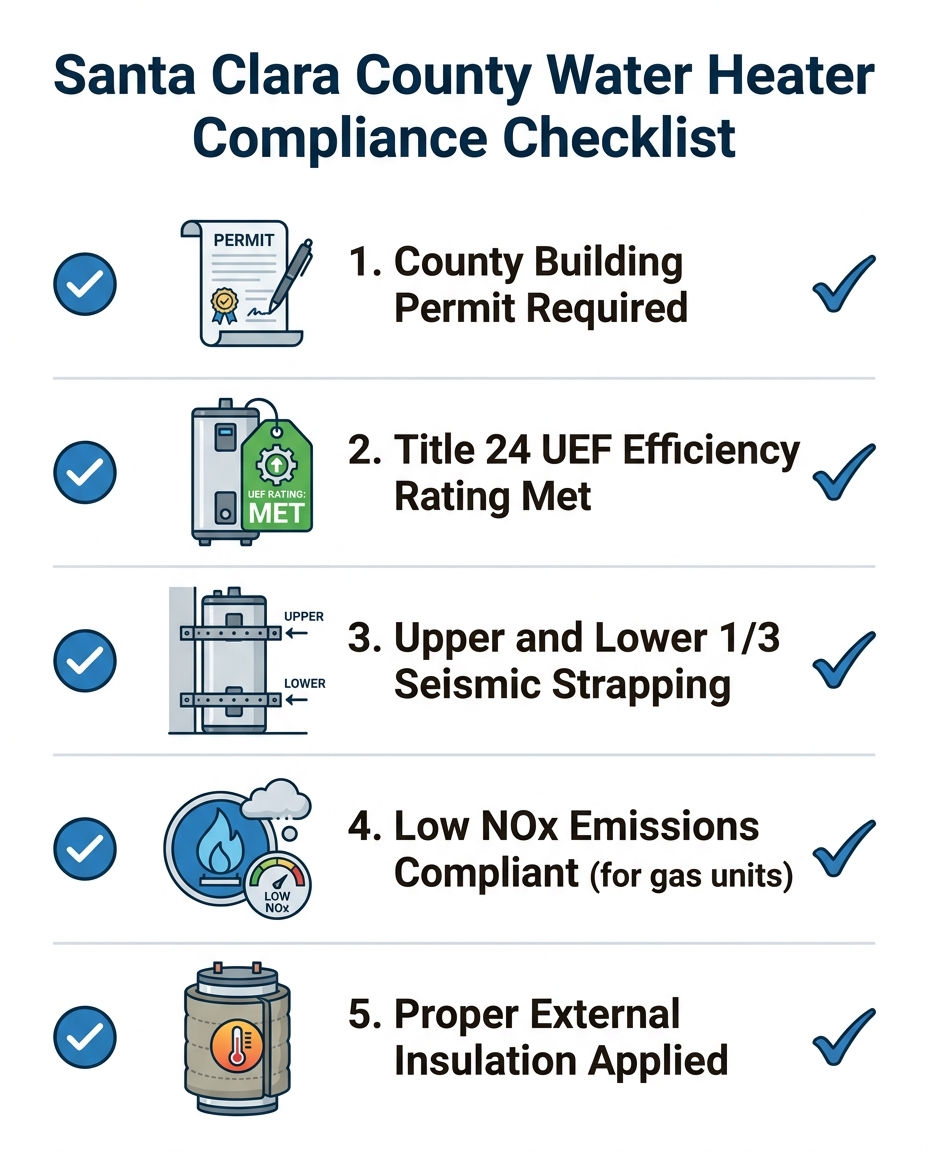

To comply with Title 24 Energy Efficiency Standards, your new water heater must meet specific performance metrics. The most important metric inspectors look for is the Uniform Energy Factor, or UEF. When our team helps you select a new unit, translating these dense energy efficiency metrics into understandable concepts is a vital part of the process.
The UEF is a standardized measurement of a water heater's overall efficiency. It calculates how much of the energy consumed by the unit is actually converted into hot water versus how much is wasted. A higher UEF rating indicates a more efficient unit. Santa Clara County inspectors will check the manufacturer's label on your new tank to verify that its UEF meets the strict minimums required by Title 24 for its specific size and fuel type. Installing a unit with a sub-standard UEF will result in an inspection failure and require the removal of the non-compliant tank.
For traditional storage tank water heaters, Title 24 often mandates specific external insulation requirements, commonly referred to as R-value mandates. Even when you are not actively using hot water, the heated water sitting inside the tank slowly loses its temperature to the surrounding air—a process known as standby heat loss.
To combat this, the state requires tanks to be heavily insulated. If the internal insulation of the manufactured tank does not meet the required R-value, our installers will properly fit and secure an external insulation blanket. This insulation prevents standby heat loss, drastically reducing the amount of energy the burner or heating elements must use to keep the water hot, ultimately saving energy over the unit's lifespan.
• UEF Rating — What It Measures: Overall energy conversion efficiency. — Why Inspectors Check It: Ensures the unit meets the state's minimum energy conservation baseline.
• R-Value — What It Measures: Thermal resistance of the tank's insulation. — Why Inspectors Check It: Verifies the tank minimizes standby heat loss when not in active use.
• First Hour Rating — What It Measures: Amount of hot water delivered in the first hour of use. — Why Inspectors Check It: Ensures the unit is appropriately sized for the home's plumbing demands.
Investing in fully compliant, high-UEF units often requires a slightly higher upfront investment than older, inefficient models. Fortunately, this transition can be made much easier by exploring flexible financing options for new water heaters, allowing you to spread the cost of a premium, code-compliant system over time.
If you are replacing a gas-powered water heater in San Jose and Santa Clara County, our team must also help you navigate strict regional air quality regulations. The Bay Area Air Quality Management District (BAAQMD) enforces rules that go beyond standard plumbing codes, specifically targeting the airborne emissions produced by gas appliances.
When natural gas burns at high temperatures, it produces Nitrogen Oxides, commonly referred to as NOx. These gases react with sunlight to create smog and poor air quality, which can aggravate respiratory conditions. To combat regional air pollution, local air quality management district rules explicitly prohibit the sale and installation of standard gas water heaters.
Any gas water heater installed in Santa Clara County must be certified as "Ultra-Low NOx." These specialized units are engineered with advanced burner designs that burn gas at lower temperatures, drastically reducing the amount of nitrogen oxide released into the atmosphere.
The compliance check: When Precision Heating & Cooling sources your new tank, we ensure the unit features an Ultra-Low NOx certification sticker. During the final permit inspection, the county inspector will look specifically for this label. If a homeowner attempts to install a standard gas water heater purchased out of state or from a non-compliant vendor, it will fail inspection immediately, and they will be forced to replace it.
Managing the complex web of local permits, Title 24 paperwork, seismic strapping codes, and emissions standards on your own is an overwhelming burden. We've seen simple replacement projects quickly spiral into stressful ordeals of delayed inspections, failed code checks, and escalating costs when homeowners try to go it alone.
This is where hiring a dedicated local expert changes the entire experience. Leveraging Precision Heating & Cooling's 20 years of local experience ensures a completely hassle-free, code-compliant installation process. Our company acts as your turnkey compliance manager, handling all local permitting and Title 24 regulations for you. From sourcing the exact Ultra-Low NOx unit required by the Bay Area air district to securing the heavy-duty seismic strapping into your wall studs, we manage every detail professionally.
Hiring our experts ensures the right equipment is selected and installed to code the very first time. Furthermore, a professional installation does not end when the inspector signs off on the permit. It includes setting up ongoing water heater maintenance to keep your fully compliant, high-efficiency unit running safely and efficiently for years to come. By trusting a local authority, you eliminate the stress of regulatory red tape and secure a reliable supply of hot water for your home.
Yes, a building permit is legally required for all water heater replacements in Santa Clara County. The permit process ensures that the installation meets current safety, seismic, and energy codes. Skipping the permit can lead to fines, voided warranties, and significant complications when attempting to sell your home.
Title 24 requirements mandate that new water heaters meet strict energy efficiency standards to reduce statewide power grid strain, particularly during peak summer cooling months. This includes meeting specific Uniform Energy Factor (UEF) ratings and, in some cases, applying external insulation to prevent standby heat loss. Your contractor must submit compliance paperwork to the county to verify the unit meets these state mandates.
The California Plumbing Code requires a minimum of two heavy-duty seismic straps for standard residential water heaters. One strap must be securely anchored in the upper one-third of the tank, and the second strap must be anchored in the lower one-third of the tank. Both straps must be secured directly into the structural wall studs.
While a highly skilled homeowner might physically connect a tank, our team strongly advises against it due to complex gas, venting, and seismic regulations. Pulling the necessary permits and passing the strict local inspections require deep knowledge of current building codes. Mistakes in gas line connections or improper venting can create severe fire and carbon monoxide hazards.
If your installation fails the county inspection, the inspector will issue a correction notice detailing the code violations. You or your contractor must fix the specific issues—such as improper seismic strapping, lack of Title 24 documentation, or non-compliant venting—and schedule a re-inspection. Working with our licensed professionals from the start usually prevents these costly delays.

Leslie was amazing for her outstanding customer service skills with me the other day. Thanks to her help my air conditioner is now all set up. She answered all my questions and took away all my problems. Leslie broke it down step by step to set it up easier. Now thanks to her my air conditioner is working perfectly. I really appreciate it Leslie and I’ll be sure to ask for you if I ever come back.
I contacted Precision Heating and Cooling for my home's AC repair. They were punctual and very professional. Guillermo was very kind and thorough. I would highly recommend them!
I am writing to express my sincere appreciation for the excellent work performed by Pablo and Alejandro from Precision Heating and Cooling. Their commitment to quality and customer satisfaction is truly commendable. Awesome job guys!
I would like to extend my sincere gratitude to Alejandro for his exceptional hard work. His passion for helping others is evident, and he consistently goes above and beyond in his service. Alejandro's thorough cleaning of my fireplace has truly made a significant difference. His dedication and professionalism are greatly appreciated.
I was very impressed. Came at night (after 9pm) to fix our AC during the middle of a heat wave the day before a national holiday! Technician was very courteous and efficient, got the job done quickly. Will definitely call them again for any AC servicing I need!
Fast and efficient, arrived when scheduled for repairs and replacement parts were ordered and installed quickly. Techs were very friendly and professional. AC system works great now! I highly recommend their services if you need repairs. Tim


.avif)
