


.avif)






Recent Blogs
Stay updated with our latest blog posts.


For our team at Precision Heating & Cooling, August marks the frantic start of the back-to-school season across the South Bay Area, bringing new schedules, early mornings, and endless to-do lists. In the middle of this transition, scheduling a Pre-School Year HVAC Check: Why August is the Time to Change Heavily Soiled Filters is one of the most critical steps you can take for your family's comfort. Your air conditioner has been running non-stop for months, pulling massive amounts of airborne debris into your ductwork. While you are busy checking off school supply lists, your air filter is quietly suffocating under a thick blanket of summer dust. Before the fall heating season arrives, evaluating your HVAC system and securing a reliable HVAC maintenance plan is a smart move.
August acts as a pivotal transition month. The peak heat of summer is still beating down on the house, yet the calendar is pushing you toward the structured routine of autumn. During this time, a hidden problem lurks behind your return vents. Your HVAC filters have spent the entire summer trapping dry dust, seasonal pollen, and early ash from the August / Late-summer California wildfire season. These contaminants build up layer by layer, slowly choking off the airflow your equipment needs to function.
The decision point you face right now: Address that heavily soiled filter today during the busy prep season, or ignore it and risk poor indoor air quality and severe mechanical strain later in the year. Many homeowners wait until the first cold snap to think about their heating and cooling equipment. By then, a clogged filter has already done months of damage to the blower motor and circulated stale, contaminated air throughout the living spaces.
A comprehensive check of your heating and cooling equipment is just as important as buying new backpacks and organizing carpools. Establishing a proactive maintenance routine ensures that your home environment remains healthy, clean, and comfortable as the kids head back to the classroom. Taking control of your indoor air quality now sets the stage for a smoother, healthier transition into the fall.
Summer weather is notoriously hard on residential cooling equipment, but the impact on your filtration setup is often entirely invisible until a problem occurs. Having served San Jose and the South Bay Area for years, our technicians see daily how the hot, dry summer climate creates stagnant air that traps pollutants close to the ground. Without regular rain to wash the atmosphere, household dust levels elevate significantly. Every time a door opens or a window is cracked, a new wave of outdoor particulates enters the home.
As these seasonal allergens—specifically high pollen counts and dry summer dust—settle into your carpets and furniture, your air conditioner acts as a giant vacuum. Continuous AC usage during the hotter months forces an enormous volume of air through the filter. The blower motor runs for hours at a time, pulling that stagnant, dusty air across the fiberglass or pleated media. This high-volume circulation accelerates the particulate accumulation process rapidly.
If you pull out a filter that has survived a full summer of continuous use, the visual difference is striking. A lightly used filter retains its white or pale color, with only a faint gray dusting between the pleats. A heavily soiled summer filter often appears dark gray or even black, with a thick, felt-like layer of debris bridging the gaps between the pleats. Functionally, this heavily caked filter acts more like a solid wall than a breathable membrane, severely restricting the volumetric airflow your equipment requires to operate safely.
Most filter manufacturers print a standard recommendation on their packaging: "Replace every 90 days." However, we consistently find that this guideline falls completely short during extreme summer conditions. That 90-day benchmark relies on laboratory testing based on average, moderate usage—not the reality of a system running around the clock to combat triple-digit heatwaves.
High-capacity cooling demands shorten the effective lifespan of standard filters dramatically. When your system cycles on twice as often and runs twice as long, it processes twice as much air. Consequently, it catches twice as much dirt. In the middle of a hot South Bay summer, a filter rated for three months can easily reach maximum capacity in just 30 to 45 days. Blindly trusting the printed date on the cardboard frame leaves your equipment vulnerable to suffocation.
Beyond standard household dust, regional environmental factors play a massive role in how quickly your system degrades. The August / Late-summer California wildfire season introduces a completely different type of contaminant into your home. Wildfire smoke contains fine particulate matter, commonly known as PM2.5. These particles are microscopic—2.5 microns or smaller in diameter—and they behave entirely differently than typical dust mites or pet dander.
The Problem: Standard fiberglass filters are designed to catch large debris like hair and heavy dust to protect the machinery. They are completely ineffective against PM2.5. When heavy smoke rolls into the valley, these fine particles pass right through basic filters, circulating freely through your ductwork and settling into your bedrooms and living spaces. This creates a hazardous breathing environment, especially for young children and individuals with asthma.
The Cause: Upgrading to a filter with a higher Minimum Efficiency Reporting Value (MERV) rating—specifically MERV 11 through 13—solves the capture problem. These dense, tightly woven filters successfully trap fine smoke particulates before they reach your family. However, this superior filtration comes with a major side effect: because they catch so much microscopic debris, they clog at an incredibly rapid pace. During heavy smoke events, a high-quality filter can become completely obstructed in a matter of weeks.
The Solution: Connecting the presence of heavy smoke to the immediate need for advanced filtration is critical for cleaner home air. We always advise homeowners to monitor their filters bi-weekly during fire season. For comprehensive protection that doesn't choke your blower motor, exploring advanced filtration systems for cleaner home air—such as whole-home media cabinets or electronic air cleaners—provides a sustainable way to manage heavy particulate loads without constantly swapping one-inch filters.
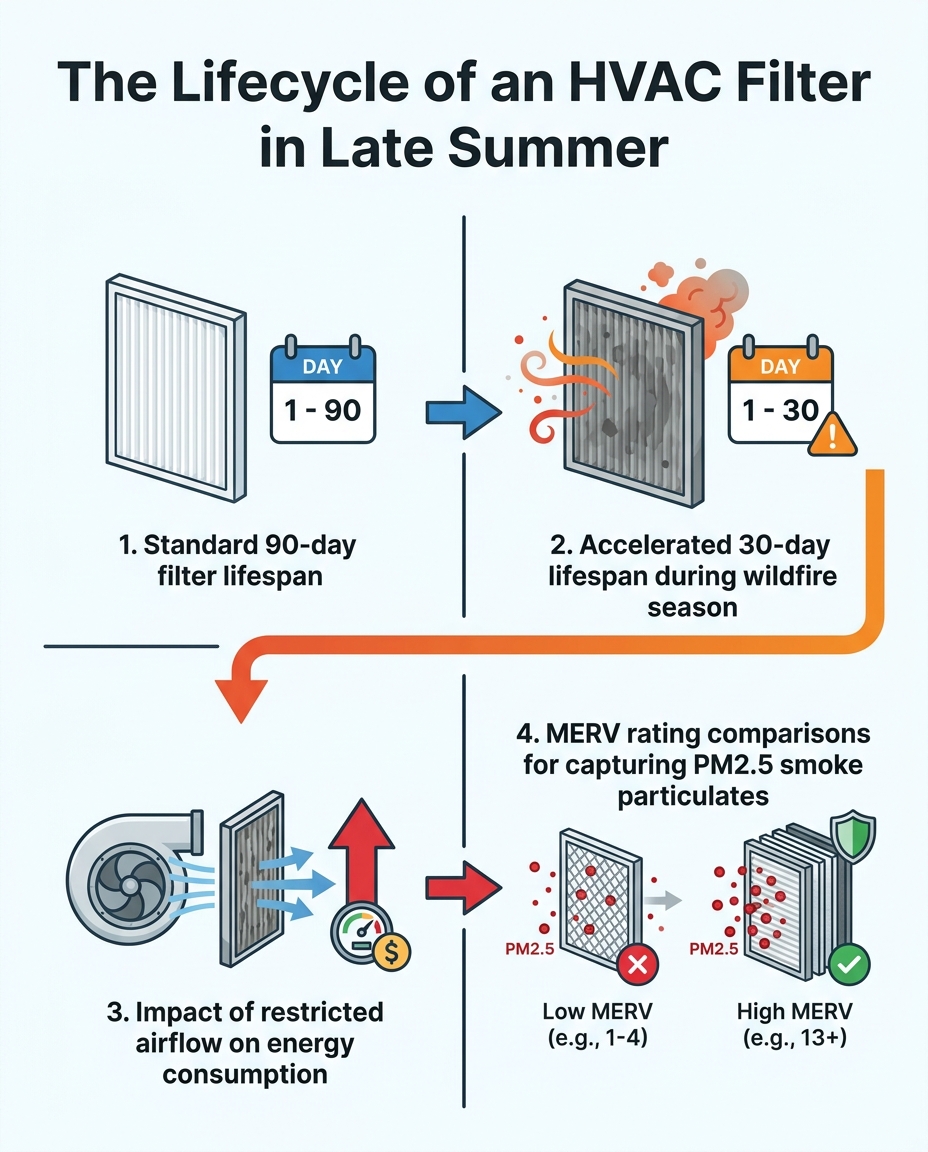

Leaving a heavily soiled filter in place does more than just degrade your indoor air quality; it actively damages your equipment. The physics of airflow restriction are unforgiving. When a clogged filter blocks the intake, the blower motor has to work much harder to pull the same amount of air through the system. This increases energy consumption, drives up your utility bills, and generates excess heat within the motor itself.
Here is exactly how a dirty filter breaks down your system during a heatwave:
1. Starved Airflow: The thick layer of dust prevents warm return air from reaching the internal components.
2. Coil Temperature Drop: Without enough warm air passing over the evaporator coil, the refrigerant inside absorbs less heat.
3. Ice Formation: The excess cold causes condensation on the coil to freeze, turning the entire component into a block of solid ice, even on a 100-degree August afternoon.
4. System Shutdown: Once the coil freezes, airflow stops entirely, and liquid refrigerant can flow backward into the compressor, causing catastrophic failure.
Running an AC with a choked filter drastically reduces overall air conditioning performance and shaves years off the equipment's lifespan. A pattern we see often during late-summer heatwaves is complete system failure due to neglected airflow. One San Jose homeowner found this out firsthand recently. Their AC unit was not working correctly despite previous servicing earlier in the year. Once our Precision Heating & Cooling technicians arrived and evaluated the system with honesty and trustworthiness, it was clear that fundamental airflow restrictions had been overlooked. The unit was fixed correctly by addressing the root cause of the strain.
Addressing operational issues early prevents complete system failures during the hottest, most uncomfortable weeks of the year. A simple filter check is your first line of defense against a costly emergency repair.
• Longer cooling cycles: The system runs constantly but struggles to reach the temperature set on the thermostat, leading to higher utility bills.
• Uneven cooling: Certain rooms feel perfectly comfortable while others, usually those furthest from the blower, remain hot and stuffy.
• Unusual noises: A high-pitched whistling or straining sound coming from the return vents indicates the motor is struggling to pull air through a blockage.
Beyond the mechanical risks, shifting your focus to the health-related milestones of children returning to school reveals just how important clean air truly is. Poor indoor air quality directly exacerbates allergies and disrupts sleep patterns. When children breathe in dust, pollen, and lingering smoke overnight, they often wake up congested, groggy, and entirely unprepared for the demands of the school day.
Your home should function as a "clean air sanctuary." Throughout the day, kids are exposed to outdoor allergens on the playground, chalk dust in the classroom, and whatever germs are circulating in the cafeteria. When they return home, their bodies need a break from fighting off airborne irritants. If your HVAC system is pushing contaminated air through the vents because of a neglected filter, that sanctuary is compromised.
Installing a fresh filter immediately improves the situation by removing the massive backlog of summer contaminants. It acts as a reset button for your home's atmosphere. The August / Late-summer California wildfire season guarantees that the outdoor air will be challenging, but you have complete control over the indoor environment.
Proactive filter management connects directly to a healthier, more comfortable living space for the entire family. When the air is clean, respiratory irritation drops, sleep quality improves, and everyone is better equipped to handle the stress of the new academic year.
While homeowners can and absolutely should change their own filters regularly, a heavily caked, soot-covered filter often points to deeper contamination within the system. Fine smoke particulates have a habit of bypassing the edges of clogged filters. Once those tiny particles get past the designated media, they stick to the blower wheel blades and coat the delicate fins of the evaporator coil.
In our experience, a heavily caked filter is often just the tip of the iceberg. Another local family recently called us about a completely non-operational unit right in the middle of summer. A prompt service call allowed our technicians to get the unit up and running quickly and efficiently by addressing deep-seated maintenance needs that a simple filter swap would have entirely missed. This is where professional intervention becomes necessary.
Precision Heating & Cooling's meticulous, thorough approach to maintenance ensures that no hidden dust or smoke residue is left to circulate through your home. A professional tune-up goes far beyond sliding a new piece of cardboard into a slot.
• Focus Area — DIY Filter Swap: Replacing the primary return filter only. — Professional Late-Summer Tune-Up: Inspecting ductwork, cleaning coils, and verifying electrical safety.
• Impact on Smoke Residue — DIY Filter Swap: Catches new particulates entering the return. — Professional Late-Summer Tune-Up: Removes existing sticky ash and soot from internal moving parts.
• System Longevity — DIY Filter Swap: Prevents immediate airflow restriction. — Professional Late-Summer Tune-Up: Reduces friction, lowers amp draw, and extends equipment life.
• Peace of Mind — DIY Filter Swap: Basic baseline protection. — Professional Late-Summer Tune-Up: Trustworthy, expert assessment of the entire system's overall health.
Relying on a professional evaluation in San Jose and the South Bay Area guarantees that the heavy toll of summer hasn't compromised your equipment's safety or efficiency before the cooler months arrive.
During active fire season, you should check your filter every two weeks and replace it at least once a month. The heavy concentration of PM2.5 ash and smoke particulates clogs the media much faster than normal household dust. Waiting the standard 90 days during the August / Late-summer California wildfire season will almost certainly lead to severe airflow restriction and poor indoor air quality.
Yes, a severely clogged filter is one of the most common reasons air conditioners fail during heatwaves. The blockage prevents warm air from reaching the evaporator coil, causing the condensation on the coil to freeze solid. Once the system turns into a block of ice, it can no longer cool your home and may trigger a complete safety shutdown to protect the compressor.
Your filter gets dirtier in the summer because the air conditioner runs for significantly longer cycles to combat high temperatures, pulling a much larger volume of air through the system. Additionally, summer brings higher pollen counts, drier weather that kicks up dust, and regional wildfire smoke. All of these environmental factors compound, forcing the filter to trap far more debris than it does during the milder winter months.
When our Precision Heating & Cooling technicians perform a comprehensive late-summer tune-up, we include inspecting the ductwork for leaks, deep-cleaning the evaporator and condenser coils, and verifying the system's overall electrical efficiency. Technicians will also clear the condensate drain line, which often becomes clogged with algae during the hot months. This meticulous process removes any bypassed smoke residue and ensures the system is healthy enough to handle the transition into fall.
Wildfire smoke introduces microscopic, sticky ash particles that easily bypass standard fiberglass filters and coat the internal components of your HVAC system. Over time, this residue unbalances the blower wheel, insulates the cooling coils (reducing efficiency), and leaves a lingering campfire smell in your ductwork. It requires high-efficiency MERV filters to capture the smoke and professional cleaning to remove the buildup from the machinery.
Taking action in August before the fall heating season officially begins is the best way to protect your home from the lingering effects of summer. The combination of intense heat, dry dust, and regional smoke in San Jose and the South Bay Area pushes your filtration system to its absolute limit. Waiting until your heater kicks on in November means you will be circulating months of trapped contaminants right back into your family's breathing air.
Encourage a healthy, restful start to the new academic year by scheduling a professional check with our experienced team today. A thorough inspection guarantees your home's air is clean, your system is operating efficiently, and your children have a true clean-air sanctuary to return to after school. Review your ongoing maintenance plan now to secure priority service and gain total peace of mind for the seasons ahead.

Leslie was amazing for her outstanding customer service skills with me the other day. Thanks to her help my air conditioner is now all set up. She answered all my questions and took away all my problems. Leslie broke it down step by step to set it up easier. Now thanks to her my air conditioner is working perfectly. I really appreciate it Leslie and I’ll be sure to ask for you if I ever come back.
I contacted Precision Heating and Cooling for my home's AC repair. They were punctual and very professional. Guillermo was very kind and thorough. I would highly recommend them!
I am writing to express my sincere appreciation for the excellent work performed by Pablo and Alejandro from Precision Heating and Cooling. Their commitment to quality and customer satisfaction is truly commendable. Awesome job guys!
I would like to extend my sincere gratitude to Alejandro for his exceptional hard work. His passion for helping others is evident, and he consistently goes above and beyond in his service. Alejandro's thorough cleaning of my fireplace has truly made a significant difference. His dedication and professionalism are greatly appreciated.
I was very impressed. Came at night (after 9pm) to fix our AC during the middle of a heat wave the day before a national holiday! Technician was very courteous and efficient, got the job done quickly. Will definitely call them again for any AC servicing I need!
Fast and efficient, arrived when scheduled for repairs and replacement parts were ordered and installed quickly. Techs were very friendly and professional. AC system works great now! I highly recommend their services if you need repairs. Tim


.avif)
