


.avif)






Recent Blogs
Stay updated with our latest blog posts.


Are you weighing the choice between R-410A vs. newer refrigerants for late-season AC repairs because your system is suddenly struggling to keep up with the San Jose heat? It is a frustrating scenario that many homeowners face just as the summer temperatures finally begin to break. You notice the air coming from your vents feels lukewarm, or your outdoor unit is running constantly without actually cooling the house. When our technicians at Precision Heating & Cooling diagnose a refrigerant leak in aging R-410A systems, you are immediately faced with a significant decision.
The core dilemma comes down to this: do you spend money to top off a dying system with an older, phasing-out refrigerant, or do you invest in a modern replacement designed for the future? The HVAC industry is currently undergoing a massive shift away from older coolants due to environmental regulations. Making the right choice now impacts your home comfort, your energy consumption, and your long-term maintenance needs. If you are dealing with a breakdown, reaching out for comprehensive HVAC services is the first step toward understanding your options. This guide will help you navigate the transition, providing the reassurance and facts you need to weigh your options for long-term, reliable comfort.
To make an informed decision about your cooling system, you first need to understand why the industry is changing. The shift away from older refrigerants is not a trend—it is a strict regulatory mandate designed to protect the environment. Understanding the timeline helps clarify why continuing to rely on older coolants carries increasing long-term risk.
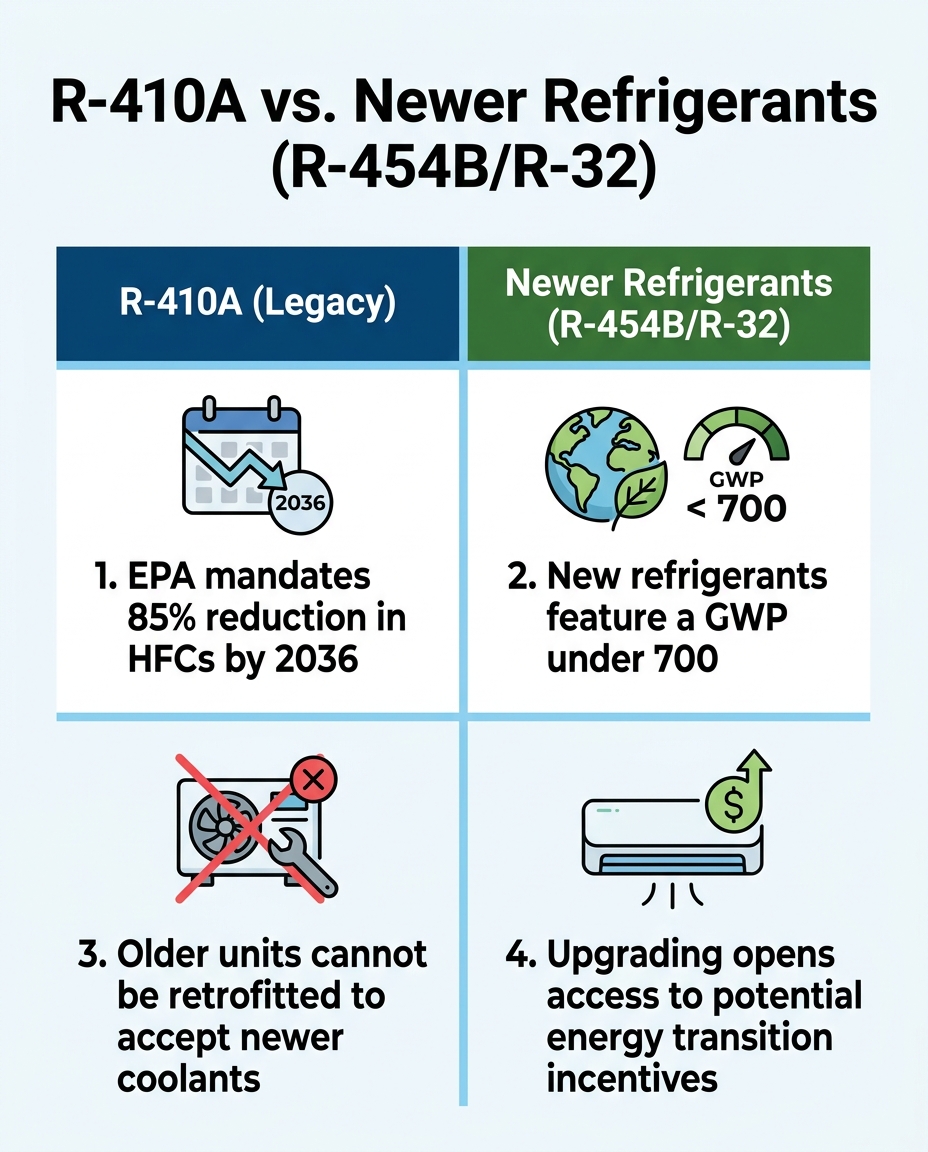
1. The AIM Act Mandate: The Environmental Protection Agency (EPA), through the American Innovation and Manufacturing (AIM) Act, has mandated an 85% reduction in the production and consumption of hydrofluorocarbons (HFCs) by the year 2036. R-410A is one of the primary HFCs targeted by this legislation.
2. Phased Production Drops: While it is not illegal to use or own a system that relies on R-410A, the production of this older refrigerant is drastically dropping. As manufacturers produce less of it each year, the remaining supply must service millions of existing units across the country.
3. California's Strict Alignment: California aligns strictly with these federal phase-down rules, often pushing for even faster adoption of eco-friendly technologies. This means local supply chains will reflect these changes rapidly.
4. The Shift to A2L Refrigerants: Manufacturers have already transitioned their assembly lines to produce equipment that utilizes newer, compliant refrigerants, meaning the era of R-410A equipment is officially coming to a close.
For homeowners, this regulatory shift creates a practical challenge. Supplies of older refrigerants will continue to shrink year after year. As scarcity increases, the logistics of maintaining older units become far more complex. Newer systems, on the other hand, are designed specifically for compliance and peak energy efficiency. Choosing to upgrade means your equipment aligns with current environmental standards, ensuring that future maintenance remains straightforward and accessible.
The timing of a breakdown is rarely convenient, but it is highly predictable when you consider the local climate. In our years of keeping local homes comfortable, we've seen firsthand how San Jose historically experiences intense heat spikes that often extend well into early autumn. These late-summer and early-fall heatwaves put maximum strain on AC units when homeowners least expect it, right as they are hoping to coast into the cooler months.
Throughout June, July, and August, your air conditioner works tirelessly to combat the relentless California sun. This continuous summer operation weakens internal components. Capacitors degrade, compressor motors endure thermal fatigue, and the constant expansion and contraction of metal coils can lead to micro-leaks. By the time September arrives, an aging system is exhausted. A sudden heatwave in early fall is often the final straw that causes a weakened coil to rupture, leaking refrigerant and halting your cooling entirely.
When faced with a sweltering house in late September, the immediate temptation is to apply a "band-aid" fix. You might consider just topping off the refrigerant to get through the remaining hot weeks of the year. While a quick patch offers immediate relief, it is crucial to evaluate whether that band-aid fix is a sound investment. Refrigerant does not just evaporate; if your system is low, there is a physical leak. Pumping new coolant into a leaking, exhausted system is a temporary measure that sets you up for another inevitable failure.
When an aging system fails, you have to weigh the immediate relief of a repair against the long-term benefits of a replacement. In one instance during a busy summer season, a local homeowner's AC unit became completely non-operational. Our Precision Heating & Cooling technicians arrived for a service call and had the unit up and running in no time. Fast, reliable repairs are entirely possible for minor mechanical failures. However, when the issue involves significant refrigerant leaks on aging R-410A systems, a quick patch requires a deeper evaluation.
To help you decide, here is a breakdown of the pros and cons of patching your current system versus moving forward with an upgrade. If you are looking for ways to manage the immediate needs of your system, exploring AC service deals can sometimes soften the blow, but the fundamental mechanical realities remain.
• Upfront Output — Patching an R-410A System: Lower immediate upfront commitment compared to a full replacement. — Upgrading to a New System: Requires a larger initial investment, though financing can help.
• Scheduling — Patching an R-410A System: Avoids scheduling a major installation during a late-season heatwave. — Upgrading to a New System: Requires a scheduled installation day, which is easier to book in fall.
• Refrigerant Compatibility — Patching an R-410A System: R-410A cannot be legally or safely retrofitted to use newer A2L refrigerants. — Upgrading to a New System: Built exclusively for modern, compliant, and readily available refrigerants.
• Long-Term Viability — Patching an R-410A System: Throwing good resources at a system that will face severe refrigerant scarcity. — Upgrading to a New System: Future-proofs your home with equipment designed for the next decade.
• Energy Efficiency — Patching an R-410A System: Does not improve the overall energy efficiency of the home. — Upgrading to a New System: Modern units offer significantly better energy transfer and lower power usage.

As the industry moves away from R-410A, two primary alternatives have emerged as the new standards for residential cooling: R-454B and R-32. Educating yourself on these modern alternatives explains why the industry is shifting and what it means for the new equipment you might install in your San Jose CA home.
These new refrigerants are classified by their Global Warming Potential (GWP). The new regulatory standard requires a GWP of under 700. Both R-454B and R-32 meet this strict environmental benchmark, offering significant environmental benefits compared to their predecessors. Beyond just being better for the planet, these modern coolants possess improved energy transfer properties. This means they absorb and release heat more efficiently, allowing the compressor to work less hard to achieve the same cooling output in your home.
A common question is whether a technician can simply drain the old R-410A and refill the system with R-454B or R-32. The short answer is no. Older units cannot accept these new refrigerants due to fundamentally different operating pressures, different synthetic oil requirements, and updated safety standards. The internal components of an R-410A system are simply not engineered to handle the thermal properties of A2L-class refrigerants. Therefore, investing in a new system that uses these refrigerants is the only way to successfully future-proof your home's climate control.
Experiencing an AC breakdown in September might feel like a disaster, but it actually presents a unique strategic opportunity. When a system fails in the middle of a July heatwave, homeowners often engage in panic-buying. Rushed decisions made in a sweltering house frequently lead to choosing whatever equipment is available that exact day, rather than what is best for the home long-term.
The September early fall transition changes the dynamic entirely. Milder autumn weather allows for a thoughtful, well-researched transition to a modern heat pump or high-efficiency AC. You have the breathing room to evaluate SEER2 ratings, compare equipment brands, and make a calculated decision without the pressure of a 100-degree house.
Furthermore, scheduling installations is often much easier and less disruptive outside of the peak summer rush. Installation crews have more flexible calendars in the fall, ensuring your project gets the dedicated time it deserves. If you choose to upgrade to a modern heat pump, you gain the added peace of mind of entering the winter heating season with a reliable, dual-purpose system that handles both cooling and heating efficiently. Once your new system is in place, enrolling in a preventative maintenance plan ensures it stays in peak condition year after year.
The ongoing refrigerant phase-down is a significant industry event, but unfortunately, it is sometimes used to scare homeowners into unnecessary or premature purchases. Navigating these HVAC decisions requires a partner you can trust, not a salesperson pushing a quota. At Precision Heating & Cooling, our commitment is to provide transparent, expert guidance on California's evolving regulations without high-pressure sales tactics.
We frequently see the fallout of rushed or pressured decisions. In one spring scenario, a local homeowner reached out because a brand-new furnace and AC system—installed just three months prior by another contractor—was already experiencing severe operational issues. Our team was able to step in, properly diagnose the underlying faults, and repair the system to resolve numerous installation errors from the previous work. This highlights why seeking honest assessments of your equipment's remaining lifespan and ensuring proper installation is so vital.
The best way to make a decision is by evaluating long-term operational costs versus short-term fixes. A trustworthy technician in San Jose CA will help you look at the age of your unit, the severity of the leak, and the overall condition of your ductwork to provide a clear picture. If a replacement is the most logical step, the availability of flexible financing options can make high-efficiency upgrades manageable, allowing you to prioritize quality and compliance without breaking your monthly budget.
One of the strongest arguments against patching an older system is the sheer volume of generic financial incentives currently available for transitioning to newer, high-efficiency equipment. These programs are specifically designed to offset the initial investment of upgrading, making the transition to modern refrigerants much more appealing during the September early fall transition.
• Federal Tax Credits: Generic federal tax credits may apply to qualifying high-efficiency heat pump and air conditioning installations, rewarding homeowners who choose eco-friendly technology.
• State-Level Programs: California offers various state-level energy transition incentives aimed at reducing reliance on older technologies and lowering the strain on the state electrical grid.
• Utility Provider Rebates: Many local utility companies provide generic rebates for upgrading from outdated, energy-hogging systems to modern, streamlined units.
• Manufacturer Promotions: During the fall transition season, equipment manufacturers often run generic promotions to encourage off-season upgrades.
The smart move: We strongly advise readers to consult with their utility provider or a qualified tax professional to verify current, applicable programs. Taking advantage of these incentives can significantly alter the math when comparing a costly repair to a full system replacement.
When weighing R-410A vs. newer refrigerants for late-season AC repairs, the path forward requires looking beyond the immediate heatwave. While topping off an older unit might offer temporary relief for a few weeks, the ongoing refrigerant phase-down and the physical realities of a leaking system make it a strictly short-term strategy.
Remember that the September early fall transition provides the perfect window to evaluate your options calmly. Instead of limping through the end of the year with unreliable equipment, use this milder weather to your advantage. We at Precision Heating & Cooling encourage you to reach out for a thorough, pressure-free system evaluation to weigh the true costs and benefits of your specific situation. You can have total reassurance that local experts are here to guide you through the transition smoothly, ensuring your home remains perfectly comfortable for every season to come.
Is it worth fixing an R-410A AC?
It depends entirely on the nature of the repair and the age of the system. If the fix is a minor electrical component like a capacitor, repairing it is usually worth the investment. However, if the system requires a major repair like a compressor replacement or fixing a severe refrigerant leak, investing in obsolete technology is rarely the best long-term financial decision.
What happens when R-410A is phased out?
When R-410A is phased out, the production of the refrigerant will drastically decrease, leading to limited supplies. It will not become illegal to operate your current system, but finding the refrigerant for future repairs will become increasingly difficult. As a result, maintaining older systems will become a significant logistical challenge for homeowners.
Can I put new refrigerant in my old AC?
No, you cannot put new refrigerants into an old AC unit. Systems designed for R-410A operate at different pressures and require different synthetic oils than newer A2L refrigerants. Attempting to mix or retrofit these chemicals is unsafe, will instantly void your warranty, and will likely destroy the compressor.
What is the new AC refrigerant for 2025 and 2026?
The HVAC industry is transitioning primarily to R-454B and R-32 for the 2025 and 2026 manufacturing years. These modern refrigerants meet the new environmental standards by having a Global Warming Potential (GWP) of less than 700. They are designed to be more eco-friendly while providing excellent energy transfer for superior cooling performance.
Why can't I just retrofit my current AC with R-454B?
Retrofitting is impossible because the internal engineering of your current AC is incompatible with R-454B. The new refrigerants are classified as A2L (mildly flammable) and require specific safety sensors, different valves, and updated compressor designs to operate safely. Your older equipment lacks these mandatory safety and operational features.
Will a new refrigerant system lower my energy bills?
Yes, upgrading to a system that uses new refrigerants typically lowers energy consumption. Modern units are built to much higher seasonal energy efficiency (SEER2) standards and utilize advanced variable-speed technology. Because the new refrigerants transfer heat more effectively, the system does not have to work as hard, which directly translates to reduced energy usage in your home.

Leslie was amazing for her outstanding customer service skills with me the other day. Thanks to her help my air conditioner is now all set up. She answered all my questions and took away all my problems. Leslie broke it down step by step to set it up easier. Now thanks to her my air conditioner is working perfectly. I really appreciate it Leslie and I’ll be sure to ask for you if I ever come back.
I contacted Precision Heating and Cooling for my home's AC repair. They were punctual and very professional. Guillermo was very kind and thorough. I would highly recommend them!
I am writing to express my sincere appreciation for the excellent work performed by Pablo and Alejandro from Precision Heating and Cooling. Their commitment to quality and customer satisfaction is truly commendable. Awesome job guys!
I would like to extend my sincere gratitude to Alejandro for his exceptional hard work. His passion for helping others is evident, and he consistently goes above and beyond in his service. Alejandro's thorough cleaning of my fireplace has truly made a significant difference. His dedication and professionalism are greatly appreciated.
I was very impressed. Came at night (after 9pm) to fix our AC during the middle of a heat wave the day before a national holiday! Technician was very courteous and efficient, got the job done quickly. Will definitely call them again for any AC servicing I need!
Fast and efficient, arrived when scheduled for repairs and replacement parts were ordered and installed quickly. Techs were very friendly and professional. AC system works great now! I highly recommend their services if you need repairs. Tim


.avif)
