


.avif)






Recent Blogs
Stay updated with our latest blog posts.


What does an HVAC maintenance visit include is a fair question — and one worth answering before your next service appointment. Whether your system has been humming along quietly or showing a few warning signs, knowing what a technician actually does during a tune-up helps you get more out of every visit.
A standard HVAC maintenance visit covers the following:
| Category | Key Tasks |
|---|---|
| Outdoor Unit | Clean condenser coils, check refrigerant levels, inspect fan motor, clear debris, tighten electrical connections |
| Indoor Unit | Clean evaporator coils, inspect blower assembly, flush condensate drain, check air filter |
| Heating System | Inspect heat exchanger, test burner assembly, check gas pressure, test for carbon monoxide |
| Cooling System | Verify refrigerant charge, test airflow, inspect drain pan, check capacitors and contactors |
| Controls & Safety | Calibrate thermostat, test safety controls, verify startup and shutdown cycles |
| Ductwork | Visual inspection for leaks, damage, or blockages |
Most visits take between one and one and a half hours per system, and a quality technician will clean, measure, and test — not just look around.
Regular maintenance matters more than most homeowners realize. Preventive care can improve your system's lifespan by up to 48% and prevent yearly efficiency losses of up to 15%. Skipping it often means paying far more later — in energy bills, repairs, or early replacement.
I'm Tony Lara, an HVAC professional with hands-on experience diagnosing and servicing heating and cooling systems, and I know how much a thorough tune-up can reveal about what does an HVAC maintenance visit include versus what some providers cut corners on. In this guide, we'll walk through every step so you know exactly what to expect — and what to ask for.
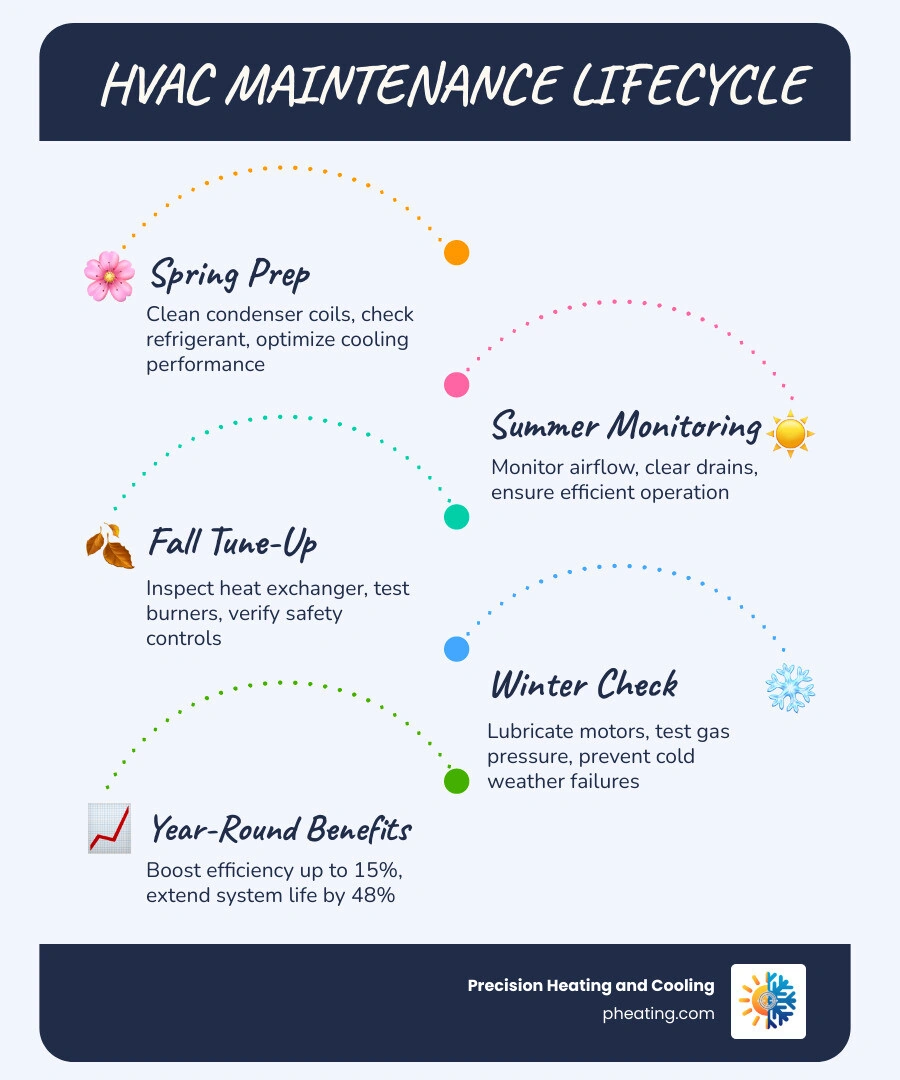

As we move through April 2026, many homeowners in the San Jose Bay Area are starting to think about the upcoming summer heat. Timing is everything when it comes to HVAC health. We generally recommend scheduling professional service twice a year: once in the spring for your cooling system and once in the fall for your heating system.
Why the seasonal split? It’s all about preparation. You don’t want to find out your AC is struggling on the first 90-degree day in Cupertino or Hanford. By scheduling a spring visit, you ensure the system is optimized for high-demand periods. Similarly, a fall visit for your furnace ensures that gas connections and heat exchangers are safe before the winter chill hits Los Gatos or Clovis.
Regular care isn't just about avoiding a breakdown; it's about maintaining energy efficiency. Did you know that an AC with a clean filter can use up to 15% less energy than one with a dirty one? Beyond the filter, The Importance of Regular AC Service lies in the fact that technicians can spot minor wear and tear — like a fraying belt or a weakening capacitor — before it cascades into a total system failure. This is why AC Tune-Ups Why Technicians Recommend Them Yearly are considered the gold standard for home maintenance.
The outdoor unit, or condenser, is the workhorse of your cooling system. Because it sits outside, it is constantly exposed to the elements — dust from the Central Valley, pollen, and even the occasional nesting pest. When people ask what does an hvac maintenance visit include, the outdoor inspection is often the most labor-intensive part.
If you are looking for AC Maintenance Los Gatos CA or HVAC Maintenance Sunnyvale CA, these outdoor checks are vital for surviving our local summer spikes without a spike in your utility bill.
While the outdoor unit handles the heavy lifting of heat exchange, the indoor unit is responsible for air distribution and humidity control. This is where your air quality is determined.
| Cooling Maintenance Focus | Heating Maintenance Focus |
|---|---|
| Evaporator coil inspection | Heat exchanger safety check |
| Condensate drain flush | Burner assembly cleaning |
| Blower motor adjustment | Gas pressure calibration |
| Refrigerant temperature split | Carbon monoxide testing |
| Drain pan treatment | Pilot/Ignition system test |
A key part of the indoor visit involves the blower assembly. If the blower wheel is caked with dust, it won't move air efficiently, leading to "hot spots" in your home. We also pay close attention to the condensate drain lines. In the humid parts of the Bay Area, these lines can grow algae and clog, leading to water damage in your attic or closet. We flush these lines to ensure moisture is safely moved out of the home.
For those interested in long-term protection, our HVAC Maintenance Plans Guide explains how regular indoor checks can prevent mold growth and keep your air clean. If you're in the Peninsula area, seeking HVAC Maintenance Palo Alto CA ensures your indoor air handler is ready for the seasonal shift.
When the focus shifts to heating, safety becomes the top priority. A furnace is a combustion appliance, and ensuring it operates correctly is essential for your family's well-being.
Whether you need Furnace Maintenance Clovis CA or Furnace Maintenance Los Gatos CA, these safety checks provide peace of mind that your home is secure.
For the cooling side of the coin, we focus on airflow optimization and refrigerant charge. If the refrigerant is even slightly off, the system's efficiency can drop by 15% or more. We also inspect the evaporator coil (located inside your home) for signs of frost or microbial growth.
In areas like the South Bay, AC Maintenance Cupertino CA and AC Service Sunnyvale CA visits often reveal that the blower motor is pulling too much amperage, which is a sign that the motor is nearing the end of its life. Catching this during a maintenance visit allows you to plan for a repair on your own schedule rather than during an emergency.
To get the most out of your technician's time, a little bit of preparation goes a long way. When we arrive for a visit in HVAC Maintenance Hanford CA or HVAC Maintenance Cupertino CA, having clear access to the equipment allows us to focus entirely on the technical checks.
A thorough, high-quality HVAC maintenance appointment should take between one and one and a half hours per system. If a technician is in and out in 20 minutes, they likely only performed a visual inspection and didn't actually "maintain" anything. For homes with multiple units, expect the visit to take longer — roughly three hours for a two-system household. The complexity of the system and the accessibility of the units can also influence the duration.
While annual visits are the standard, your system might cry out for help sooner. Watch for these red flags:
Absolutely! While tasks involving high voltage or refrigerant require a pro, you can handle the basics:
Understanding what does an hvac maintenance visit include is the first step toward a more comfortable, efficient home. At Precision Heating and Cooling, we bring over two decades of experience to every home in the San Jose Bay Area and Central Valley. Whether you are in Santa Clara, Sunnyvale, or Clovis, our goal is to provide reliable service that keeps your system running at peak performance for its full 15- to 20-year lifespan.
We pride ourselves on competitive pricing and flexible payment options, ensuring that essential home maintenance is accessible for everyone. Don't wait for your system to fail during a heatwave or a cold snap. Experience the peace of mind that comes with a professional tune-up.
If you are looking for expert HVAC Maintenance San Jose CA, we are here to help. Schedule your professional HVAC service in San Jose today and let us ensure your home stays comfortable all year long.

Leslie was amazing for her outstanding customer service skills with me the other day. Thanks to her help my air conditioner is now all set up. She answered all my questions and took away all my problems. Leslie broke it down step by step to set it up easier. Now thanks to her my air conditioner is working perfectly. I really appreciate it Leslie and I’ll be sure to ask for you if I ever come back.
I contacted Precision Heating and Cooling for my home's AC repair. They were punctual and very professional. Guillermo was very kind and thorough. I would highly recommend them!
I am writing to express my sincere appreciation for the excellent work performed by Pablo and Alejandro from Precision Heating and Cooling. Their commitment to quality and customer satisfaction is truly commendable. Awesome job guys!
I would like to extend my sincere gratitude to Alejandro for his exceptional hard work. His passion for helping others is evident, and he consistently goes above and beyond in his service. Alejandro's thorough cleaning of my fireplace has truly made a significant difference. His dedication and professionalism are greatly appreciated.
I was very impressed. Came at night (after 9pm) to fix our AC during the middle of a heat wave the day before a national holiday! Technician was very courteous and efficient, got the job done quickly. Will definitely call them again for any AC servicing I need!
Fast and efficient, arrived when scheduled for repairs and replacement parts were ordered and installed quickly. Techs were very friendly and professional. AC system works great now! I highly recommend their services if you need repairs. Tim


.avif)
