


.avif)






Recent Blogs
Stay updated with our latest blog posts.


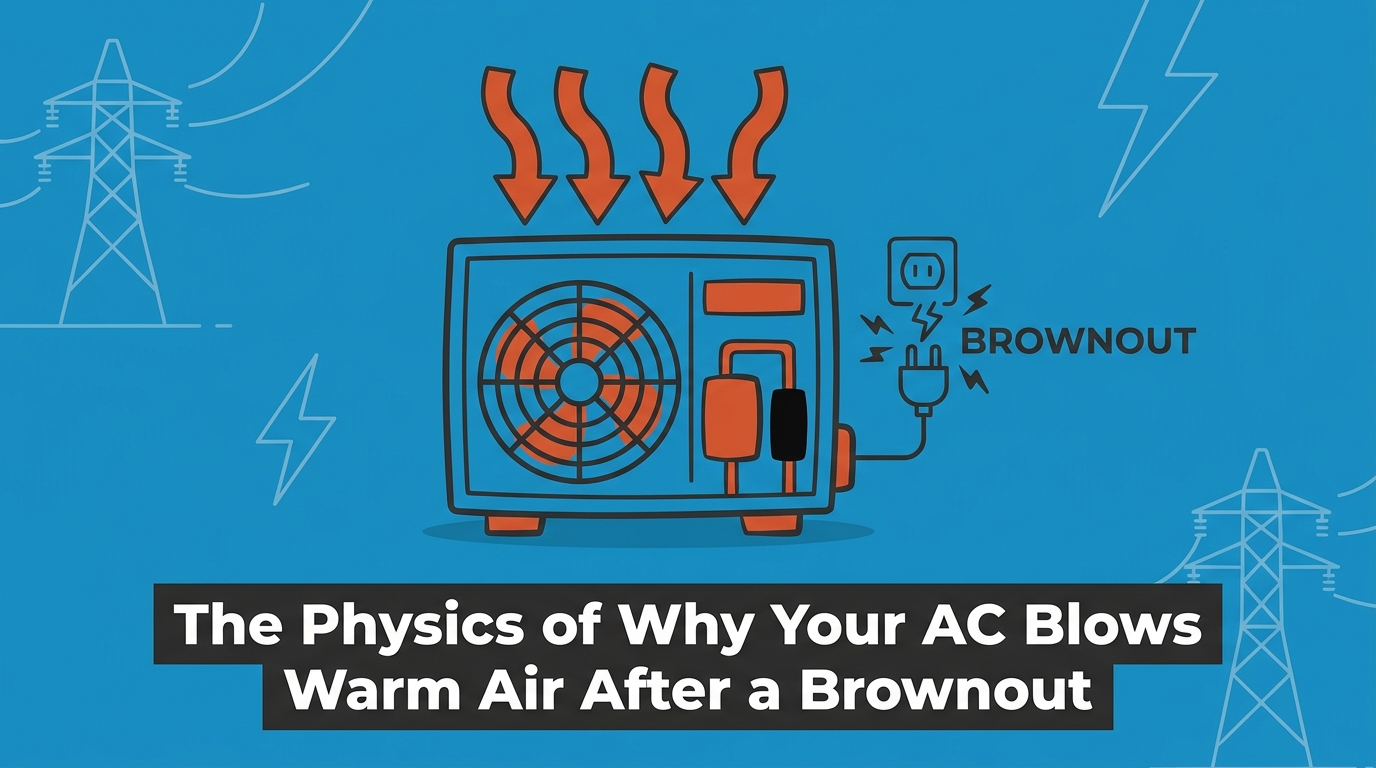
August late-summer heatwaves in the Valley bring more than just triple-digit temperatures and a spike in your utility bill. Here at Precision Heating & Cooling, our team fields countless panicked calls during the back-to-school transition when these heatwaves trigger Flex Alerts, neighborhood voltage drops, and the exact scenario where you need to understand the physics of why your AC blows warm air after a brownout. You hear the indoor fan blowing, but the air coming from the vents is completely unconditioned. The house is getting warmer by the minute, and panic naturally sets in. Is the compressor dead? Did the power dip destroy your expensive cooling system?
Here is the thing: what looks like a catastrophic equipment failure is often a built-in safety mechanism working exactly as designed. When the electrical grid struggles to deliver consistent voltage, your air conditioner protects itself by shutting down its most critical, power-hungry components. To keep your HVAC systems running smoothly and safely, understanding this mechanical defense is crucial. As we regularly tell our San Jose customers, professional air conditioning service is always your best safety net when a system refuses to reset.
To understand why your air conditioner behaves so strangely during a power dip, we have to look at what is actually happening on the utility side of your meter. A brownout is fundamentally different from a total blackout or a sudden power surge, and it places a unique type of stress on heavy household appliances.
A brownout is a temporary dip in electrical voltage. Unlike a blackout where the power is completely severed, a brownout means power is still flowing to your home, but it lacks the standard "push" or pressure (voltage) required to operate heavy machinery. On the San Jose grid, our technicians see these voltage drops frequently occur during peak summer load events when thousands of homes are running their air conditioners simultaneously. The utility infrastructure simply struggles to maintain the standard 120/240 volts to every neighborhood.
The core physics of a brownout come down to Watt's Law, which states that Power (Watts) equals Voltage multiplied by Current (Amps). Your air conditioner requires a specific amount of total power to compress refrigerant and cool your home. If the voltage from the grid suddenly drops, the system must draw more current (amps) to make up the difference and maintain that required power output.
The heat problem: As the amperage spikes, the electrical wiring and the motor windings inside your compressor begin to generate massive amounts of excess heat. High amperage is the enemy of electric motors, and a prolonged brownout effectively forces your compressor to work twice as hard just to stay running.
• Brownout (Voltage Drop) — What Happens to the Grid: Voltage dips below standard levels due to high neighborhood demand. — Impact on Your HVAC System: Motors draw excessive amps, overheat, and trigger internal safety lockouts.
• Power Surge — What Happens to the Grid: A sudden, massive spike in voltage (often after a blackout ends). — Impact on Your HVAC System: Can instantly fry circuit boards, blow fuses, and destroy run capacitors.
• Blackout — What Happens to the Grid: Total loss of electrical power. — Impact on Your HVAC System: System shuts down completely; requires a safe restart when power returns.
The most confusing part of a brownout response is the symptom itself: the vents are still actively blowing air, but the air is warm. If the system is starved for power, why is it running at all? The answer lies in how your central air conditioning system distributes electricity across its different components.
Your central cooling system is actually split into two main halves. The indoor unit, typically housed in your attic, garage, or utility closet, contains the blower fan. This fan is responsible for pulling warm air from your rooms, pushing it over the cold evaporator coil, and circulating it back through the ductwork. Most residential indoor blower fans operate on a standard 120-volt circuit. Because they require relatively little power to spin a fan blade, they can often survive a moderate voltage dip without shutting down. A pattern we see often during August late-summer heatwaves is that when voltage sags slightly, the indoor fan keeps right on spinning.
The outdoor unit (the condenser) houses the compressor, which is the heavy-lifting engine of your entire cooling system. The compressor's job is to squeeze gaseous refrigerant into a high-pressure liquid, a process that requires massive mechanical force. To achieve this, the outdoor unit runs on a dedicated 240-volt circuit. It draws significantly more power than any other appliance in your home.
The mechanical disconnect: When a brownout hits, the voltage drop is too severe for the 240-volt compressor to handle. It stalls out and shuts down to prevent an electrical fire. Meanwhile, the 120-volt indoor fan continues to run. Because the compressor is offline, no cold refrigerant is being sent indoors. The result? Your indoor fan is simply sucking in 85-degree house air and blowing it right back out through your vents.
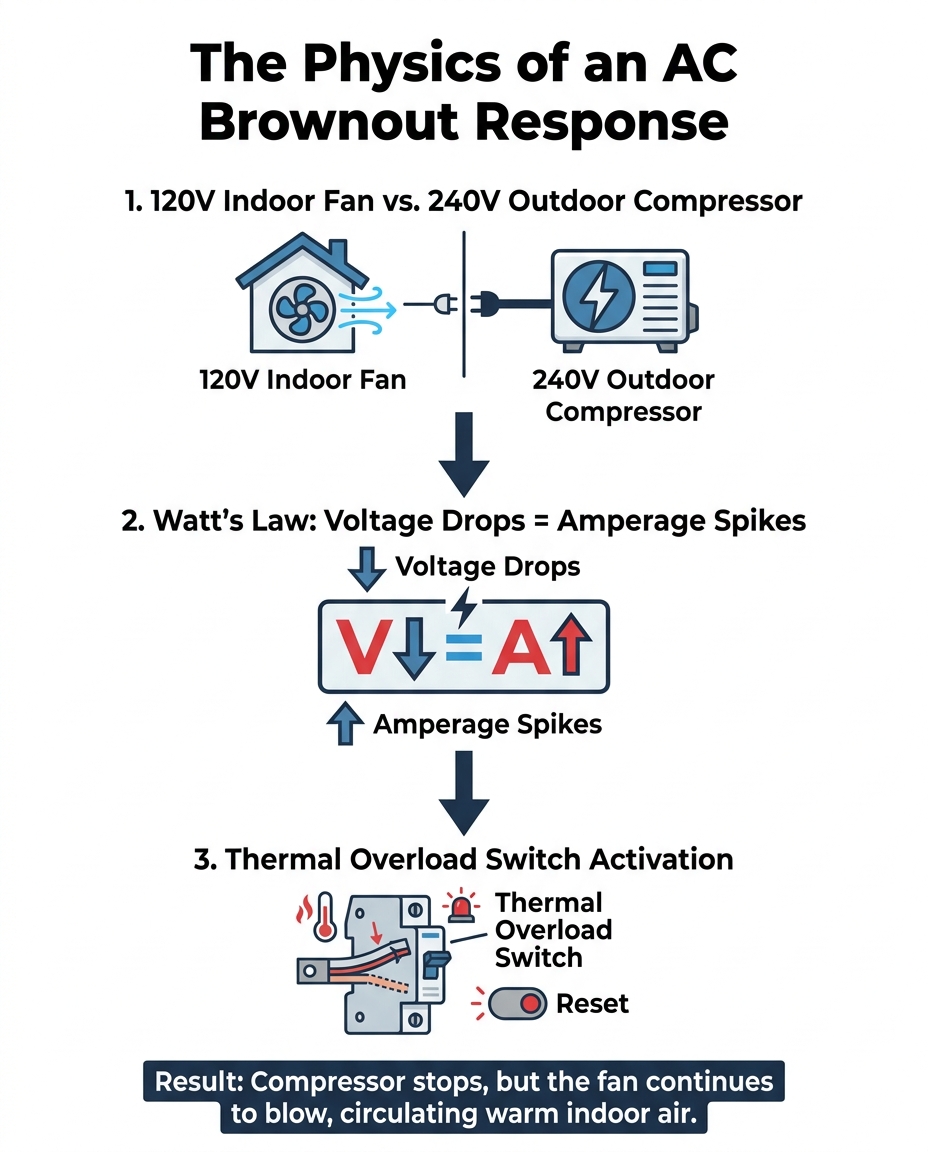

When the 240-volt compressor stalls during a brownout, it does not just quietly turn off. The excessive amperage draw we discussed earlier causes the motor windings to heat up rapidly. If left unchecked, this heat would literally melt the insulation off the copper wiring, causing a catastrophic short circuit and permanently destroying the compressor.
To prevent this total failure, engineers build a thermal overload switch into the compressor. This is a temperature-sensitive safety device that monitors the internal heat of the motor. When the temperature exceeds a safe threshold—usually due to the high amps drawn during a voltage drop on the San Jose grid—the switch trips and physically breaks the electrical connection to the compressor.
This thermal lockout is exactly why your system stops cooling. With over 20 years of local HVAC experience at Precision Heating & Cooling, we always remind homeowners that a tripped thermal overload is actually a sign of a healthy safety system doing its job. It is stepping in to save your expensive equipment from destroying itself. However, because this protective measure can sometimes look identical to AC circuit breaker problems, our team emphasizes that proper diagnosis is incredibly important.
• Sudden loss of cooling: The most obvious sign the switch has tripped.
• Buzzing or humming: The outdoor unit may make a brief humming sound as it tries to start before the overload switch cuts the power.
• Hot exterior: The metal casing of the outdoor compressor may feel unusually hot to the touch if you check it immediately after a brownout.
Once the thermal overload switch trips, your immediate instinct might be to rush to the thermostat and rapidly flip the system off and back on to force a restart. This is one of the most dangerous things you can do to your air conditioner. The system is locked out for a very specific mechanical reason, and patience is required.
When an air conditioner is running normally, it creates a massive pressure difference between the high side (condenser) and the low side (evaporator) of the refrigerant loop. If the compressor shuts down abruptly during a brownout, that high pressure is still trapped in the lines. If you try to force the compressor to restart immediately, the motor has to push against that immense wall of pressure. This is known as starting against "high head pressure," and it requires a staggering amount of electrical torque.
To protect against this, modern HVAC systems and digital thermostats have built-in time delays, usually lasting 5 to 15 minutes. This delay gives the trapped refrigerant time to equalize across the system, lowering the pressure so the compressor can start smoothly.
In our daily work repairing San Jose cooling systems, we've found that trying to bypass this delay by rapidly flipping switches is one of the most common ways homeowners accidentally cause severe short cycling. Short cycling forces the compressor to start and stop repeatedly, which generates even more heat, trips the thermal overload again, and drastically shortens the lifespan of the equipment. If the power flickers during an August late-summer heatwave, the golden rule is always to wait.
If the grid power has stabilized but your system is still blowing warm air, you may need to perform a manual reset. We firmly believe in drawing a hard line between safe homeowner troubleshooting and dangerous DIY electrical work. You should never open the outdoor service panel, test internal wiring, or handle capacitors. Those tasks carry severe electrocution risks and require a licensed professional. You can, however, safely reset the system using only your thermostat and the main household electrical panel.
1. Turn the thermostat to the "Off" position: Stop asking the system for cooling. This prevents the thermostat from sending conflicting signals to the equipment while you reset the power.
2. Locate your main electrical panel: Find your home's primary circuit breaker box. Look for the large double-pole breaker labeled "AC" or "Condenser."
3. Check for tripped breakers: A tripped breaker will often rest in the middle position, feeling slightly spongy. Even if it looks fully "On," it may have tripped internally.
4. Reset the breaker firmly: Push the AC breaker completely to the "Off" position until it clicks, wait a few seconds, and then firmly push it back to the "On" position.
5. Wait a full 30 minutes: This is the most crucial step. You must give the outdoor compressor time to physically cool down so the internal thermal overload switch can reset. If you skip this wait, the compressor will remain locked out.
6. Restore the cooling call: Turn the thermostat back to "Cool" and set your desired temperature. Go outside and listen for the outdoor unit's fan and compressor to engage smoothly.
If you are struggling with the digital interface during this process, basic thermostat troubleshooting can ensure you aren't fighting a programming error while trying to reset the main system.
If you follow the safe, 30-minute reset procedure and the air conditioner still blows warm air, or if the main circuit breaker trips again immediately upon restart, the brownout likely caused lasting electrical damage. While the thermal overload switch protects the compressor motor, other sensitive components are highly vulnerable to voltage fluctuations.
The run capacitor is usually the first casualty. This cylindrical component stores energy and provides the extra jolt of electricity the compressor needs to start. When voltage drops and amperage spikes, capacitors overheat, bulge, and fail. If the capacitor is dead, the compressor cannot start, no matter how many times you reset the breaker.
One local homeowner reached out this past summer after their AC stopped working correctly following a series of neighborhood power issues. Multiple other companies had previously attempted repairs without resolving the underlying electrical strain. Guillermo from our team serviced the AC, providing an honest and trustworthy assessment of the damaged components, and replaced the fried capacitor to get the system back online safely.
Signs of lasting damage include:
• Immediate breaker tripping: If the breaker snaps off the second the outdoor unit tries to start, you have a direct short circuit.
• Loud buzzing or clicking: A distinct buzzing from the outdoor unit usually indicates a failed capacitor or a welded contactor switch.
• Acrid electrical smells: Any burning plastic or ozone smell near the outdoor unit means wiring has overheated.
Because August late-summer heatwaves continually stress the grid, keeping your system resilient is vital. Enrolling in a preventative maintenance plan ensures that your safety switches, capacitors, and contactors are tested regularly, giving your air conditioner the best chance of surviving the next neighborhood brownout without requiring emergency repairs.
The indoor fan and outdoor compressor operate on different electrical circuits. The indoor fan typically uses 120 volts and can often survive a moderate voltage dip. The outdoor compressor requires 240 volts; when a brownout hits, it stalls from a lack of power and triggers a safety shutdown, leaving the indoor fan to circulate warm, uncooled air.
You can safely reset your system at the main electrical panel without opening any equipment. Turn your thermostat to the "Off" position, locate the AC breaker in your main electrical box, flip it completely off and then back on, and wait 30 full minutes. This waiting period allows the internal thermal overload switch to cool down before you turn the thermostat back to "Cool."
Yes, prolonged low voltage can cause severe damage if the safety mechanisms fail. When voltage drops, the system draws higher amperage to compensate, which generates massive heat. This heat can fry run capacitors, melt contactor switches, and eventually destroy the compressor motor windings if the thermal overload switch does not trip in time.
A brownout is a temporary drop in electrical voltage, effectively starving your appliances of the pressure they need to operate. A power surge is the exact opposite—a sudden, massive spike in voltage that forces too much electricity into the system. While brownouts cause overheating through high amperage draw, surges cause immediate electrical shorts and blown fuses.
You should wait a minimum of 30 minutes before attempting a manual restart after a power dip. This allows the high-pressure refrigerant trapped in the lines to equalize and gives the overheated compressor time to cool down. Rushing this process forces the system to start against high pressure, which can cause permanent mechanical damage.
A repeatedly tripping breaker indicates a direct electrical short or a failed component. The brownout likely damaged the run capacitor, welded the contactor switch, or compromised the compressor's wiring. When the breaker trips instantly upon restart, it is doing its job to prevent an electrical fire, and you must call a licensed professional for repairs.
Understanding the physics of a brownout takes the mystery out of why your system suddenly starts blowing warm air. When the grid struggles, your air conditioner's thermal overload protection is your best defense against catastrophic failure. By practicing patience, utilizing safe, panel-closed resets, and knowing when to call a licensed professional, you can protect your investment. At Precision Heating & Cooling, we believe that having a clear understanding of these mechanics ensures you get clear, safe answers without risking electrocution or permanent equipment damage.

Leslie was amazing for her outstanding customer service skills with me the other day. Thanks to her help my air conditioner is now all set up. She answered all my questions and took away all my problems. Leslie broke it down step by step to set it up easier. Now thanks to her my air conditioner is working perfectly. I really appreciate it Leslie and I’ll be sure to ask for you if I ever come back.
I contacted Precision Heating and Cooling for my home's AC repair. They were punctual and very professional. Guillermo was very kind and thorough. I would highly recommend them!
I am writing to express my sincere appreciation for the excellent work performed by Pablo and Alejandro from Precision Heating and Cooling. Their commitment to quality and customer satisfaction is truly commendable. Awesome job guys!
I would like to extend my sincere gratitude to Alejandro for his exceptional hard work. His passion for helping others is evident, and he consistently goes above and beyond in his service. Alejandro's thorough cleaning of my fireplace has truly made a significant difference. His dedication and professionalism are greatly appreciated.
I was very impressed. Came at night (after 9pm) to fix our AC during the middle of a heat wave the day before a national holiday! Technician was very courteous and efficient, got the job done quickly. Will definitely call them again for any AC servicing I need!
Fast and efficient, arrived when scheduled for repairs and replacement parts were ordered and installed quickly. Techs were very friendly and professional. AC system works great now! I highly recommend their services if you need repairs. Tim


.avif)
