


.avif)





Recent Blogs
Stay updated with our latest blog posts.


Are you wondering why your vents suddenly smell like a dusty campfire the moment you turn on the heat? At Precision Heating & Cooling, we know that when searching for reliable home maintenance tips and troubleshooting, few things cause as much immediate alarm as a strong burning odor filling your living room. As temperatures finally drop and you switch your thermostat to "heat" for the mid-fall heating startup, encountering a distinct smoky scent is extremely common. This sudden odor forces a stressful decision: do you let the system run, or do you shut it down immediately to prevent a fire?
Our San Jose technicians frequently reassure homeowners that the immediate panic they feel when smelling smoke or burning dust is entirely understandable. Your senses are naturally wired to treat any burning smell in a home as an immediate threat. However, during the very first time your furnace ignites after months of dormancy, specific odors are not only expected—they are usually a harmless part of the seasonal transition. The key to keeping your home safe is distinguishing between normal dust accumulation and a genuine electrical or mechanical hazard.
By understanding the source of the smell, you take the first crucial step in protecting your property and ensuring your equipment operates efficiently. Setting a neutral, expert baseline for how your heating equipment should behave prevents unnecessary panic while keeping you alert to real dangers. Whether you are looking for routine upkeep or comprehensive servicios de climatización y HVAC, knowing exactly how your system behaves during seasonal transitions is essential for a safe, comfortable home.
To understand why your furnace smells like burning dust during the mid-fall heating startup, you have to look at what happens to the equipment during the off-season. Heating systems typically sit completely idle for six to eight months during the warmer seasons. While the air conditioner handles the cooling, the furnace's heat exchanger and burner assembly remain cold, dark, and unused in your utility closet, attic, or basement.
Even in the cleanest homes, indoor air is filled with microscopic particulate matter. This includes pet dander, skin cells, textile fibers from carpets and furniture, and pollen brought in from outside. In our experience, San Jose's dry, hot summers significantly increase the amount of airborne particulate matter that circulates through your home. This dry summer air carries fine dust, much of which eventually settles inside idle residential HVAC systems over the long off-season. Because the furnace burners are not firing, this layer of dust simply accumulates on the metal surfaces of the heat exchanger.
When you finally initiate the mid-fall heating startup, the burners ignite, and the heat exchanger rapidly climbs to temperatures exceeding 140 degrees Fahrenheit. The physical process of this accumulated dust burning off the hot metal is exactly what creates that distinct, smoky odor. The blower motor then pushes this scented air through your ductwork, distributing the smell into every room of the house almost simultaneously.
Transitioning from cooling seasons requires recognizing how summer AC usage impacts overall HVAC cleanliness. If your system ran heavily during the summer without frequent filter changes, the amount of dust waiting on the heat exchanger will be much higher. This is why staying on top of reparación de aire acondicionado and summer maintenance directly influences how aggressively your furnace will smell when autumn arrives.
When dealing with unexpected HVAC behaviors, prompt diagnostics and clear timelines are everything. For example, when our Precision Heating & Cooling team responds to a sudden AC system malfunction, our knowledgeable technicians diagnose the issue immediately and aim to fix the cooling problem successfully within thirty minutes. You can apply that same strict thirty-minute threshold to monitoring your furnace's startup behavior.
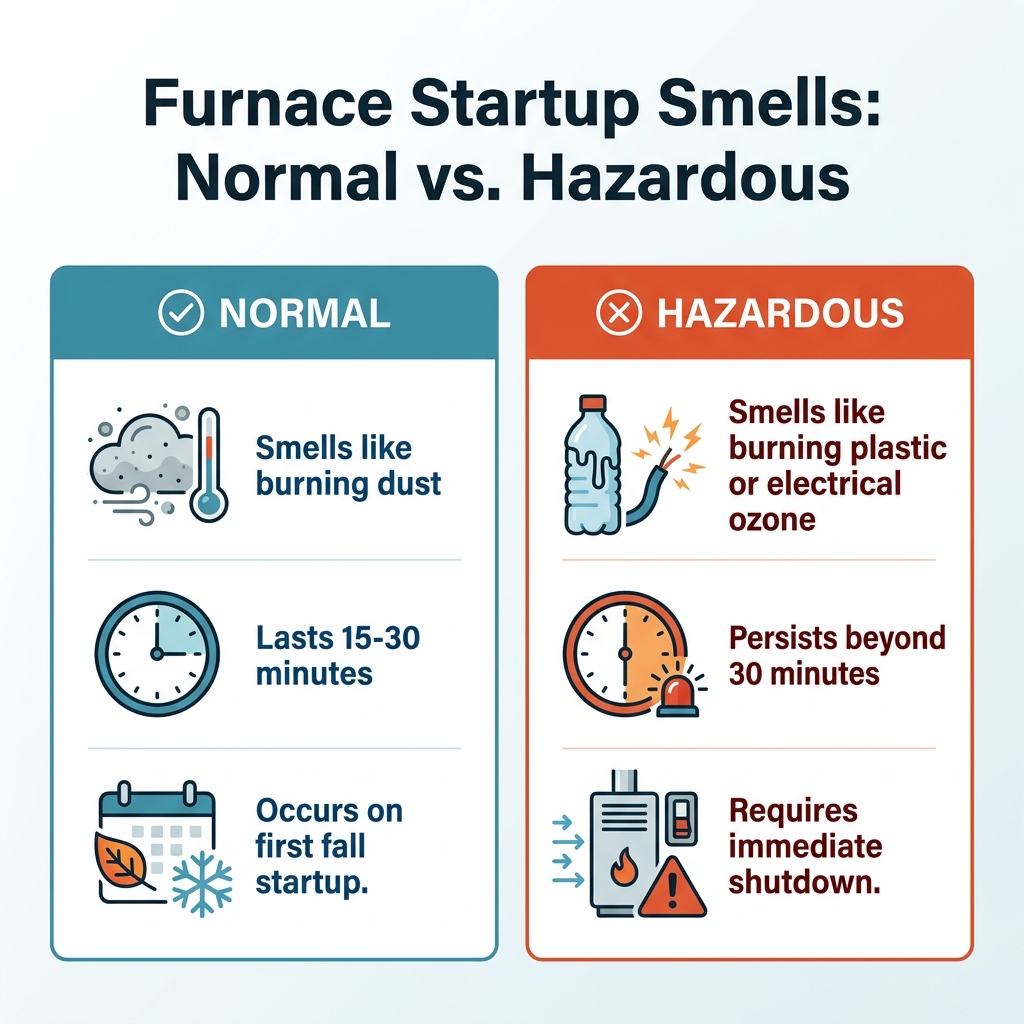
Establishing a definitive, time-bound safety threshold is the most effective way to monitor a startup odor. For normal dust burn-off, the standard rule is that the smell should completely dissipate within 15 to 30 minutes of continuous operation. If the odor falls within this specific window, the system is likely operating normally and safely.
1. Turn on the heat deliberately: Choose a time when you are home and awake to run the furnace for the first time. Do not set it to turn on automatically while you are sleeping.
2. Open windows for ventilation: Instead of immediately shutting the system down when you smell dust, open a few windows to ventilate the harmless smell. This allows the system to complete the burn-off process while keeping your indoor air fresh.
3. Monitor the clock: Note the exact time the furnace ignites. You are looking for a strict 15-30 minutes for normal dust burn-off.
4. Observe the vents: The smell should peak within the first five minutes and steadily decrease over the next twenty minutes.
5. Assess the outcome: If the smell completely vanishes within the half-hour mark, your system has successfully cleared the summer dust.
Emphasizing this timeline provides a critical baseline for home maintenance tips and troubleshooting. It gives you a concrete metric to measure against, ensuring you do not ignore a persistent problem or panic over a harmless, temporary condition.
Our team always stresses that while a brief dusty smell is harmless, other odors indicate severe mechanical failures or safety hazards that require immediate intervention. Clearly differentiating between harmless dust burn-off and dangerous electrical or mechanical smells is vital for the safety of your home. If an odor persists beyond the 15-30 minutes for normal dust burn-off, or if it smells like anything other than dry dust, you must take action.
• Burning plastic or rubber: This distinct, harsh chemical smell often indicates a melting wire casing, a failing capacitor, or an overheated blower motor belt. It will not go away on its own and poses a severe fire risk.
• Electrical ozone: Often described as smelling like a lightning storm or overheated metal, an ozone smell points to an electrical short or a failing motor drawing too much amperage.
• Rotten eggs or sulfur: If you have a gas furnace, this smell indicates a natural gas leak. This is an immediate, critical emergency.
• Continuous smoky odor: If the smell of burning dust does not fade after the 15-30 minute window, or if it sets off your smoke alarms, the system may be overheating or suffering from severe airflow restriction.
• Smells like dusty/dry heat — Likely Cause: Settled summer dust on heat exchanger — Required Action: Monitor for 15-30 minutes; open windows.
• Smells like melting plastic — Likely Cause: Failing electrical components or wiring — Required Action: Shut off immediately; call a professional.
• Smells like electrical ozone — Likely Cause: Overheating blower motor or short circuit — Required Action: Shut off immediately; call a professional.
• Smells like rotten eggs — Likely Cause: Natural gas leak — Required Action: Evacuate, call utility company, then HVAC pro.
If you encounter any of the hazardous odors listed above, the exact protocol is to shut the system off immediately at the thermostat. Do not wait to see if the smell improves. Furthermore, we strongly advise against DIY internal furnace inspections; never open the cabinet to investigate electrical smells yourself. High-voltage components and combustible gases require a licensed professional. Ignoring persistent electrical smells can lead to catastrophic mechanical failures or severe safety hazards, making it imperative to programar una revisión técnica at the first sign of trouble.

Most modern residential HVAC systems share a central air handler. This means the blower motor that pushes cold air in July is the exact same motor pushing hot air in October. Because of this shared infrastructure, issues from the summer cooling season frequently carry over to the mid-fall heating startup, bridging the gap between AC troubleshooting and furnace performance.
Consider a situation our team frequently encounters in San Jose where an AC unit failed during the summer after being improperly maintained. When our qualified technicians arrive to properly service the malfunctioning system with honesty, we accurately diagnose and correctly resolve the persistent AC issues. If those issues—such as a heavily soiled blower wheel or restricted airflow—had been left unresolved, that same struggling blower motor would now be responsible for pushing heated air through your home. A motor that strains to move air will overheat, contributing an electrical burning smell that compounds the normal dust burn-off.
Unresolved AC problems, such as restricted airflow from a clogged filter or dirty evaporator coils, exacerbate the burning dust smell when the heat turns on. When airflow is restricted, the heat exchanger gets hotter than it normally would, causing the settled dust to burn off much more aggressively. Additionally, a dirty system from summer cooling will circulate that same dust through the ductwork the moment the heat engages.
Proper troubleshooting requires looking at the HVAC system holistically across both seasons. You cannot treat the air conditioner and the furnace as completely isolated units. Ensuring your cooling system is clean and functioning correctly is the best way to guarantee a smooth transition into the heating season. Understanding lo que revisamos primero en San José cuando el AC no enfría gives you insight into the very same components that dictate your furnace's startup success.
While a brief odor during the mid-fall heating startup is normal, you do not have to simply accept a house full of smoke. There are several actionable, safe home maintenance tips you can perform to reduce startup smells without resorting to dangerous DIY internal work.
• Change the air filter early: We recommend changing the air filter before the mid-fall heating startup. A fresh filter ensures clean airflow, reduces airborne dust, and prevents the blower motor from straining.
• Clear the mechanical room: Clear the area around the furnace of any stored summer items, boxes, or debris. Furnaces require ample clearance for combustion air, and combustible items stored too close present a severe fire hazard.
• Clean the vent registers: Vacuum the supply and return vents in your living spaces. Dust often settles inside the registers during the summer, and the first blast of hot air will push that dust straight into your rooms.
Beyond these homeowner-safe steps, our team recommends professional pre-season inspections as the most effective way to minimize odors. One of our licensed technicians can clean the heat exchanger safely, removing the bulk of the settled dust before it ever has a chance to burn. With 20 years of experience and our status as a Day and Night Elite Dealer, Precision Heating & Cooling has the established authority to safely diagnose complex seasonal transitions. Trusting an elite dealer like us ensures your equipment is evaluated to the highest manufacturer standards. Additionally, local utility incentives or federal tax credits may apply to qualifying high-efficiency upgrades, making fall an excellent time to evaluate your system's overall health.
Regular upkeep prevents panic during the first major temperature drop. By scheduling a plan de mantenimiento preventivo, you ensure that your system is clean, calibrated, and ready to provide safe, odor-free warmth the moment you need it.
Our team typically sees the smell completely dissipate within 15 to 30 minutes of continuous operation. This timeframe is the standard baseline for 15-30 minutes for normal dust burn-off. If the odor continues past the half-hour mark, it is no longer considered normal settled dust. In that case, you should shut the system down and contact a professional.
Yes, it is entirely normal due to dust settling on the heat exchanger during the months it was not in use. When the mid-fall heating startup occurs, the burners heat the metal plates to high temperatures, incinerating the microscopic debris. The resulting smell is simply the byproduct of this harmless physical process.
While normal household dust burns off harmlessly inside the heat exchanger, excessive debris or items stored too close to the unit can pose a hazard. The dust inside the unit will not spark a house fire, but restricting the furnace's airflow with dirty filters can cause the unit to overheat. Always keep the physical area around the furnace clear of boxes, chemicals, and clutter.
You should be concerned if the smell resembles burning plastic, melting rubber, or electrical ozone, or if a dust smell persists beyond 30 minutes. These odors indicate electrical shorts, failing motors, or melting wire casings. Additionally, a rotten egg smell indicates a gas leak, which requires immediate evacuation and emergency response.
No, setting the temperature higher does not speed up the process; the burners run at the same temperature regardless of the thermostat setting. The thermostat only dictates how long the system runs, not how hot the flames get. Pushing the thermostat to 85 degrees will only waste energy without clearing the dust any faster.
Because they share the same ductwork and blower motor, a dirty system from summer cooling will circulate that same dust when the heat turns on. If your evaporator coil or blower wheel became caked with debris over the summer, that restriction forces the furnace to run hotter. Maintaining clean cooling equipment directly leads to cleaner, safer heating startups.
Navigating seasonal transitions does not have to be a stressful experience. A brief odor during the mid-fall heating startup is a perfectly normal occurrence that usually resolves within the standard 15-30 minutes for normal dust burn-off. By changing your filters, clearing the area around your equipment, and monitoring the initial startup timeline, you can enjoy a warm house without the panic.
However, you should never ignore lingering smells, electrical odors, or the scent of melting plastic. These require immediate professional attention to protect your property and your family. If there is any doubt about your system's safety or performance, scheduling a professional inspection provides the ultimate peace of mind. Let our experts at Precision Heating & Cooling ensure your heating system is clean, safe, and ready to handle whatever the colder months bring.

Leslie was amazing for her outstanding customer service skills with me the other day. Thanks to her help my air conditioner is now all set up. She answered all my questions and took away all my problems. Leslie broke it down step by step to set it up easier. Now thanks to her my air conditioner is working perfectly. I really appreciate it Leslie and I’ll be sure to ask for you if I ever come back.
I contacted Precision Heating and Cooling for my home's AC repair. They were punctual and very professional. Guillermo was very kind and thorough. I would highly recommend them!
I am writing to express my sincere appreciation for the excellent work performed by Pablo and Alejandro from Precision Heating and Cooling. Their commitment to quality and customer satisfaction is truly commendable. Awesome job guys!
I would like to extend my sincere gratitude to Alejandro for his exceptional hard work. His passion for helping others is evident, and he consistently goes above and beyond in his service. Alejandro's thorough cleaning of my fireplace has truly made a significant difference. His dedication and professionalism are greatly appreciated.
I was very impressed. Came at night (after 9pm) to fix our AC during the middle of a heat wave the day before a national holiday! Technician was very courteous and efficient, got the job done quickly. Will definitely call them again for any AC servicing I need!
Fast and efficient, arrived when scheduled for repairs and replacement parts were ordered and installed quickly. Techs were very friendly and professional. AC system works great now! I highly recommend their services if you need repairs. Tim



.avif)
