


.avif)





Recent Blogs
Stay updated with our latest blog posts.


If you are standing by your thermostat on the first chilly October morning, smelling a sudden burning odor and urgently searching for common homeowner questions answered, you are not alone. The moment your heating system clicks on for the first time after a long summer, a wave of warm air often brings an alarming, dusty, burning scent with it. Your immediate reaction is likely concern. You might find yourself wondering if you need to shut the system down immediately, evacuate the house, or call the fire department. That momentary panic is completely understandable, but in the vast majority of cases, this specific odor is a harmless part of the seasonal transition.
The primary decision you face right now is whether to turn the system off or let it run. The short answer is that a brief, dry, burning dust odor is the single most common symptom of a normal seasonal startup. When your furnace sits unused for months, it naturally collects a layer of household particulates. The moment the burners ignite, that layer incinerates. We support local homeowners through every phase of the year, offering complete guidance on sistemas de climatización HVAC for winter heating, as well as expert reparación de aire acondicionado when the summer heat eventually returns. Right now, your focus is on heating safely. By understanding exactly what is happening inside your ductwork, you can confidently monitor the situation without unnecessary stress.
To understand why your house smells like a dusty campfire, it helps to know what happens inside your furnace. The core component responsible for warming your home is the heat exchanger. This is a large metal chamber that gets incredibly hot. It separates the dangerous combustion gases from the clean air that blows into your living spaces. During the months your system is turned off, this metal surface acts like a magnet for airborne particles in the San Jose Bay Area.
When you finally switch your thermostat to "heat," the burners ignite and rapidly heat that metal chamber. The settled dust, pet dander, and microscopic debris resting on the surface are instantly vaporized by the high temperatures. Because the blower fan immediately pushes air over this hot metal and into your ductwork, that burnt-dust smell is carried directly into every room of your house within seconds. This is a surface-level burn-off process, not an internal mechanical failure. Your furnace is functioning exactly as designed; it is simply cleaning its own internal surfaces through heat.
You might keep an impeccably clean house and still experience a strong odor. That is because the particles we are talking about are microscopic. Here is what is actually incinerating on the heat exchanger:
• Microscopic skin cells: The primary component of standard household dust.
• Pet dander and hair: Extremely light particles that easily bypass standard air filters.
• Textile fibers: Microscopic threads from carpets, clothing, and furniture upholstery.
• Pollen and outdoor allergens: Airborne particles that drift indoors during the long summer months.
The smell is highly pungent because these organic materials are being subjected to sudden, intense heat. Even a layer of dust thinner than a sheet of paper is enough to create a noticeable odor that fills a standard-sized home.
While a burning dust smell is normal, it should not last all day. To determine if your system is operating safely on that first chilly October morning, you need to follow a clear, actionable timeframe. We call this the 15-to-30 minute safety rule. This gives the furnace enough time to incinerate the accumulated debris without masking a potential ongoing issue.
1. Note the exact time: The moment you smell the odor, look at the clock. Do not guess how long it has been running.
2. Keep the system running continuously: Do not turn the thermostat on and off. Short-cycling the furnace prevents the heat exchanger from reaching the sustained temperature needed to fully burn off the dust layer. Let it run in one continuous cycle.
3. Ventilate the space: Open a few windows and turn on ceiling fans. This helps clear the initial wave of odor and allows you to accurately judge if the smell is dissipating or getting stronger.
4. Evaluate at the 15-minute mark: By this time, the smell should be noticeably weaker. It may still be present, but the intensity should be dropping.
5. Make the final call at 30 minutes: If the smell persists beyond 30 minutes of continuous operation, or if it grows significantly stronger and more acrid at any point, shut the system down immediately at the thermostat.
This rule provides a safe window for normal operation while protecting your home from actual mechanical hazards.
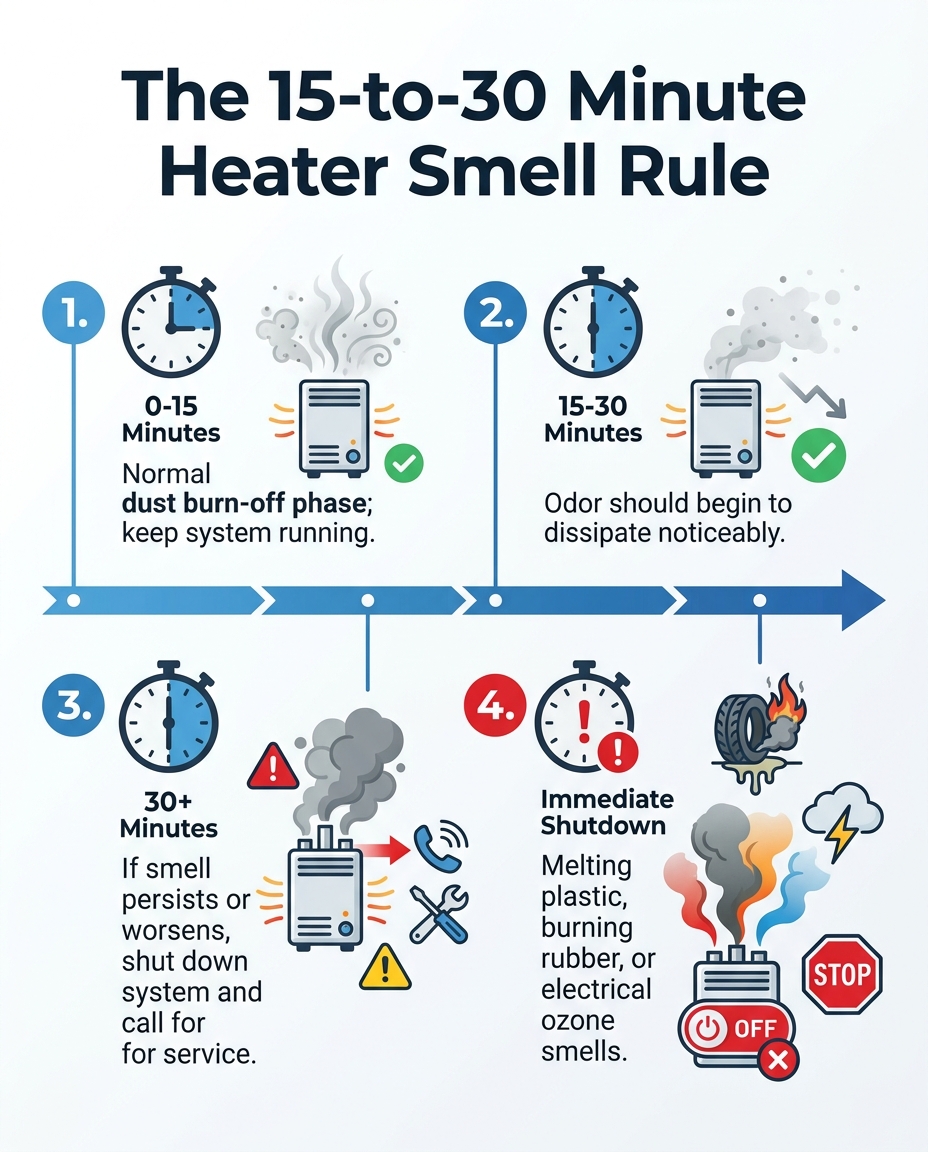

Knowing how to identify the exact type of odor coming from your vents is a critical skill for any homeowner in the San Jose Bay Area. Not all burning smells are created equal. While burning dust is harmless, other scents indicate a true HVAC emergency that requires immediate professional intervention.
A normal dust burn-off smells dry, slightly musty, and very similar to the scent of a space heater that has just been turned on. It is an earthy, stale smell. In contrast, electrical and mechanical failures produce sharp, chemical odors that catch in the back of your throat. If a blower motor is failing, a capacitor is frying, or wire insulation is melting, the scent will be distinctly synthetic.
• Burning Dust — What It Smells Like: Dry, stale, earthy, like a hot radiator — Likely Cause: Settled debris on the heat exchanger — Required Action: Monitor for 15-30 minutes
• Melting Plastic — What It Smells Like: Harsh, chemical, acrid — Likely Cause: Foreign object in ducts or melting wire casing — Required Action: Shut down immediately
• Electrical Ozone — What It Smells Like: Sharp, metallic, similar to a lightning storm — Likely Cause: Overheating blower motor or fried capacitor — Required Action: Shut down immediately
• Burning Rubber — What It Smells Like: Pungent, heavy, distinct tire-like scent — Likely Cause: Slipping or melting fan belt — Required Action: Shut down immediately
Never attempt to open the furnace cabinet to investigate electrical smells yourself. The internal components carry high voltage and pose a severe shock risk. Instead, watch for these secondary signs that indicate a critical failure:
• Visible smoke: If you see actual gray or black smoke coming from your vents, shut the system off immediately. Dust burn-off does not produce visible smoke.
• Popping or sparking sounds: If the burning smell is accompanied by loud pops, cracks, or buzzing noises from the furnace cabinet, you have an electrical short.
• Carbon monoxide alarms: If your CO detector sounds an alarm at any point during the heating cycle, evacuate the home and call emergency services. This indicates a cracked heat exchanger leaking deadly exhaust gases into your breathing air.
If you have recently moved to the area from a colder state, you might be surprised by how intense the startup smell is here. The explanation lies in our specific regional weather patterns. With San Jose's Mediterranean climate, our winters are relatively mild, and our summers are long and dry. This means a typical local furnace sits completely idle for an extended off-season—often from March through late October.
In colder climates, heating systems are used sporadically throughout the spring and early fall, which prevents heavy dust buildup. Here in the San Jose Bay Area, seven to eight months of continuous downtime allows a significant amount of particulate matter to settle deep inside the unit. During our long, dry summers, microscopic dust easily bypasses idle air filters and coats the internal components.
Because the accumulation is much thicker after such a long break, the resulting burn-off odor is naturally stronger and lasts a bit longer. Upgrading your home's filtration can significantly reduce this off-season buildup. Investing in professional calidad del aire interior solutions helps capture these microscopic particles year-round, meaning less dust settles on your furnace components while they sit dormant over the summer.
There is a distinct line between monitoring a harmless seasonal symptom and needing an expert intervention. If you have followed the 30-minute rule and the smell is still lingering strongly, or if your system is short-cycling (turning on and off rapidly before reaching the set temperature), it is time to call a professional. A persistent smell often means the airflow is restricted, causing the furnace to overheat, or that a larger mechanical issue is developing.
A licensed professional has the specialized tools necessary to safely test gas lines, verify heat exchanger integrity, and measure electrical draws. We use combustion analyzers to ensure your system is venting properly and multi-meters to check the health of your blower motor. We bring 20 years of local HVAC experience to every call, allowing us to quickly and accurately diagnose complex failures versus harmless dust burn-off.
Our commitment to rapid, accurate diagnostics applies year-round. One local homeowner reached out to us during a summer heatwave when their cooling unit stopped working unexpectedly. A technician arrived quickly, diagnosed the issue, explained the problem clearly, and successfully restored the system. That same level of urgent, transparent service is exactly what you can expect if you experience a heating scare on that first chilly October morning. To avoid these unexpected breakdowns entirely, enrolling in a comprehensive plan de mantenimiento preventivo ensures your system is cleaned, inspected, and safely prepped before you ever touch the thermostat.
While the first burn odor is normal, you do not have to just accept it as an inevitable part of fall. By taking a few proactive steps before the temperatures drop completely, you can minimize the dust buildup and ensure a smooth, odorless transition into heating season.
Your Pre-Winter Checklist:
• Change the air filter immediately: Do not wait until your summer filter looks completely clogged. Install a fresh, clean air filter right before the first heating cycle. A clean filter ensures maximum airflow, which helps push the initial dust burn-off out of the system faster.
• Schedule a pre-winter inspection: Having a technician clean the burners and inspect the heat exchanger before you turn the system on removes the majority of the settled dust manually, drastically reducing the startup smell.
• Keep the furnace area clear: Ensure the space around your indoor unit is free of stored boxes, laundry, and clutter. A clean perimeter reduces the amount of ambient dust that gets pulled into the system's intake during operation.
• Clean your floor registers: Vacuum the grilles and the visible ductwork just inside your floor or wall vents. Dust settling in the vents over the summer can contribute to the burning smell when hot air hits it.
Understanding how your system operates is the best way to prevent unnecessary panic. If you want to learn more about how different HVAC components interact and why systems sometimes struggle during seasonal transitions, read our guide on qué pasa cuando el aire acondicionado funciona pero no enfría. The more you know about your equipment, the more comfortable you will be operating it.
The most common cause is the incineration of household dust that has settled on the heat exchanger. Over the summer, particles accumulate on the internal metal surfaces of your furnace. When the system ignites for the first time in the fall, the intense heat vaporizes this dust, sending a dry, burning scent through your ductwork. This is a normal, harmless process.
A normal dust burn-off smell should begin to dissipate within 15 to 30 minutes of continuous operation. You may notice a faint lingering scent for an hour or two, but the strong, pungent odor should fade quickly. If the smell remains intense after half an hour, shut the system down and contact a professional.
You should be concerned if the odor smells like melting plastic, burning rubber, or electrical ozone. These distinct chemical smells indicate failing motors, melting wire insulation, or fried capacitors. Additionally, if you see visible smoke, hear loud popping sounds, or your carbon monoxide detector goes off, shut the system down immediately.
Yes, it is generally safe to run the heater if the smell is strictly a dry, dusty odor during the first seasonal startup. In fact, you need to let the system run continuously to fully burn off the accumulated debris. Just be sure to monitor the system closely for the first 30 minutes to ensure the smell begins to fade.
Yes, a severely clogged air filter can restrict airflow, causing the furnace to overheat and produce a burning smell. When the blower motor has to strain against a dirty filter, it can run too hot, leading to an electrical burning odor. Always start the heating season with a brand-new filter to ensure proper airflow and safe operation.
Our mild Mediterranean climate means local furnaces sit completely idle for seven to eight months of the year. This extended downtime allows a much thicker layer of dust and particulate matter to settle on the internal components compared to colder regions where heaters are used more frequently. More settled dust results in a stronger initial burn-off odor.
The bottom line: A brief burning dust smell on the first chilly morning of the year is usually just your furnace clearing its throat after a long summer nap. By following the 15-to-30 minute rule, you can safely monitor the system and ensure your home stays comfortable. If the odor persists, turns chemical, or causes you any ongoing concern, reach out to our team for a rapid, reassuring diagnostic visit.

Leslie was amazing for her outstanding customer service skills with me the other day. Thanks to her help my air conditioner is now all set up. She answered all my questions and took away all my problems. Leslie broke it down step by step to set it up easier. Now thanks to her my air conditioner is working perfectly. I really appreciate it Leslie and I’ll be sure to ask for you if I ever come back.
I contacted Precision Heating and Cooling for my home's AC repair. They were punctual and very professional. Guillermo was very kind and thorough. I would highly recommend them!
I am writing to express my sincere appreciation for the excellent work performed by Pablo and Alejandro from Precision Heating and Cooling. Their commitment to quality and customer satisfaction is truly commendable. Awesome job guys!
I would like to extend my sincere gratitude to Alejandro for his exceptional hard work. His passion for helping others is evident, and he consistently goes above and beyond in his service. Alejandro's thorough cleaning of my fireplace has truly made a significant difference. His dedication and professionalism are greatly appreciated.
I was very impressed. Came at night (after 9pm) to fix our AC during the middle of a heat wave the day before a national holiday! Technician was very courteous and efficient, got the job done quickly. Will definitely call them again for any AC servicing I need!
Fast and efficient, arrived when scheduled for repairs and replacement parts were ordered and installed quickly. Techs were very friendly and professional. AC system works great now! I highly recommend their services if you need repairs. Tim


.avif)
