


.avif)







Recent Blogs
Stay updated with our latest blog posts.


You replaced the safety sensor, the pilot flame is burning strong, and you followed all the relighting procedures perfectly—but the shower is still running cold. Diagnosing a water heater that produces lukewarm water even with a new thermocouple requires shifting your focus away from the gas supply and looking deep inside the tank itself. You secured a major victory by successfully swapping that part and getting the pilot to stay lit. However, as we enter the September pre-heating season, dropping municipal water temperatures make it impossible to ignore the fact that your tank is struggling to heat properly. At Precision Heating & Cooling, we see this exact scenario frequently as San Jose transitions into the fall.
The issue is no longer about combustion; it is about internal mechanical failures preventing heat transfer or proper water flow. When a water heater fails to deliver the expected temperature despite a healthy pilot flame, homeowners often feel stuck. The natural instinct is to suspect that the new part is defective, but that is rarely the case. Instead, the persistent lukewarm water points to hidden culprits like broken internal tubes, severe mineral buildup, or secondary valve failures that require a different approach to troubleshoot.
If you are tired of taking lukewarm showers and want a permanent solution, reaching out for Professional HVAC and Home Services is the most reliable next step. A licensed technician can perform comprehensive Water Heater Repair and Diagnostic Services to pinpoint the exact cause of the failure, ensuring your home is ready for the cooler months ahead.
The problem: In our experience fielding service calls across the South Bay, many homeowners assume that if the pilot light is on, the water heater should be producing hot water. When the water remains stubbornly lukewarm, confusion sets in.
The cause: To understand the disconnect, our technicians usually explain the specific job of the part you just replaced. The thermocouple is strictly a safety device. Its only function is to sense the heat of the pilot flame and generate a tiny electrical current (millivolts) that signals the main gas valve to stay open. If the pilot light stays lit after you release the gas control knob, your new thermocouple is working perfectly. You can confidently rule out the safety sensor as the source of your lukewarm water. For more context on related combustion issues, you can read about Why Your Water Heater Pilot Light Keeps Going Out After a Thermocouple Replacement.
The solution: Heating water requires much more than just a sustained pilot flame. The main gas valve must open fully, the main burner must ignite, the heat must transfer efficiently through the metal bottom of the tank, and the internal plumbing must route the water correctly. When any of these secondary processes fail, the water temperature drops. The two most common internal culprits responsible for this specific scenario are compromised dip tubes and severe thermal insulation caused by hard water scale. Because these issues occur inside the sealed tank, they cannot be fixed by adjusting the external gas components.
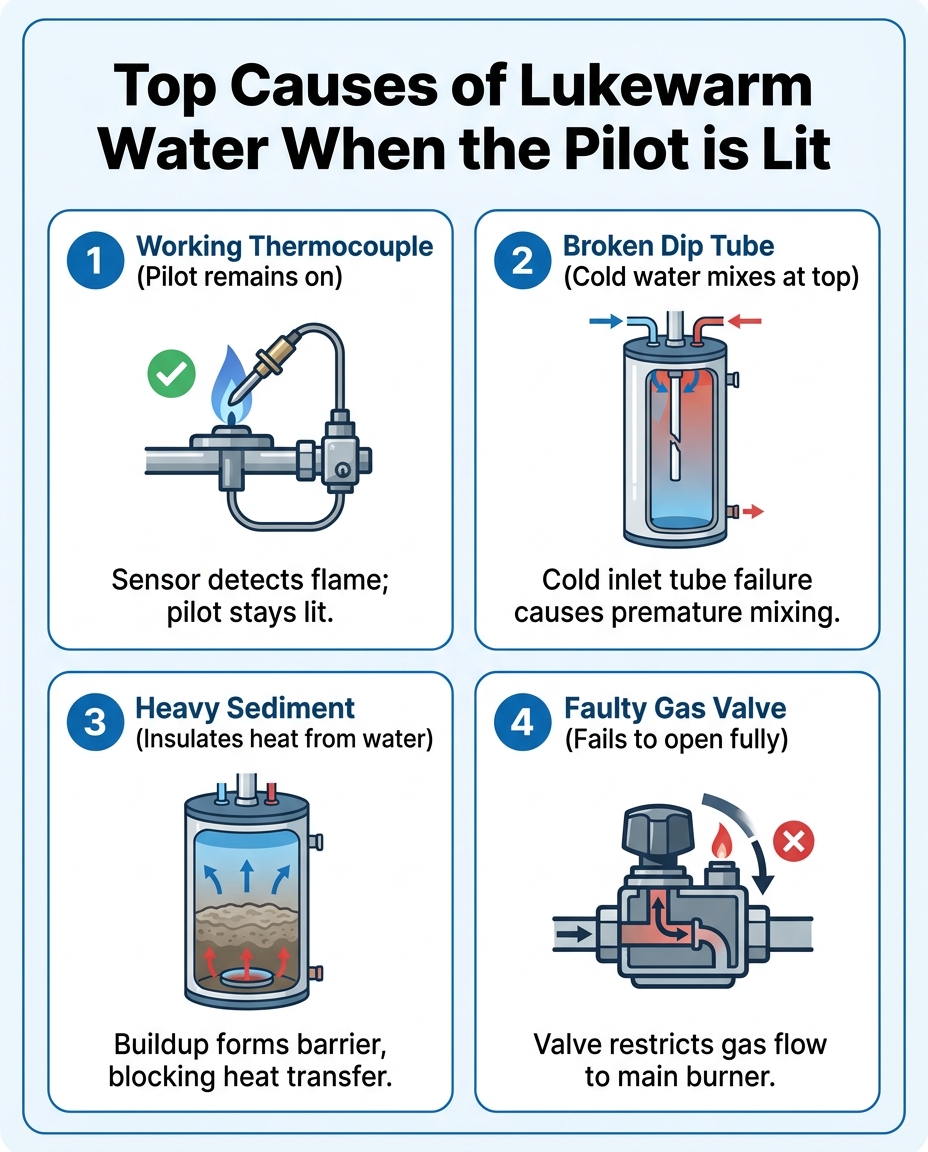

One of the most common non-combustion reasons for a sudden drop in water temperature is a failed dip tube. The dip tube is a long plastic pipe inserted into the cold water inlet at the top of your water heater. Its job is to route incoming cold municipal water all the way down to the bottom of the tank, placing it directly above the gas burner where it can be heated efficiently.
Water heaters rely on a principle called thermal stratification. Because hot water is less dense than cold water, it naturally rises to the top of the tank, where the outlet pipe carries it to your showers and faucets. The cold water stays at the bottom to be heated. This continuous cycle ensures that the water leaving the tank is always at the highest possible temperature.
Over time, the plastic dip tube can become brittle due to constant exposure to heat, pressure, and water chemistry. When the tube shears off or breaks near the top of the tank, the entire heating dynamic collapses. Instead of traveling to the bottom, incoming cold water dumps directly into the top of the tank. It immediately mixes with the heated water that is trying to exit, drastically lowering the overall temperature before it ever reaches your showerhead.
Our Precision Heating & Cooling technicians often meet homeowners in San Jose who mistake a broken dip tube for a failing gas burner because the resulting water temperature is so noticeably poor. However, the symptoms of a broken dip tube are quite distinct from a combustion issue.
• Healthy Dip Tube — Water Temperature Behavior: Consistent hot water until the tank is fully depleted. — Burner Activity: Cycles on normally as cold water fills the bottom.
• Sheared Dip Tube — Water Temperature Behavior: Short burst of hot water, turning lukewarm within minutes. — Burner Activity: May short-cycle or run continuously without improving output.
• Heavy Sediment — Water Temperature Behavior: Water never gets fully hot; overall capacity feels reduced. — Burner Activity: Runs excessively long, often with popping or rumbling noises.
If you experience a brief moment of hot water that rapidly turns lukewarm, your burner is likely functioning properly, but a sheared dip tube is sabotaging the delivery.
The problem: Even if the dip tube is intact and the pilot is lit, the main burner may run for hours without ever bringing the water up to the set temperature.
The cause: The culprit is often a thick layer of mineral scale baked onto the bottom of the tank. San Jose water is notoriously hard, often exceeding 120 to 200 mg/L (7 to 12 grains per gallon). We constantly see the effects of this in the field; when hard water is heated, dissolved minerals like calcium and magnesium precipitate out of the liquid and settle at the lowest point of the tank. Over months and years, this sediment hardens into a dense, rock-like layer.
This sediment layer sits directly between the gas burner flame (located under the tank) and the water inside. Because calcium carbonate is a poor conductor of heat, it acts as a highly effective thermal insulator. The gas burner fires up, but instead of heating the water, it wastes its energy heating the thick layer of rock. The heat struggles to penetrate the sediment, leaving the water above it lukewarm.
This forces the water heater to run much longer than necessary, driving up your energy usage while delivering poorer results. You might notice several warning signs that sediment has taken over your tank:
• Popping or rumbling noises: As water gets trapped under the sediment layer, it boils and bubbles up, creating a loud popping sound similar to a percolating coffee pot.
• Extended recovery times: The tank takes significantly longer to reheat after a shower or load of laundry.
• Fluctuating temperatures: The thermostat struggles to read the water temperature accurately through the scale buildup.
The solution: While routine flushing can prevent this issue from forming, our team finds that severe, hardened buildup usually requires professional intervention. Once the sediment has baked into a solid mass, standard draining will not remove it. Enrolling in a Routine Water Heater Maintenance Plan is the best way to manage San Jose's hard water and keep the bottom of your tank free from insulating scale.
When our experts rule out the dip tube and confirm the tank is relatively free of sediment, we often find the issue lies with the main gas control valve. It is entirely possible for the pilot light to stay lit while the main burner fails to ignite properly.
The gas control valve is the brain of the water heater. It regulates the flow of gas to both the pilot and the main burner. When the internal thermostat senses that the water temperature has dropped below your desired setting, it signals the gas valve to open fully, sending a large volume of gas to the main burner to be ignited by the pilot flame.
However, gas valves are complex mechanical devices that can fail partially. The pilot side of the valve might remain perfectly functional, held open by the millivolts from your new thermocouple, while the main burner side seizes up. If the main valve only opens a fraction of the way, the resulting burner flame will be weak and anemic. A weak flame simply cannot produce enough British Thermal Units (BTUs) to heat 40 or 50 gallons of water, especially during the September pre-heating season when incoming municipal water begins to drop in temperature.
Another secondary failure involves the thermostat probe itself. The probe extends from the back of the gas control valve directly into the water inside the tank. If this probe becomes heavily coated in mineral scale, it loses its ability to sense the actual water temperature. The probe might falsely register that the water is hot, prompting the gas valve to shut off the main burner prematurely. The result is a tank full of lukewarm water and a burner that refuses to turn back on.
The danger of DIY gas repairs: While replacing a thermocouple is a manageable task for a handy homeowner, altering gas lines or replacing a main gas control valve is strictly a job for a licensed professional. Incorrectly threading a gas pipe, failing to properly seal the connections, or improperly setting the manifold gas pressure can result in severe safety hazards. If you suspect the gas valve is failing, it is time to stop troubleshooting and call an expert.
After a successful DIY thermocouple replacement, the frustration of still having lukewarm water often tempts homeowners into a game of "parts roulette." This involves guessing at the next possible cause and replacing parts—such as the gas valve, the thermostat, or the burner assembly—hoping one of them will magically fix the issue. This approach is rarely successful, highly frustrating, and financially wasteful.
Accurately distinguishing between a sheared dip tube, heavy sediment buildup, and a failing gas control valve requires specialized diagnostic experience. A trained technician does not guess; they test. Using calibrated manometers to check gas pressure, multimeters to verify electrical continuity, and visual inspections to assess internal tank health, a professional can identify the exact root cause within minutes.
At Precision Heating & Cooling, our deep professional diagnostic experience has taught us the immense value of accurate troubleshooting over endless DIY part replacements. Our technicians understand exactly how San Jose's unique water chemistry interacts with internal plumbing components, allowing us to quickly separate combustion issues from mechanical failures.
We recently helped a San Jose homeowner who had spent days swapping out parts on their older system before calling us. Rather than throwing random parts at the unit, our technicians accurately diagnosed the core issue and later returned to resolve a secondary complication fully under our service warranty. We apply that exact same diagnostic rigor and commitment to reliability when servicing water heaters. Opening the tank to replace a dip tube or safely disconnecting supply lines to replace a gas control valve requires professional licensing and expertise. Trusting a trained technician ensures the job is done safely, restoring your comfort without the headache of unnecessary expenses.
Once combustion issues are ruled out by a steadily burning pilot light, internal tank failures become the most likely culprits for your lukewarm water. Whether a sheared dip tube is mixing cold water directly into your supply lines, or heavy sediment is blocking the burner's heat from reaching the water, these mechanical issues require a deeper level of intervention.
Your DIY efforts were not in vain—you successfully eliminated the thermocouple as the source of the problem and ensured the safety mechanisms are functioning correctly. However, professional help is now the safest and most effective route to resolve the core issue. As the September pre-heating season progresses and incoming water temperatures continue to drop, ignoring a struggling water heater will only result in colder showers. If a tank replacement ends up being the most cost-effective route, upgrading to a high-efficiency model may even qualify you for generic federal tax credits or utility incentive programs (always verify current programs with your utility or a tax professional). Schedule a professional diagnostic visit today to pinpoint the exact failure, replace the necessary internal components safely, and restore reliable, consistent hot water to your home for the colder months ahead.
Why is my water heater pilot lit but water is lukewarm?
If the pilot is lit, the thermocouple is working, but secondary issues are preventing heat transfer. The most common causes are a broken dip tube mixing cold water at the top of the tank, heavy mineral sediment insulating the water from the burner, or a faulty main gas valve failing to open fully.
How do I know if my water heater dip tube is broken?
The primary symptom of a broken dip tube is a very short burst of hot water that quickly turns lukewarm during a shower. Because the broken tube dumps incoming cold water at the top of the tank instead of the bottom, it immediately mixes with the heated water exiting to your home.
Can sediment cause a water heater to stop heating completely?
Yes, severe sediment buildup can drastically reduce a water heater's ability to heat. The hardened minerals act as a thermal insulator, absorbing the gas burner's heat and preventing it from reaching the water inside the tank, which leads to lukewarm temperatures and long recovery times.
Does a bad thermocouple cause lukewarm water?
No, a bad thermocouple typically results in no hot water at all, because it will shut off the gas supply and extinguish the pilot light completely. If your pilot light is currently burning steadily, your thermocouple is functioning properly and is not the cause of the lukewarm water.
How long does it take for a water heater to recover after a repair?
Once a professional repairs the internal issue, a standard 40- or 50-gallon gas water heater usually takes about 30 to 45 minutes to fully heat the tank. If the water is still lukewarm after an hour of continuous burner operation, further diagnostics may be required to check for secondary failures.

Leslie was amazing for her outstanding customer service skills with me the other day. Thanks to her help my air conditioner is now all set up. She answered all my questions and took away all my problems. Leslie broke it down step by step to set it up easier. Now thanks to her my air conditioner is working perfectly. I really appreciate it Leslie and I’ll be sure to ask for you if I ever come back.
I contacted Precision Heating and Cooling for my home's AC repair. They were punctual and very professional. Guillermo was very kind and thorough. I would highly recommend them!
I am writing to express my sincere appreciation for the excellent work performed by Pablo and Alejandro from Precision Heating and Cooling. Their commitment to quality and customer satisfaction is truly commendable. Awesome job guys!
I would like to extend my sincere gratitude to Alejandro for his exceptional hard work. His passion for helping others is evident, and he consistently goes above and beyond in his service. Alejandro's thorough cleaning of my fireplace has truly made a significant difference. His dedication and professionalism are greatly appreciated.
I was very impressed. Came at night (after 9pm) to fix our AC during the middle of a heat wave the day before a national holiday! Technician was very courteous and efficient, got the job done quickly. Will definitely call them again for any AC servicing I need!
Fast and efficient, arrived when scheduled for repairs and replacement parts were ordered and installed quickly. Techs were very friendly and professional. AC system works great now! I highly recommend their services if you need repairs. Tim


.avif)
