


.avif)






Recent Blogs
Stay updated with our latest blog posts.


Figuring out exactly why your water heater pilot light keeps going out after a thermocouple replacement is one of the most frustrating roadblocks a homeowner can face. You likely spent your Saturday turning off the gas supply, draining the tank, unthreading the old connections, and carefully routing the new copper tubing. You pressed the pilot button, lit the flame, held it down for a minute, and felt a sense of accomplishment. But the moment you let go, or perhaps an hour later, that small blue flame vanished again. As our team at Precision Heating & Cooling helps homeowners prep for early fall and the demand for reliable hot water increases, dealing with a cold shower after you thought you fixed the problem is incredibly discouraging.
Here is the good news: your hard work was not a waste of time. By successfully installing a new thermocouple, you have actually eliminated one of the most common variables in water heater troubleshooting. A new, correctly installed thermocouple that still fails to keep the pilot lit acts as a crucial diagnostic clue. It tells us that the issue is no longer about the sensor itself, but rather about gas flow restriction, a failing internal valve mechanism, or oxygen supply problems within the combustion chamber.
At this stage, you have reached a critical decision point. Swapping out the most accessible part is a standard DIY move, but when that fails, continuing to throw parts at a gas appliance becomes both expensive and dangerous. The remaining culprits require specialized testing equipment and a deep understanding of gas pressures and electrical currents. Instead of guessing at the next fix, this is the exact moment to step back and rely on professional home comfort services.
When you transition from DIY troubleshooting to scheduling a proper water heater repair and inspection, you protect your home from potential gas leaks and ensure the root cause is identified accurately.
If you have already ruled out the thermocouple, the remaining causes usually fall into three main categories: fuel, air, or mechanical failure. To quickly narrow down what might be happening inside your water heater, here are the primary culprits that professionals look for during a diagnostic visit.
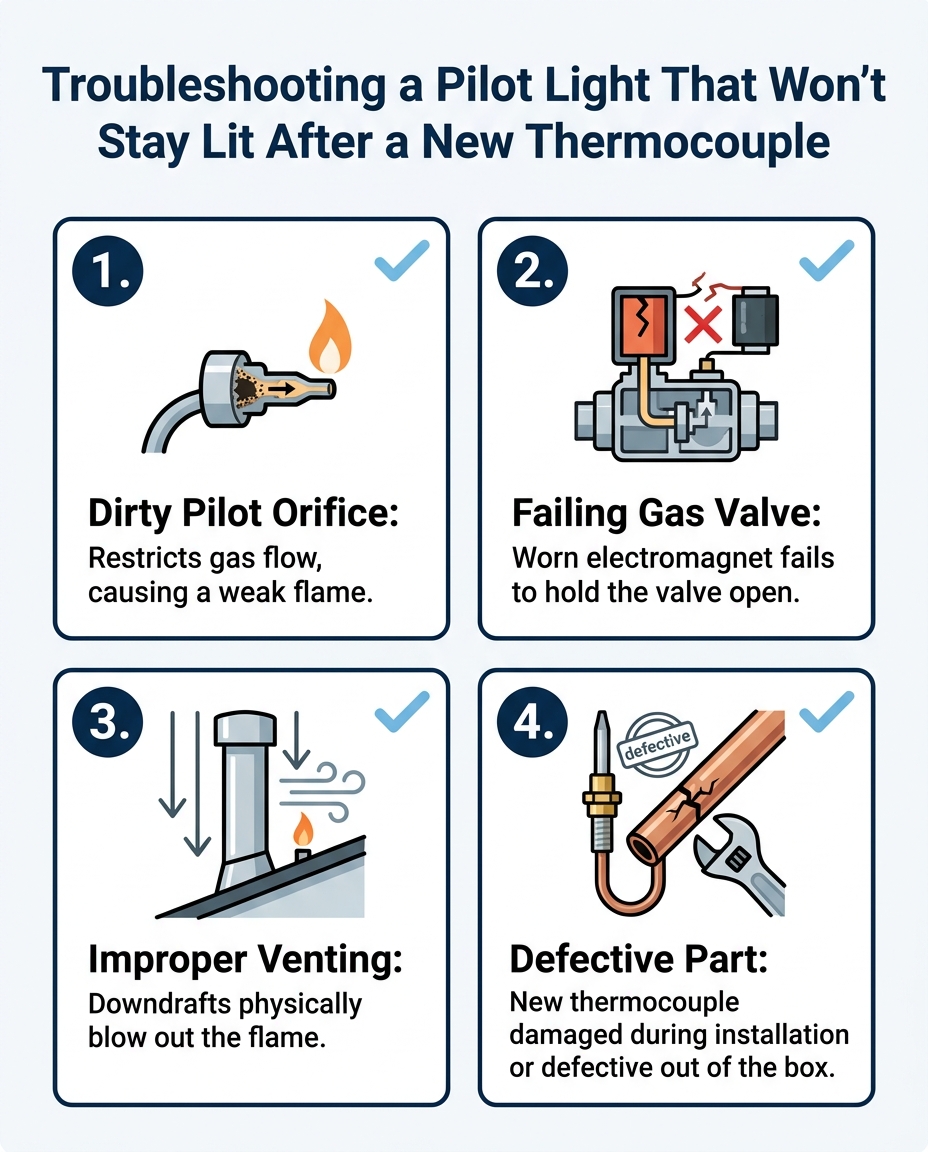
• A dirty pilot tube or clogged orifice: The tiny opening that supplies gas to the pilot flame can easily become obstructed by dust, debris, or spider webs, restricting the fuel needed to create a strong, hot flame.
• A failing gas control valve: The main control box features an internal electromagnetic coil. If this coil wears out, it will refuse to hold the safety valve open, regardless of how much voltage the new thermocouple generates.
• Improper venting or downdrafts: A pilot flame is surprisingly delicate. If your water heater's exhaust vent is improperly configured, gusts of wind can travel down the flue and physically blow the flame out.
• A defective replacement part: While it is relatively rare, new parts can sometimes be defective right out of the box. More commonly, the new thermocouple's soft copper line may have been bent too sharply or overtightened during installation, damaging its internal wiring.
• Main burner ambient temperature issues: Sometimes, the pilot stays lit initially, but when the main burner kicks on, it consumes all the available oxygen or creates erratic drafts inside the chamber, starving the pilot flame.
• Flame is entirely yellow or orange, not blue — Most Likely Underlying Cause: Dirty pilot orifice or restricted air intake
• Flame goes out the exact second you release the button — Most Likely Underlying Cause: Failing gas control valve electromagnet
• Flame stays lit for hours, but goes out on windy days — Most Likely Underlying Cause: Improper venting or severe downdrafts
• Flame looks strong, but still won't stay lit — Most Likely Underlying Cause: Defective or improperly positioned thermocouple

To understand why your pilot light is struggling, it helps to understand how the system generates electricity. Your water heater doesn't plug into a wall outlet to keep the pilot running. Instead, the pilot flame constantly heats the tip of the thermocouple. This heat creates a tiny electrical current—measured in millivolts—that travels up the copper wire to power a small electromagnet inside the gas valve. If the flame is not hot enough, the current drops, the magnet releases, and the gas shuts off.
The pilot orifice is responsible for regulating the exact, tiny amount of gas needed to sustain that pilot flame. The opening on this orifice is microscopic—often no larger than a pinhole. Because it is so small, even a single grain of sand or a tiny speck of lint can partially block the flow of gas. When gas flow is restricted, the resulting flame becomes weak, lazy, and often yellow instead of a sharp, hot blue.
In our years of servicing home comfort systems across San Jose, our team has found this to be a particularly common issue. Our technicians frequently see how our region's dry summer season leads to significant dust accumulation, especially in unconditioned utility spaces and garages where most water heaters are installed. Over the months, the natural draft of the water heater pulls this dusty air directly into the combustion chamber. The dust settles over the pilot assembly, effectively choking the orifice.
Even with a brand new thermocouple installed perfectly, a weak flame simply cannot generate the necessary millivolts to keep the safety valve open. Cleaning this delicate assembly requires precision. The orifice is made of soft metal, and poking it with a needle or wire can easily widen the hole, permanently ruining the part and creating a dangerous gas flow imbalance. This is why addressing environmental dust through routine preventative maintenance is so critical for the longevity of your utility appliances.
If the pilot orifice is completely clean, the flame is a strong blue, and the new thermocouple is perfectly positioned, the diagnostic focus shifts to the gas control valve itself. The gas control valve is the central command hub of your water heater. It regulates the thermostat, controls gas flow to the main burner, and houses the critical safety mechanisms that prevent raw gas from flooding your home.
Inside that valve sits a small electromagnetic coil. When you press and hold the pilot button, you are manually pushing a plunger that opens the gas line. Once the thermocouple heats up and sends its millivolt current to the coil, the coil becomes magnetized and holds that plunger open for you. However, these electromagnets endure constant heat and mechanical stress. Over time, the coil can simply wear out. When this happens, the magnet loses its strength. No matter how much voltage your new thermocouple produces, a dead electromagnet will drop the plunger the second you take your thumb off the button.
A pattern we see often at Precision Heating & Cooling is homeowners calling us in frustration after multiple failed repair attempts. Just recently, during a pre-heating-season tune-up, our technicians arrived to find a unit completely non-operational because of a dead electromagnet. Instead of letting the customer guess at more parts, our team used diagnostic tools to pinpoint the failure, got the unit up and running safely, and fully informed the customer about the specific mechanical issue inside their control system.
Testing and replacing a gas control valve is not a weekend DIY project. It requires a specialized multimeter to read the exact millivolt output under a load, and a manometer to verify that the gas manifold pressure meets strict safety standards. Precision Heating & Cooling is committed to thorough, accurate diagnostics—using the proper tools to pinpoint the exact failure point between the valve, the venting, or the orifice. This precise approach ensures homeowners in San Jose do not waste money buying unnecessary parts. Furthermore, replacing a gas valve involves breaking and resealing major gas line connections. Mistakes here can lead to highly dangerous leaks. If you are noticing a faint gas smell when your water heater ignites, or if you suspect your valve has failed, it is time to call a licensed professional immediately.
Sometimes, the problem isn't a mechanical failure or a dirty part at all. A pilot light requires a steady, undisturbed supply of oxygen and a relatively calm environment inside the combustion chamber to stay lit. If the atmospheric conditions around your water heater are unstable, the flame can simply be blown out.
Modern homes are built to be remarkably airtight. While this is great for energy efficiency, it can create unintended consequences for gas appliances. When exhaust fans, clothes dryers, or powerful range hoods run, they pull air out of the house. If there is not enough replacement air coming in, the house can experience negative pressure. The home will try to pull air from anywhere it can—including down the exhaust flue of your water heater. This sudden rush of air traveling backward down the vent pipe can easily extinguish a pilot flame.
As we enter September, our team notices that early fall weather transitions can dramatically alter garage drafting dynamics in San Jose homes. As the outdoor temperatures begin to drop and seasonal winds pick up, previously unnoticed venting issues are suddenly exposed. A poorly designed draft hood or a vent pipe with too many elbows can fail to exhaust combustion gases properly, creating turbulence that suffocates the flame.
Signs of severe venting issues include localized heat damage, melted plastic rings around the water heater's water connections, or dark soot buildup near the draft hood. Because improper venting can also cause dangerous carbon monoxide to spill back into your utility space, this issue requires an expert eye. Ensuring your flue pipes are drafting correctly is a vital part of comprehensive heating system care as you prepare your home for the cooler months ahead.
The most common secondary causes are a dirty pilot orifice, a failing gas control valve, and downdrafts caused by improper venting. When dust clogs the tiny gas orifice, the resulting flame is too weak to heat the sensor. Alternatively, if the internal electromagnet in the gas valve wears out, it will refuse to stay open regardless of how well the other parts are functioning.
A bad gas valve typically reveals itself when the pilot light goes out the exact second you release the manual pilot button, even after replacing the thermocouple. It can also fail by refusing to ignite the main burner even when the pilot is successfully lit. Confirming a bad valve requires a professional technician using a multimeter and a manometer to test the electrical and gas pressure safely.
Yes, while it is rare, out-of-the-box manufacturing defects do happen with new components. More frequently, a new thermocouple is accidentally ruined during the installation process. Bending the soft copper tubing too sharply or overtightening the connection nut at the gas valve can easily break the fragile internal wiring, rendering the new part useless.
This specific symptom almost always means the electromagnet inside the gas control valve is not engaging to hold the safety plunger open. This points directly to one of two things: either the flame is too weak to generate sufficient millivolts, or the electromagnet itself has died and the entire gas valve must be professionally replaced.
No, it is absolutely never safe to bypass or tamper with the gas control valve. This component is a critical, life-saving safety device designed to immediately shut off the flow of gas if the flame goes out. Bypassing it can allow raw, unburned gas to flood your home, creating a severe fire and explosion hazard.
Reaching the limit of DIY troubleshooting is frustrating, especially when you have already invested your weekend into replacing the thermocouple. However, recognizing when to stop swapping parts is the smartest move a homeowner can make. The remaining culprits—whether it is a clogged orifice, a failing electromagnetic valve, or unpredictable early fall drafts disrupting your venting—all require specialized diagnostic tools and strict safety protocols to resolve.
At Precision Heating & Cooling, we believe you deserve a clear, empathetic explanation of what is actually going wrong inside your system, along with a safe, permanent resolution. Instead of making another trip to the hardware store for parts you might not need, let a licensed professional pinpoint the exact issue. Schedule an expert inspection today to restore your hot water safely and efficiently.

Leslie was amazing for her outstanding customer service skills with me the other day. Thanks to her help my air conditioner is now all set up. She answered all my questions and took away all my problems. Leslie broke it down step by step to set it up easier. Now thanks to her my air conditioner is working perfectly. I really appreciate it Leslie and I’ll be sure to ask for you if I ever come back.
I contacted Precision Heating and Cooling for my home's AC repair. They were punctual and very professional. Guillermo was very kind and thorough. I would highly recommend them!
I am writing to express my sincere appreciation for the excellent work performed by Pablo and Alejandro from Precision Heating and Cooling. Their commitment to quality and customer satisfaction is truly commendable. Awesome job guys!
I would like to extend my sincere gratitude to Alejandro for his exceptional hard work. His passion for helping others is evident, and he consistently goes above and beyond in his service. Alejandro's thorough cleaning of my fireplace has truly made a significant difference. His dedication and professionalism are greatly appreciated.
I was very impressed. Came at night (after 9pm) to fix our AC during the middle of a heat wave the day before a national holiday! Technician was very courteous and efficient, got the job done quickly. Will definitely call them again for any AC servicing I need!
Fast and efficient, arrived when scheduled for repairs and replacement parts were ordered and installed quickly. Techs were very friendly and professional. AC system works great now! I highly recommend their services if you need repairs. Tim


.avif)
