


.avif)







Recent Blogs
Stay updated with our latest blog posts.


You are standing in the garage, the tank kicks on, and you immediately wonder: Is that faint gas smell normal when my water heater ignites? At Precision Heating & Cooling, we receive calls every week from frantic San Jose homeowners who catch a sudden whiff of that unmistakable mercaptan or rotten egg odor near a major appliance. It is completely natural to feel an immediate spike of anxiety. Gas systems demand profound respect, and human senses are biologically wired to alert us to potential danger. However, in our over two decades of local experience, we have learned that before you panic and assume the worst, it is critical to understand the distinction between a harmless, momentary ignition puff and a continuous, hazardous gas leak.
If you are ever in doubt about the safety of your home's appliances, reaching out to our team for professional heating services is always the most secure choice. But in many cases, a very brief odor exactly at the moment of ignition is a standard byproduct of the combustion process.
The quick fix: Take a step back and time the odor. Does it vanish instantly, or does it persist?
Because natural gas is highly combustible, utility companies intentionally odorize it to ensure even the smallest leaks are detectable. This means your nose is picking up on trace amounts of gas that are often too small to pose a threat. The core decision point for any homeowner is determining whether that trace amount is simply unburned fuel escaping during a normal startup sequence, or if a valve or pipe is actively leaking fuel into the home. Establishing a calm, observant approach prevents unnecessary panic while prioritizing your household's safety.
To understand why you might smell gas, it helps to understand exactly what happens inside the combustion chamber. Natural gas in its raw state is completely odorless. Utility providers add a chemical compound called mercaptan, which provides that distinct rotten egg odor, specifically as a safety warning. Because this odorant is incredibly potent, human noses can detect it at less than one part per billion.
When a gas water heater starts its heating cycle, a precise mechanical sequence occurs. If any part of this sequence falls out of calibration, it might be time to look into water heater repair and inspection.
1. The Call for Heat: The internal thermostat detects that the water temperature has dropped below the set threshold and sends a signal to the gas control valve.
2. The Valve Opens: The mechanical gas valve clicks open, allowing pressurized natural gas to flow into the burner assembly.
3. The Ignition Delay: There is a fraction of a second between the gas valve opening and the pilot light (or electronic igniter) catching the fuel to create a flame.
4. The Combustion Phase: The burner ignites with a soft sound, and the gas begins heating the tank.
During step three—the milliseconds before the flame catches—a microscopic amount of unburned gas escapes into the combustion chamber and drafts outward. This tiny, momentary release is what causes the brief odor. It is a mechanical reality of gas appliances, not a flaw in the system.
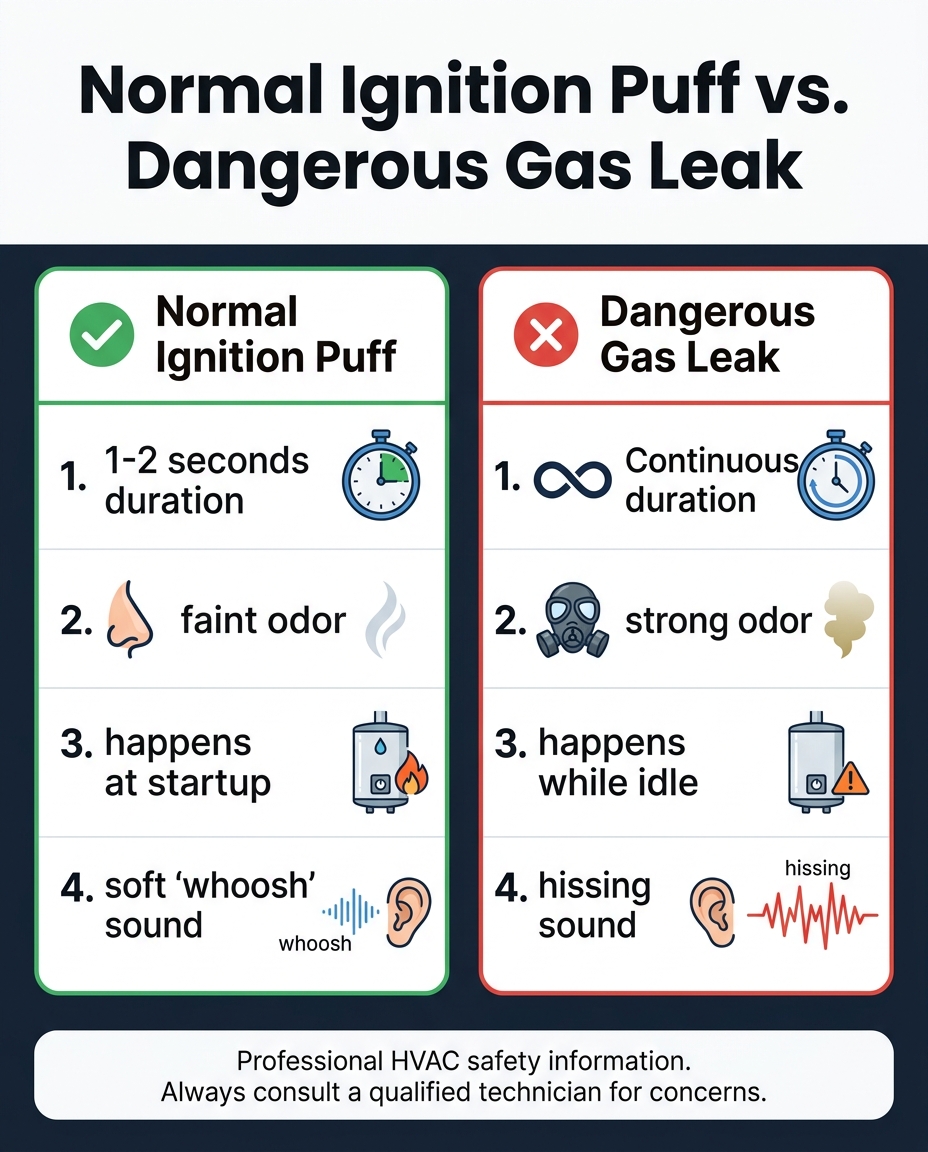
Differentiating between a normal mechanical function and a dangerous situation comes down to timing, duration, and intensity. A healthy system operates predictably, while a compromised system will display clear warning signs.
• Duration — Normal Ignition Puff: Lasts only 1 to 2 seconds before fading completely. — Dangerous Gas Leak: Continuous odor that does not dissipate over time.
• Timing — Normal Ignition Puff: Happens strictly at the moment the burner turns on. — Dangerous Gas Leak: Happens while the unit is completely idle and off.
• Odor Intensity — Normal Ignition Puff: Very faint trace of mercaptan or rotten egg odor. — Dangerous Gas Leak: Strong, overpowering smell that fills the immediate area.
• Auditory Clues — Normal Ignition Puff: A soft, muffled "whoosh" as the burner catches. — Dangerous Gas Leak: A continuous, high-pitched hissing sound near the pipes.
What to look and listen for:
• Monitor the idle state: Walk past the unit when it is not actively heating water. If you smell gas, it is a leak.
• Listen closely: A normal ignition has a distinct, brief sound. Hissing indicates gas escaping under pressure from a compromised fitting.
• Check the connections: While you should never attempt repairs, visually inspecting the yellow or black gas line for severe kinks can provide clues.
Reiterate this golden rule: If there is ever any doubt in your mind, treat the situation as an active leak. It is always better to have a professional confirm a false alarm than to ignore a genuine hazard.

Environmental factors play a massive role in how we perceive gas odors. Water heaters are typically located in unventilated garages, utility closets, or basement corners. These locations are prone to poor air circulation, which can dramatically alter how a normal ignition puff behaves.
San Jose's moderate climate means water heaters run consistently year-round, but as families transition back to school and face those intense August late-summer heatwaves, a closed garage creates a unique challenge. Our technicians frequently notice that high ambient temperatures create a blanket of stagnant air. Because the mercaptan odorant and natural gas can become heavy in stagnant, unventilated spaces, they tend to trap near the floor rather than drafting up and away.
In a well-ventilated space during the cooler months, a two-second puff of unburned gas is swept away by natural drafts so quickly that you likely never notice it. However, in a sweltering, sealed garage, that exact same microscopic puff has nowhere to go.
The quick fix: If you notice a faint smell immediately after the tank fires up, safely increase the ventilation. Open the main garage door or a utility room window for a few minutes. If the smell clears out and does not return while the unit is running, you were likely just dealing with trapped stagnant air holding onto a normal ignition puff. If the smell persists despite fresh air, you must assume a leak is present.
Modern gas water heaters are equipped with robust safety mechanisms designed to prevent unburned fuel from flooding your home. The most critical of these components is the thermocouple.
The thermocouple is a small thermoelectric device positioned directly inside the pilot light flame. As the pilot flame heats the tip of the thermocouple, it generates a tiny electrical current—measured in millivolts. This current travels up a copper wire to the main gas control valve, acting as an electromagnetic lock that holds the valve open. If the pilot light goes out for any reason, the thermocouple rapidly cools down. The electrical current stops, and the gas valve snaps shut automatically, cutting off the fuel supply entirely.
While the thermocouple is an excellent safety net, it degrades over time due to constant exposure to heat. When our experts inspect water heaters, we often find that a failing thermocouple may not generate a strong enough current to open the gas valve swiftly. This can cause ignition delays.
• Delayed Ignition: The gas valve opens slightly, but the burner takes too long to catch, releasing a larger puff of gas into the room.
• Pilot Outages: The pilot light refuses to stay lit, requiring constant relighting.
• Inconsistent Heating: The burner shuts off prematurely before the water reaches the target temperature.
If you are experiencing delayed ignitions that result in stronger gas smells, the system requires professional attention. Navigating the intricacies of repairing vs. replacing a tripped water heater thermocouple is a delicate process that our certified technicians handle safely for San Jose families every day.
If the odor is strong, continuous, or occurring while the burner is entirely off, you have moved past a normal ignition puff and are now dealing with an active gas leak. In these scenarios, immediate and decisive action is required to protect your property and your family.
Our team at Precision Heating & Cooling brings over 20 years of hands-on experience protecting San Jose homes. Because our community-focused approach prioritizes your safety above all else, we insist our customers follow these strict safety protocols without exception when a leak is suspected.
1. Do not touch anything electrical: Do not flip light switches, do not unplug appliances, do not use the garage door opener, and do not use your cell phone near the unit. Even the microscopic spark from a light switch can ignite accumulated gas.
2. Shut off the gas supply (if safe): If you can do so without breathing in heavy gas, locate the dedicated gas shutoff valve on the pipe leading directly to the water heater. Turn the handle a quarter-turn so it is perpendicular to the pipe to stop the flow of fuel.
3. Evacuate immediately: Get all family members and pets out of the house. As you leave, leave doors and windows open to allow the gas to vent outdoors.
4. Make the call from outside: Walk a safe distance away from the property before using your cell phone. Call PG&E (the local utility provider) or dial 911 to report the leak.
Never attempt DIY repairs on compromised gas lines or valves. Gas systems require specialized tools, pressure testing, and professional licensing to ensure they are sealed and operating safely.
A tiny amount of gas escapes between the valve opening and the burner lighting. This is known as an ignition puff and is a standard mechanical function of gas appliances. Because natural gas is odorized with mercaptan, human noses easily detect this microscopic, unburned release, which should dissipate almost instantly.
Only at the exact moment of ignition. If you catch a faint whiff right as the burner clicks on, it is generally harmless. However, if the unit is completely idle and you smell gas, or if the smell is continuous, you are dealing with a leak that requires professional inspection.
Typically 1 to 2 seconds. In a well-ventilated area, the normal ignition puff vanishes immediately. In a poorly ventilated space or a hot, closed garage, the stagnant air may cause the faint mercaptan or rotten egg odor to linger slightly longer, but it should never continuously generate.
Assess if it is a momentary puff or a continuous smell. If it is a brief puff during startup, monitor it to ensure it dissipates. If the smell is continuous, strong, or accompanied by a hissing sound, evacuate your home immediately and call the utility company from a safe distance.
Worry if the smell is strong, continuous, accompanied by a hissing sound, or happens when the burner is off. These are clear indicators that a pipe fitting, gas valve, or supply line has failed. A normal system will never leak fuel while sitting in an idle state.
Yes, lack of airflow can trap the faint odor near the floor, making it seem like a persistent issue. Because gas and odorants can settle in unventilated spaces, a normal two-second release can take much longer to clear out, often causing unnecessary alarm for homeowners, a pattern our team sees frequently during late-summer service calls.
In our experience, guessing with gas appliances is never worth the risk. While understanding the mechanics of a normal ignition puff can prevent unnecessary panic, relying on a professional assessment is the only way to guarantee your home's safety. If you are ever unsure about your water heater's behavior, or if you notice the startup odors becoming stronger or more delayed over time, it is time to call in the experts.
Regular inspections ensure that your thermocouple, gas valve, and burner assembly are all operating in perfect harmony. Enrolling in a routine preventative maintenance plan with our team is the most effective way to keep your system safe, efficient, and reliable for years to come in San Jose. Protect your home by letting our certified professionals handle the technical details.

Leslie was amazing for her outstanding customer service skills with me the other day. Thanks to her help my air conditioner is now all set up. She answered all my questions and took away all my problems. Leslie broke it down step by step to set it up easier. Now thanks to her my air conditioner is working perfectly. I really appreciate it Leslie and I’ll be sure to ask for you if I ever come back.
I contacted Precision Heating and Cooling for my home's AC repair. They were punctual and very professional. Guillermo was very kind and thorough. I would highly recommend them!
I am writing to express my sincere appreciation for the excellent work performed by Pablo and Alejandro from Precision Heating and Cooling. Their commitment to quality and customer satisfaction is truly commendable. Awesome job guys!
I would like to extend my sincere gratitude to Alejandro for his exceptional hard work. His passion for helping others is evident, and he consistently goes above and beyond in his service. Alejandro's thorough cleaning of my fireplace has truly made a significant difference. His dedication and professionalism are greatly appreciated.
I was very impressed. Came at night (after 9pm) to fix our AC during the middle of a heat wave the day before a national holiday! Technician was very courteous and efficient, got the job done quickly. Will definitely call them again for any AC servicing I need!
Fast and efficient, arrived when scheduled for repairs and replacement parts were ordered and installed quickly. Techs were very friendly and professional. AC system works great now! I highly recommend their services if you need repairs. Tim


.avif)
