


.avif)






Recent Blogs
Stay updated with our latest blog posts.


The September early fall transition brings welcome cooler evenings to San Jose, but it also signals a critical period for your cooling equipment. At Precision Heating & Cooling, we consistently remind our customers that clearing debris from your outdoor AC unit before the fall leaves drop is a necessary step to protect your system from unnecessary strain. As summer winds down, overgrown vegetation and early leaf drops begin to choke the exterior condenser precisely when late-season heatwaves demand maximum cooling capacity. Homeowners often overlook the exterior cabinet until the system abruptly stops blowing cold air. Protecting your HVAC system starts with a clear perimeter, and enrolling in a preventative maintenance plan ensures a professional eye catches hidden strain before it leads to a breakdown.
The outdoor unit, commonly known as the condenser, requires a massive amount of unobstructed airflow to function correctly. Throughout the summer months, nearby shrubs, tall grasses, and weeds naturally grow outward, slowly encroaching on the equipment. By the time the September early fall transition arrives, this vegetation is often dry, brittle, and resting directly against the intake grilles. When you combine this overgrowth with the first major drop of autumn leaves, the condenser becomes effectively suffocated.
Restricted airflow causes an immediate chain reaction inside the machinery. The compressor is forced to work overtime to pull air through the blocked grilles, drawing more electricity and generating excessive internal heat. This mechanical strain is entirely preventable with timely yard maintenance, but knowing exactly how to safely clear landscaping and debris without damaging delicate aluminum fins or high-voltage electrical components is critical. Maintaining long-term system health requires a balance of safe exterior clearing and professional oversight.
To understand why a few overgrown bushes or a pile of leaves can cause a catastrophic breakdown, you have to look at how the condenser operates. The outdoor unit does not actually produce cold air; its primary job is to dissipate the heat that was absorbed from inside your home. The large fan at the top of the unit pulls outside air through the sides of the cabinet, across the hot refrigerant coils, and exhausts the heat out through the top. This heat transfer process relies entirely on a steady, unobstructed volume of air.
When debris blocks the exterior grille, the volume of air moving across the coils drops significantly. The refrigerant running through the system cannot release its heat effectively, which means it returns to the indoor unit warmer than it should be. The U.S. Department of Energy notes that airflow restrictions can reduce your overall system efficiency by up to 15%. In our years of servicing HVAC systems across San Jose, we have seen first-hand how this loss of efficiency forces the system to run in longer cycles, driving up monthly energy usage while failing to keep homes comfortable.
The most severe consequence of a suffocated condenser is the invisible mechanical strain placed on the compressor. As airflow drops and heat builds up in the outdoor coil, the pressure of the refrigerant inside the system spikes. This condition is known in the HVAC industry as high head pressure.
Sustained high head pressure forces the compressor motor to work against heavy physical resistance. Over time, this degrades the internal compressor valves, wears out the electrical windings, and compromises the internal seals. Because the compressor is the heart of the refrigeration cycle—and the most expensive component to replace—this hidden damage is incredibly costly. Our technicians frequently respond to emergency calls on hot autumn afternoons where a suffocated condenser has abruptly failed and tripped the circuit breaker, a situation entirely avoidable with seasonal prep.
• Optimal Airflow — System Symptoms: Short, efficient cooling cycles; quiet operation. — Mechanical Impact: Normal head pressure; minimal wear on compressor bearings.
• Partial Restriction (Leaves/Weeds) — System Symptoms: Longer run times; higher energy usage; warm spots in the home. — Mechanical Impact: Elevated head pressure; increased electrical draw; moderate compressor strain.
• Severe Restriction (Overgrown Shrubs/Mats of Debris) — System Symptoms: System runs constantly; warm air blowing from vents; breaker tripping. — Mechanical Impact: Critical head pressure; internal valve degradation; high risk of premature failure.
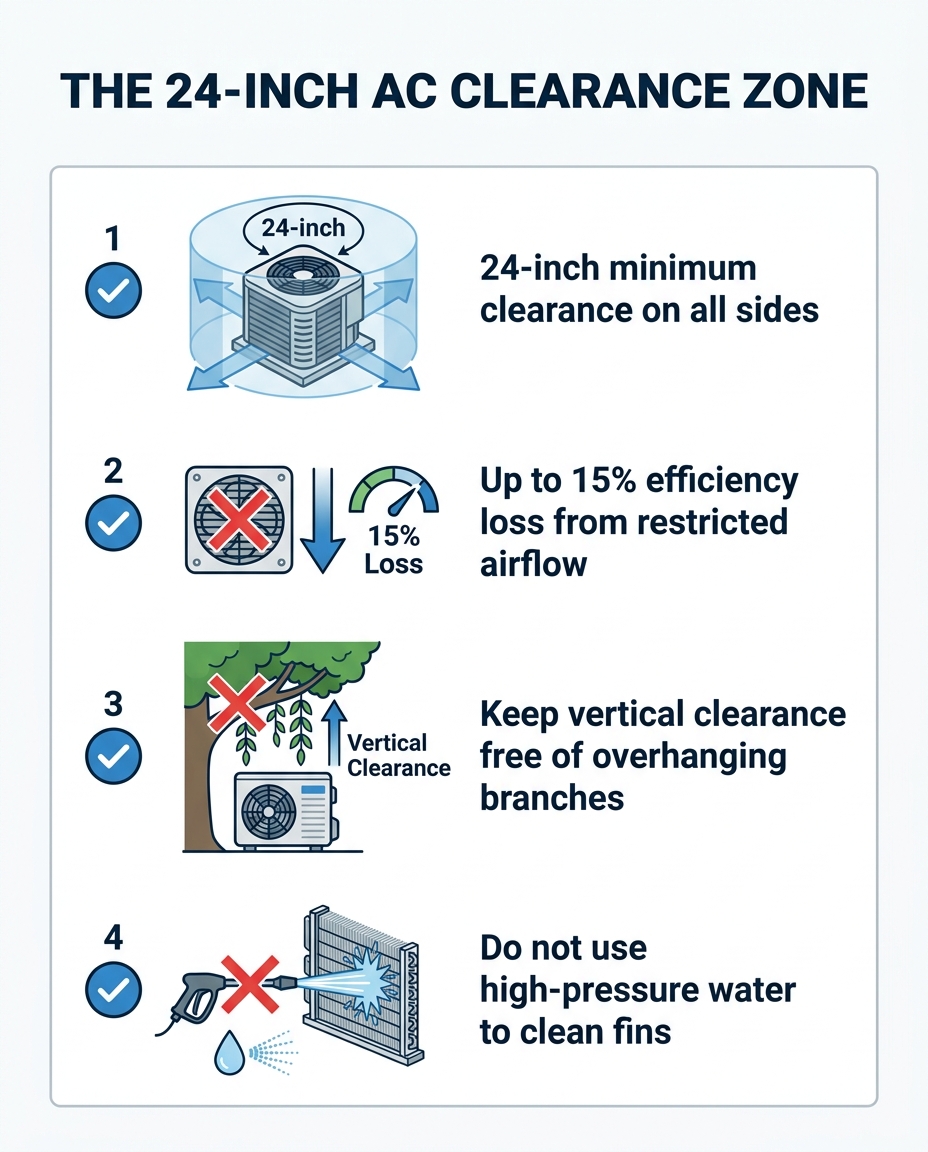
Preventing high head pressure and compressor strain begins with establishing a strict physical boundary around your outdoor equipment. The industry-standard requirement for safe operation is a 24-inch minimum clearance zone on all sides of the condenser. This space allows the fan to draw in enough ambient air to cool the internal coils efficiently.
Creating this zone requires a proactive approach to your landscaping and exterior maintenance. Follow these actionable steps to ensure your equipment has the breathing room it needs to survive the remaining hot days of the year:
1. Measure the perimeter accurately: Use a tape measure to verify you have at least two feet of completely clear space extending outward from every side of the cabinet. This includes the space between the unit and your home's exterior wall.
2. Check the vertical clearance: The fan exhausts hot air straight up. Ensure there is at least five feet of unobstructed vertical space above the unit. Trim back any low-hanging tree branches or overhanging roof awnings that might deflect the hot exhaust air back down toward the equipment.
3. Remove low-lying yard items: Relocate garden hoses, children's toys, stacked firewood, and garbage cans well outside the two-foot boundary. These items block airflow just as effectively as dense vegetation.
4. Establish a monthly visual inspection: Walk around the unit once a month, particularly during the transition from summer to fall, to ensure the perimeter remains clear as the seasons change and the wind picks up.
The 24-inch minimum clearance zone is not just a suggestion for yard aesthetics; it is a mechanical necessity. When objects or plants sit closer than two feet to the grille, they create a barrier that forces the fan to work harder. More importantly, inadequate clearance can cause a phenomenon known as localized air recirculation. This occurs when the hot exhaust air blowing out of the top of the unit is deflected by an obstacle and pulled right back into the side intake grilles. Instead of cooling the coils with ambient yard air, the unit attempts to cool itself using its own super-heated exhaust, which rapidly accelerates compressor overheating.

As the cooling season progresses, the landscaping choices around your home play a major role in your system's efficiency. San Jose's late summer dry spells leave vegetation brittle and highly prone to breaking off into condenser grilles. Shrubs that looked neat and tidy in May can easily grow into a dense, airflow-blocking wall by September.
Managing this vegetation requires careful trimming techniques to ensure you do not accidentally damage the equipment while doing yard work. Keep these landscaping guidelines in mind as you prep your yard for the early fall transition:
• Identify aggressive growers: Common landscaping plants like hydrangeas, ornamental grasses, and fast-growing hedges tend to overgrow quickly. Monitor these plants closely if they are planted near your equipment.
• Use safe trimming techniques: Always trim branches away from the unit, not toward it. Never use a powered hedge trimmer right up against the metal cabinet, as a slip could easily pierce the delicate aluminum condenser fins or sever the thermostat wiring.
• Remove deadwood immediately: Prune away brittle, dry branches that could snap off in the wind and fall directly into the top fan grille.
• Choose low-debris alternatives: If you are redesigning your yard, replace heavy-shedding plants near the HVAC unit with slow-growing, low-debris alternatives. Succulents, compact evergreens, or a simple border of decorative gravel are excellent choices for the 24-inch zone.
While above-ground foliage blocks airflow, aggressive root systems pose a different kind of threat beneath the surface. Large bushes and trees planted too close to the equipment can send thick roots under the concrete condenser pad. Over time, these roots heave the concrete upward, causing the entire outdoor unit to sit at a severe tilt.
An unlevel condenser is a serious mechanical hazard. The compressor inside the cabinet contains oil that lubricates its internal bearings. When the unit is tilted, this oil pools on one side, leaving the bearings on the opposite side to run dry. This uneven wear destroys the compressor motor long before its expected lifespan. If you notice the concrete pad shifting, the encroaching roots must be removed, and the pad must be professionally leveled. We see this often in mature San Jose neighborhoods, where decades-old trees quietly wreak havoc on condenser pads if left unchecked.
The shift into the September early fall transition introduces a new set of challenges. San Jose's autumn winds aggressively shed dry summer foliage, creating an immediate hazard for the condenser. These winds can blow mats of leaves, pine needles, and dirt directly into the unit precisely when late-season heatwaves are still demanding heavy AC usage.
The Threat of Wet Debris: Dry leaves are problematic enough, but when early fall rains or morning dew saturate those leaves, the situation worsens. Wet leaves act like papier-mâché, plastering themselves flat against the exterior grille and effectively suffocating the unit. Furthermore, decaying wet leaves release acidic compounds that can accelerate corrosion on the metal components of the cabinet.
Safe Exterior Clearing: Removing this debris requires a gentle touch. Use a soft-bristled brush or a standard household broom to lightly sweep leaves off the outside of the metal grilles. You can also use a heavy-duty shop vacuum with a soft brush attachment to pull debris away from the sides. Never scrape the sides of the unit with a metal rake, shovel, or stiff wire brush, as this will instantly bend the aluminum fins and permanently restrict airflow.
The Covering Dilemma: A common question during the fall transition is whether the outdoor unit should be covered. You should never wrap the condenser in a tight, non-breathable plastic tarp. Full covers trap ground moisture inside the cabinet, accelerating rust on the electrical contacts and creating a dark, sheltered environment that invites rodents to nest in the wiring. If you are concerned about falling leaves entering the top fan grille, our team recommends using a breathable, heavy-duty mesh top-cover that only shields the fan opening while allowing the sides to breathe freely.
While maintaining the 24-inch clearance zone and brushing leaves off the exterior grille are excellent weekend tasks, there is a hard line where DIY yard work must end and professional maintenance must begin. The internal components of the condenser are highly sensitive and carry a lethal amount of high-voltage electricity.
Never Open the Cabinet: Homeowners should never unscrew the exterior panels or remove the top fan assembly to reach leaves that have fallen inside. Opening the condenser cabinet exposes you to the high-voltage capacitor and contactor. Furthermore, dismantling the unit yourself often voids the manufacturer's warranty. If you shine a flashlight through the top grille and see a thick layer of decomposing leaves sitting at the bottom of the unit, it is time to schedule a professional deep coil cleaning before putting your unit to bed for winter.
One of the most common and destructive mistakes homeowners make is attempting to wash out the condenser with a high-pressure hose or a pressure washer. The aluminum fins that wrap around the exterior of the coil are incredibly thin—often no thicker than a few sheets of heavy foil. They are designed this way to maximize heat transfer, but it makes them extremely fragile.
Hitting these fins with a high-pressure stream of water will instantly flatten them against the coil. Bent fins permanently block the air from passing through, recreating the exact airflow restriction problem you were trying to solve in the first place. Additionally, spraying high-pressure water from the outside simply blasts the dirt, pollen, and leaf fragments deeper into the center of the coil block, turning a minor surface blockage into a severe internal clog.
If overgrown bushes or heavy leaf fall have already restricted your unit's airflow for several weeks, the hidden damage may already be done. Recognizing the early warning signs of compressor strain allows you to intervene before the system suffers a catastrophic failure. If you notice unusual grinding or buzzing noises coming from the outdoor cabinet, if the system is running in endless cycles without cooling the house, or if the unit repeatedly trips the circuit breaker, you need professional assistance immediately.
One local homeowner contacted us during a late-summer heatwave when their AC was struggling to keep up after being serviced previously. Our technician Guillermo arrived promptly and found the unit completely choked by overgrown ornamental grasses. He provided an honest assessment of the mechanical issues, addressing the underlying airflow restrictions and getting the system back on track quickly. This highlights the value of having a trained Precision Heating & Cooling professional evaluate your equipment rather than ignoring the warning signs.
During an end-of-season inspection, a licensed technician does much more than just remove leaves. They check the exact refrigerant levels to ensure the system is operating at the correct pressures. They test the electrical draw of the compressor and the dual-run capacitor to identify early signs of motor wear. Most importantly, they use specialized, non-acidic chemical foaming agents and low-pressure water to safely push dirt and debris out of the internal coils from the inside out. Addressing these issues now with professional air conditioning services restores system efficiency and prevents a sudden breakdown during the next unexpected heatwave.
At Precision Heating & Cooling, our technicians approach every service call with a preventative care mindset. We know exactly how restricted airflow from landscaping debris leads to premature compressor failure, and we know how to spot the subtle early warning signs that untrained eyes miss.
Protecting your cooling equipment during the September early fall transition comes down to consistency and awareness. By maintaining a strict 24-inch clearance zone, safely trimming back brittle summer vegetation, and gently brushing away the first autumn leaves, you are actively defending your compressor against hidden mechanical strain.
However, surface clearing is only the first half of the equation. If your unit has been fighting against overgrown bushes all summer, it is highly recommended to schedule a professional inspection to ensure no internal damage has occurred. Secure your system's longevity and automate your equipment's care by enrolling in a preventative maintenance plan today, ensuring your home stays comfortable and efficient year-round.
How much clearance does an outdoor AC unit need?
An outdoor AC unit requires a minimum of 24 inches of completely clear space on all sides. This two-foot boundary ensures the fan can draw in enough ambient air to cool the internal coils efficiently. You should also maintain at least five feet of vertical clearance above the unit to allow the hot exhaust air to escape without being deflected back down.
Should I cover my AC unit in the fall?
You should avoid wrapping your AC unit in a tight, non-breathable plastic tarp or full cover. Full covers trap ground moisture inside the cabinet, which accelerates rust on electrical components and creates a sheltered environment for rodents. If you are worried about falling leaves, use a breathable mesh top-cover that protects the fan grille while allowing the sides to breathe.
How do I safely remove leaves from my AC unit exterior?
The safest way to remove exterior leaves is by using a soft-bristled brush or a standard household broom to gently sweep the debris away from the metal grilles. You can also use a heavy-duty shop vacuum with a soft brush attachment to pull leaves off the sides. Never use metal rakes or stiff wire brushes, as they will instantly bend the delicate aluminum fins.
Can I spray my outside AC unit with water?
You can use a gentle, low-pressure stream from a standard garden hose to rinse light dust off the exterior, but you must never use a high-pressure nozzle or a pressure washer. High-pressure water will flatten the fragile aluminum fins, permanently restricting airflow. Furthermore, spraying from the outside in can force dirt and debris deeper into the sensitive internal coils.
What happens if leaves get inside the AC condenser?
Leaves that fall inside the condenser trap moisture and begin to decompose at the bottom of the cabinet. This decaying organic matter releases acidic compounds that can corrode the metal components and copper lines over time. Thick mats of internal leaves also block the drainage holes, causing standing water to pool around the base of the compressor.
How often should I trim bushes around my HVAC unit?
You should inspect the landscaping around your HVAC unit at least once a month during the growing season. Trim bushes and shrubs whenever they begin to encroach on the 24-inch minimum clearance zone. Pay special attention during the late summer and early fall transition, removing any deadwood or brittle branches before the autumn winds pick up.

Leslie was amazing for her outstanding customer service skills with me the other day. Thanks to her help my air conditioner is now all set up. She answered all my questions and took away all my problems. Leslie broke it down step by step to set it up easier. Now thanks to her my air conditioner is working perfectly. I really appreciate it Leslie and I’ll be sure to ask for you if I ever come back.
I contacted Precision Heating and Cooling for my home's AC repair. They were punctual and very professional. Guillermo was very kind and thorough. I would highly recommend them!
I am writing to express my sincere appreciation for the excellent work performed by Pablo and Alejandro from Precision Heating and Cooling. Their commitment to quality and customer satisfaction is truly commendable. Awesome job guys!
I would like to extend my sincere gratitude to Alejandro for his exceptional hard work. His passion for helping others is evident, and he consistently goes above and beyond in his service. Alejandro's thorough cleaning of my fireplace has truly made a significant difference. His dedication and professionalism are greatly appreciated.
I was very impressed. Came at night (after 9pm) to fix our AC during the middle of a heat wave the day before a national holiday! Technician was very courteous and efficient, got the job done quickly. Will definitely call them again for any AC servicing I need!
Fast and efficient, arrived when scheduled for repairs and replacement parts were ordered and installed quickly. Techs were very friendly and professional. AC system works great now! I highly recommend their services if you need repairs. Tim


.avif)
