


.avif)






Recent Blogs
Stay updated with our latest blog posts.


When the temperature finally drops and you switch your thermostat to "heat," you expect a rush of cozy warmth. Instead, you are hit with an alarming, acrid odor. At Precision Heating & Cooling, one of the most common homeowner questions answered by our team every fall is why a heater smells like burning dust when it first kicks on. It is a stressful moment that leaves you wondering if something is on fire or if your entire system is about to fail. Unlike your Water Heaters, which run continuously year-round without a dormant period, your furnace sits completely inactive for months. While most early-season smells are completely harmless, our technicians always emphasize that knowing the exact difference between normal dust burn-off and a dangerous electrical issue can save your home from a serious hazard.
If you are experiencing a heating emergency, do not wait. Schedule a Service Call immediately to keep your home safe.
To understand why that burning smell happens, you have to look at what your heating system does during its long off-season. When you search for why a heater smells like burning dust, the answer almost always comes down to the physical accumulation of airborne particles inside the unit. In our years of servicing San Jose area homes, we have seen that this accumulation is particularly heavy due to our unique local climate and the extended period of time the heater remains turned off.
Our technicians frequently explain to homeowners that the core component of your furnace is the heat exchanger. This is a large, metallic component designed with a massive surface area to efficiently transfer heat from the combustion chamber into the air that circulates through your vents. Because of its size and location, the heat exchanger acts as a giant magnet for airborne particulates. When the system is dormant, everything floating through your indoor air eventually finds its way into the ductwork and settles on this large metal surface. When the burners finally ignite in the fall, the metal heats up rapidly, and those settled particles carbonize—literally burning off the surface. As we reassure our customers, this physical process is a normal, expected part of the system's life cycle.
The severity of this startup smell is heavily influenced by where you live. As local HVAC experts, we know firsthand that San Jose experiences long, dry summers, typically stretching from May through September with virtually no precipitation. This extended dry spell leads to significantly heavier airborne dust buildup compared to more humid climates.
During these dry months, regular household activities stir up particulates that ultimately settle in the HVAC system. Common sources of this debris our team encounters include:
• Pet dander and hair: Shedding increases during warmer months and gets pulled into the return vents.
• Pollen and outdoor dust: Open windows in the spring and summer allow fine outdoor particles to drift inside.
• Indoor lint and fabric fibers: Everyday movement of clothing, carpets, and upholstery releases microscopic fibers.
• Cooking airborne oils: Microscopic grease particles can travel through the air and coat internal HVAC components.
By the time October rolls around, your heat exchanger is wearing a thick sweater of this accumulated debris, making the initial startup smell highly pronounced.
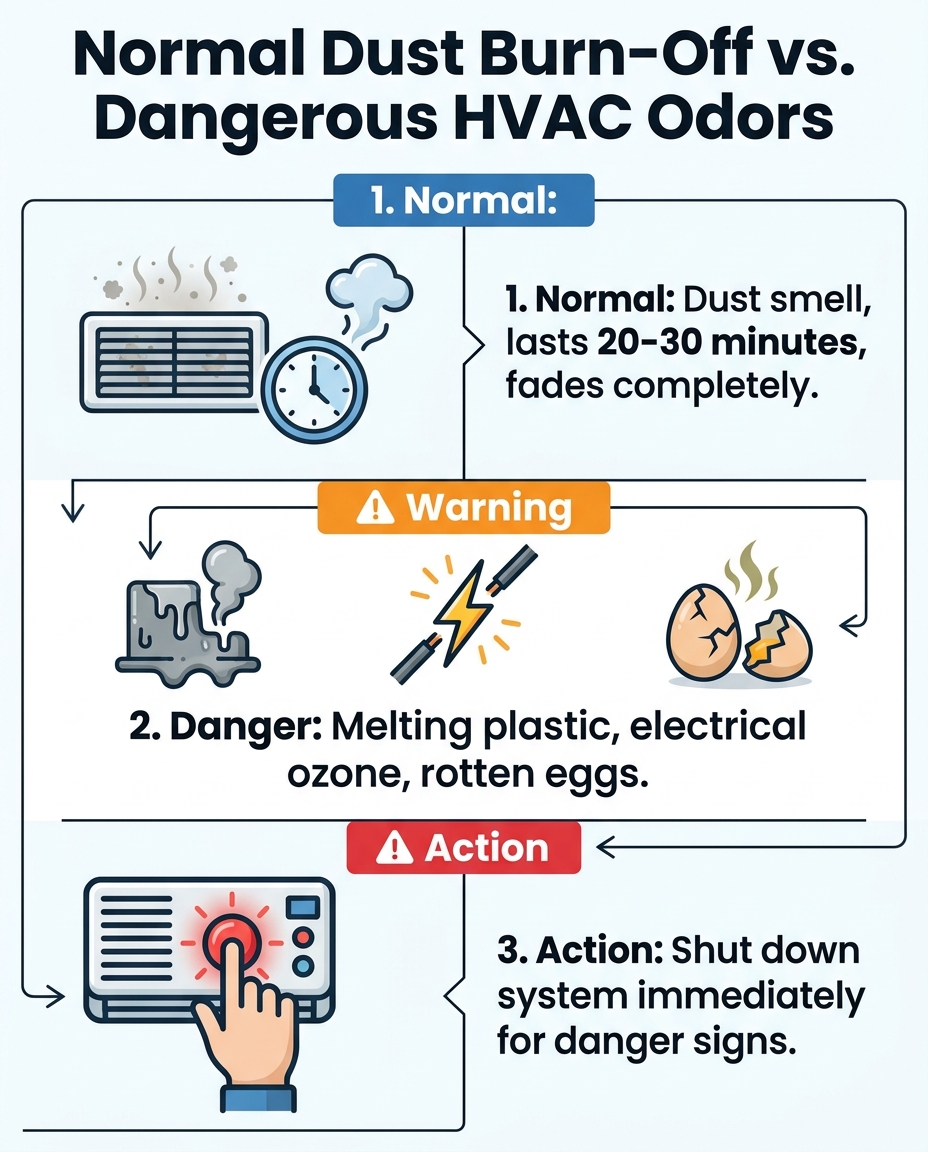
When our team guides customers through their mid-fall heating startup in October, we always note that a brief period of odor is entirely normal. However, that smell should not linger indefinitely. Having a clear timeline helps you differentiate between a routine seasonal quirk and a mechanical problem that requires intervention. Normal dust burn-off should dissipate completely within 20 to 30 minutes of continuous operation. Here is how we recommend you handle that initial 30-minute window:
1. Leave the system running: Your first instinct might be to turn the heater off immediately. However, if the smell is strictly burning dust, you need to let the system run continuously. Turning it off only pauses the process, meaning the smell will just return the next time you try to heat the house.
2. Monitor the clock: Note the exact time the furnace turned on. The smell might actually seem to get worse for the first 5 to 10 minutes as the blower fan pushes the odor through the ductwork into every room of the house.
3. Ventilate the space: To clear the air faster and reduce the overwhelming smell, open a few windows and turn on ceiling fans. This helps push the carbonized dust particles outside.
4. Track the intensity: By the 15-minute mark, the smell should begin to fade noticeably. By 30 minutes, it should be completely gone. If the smell grows sharper, changes in character, or persists past 45 minutes, you are no longer dealing with simple dust.
While a brief dust smell is routine, certain odors indicate a critical failure. If your heater smells like burning dust, it is usually fine, but if the scent shifts to something chemical or metallic, you must act quickly. With our team's 20 years of experience serving Silicon Valley at Precision Heating & Cooling, we know that acting promptly during a stressful heating emergency is the best way to prevent catastrophic property damage.
Electrical failures have a very distinct scent. If you smell melting plastic, this strongly indicates that a wire's insulation is overheating and melting away, or that a plastic component near the heat exchanger has fallen out of place. Another major red flag our technicians look for is the smell of electrical ozone, which smells slightly sweet, metallic, or similar to a sparking motor. This signals a severe electrical hazard, such as a failing blower motor or a short circuit in the control board. If you notice these smells—especially if they are accompanied by a tripped circuit breaker—turn the thermostat off immediately at the wall.
The most dangerous odor you can encounter is the smell of rotten eggs. Natural gas is naturally odorless, but utility companies add a chemical called mercaptan to give it that distinct, sulfur-like smell. If you detect rotten eggs, you have a natural gas leak. This is a highly dangerous situation. Do not touch any electrical switches, immediately turn off the thermostat, shut off the main gas valve if you know how to do so safely, evacuate the home, and call for emergency assistance.
Unexpected weekend failures require prompt, professional diagnosis. One homeowner reached out to us when their heater went out unexpectedly on a winter weekend and started emitting a strange odor. Our technician Guillermo arrived before his scheduled time on a Sunday to service the heater, ensuring the issue was resolved professionally and politely. We understand that sudden breakdowns can be stressful, which is why we offer flexible Financing Options to help you handle unexpected replacements without delay.

When a burning smell persists in San Jose area homes, we find many homeowners want to investigate the cause themselves. It is vital to know exactly what you can safely check and what requires a licensed HVAC technician from our team. Attempting DIY repairs on combustion appliances is incredibly dangerous and can void your warranty.
The safe steps you can take: First, check your air filter. A heavily clogged air filter restricts airflow, causing the furnace motor to work harder and the heat exchanger to overheat. This overheating can produce a strong burning smell. If the filter is dark gray or completely coated in debris, replace it immediately. Next, walk through your home and check all room vents. Ensure that supply and return registers are completely open and are not blocked by heavy furniture, rugs, or curtains, which can also cause the system to overheat.
• Replacing a dirty, clogged air filter — Requires a Licensed Professional: Opening the sealed furnace cabinet
• Unblocking vents and return registers — Requires a Licensed Professional: Touching or cleaning the heat exchanger
• Opening windows to ventilate dust smells — Requires a Licensed Professional: Adjusting internal gas burners or valves
• Checking the thermostat settings — Requires a Licensed Professional: Diagnosing electrical ozone or plastic smells
You must explicitly avoid opening the furnace cabinet. Never attempt to touch the heat exchanger, clean the internal burners, or adjust the wiring. If you have changed the filter, ensured the vents are clear, and the burning smell continues for longer than 45 minutes, turn the system off. That duration means it is no longer normal dust burn-off and warrants a professional diagnostic visit from one of our technicians.
A furnace does not operate in isolation. An issue with the furnace's gas valve, electrical connections, or ventilation can sometimes indicate broader home infrastructure issues that our team checks for during a mid-fall heating startup in October.
Older heating systems rely on specific safety fail-safes, such as the pilot light and thermocouple mechanisms. The thermocouple is a heat sensor that detects whether the pilot light is actively burning. If the pilot light goes out, the thermocouple cools down and automatically shuts off the gas valve to prevent raw gas from flooding your home. If you are constantly relighting your system, you might want to learn Why Your Pilot Light Keeps Going Out, as this points to a failing safety mechanism.
Pay attention to how your other gas appliances are functioning during the seasonal shift. If your gas stove or gas water heater is also exhibiting strange odors or yellow flames instead of crisp blue ones, you may have a systemic gas pressure or ventilation issue. A professional inspection evaluates the entire combustion and ventilation safety loop, ensuring that exhaust gases like carbon monoxide are safely routed out of your home rather than drifting into your living spaces.
At Precision Heating & Cooling, we always tell our customers that the best way to handle the anxiety of a mid-fall heating startup in October is to prevent the smell from happening in the first place. Shifting from reactive panic to proactive prevention protects your home and your peace of mind.
A pre-season tune-up physically removes the summer dust buildup before the first ignition. A technician carefully cleans the heat exchanger, burners, and blower motor, ensuring that the heavy layer of San Jose summer dust is vacuumed away rather than burned off into your indoor air.
Beyond simply cleaning the unit, our technicians meticulously inspect electrical connections for fraying or loose wires that could cause melting plastic smells. We also use specialized tools to inspect the heat exchanger for microscopic cracks. A cracked heat exchanger is a severe hazard that can leak carbon monoxide into your home, and it often presents with unusual smells or burner behavior.
Regular tune-ups extend the lifespan of the equipment, ensure peak efficiency, and keep your utility bills predictable. High-efficiency upgrades or maintenance may even qualify you for generic local utility incentive programs or federal tax credits for energy efficiency—be sure to verify current programs with your utility provider or tax professional. Enrolling in a Routine Maintenance Plan positions scheduled care as the ultimate peace of mind against early-morning heating emergencies, ensuring your system is safe to operate before the first cold snap arrives.
Your furnace smells like burning dust because airborne particles settle on the heat exchanger during the months it sits idle. When you search for why a heater smells like burning dust, the answer is usually this normal accumulation. Once the burners ignite for the first time in the fall, those settled particles carbonize and burn off, sending a dusty odor through your vents.
Our technicians find that a normal dust burn-off smell should last between 20 to 30 minutes. You should leave the system running continuously during this window so the dust can fully clear. If the smell persists past 45 minutes, it is no longer considered normal and you should turn the system off.
An electrical fire in a furnace typically smells like melting plastic, burning rubber, or electrical ozone. The ozone smell is often described as a sharp, metallic, or slightly sweet chemical odor. If you detect any of these scents, shut off the furnace immediately at the thermostat and check your breaker panel.
A brief dust smell is not dangerous, but chemical, electrical, or gas smells are highly hazardous. Smells resembling rotten eggs indicate a natural gas leak, while melting plastic indicates an electrical short. Any odor that is sharp, metallic, or lasts longer than an hour requires immediate professional attention.
Yes, a severely clogged air filter restricts airflow, causing the system to overheat. When the blower motor strains to pull air through a dirty filter, the motor itself can run hot and produce a burning smell. Replacing your filter regularly prevents this dangerous overheating cycle.
Opening windows during the first startup is a great way to help ventilate the home and clear the dust smell faster. You can also turn on ceiling fans to keep the air moving. Once the 30-minute burn-off period is complete and the smell is gone, you can close the windows to trap the heat.
Understanding why your heater smells like burning dust transforms a moment of panic into a simple, manageable homeowner task. While a brief, 30-minute dust smell is completely normal after a long summer, your family's safety should never be left to guesswork. If you ever detect the scent of melting plastic, electrical ozone, or rotten eggs, immediate action is required. Professional diagnostics are the safest, most reliable route for any persistent or chemical odors. Do not wait for a strange smell to turn into a complete system breakdown. Ensure your system is clean, safe, and ready for the winter chill by having a professional from our team clear away the dust and verify your safety mechanisms. Schedule a Service Call with Precision Heating & Cooling today to enjoy a warm, worry-free heating season.

Leslie was amazing for her outstanding customer service skills with me the other day. Thanks to her help my air conditioner is now all set up. She answered all my questions and took away all my problems. Leslie broke it down step by step to set it up easier. Now thanks to her my air conditioner is working perfectly. I really appreciate it Leslie and I’ll be sure to ask for you if I ever come back.
I contacted Precision Heating and Cooling for my home's AC repair. They were punctual and very professional. Guillermo was very kind and thorough. I would highly recommend them!
I am writing to express my sincere appreciation for the excellent work performed by Pablo and Alejandro from Precision Heating and Cooling. Their commitment to quality and customer satisfaction is truly commendable. Awesome job guys!
I would like to extend my sincere gratitude to Alejandro for his exceptional hard work. His passion for helping others is evident, and he consistently goes above and beyond in his service. Alejandro's thorough cleaning of my fireplace has truly made a significant difference. His dedication and professionalism are greatly appreciated.
I was very impressed. Came at night (after 9pm) to fix our AC during the middle of a heat wave the day before a national holiday! Technician was very courteous and efficient, got the job done quickly. Will definitely call them again for any AC servicing I need!
Fast and efficient, arrived when scheduled for repairs and replacement parts were ordered and installed quickly. Techs were very friendly and professional. AC system works great now! I highly recommend their services if you need repairs. Tim


.avif)
