


.avif)






Recent Blogs
Stay updated with our latest blog posts.


Your eyes are watering, your throat feels scratchy, and that distinct campfire smell is lingering in your living room even though the windows are locked tight. Addressing poor indoor air quality in Silicon Valley homes after summer wildfires is a frustrating reality for many local families, especially as you transition your system from heavy summer cooling to early fall heating prep. The September fire season brings dry conditions, offshore Diablo winds, and heavy atmospheric inversions that trap thick smoke right here in the Santa Clara Valley. At Precision Heating & Cooling, our technicians hear these concerns daily. You know you need better filtration to protect your family's lungs, but you might be unsure how to upgrade without accidentally suffocating your HVAC equipment. Finding the right balance requires a strategic approach, not just grabbing the thickest filter off a hardware store shelf.
Exploring professional indoor air quality solutions and keeping up with routine HVAC maintenance are the first crucial steps to preparing your system for the heavy load of fall fire season.
The Problem: When a "Spare the Air" alert is issued across the Bay Area, the sky turns an eerie orange, and the air feels heavy. But the real danger is what you cannot easily see. The primary pollutant in wildfire smoke is PM2.5 fine particulate matter. During our pre-heating season inspections, our team consistently sees how these microscopic particles easily bypass standard weatherstripping, slipping through microscopic gaps around your doors, windows, and roof vents to settle deep into your home's fabrics, carpets, and ductwork.
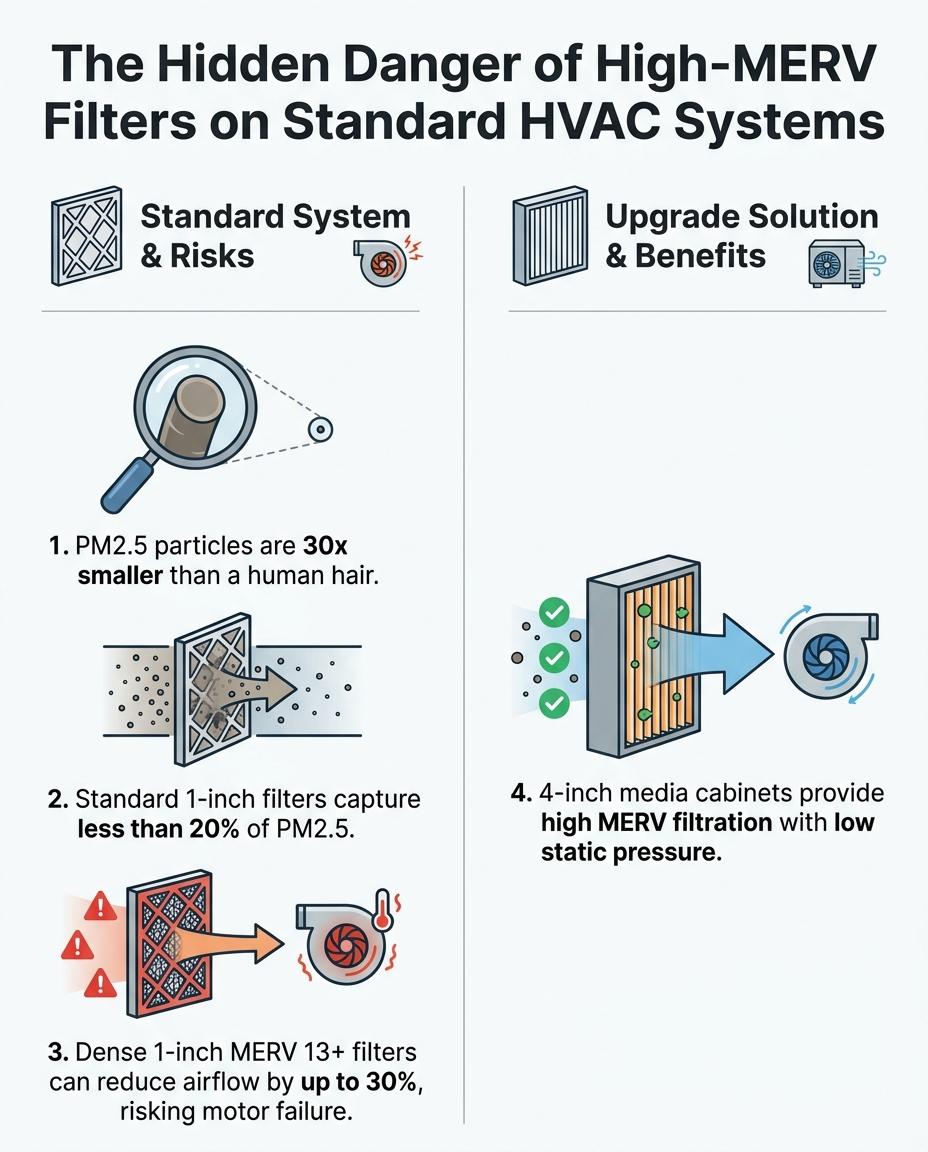
The Cause: To understand why PM2.5 fine particulate matter is so stubborn, you have to look at its size. PM2.5 refers to particles that are 2.5 micrometers in diameter or smaller. For context, a single strand of human hair is about 70 micrometers across. This means PM2.5 particles are roughly 30 times smaller than the width of a hair. Because they have almost zero mass, they remain suspended in your indoor air for days. When you inhale, these particles are small enough to bypass your body's natural respiratory defenses and enter your bloodstream directly, causing significant irritation and long-term health concerns.
The Solution: Neutralizing this microscopic threat requires specialized technology. Capturing a dog hair or a speck of dust is easy; capturing a particle of ash that is a fraction of a micrometer wide requires tightly woven filtration media or active air purification. You cannot simply wait for the smoke to settle, because every time you walk across a rug or turn on your heating system for a brisk fall morning, those invisible particles are kicked back into your breathing space.
When our team performs fall maintenance across San Jose, we routinely find homes equipped with a standard 1-inch fiberglass filter located at the return grille or right at the furnace. When the September fire season hits, homeowners often assume this standard filter will clean the smoky air. Unfortunately, this is a dangerous misconception we have to correct frequently.
The true purpose of a standard filter: Basic 1-inch fiberglass filters were never designed to clean the air you breathe. Their sole purpose is to protect the internal mechanical components of your HVAC system—specifically the blower motor and the evaporator coil—from large debris like pet hair, heavy dust bunnies, and loose insulation. They are meant to keep the machine running, not to purify your indoor environment.
When it comes to PM2.5 fine particulate matter, a standard fiberglass filter acts like a chain-link fence trying to stop a handful of sand. The microscopic ash and smoke particles simply pass right through the wide gaps in the fiberglass, travel through your ductwork, and blow directly out of your supply vents into your bedrooms and living areas. Relying on these basic filters during a heavy smoke event leaves your home completely vulnerable to poor air quality, allowing odors and irritants to cycle continuously through your living space.
The Problem: Realizing that standard filters are ineffective, many homeowners head to the local hardware store and purchase the most expensive, highest-rated MERV (Minimum Efficiency Reporting Value) filter they can find. They drop a dense, 1-inch MERV 13 filter into their ceiling grate, expecting instant relief from the smoke. Instead, they inadvertently put their entire heating and cooling system at risk of catastrophic failure.
The Cause: The issue boils down to a critical mechanical concept called static pressure. Drawing on our extensive local South Bay experience at Precision Heating & Cooling, we see a distinct pattern: older tract homes in San Jose were built with ductwork and return drops sized for basic airflow, vastly differing from newer builds that are designed to accommodate advanced, high-MERV whole-home filtration systems. When you place a dense filter into a system not designed for it, you choke the equipment.
The Solution: True IAQ protection in Silicon Valley requires balancing PM2.5 capture with proper, professionally measured static pressure. You must match the filtration density to the specific output capabilities of your blower motor.
Static pressure is simply the resistance to airflow within your HVAC system. Your blower motor is designed to push a specific volume of air against a specific amount of resistance. Think of it like drinking water through a straw. A standard filter is like drinking through a wide milkshake straw—it requires very little effort. Dropping a dense, 1-inch MERV 13 filter into that same system is like trying to breathe through a thick wool blanket. The motor has to work twice as hard to pull the same amount of air, causing extreme stress on the electrical components.
If you have recently installed a high-MERV filter to combat wildfire smoke, our technicians recommend watching closely for these warning signs that your system is struggling:
• Increased energy bills: Your blower motor draws significantly more electricity as it strains against the dense filter material.
• Weak airflow from the vents: You may notice that rooms furthest from the equipment feel stagnant, warm, or lack the usual breeze from the registers.
• Unusual whistling noises: High resistance often causes air to forcefully bypass the filter frame, creating a high-pitched whistling or howling sound near the return vent.
• Frozen evaporator coils: Without enough warm air passing over the indoor coil, the refrigerant drops below freezing, turning your AC coil into a block of solid ice.

Even if you invest in the most advanced air purifier on the market, your efforts will be entirely undermined if the ductwork hidden in your unconditioned spaces is leaking. The air ducts running through your hot attic or dusty crawlspace are essentially the lungs of your home. When these ducts age, the seals crack, and the metal joints pull apart.
This creates a dangerous phenomenon known as negative pressure. When your blower motor turns on, it creates a powerful suction. If there is a leak on the return side of your ductwork (the side pulling air back to the machine), that leak acts like a vacuum. Instead of pulling clean, conditioned air from your hallway, the system actively sucks smoke-filled outdoor air, fiberglass insulation dust, and attic debris directly into your duct stream. This contaminated air is then blown straight into your bedrooms, completely bypassing your carefully chosen air filter.
Our installation crews at Precision Heating & Cooling see this pattern frequently. One local homeowner reached out to us recently because their existing ductwork was failing, resulting in poor air distribution and terrible indoor air quality as the early fall fire season rolled in. Our team replaced the compromised ductwork in a single day, immediately restoring the integrity of the home's envelope. A thorough duct inspection during your pre-heating season tune-up is a critical component of any comprehensive IAQ strategy, ensuring that PM2.5 fine particulate matter isn't being actively pumped into your home from the attic.
If standard filters are useless against smoke, and DIY dense 1-inch filters can destroy your equipment, what is the correct path forward? Our IAQ specialists recommend professional, whole-home solutions that capture fine ash without restricting airflow. By integrating these solutions directly into your air conditioning system or furnace, you can scrub the air in every room simultaneously every time the fan runs.
1. Schedule a static pressure test: A professional technician measures the exact airflow resistance of your current setup to determine what level of filtration your blower motor can safely handle.
2. Evaluate the return plenum space: The technician inspects the area around your furnace or air handler to see if there is physical room to install a wider filter housing.
3. Install the chosen IAQ solution: The ductwork is modified to accept a high-capacity media cabinet or an active electronic air cleaner.
4. Verify system balance: Once installed, airflow is measured again to ensure the system operates at peak efficiency without strain.
Homeowners in Silicon Valley should also note that various energy rebates or utility incentive programs may apply when upgrading to high-efficiency, properly balanced systems. Always check with your local utility provider or a tax professional to see what current incentives are available for improving your home's energy performance.
In our experience, the most effective mechanical solution for wildfire smoke is retrofitting your system with a media filter cabinet. Instead of a 1-inch slot, a professional installs a housing that accommodates a filter 4 to 5 inches thick. This thickness is the secret to safe filtration. Because the filter material is deeply pleated, it offers a massive amount of surface area. This allows it to achieve a MERV 11, MERV 13, or even MERV 16 rating to capture microscopic smoke particles while maintaining incredibly low static pressure. The air moves slowly and easily through the vast surface area, protecting both your lungs and your blower motor.
For homes dealing with severe smoke odors, we often pair active air purification with media filtration. These systems use ultraviolet (UV) light and ionization technology to actively neutralize ultrafine particles. Instead of just catching debris like a net, ionizers send charged ions into your ductwork. These ions attach to microscopic smoke particles, causing them to clump together. Once they clump, they become large enough for the media filter to easily trap them, effectively removing the lingering campfire smell from your home.
When the September fire season peaks, your HVAC system is often already fatigued from battling the dry, intense summer heatwaves common to our region. Adding heavy smoke to the mix compounds the stress on your blower motor just as you are prepping for cooler weather. To protect your equipment and your indoor air quality simultaneously, our team suggests these crucial steps:
• Keep your home sealed tight: Keep all windows and doors completely closed. Ensure weatherstripping is intact to prevent outdoor smoke from drifting inside.
• Run the fan continuously: If your system is equipped with a professionally installed media cabinet or air purifier, switch your thermostat fan setting from "Auto" to "ON" or "Circulate." This keeps the air constantly moving through the filtration system, scrubbing the indoor air even when the heating or cooling cycle is off.
• Monitor filter condition weekly: During a heavy smoke event, a filter that normally lasts six months can become completely clogged in just a few weeks. Pull the filter out and inspect it visually; if it looks dark gray or black, it is severely restricting airflow.
• Replace compromised filters immediately: It is vital that you change heavily soiled filters promptly. Leaving a clogged filter in place forces the motor to overheat and can cause sudden system failure right when you need it most.
• Plan ahead: Do not wait for the smoke to arrive. Schedule professional static pressure testing and IAQ upgrades during your early fall maintenance visit.
The EPA recommends using a filter with a MERV 13 rating or higher to effectively capture fine wood smoke particulates. However, this recommendation comes with a strict caveat: we advise using a MERV 13 filter only if your HVAC system has been professionally rated to handle the significant airflow restriction it creates. Using one in an incompatible system will cause mechanical damage.
Yes, absolutely. Installing a dense 1-inch MERV 13 or higher filter in a standard residential system acts like a roadblock for your airflow. This severe restriction can lead to frozen evaporator coils, an overheated blower motor, cracked heat exchangers, and premature, total system failure.
The most effective method is to keep all doors and windows tightly sealed, upgrade to a professionally installed whole-home air purifier or a 4-inch media filter cabinet, and run your HVAC fan continuously. This ensures that all the air inside your home is constantly being pulled through the high-efficiency filtration media, actively scrubbing the PM2.5 fine particulate matter out of your living space.
Without active, high-efficiency filtration, smoke particulates can settle deep into your ductwork, carpets, upholstery, and curtains. Because these microscopic particles embed themselves in fabrics, the distinct campfire odor can linger for weeks or even months after the outdoor fires have been completely extinguished.
Yes, running your system is perfectly safe and actually beneficial, provided it does not draw fresh air directly from the outside (most residential systems only recirculate indoor air). As long as your system is equipped with proper, unrestrictive filtration, running the fan helps filter the indoor air and keeps your family comfortable during late-summer heatwaves or early fall chills.
Our team at Precision Heating & Cooling knows firsthand that the reality of living in Silicon Valley is that early fall transitions and poor air quality often arrive hand-in-hand. While standard fiberglass filters completely fail against fine wildfire smoke, and DIY high-MERV drop-ins risk destroying your equipment, you do not have to choose between breathing clean air and maintaining a functioning HVAC system. Proper, professional upgrades provide a clear, safe path forward for healthy indoor air.
Before the smoke worsens and settles permanently into your home's ductwork, it is crucial to have your system evaluated. Schedule a fall maintenance inspection with our team to assess your duct integrity, measure your system's static pressure, and explore the installation of a high-capacity media cabinet. Take control of your indoor environment today by contacting Precision Heating & Cooling for a comprehensive IAQ assessment, ensuring your home remains a safe, breathable sanctuary all season long.

Leslie was amazing for her outstanding customer service skills with me the other day. Thanks to her help my air conditioner is now all set up. She answered all my questions and took away all my problems. Leslie broke it down step by step to set it up easier. Now thanks to her my air conditioner is working perfectly. I really appreciate it Leslie and I’ll be sure to ask for you if I ever come back.
I contacted Precision Heating and Cooling for my home's AC repair. They were punctual and very professional. Guillermo was very kind and thorough. I would highly recommend them!
I am writing to express my sincere appreciation for the excellent work performed by Pablo and Alejandro from Precision Heating and Cooling. Their commitment to quality and customer satisfaction is truly commendable. Awesome job guys!
I would like to extend my sincere gratitude to Alejandro for his exceptional hard work. His passion for helping others is evident, and he consistently goes above and beyond in his service. Alejandro's thorough cleaning of my fireplace has truly made a significant difference. His dedication and professionalism are greatly appreciated.
I was very impressed. Came at night (after 9pm) to fix our AC during the middle of a heat wave the day before a national holiday! Technician was very courteous and efficient, got the job done quickly. Will definitely call them again for any AC servicing I need!
Fast and efficient, arrived when scheduled for repairs and replacement parts were ordered and installed quickly. Techs were very friendly and professional. AC system works great now! I highly recommend their services if you need repairs. Tim


.avif)
