


.avif)






Recent Blogs
Stay updated with our latest blog posts.


At Precision Heating & Cooling, our team typically sees that nearly 80% of catastrophic commercial cooling failures occur during the warmest months of the year, pushing facility resources to their absolute limits. When a critical system goes down, dealing with Commercial Refrigeration Repair Delays: Navigating Parts Shortages in the South Bay becomes an immediate, high-stakes challenge for any facility manager. A critical failure during the August late-summer peak cooling demand does not just cause a temporary inconvenience; it introduces a severe concrete problem. Food spoilage and operational downtime represent significant revenue losses for commercial facilities per incident, and those losses compound rapidly when specialized replacement parts are nowhere to be found.
National supply chain lead times for specialized commercial HVAC/R parts are currently extending for weeks rather than days. This reality forces a critical decision point: facility managers must choose between reactive waiting—hoping local supply houses have inventory—or adopting a proactive on-site inventory strategy. To mitigate these risks effectively, we emphasize to our clients that establishing robust commercial refrigeration systems and maintaining a comprehensive commercial maintenance plan are no longer optional. They are the baseline requirements for keeping your doors open and your inventory safe.
The underlying issue: The timing of these parts shortages is particularly devastating. When August late-summer peak cooling demand hits, systems that have been running continuously for months finally give out. In our experience, the strain on compressors, condensers, and electronic controllers reaches its maximum threshold just as local supply houses are completely depleted of backup inventory. Waiting for a factory backorder is simply not a viable operational strategy when perishable goods are at stake.
To navigate the current landscape, you must understand the macro and micro supply chain trends affecting HVAC/R manufacturing. Globally, the production of essential components—specifically electronic controllers and Electronically Commutated Motors (ECM)—remains constrained by raw material availability and logistics bottlenecks. However, our technicians see this problem become uniquely intense when these global shortages meet localized demand spikes.
In our years serving San Jose and the South Bay region, we've noticed a remarkably dense concentration of restaurants, corporate tech cafeterias, and large-scale commercial facilities. This high regional competition creates a localized scarcity for limited replacement parts. When a late-summer heatwave strikes, hundreds of facilities experience simultaneous equipment stress, leading to a race for the exact same contactors, relays, and motors at regional supply houses.
There is a distinct difference between a factory backorder and local supply house depletion, and understanding this difference is key to protecting your operations. Just-in-time inventory models, which many suppliers rely on to reduce overhead, fail spectacularly during periods of high demand.
• Global Manufacturing — Primary Bottleneck Factor: Microchip and raw material shortages affecting ECMs and control boards. — Impact on Local Facilities: Multi-week or multi-month delays for highly specific OEM components.
• National Distribution — Primary Bottleneck Factor: Freight delays and warehouse labor constraints. — Impact on Local Facilities: Inconsistent restocking schedules at regional hubs.
• Local Supply Houses — Primary Bottleneck Factor: High density of commercial kitchens competing for limited stock. — Impact on Local Facilities: Same-day depletion of universal parts during sudden heatwaves.
The logistical reality: When San Jose and the South Bay region experience prolonged heat, local distributors simply cannot restock fast enough to support the sheer volume of emergency service calls we see coming in. The parts exist somewhere in the national pipeline, but they are not on the shelf when your walk-in freezer temperature starts rising.
When commercial systems run continuously, specific parts bear the brunt of the workload. Our crews know firsthand that San Jose's warm climate forces commercial systems to run without typical resting cycles, accelerating wear on moving parts and electrical connections. Condensers and compressors experience maximum wear during these continuous operation cycles, making them highly susceptible to sudden failure.
Electronic components, relays, and specific fan motors are especially vulnerable to heat-related degradation. The ambient heat combined with the mechanical heat generated by the equipment creates an environment where electrical insulation breaks down and mechanical bearings dry out. This is why identifying failing walk-in cooler parts early—before a catastrophic shutdown occurs—is an essential skill for any facility management team.
Understanding how different components fail can help you anticipate issues during the August late-summer peak cooling demand.
• Mechanical Failures: Parts like fan blades, belts, and bearings typically show physical signs of wear before failing. You might hear grinding noises, notice excessive vibration, or see physical degradation. While disruptive, mechanical parts are sometimes easier to source or substitute in an emergency.
• Electrical Failures: Components like contactors, capacitors, and control boards often fail without obvious visual warning. A power surge or prolonged heat exposure can fry a board instantly. Electrical components often have longer backorder times because they require specific microprocessors and exact OEM matching to function correctly with your system's software.
The continuous load factor: To maintain food-safe temperatures, your equipment must run harder and longer. This continuous heavy load means that a part that might normally last five years could burn out in three, making proactive identification critical.
We strongly advise our commercial clients that pre-purchasing specific high-risk OEM parts is no longer just a good idea; it is a necessary insurance policy against supply chain bottlenecks. Relying on a technician to drive to a supply house and find the exact part you need on a Friday afternoon in August is a gamble that commercial facilities cannot afford to take.
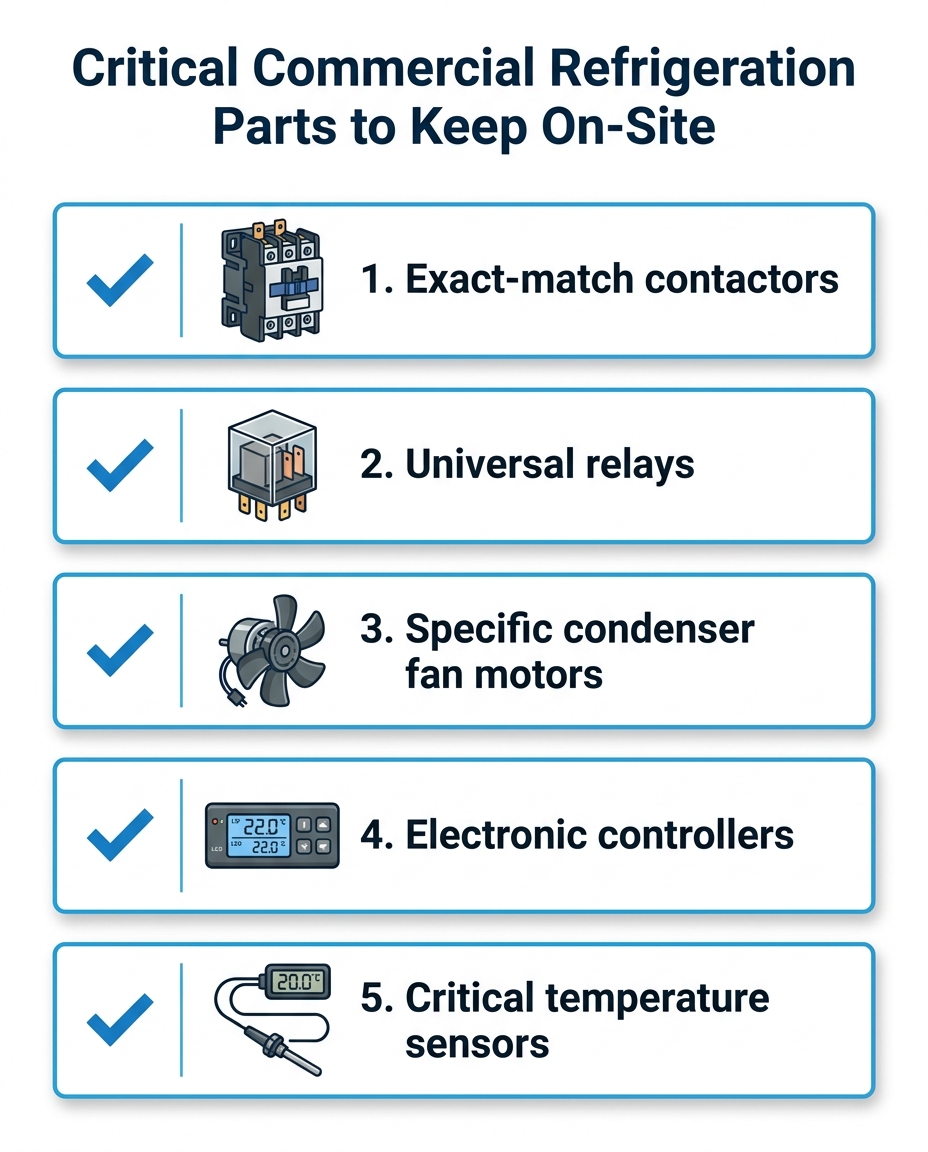
To turn a multi-week catastrophic delay into a same-day repair, facility managers in San Jose and the South Bay region must audit their current equipment, determine exact part numbers, and balance inventory costs against the potential revenue loss of operational downtime. Based on our field experience, here is what should be in your on-site emergency kit:
• Exact-match contactors: These bear the brunt of the electrical load every time the compressor cycles on. Having the exact OEM match prevents wiring complications.
• Universal relays: Essential for communication between the thermostat and the cooling unit.
• Specific condenser fan motors: If the fan dies, the compressor overheats and fails shortly after. Keep the exact horsepower and RPM match on hand.
• Electronic controllers: The "brain" of modern refrigeration units. These are highly susceptible to supply chain delays due to microchip shortages.
• Critical temperature sensors: Inexpensive to stock, but if they fail, the system cannot regulate temperature, leading to frozen coils or spoiled food.
Storage matters: Storing these components correctly is just as important as buying them. Sensitive electronic HVAC/R components must be kept in a climate-controlled, dry environment to prevent corrosion or static damage before they are ever installed.

Even with a robust on-site inventory, you may eventually need a part you do not have. This is where partnering with established professionals who have deep local networks becomes invaluable. Standard regional supply houses prioritize high-volume, established contractors like Precision Heating & Cooling during shortages. If a facility manager calls looking for a rare control board, they might be put on a waiting list. When a highly connected local professional calls, that same part can often be sourced through specialized channels or reserved stock.
Furthermore, our established local supplier relationships and deep industry experience enable the sourcing of hard-to-find commercial refrigeration parts faster than standard channels. Deep industry experience allows our technicians to safely cross-reference compatible parts when exact OEM specific parts are unavailable, ensuring your system gets back online without compromising safety or efficiency.
Real-world impact: Consider a typical scenario we handle in San Jose and the South Bay region. A commercial building recently experienced severe HVAC system issues that threatened to shut down operations. Because our responding team provided fast, reliable, responsive, and knowledgeable service—bypassing standard supply chain delays through our established networks—we quickly resolved the crisis and became the facility's top choice for all ongoing commercial HVAC services. A responsive partner who expedites sourcing rather than waiting passively for backordered shipments is a crucial asset for any commercial operation.
The ultimate defense against supply chain unpredictability is bridging the gap between reactive inventory management and proactive system maintenance. You do not have to wait for a part to break to know it is failing. During our routine maintenance visits, we track amperage draws, voltage imbalances, and temperature fluctuations that signal impending part failure long before the system actually shuts down.
Catching a failing component weeks before it breaks allows time to order the part through standard channels without incurring emergency shipping fees or suffering through operational downtime. Our technicians use predictive diagnostics to integrate part lifecycle tracking directly into your facility management protocols.
• Vibration Analysis: Detects worn bearings in motors and compressors before they seize up completely.
• Amperage Tracking: A compressor drawing more amps than its rating is working too hard and is on the path to failure.
• Coil Inspections: Identifies micro-leaks or airflow restrictions that force the entire system to run longer cycles.
The strategic advantage: By adopting a strategic, preventative approach, you shift the power back into your hands. Ordering a part on your own timeline removes the stress of emergency sourcing and ensures your facility remains operational regardless of national logistics bottlenecks.
In our field experience, electrical components bear the highest rate of failure in commercial refrigeration systems. Contactors, capacitors, and universal relays degrade quickly due to the constant cycling of high voltage required to run compressors. Additionally, condenser fan motors are highly susceptible to failure because they operate continuously in hot, outdoor environments, causing bearings to wear out prematurely.
If the required part is in stock locally, our professionals can typically complete the repair the same day. However, if a specialized OEM component like an electronic controller or a specific compressor is required, supply chain shortages can extend the repair timeline from several days to multiple weeks. This variability is why maintaining an on-site inventory of critical parts is highly recommended.
We tell our restaurant clients that the most effective prevention strategy is proactive inventory management combined with routine diagnostics. Restaurant owners should pre-purchase high-risk replacement parts and store them on-site to bypass supply house delays. Furthermore, scheduling regular maintenance allows our technicians to identify and replace wearing components before they cause a complete system shutdown.
The backorders stem from a combination of global raw material shortages and localized spikes in demand. Modern commercial HVAC and refrigeration units rely heavily on microchips for their electronic control boards and ECM motors, which are currently facing global production limits. When a regional heatwave occurs, the sudden surge in local breakdowns instantly depletes whatever limited stock made it to regional supply houses.
The financial impact extends far beyond the cost of the repair itself. Facilities face severe revenue losses from spoiled perishable inventory, health department compliance issues, and the inability to serve customers. For high-volume restaurants or corporate cafeterias, even a single day of operational downtime can result in significant financial disruption.
Yes, in many cases, our experienced professionals can safely utilize universal parts to restore cooling temporarily. Universal relays, certain contactors, and adjustable fan motors can often be cross-referenced and installed to keep a system running while waiting for the exact OEM part to arrive. However, this requires deep technical expertise to ensure the temporary part can safely handle the system's specific electrical load.
Waiting for a breakdown during peak season is no longer a viable strategy for any facility manager. The reality of San Jose and the South Bay region is that high demand and limited supply will continue to cause extended repair timelines. By keeping critical components on-site and implementing a proactive monitoring strategy, you can completely bypass the chaos of regional supply house shortages.
To secure your operations, consult with our experts at Precision Heating & Cooling to develop a tailored commercial maintenance plan that includes predictive diagnostics and a customized on-site parts inventory. Taking these steps today ensures that when you face Commercial Refrigeration Repair Delays: Navigating Parts Shortages in the South Bay, you will be fully prepared with a clear, actionable game plan and the exact components needed to keep your business running smoothly.

Leslie was amazing for her outstanding customer service skills with me the other day. Thanks to her help my air conditioner is now all set up. She answered all my questions and took away all my problems. Leslie broke it down step by step to set it up easier. Now thanks to her my air conditioner is working perfectly. I really appreciate it Leslie and I’ll be sure to ask for you if I ever come back.
I contacted Precision Heating and Cooling for my home's AC repair. They were punctual and very professional. Guillermo was very kind and thorough. I would highly recommend them!
I am writing to express my sincere appreciation for the excellent work performed by Pablo and Alejandro from Precision Heating and Cooling. Their commitment to quality and customer satisfaction is truly commendable. Awesome job guys!
I would like to extend my sincere gratitude to Alejandro for his exceptional hard work. His passion for helping others is evident, and he consistently goes above and beyond in his service. Alejandro's thorough cleaning of my fireplace has truly made a significant difference. His dedication and professionalism are greatly appreciated.
I was very impressed. Came at night (after 9pm) to fix our AC during the middle of a heat wave the day before a national holiday! Technician was very courteous and efficient, got the job done quickly. Will definitely call them again for any AC servicing I need!
Fast and efficient, arrived when scheduled for repairs and replacement parts were ordered and installed quickly. Techs were very friendly and professional. AC system works great now! I highly recommend their services if you need repairs. Tim


.avif)
