


.avif)






Recent Blogs
Stay updated with our latest blog posts.


When you understand the parts of a walk in cooler, it becomes much easier to see why your system is struggling to hold safe temperatures during the August late-summer heat. Your commercial walk-in cooler is running nonstop, but the interior temperature keeps creeping up. The compressor sounds like it is working overtime, yet the heavy toll of continuous operation during peak summer months is clearly compromising your equipment. When a walk-in cooler struggles to hold temperature under these demanding conditions, the issue is often an invisible micro-leak rather than a sudden, catastrophic failure.
Recognizing these early signs is absolutely necessary before a total system shutdown ruins valuable inventory. Finding these hidden leaks requires a solid understanding of the system's anatomy, specifically where stress points naturally occur. To learn more about how we support these complex setups, explore our commercial refrigeration systems services.
One of the most common misunderstandings in the commercial food service industry is the idea that refrigeration systems naturally consume or "burn up" their refrigerant over time. This is entirely false. Commercial refrigeration systems operate as strictly closed-loop environments. The chemical refrigerant circulating through the pipes is never used up or consumed like fuel in an engine or oil in a generator.
If a system is low on refrigerant, it means there is a physical breach or leak somewhere in the lines. The refrigerant is escaping into the atmosphere. Because the system is pressurized, even a microscopic pinhole can allow a significant amount of refrigerant gas to escape over several weeks or months. This is why the dangerous and temporary practice of just "topping off" the system is so problematic. Adding more refrigerant without fixing the underlying leak is like pouring water into a bucket with a hole in the bottom—it only delays the inevitable failure while increasing your operating costs and environmental impact.
• Refrigerant gets used up over time and needs routine refilling. — The Reality: Refrigerant exists in a sealed, closed loop. It never degrades or gets consumed.
• A "top-off" is a standard, acceptable seasonal maintenance procedure. — The Reality: Topping off a leaking system is a temporary band-aid and violates environmental best practices.
• Small leaks don't impact overall cooling performance significantly. — The Reality: Even minor refrigerant loss forces the compressor to overwork, risking total system failure.
Understanding this closed-loop principle changes how facility managers should approach maintenance. Instead of treating low refrigerant as a routine consumable expense, it must be treated as a mechanical failure that requires immediate, precise diagnostics to locate the physical breach.
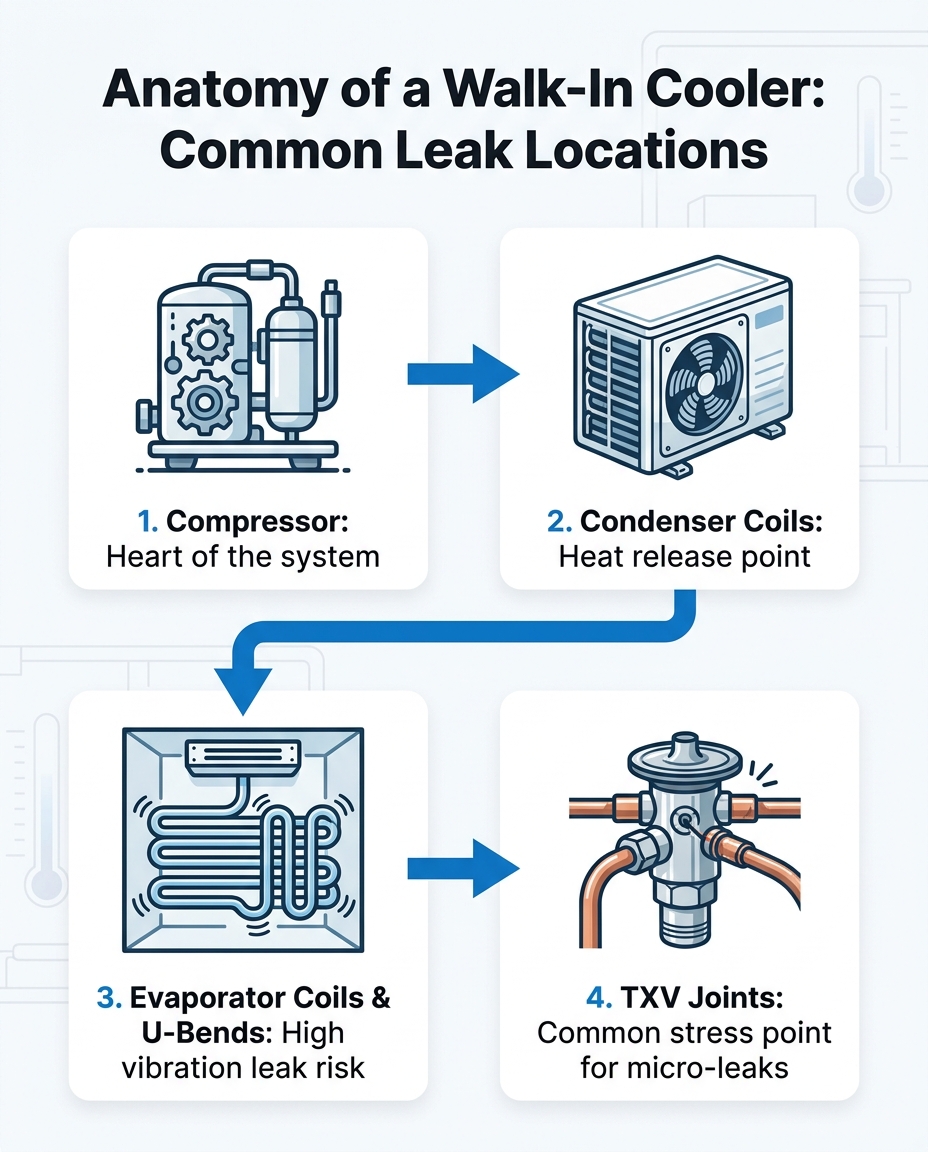
To understand where refrigerant escapes, you first need to understand the anatomy of the equipment. A commercial walk-in cooler relies on a synchronized dance of pressure and temperature changes to remove heat from the insulated box. Here is a high-level overview of how the primary components work together.
1. The Compressor: This is the heart of the system. The compressor's job is to pump refrigerant vapor, pressurizing it and pushing it through the lines. Because it is a heavy mechanical device with moving parts, it generates significant vibration. If the compressor fails, the entire cooling cycle stops immediately.
2. The Condenser Coils: Located outside the cooler (often on the roof or behind the building), the condenser coils receive the hot, high-pressure refrigerant gas from the compressor. As outside air blows across these coils, the heat absorbed from inside the walk-in is released into the atmosphere, causing the refrigerant to condense into a high-pressure liquid.
3. The Expansion Valve: Also known as the metering device, this component regulates the flow of the liquid refrigerant into the evaporator. It drops the pressure of the liquid dramatically, preparing it to absorb heat. This sudden pressure change makes the expansion valve a critical junction in the system.
4. The Evaporator Coils: Located inside the walk-in cooler, these coils receive the low-pressure, cold refrigerant. Fans blow the warm air from inside the cooler over these coils. The refrigerant absorbs the heat from the air, boiling back into a gas, and the newly cooled air is circulated back into the storage area.
5. The Insulated Enclosure: While not a moving mechanical part, the insulated box itself is vital. It traps the cold air inside and keeps ambient heat out, reducing the workload on the mechanical components.
If you suspect a component is struggling, recognizing the signs early is critical. For more on this, read our guide on identifying failing walk-in cooler parts before a total breakdown occurs.
Refrigerant leaks rarely happen because a copper pipe simply bursts open on its own. Instead, they are the result of cumulative mechanical stress, environmental factors, and relentless continuous operation. Commercial cooling equipment vibrates slightly during normal operation. Every time the compressor kicks on, a subtle shudder travels through the copper lines, the brass fittings, and the mounting brackets.
When ambient temperatures soar, the system's workload multiplies. San Jose summer heatwaves routinely push ambient temperatures up, forcing outdoor condensing units to run at maximum capacity. Instead of running in short, efficient cycles and resting, the compressor must run continuously just to keep the interior of the walk-in cooler at food-safe temperatures. There are no resting cycles. The equipment is constantly vibrating, hour after hour, day after day.
This relentless vibration causes metal fatigue in the copper lines and brass fittings over time. Copper is an excellent conductor of heat, which makes it perfect for refrigeration lines, but it is also a relatively soft metal. When subjected to constant, microscopic shaking, the metal begins to harden and become brittle at its weakest points—specifically at the joints where pipes are brazed together or connected to valves. The continuous expansion and contraction from temperature swings further stresses these connections.
This cumulative wear-and-tear turns microscopic weak points into active refrigerant leaks. What starts as a localized stress fracture eventually breaches the wall of the pipe or the seal of a fitting. Because the system is under high pressure, the refrigerant gas forces its way out through these tiny fissures. The solution requires proactive monitoring and an understanding that heavy summer usage directly accelerates the physical degradation of your system's joints.
When a professional technician searches for a refrigerant leak, they don't just look randomly along the miles of copper piping. They know exactly where the weak points are. Leaks rarely happen in the middle of a straight, undisturbed copper pipe; they happen almost exclusively at connection points, bends, and valves where mechanical stress is highest.
TXV (Thermostatic Expansion Valve) joints: The expansion valve is one of the most vulnerable spots in the entire system. Because the TXV regulates high-pressure liquid dropping into low-pressure gas, the temperature and pressure differentials here are extreme. Furthermore, the TXV (Thermostatic Expansion Valve) joints often involve connecting different types of metals (like brass to copper), which expand and contract at different rates. This constant thermal shifting, combined with vibration, makes TXV connections a prime hiding spot for micro-leaks.
Evaporator U-Bends: Inside the walk-in cooler, the evaporator coil consists of copper tubes that snake back and forth, connected at the ends by tight, 180-degree "U-bends." These bends are highly susceptible to vibration fatigue. Additionally, because the evaporator operates in a moist environment (absorbing humidity from the air), these U-bends are prone to localized corrosion over time. The combination of corrosion and vibration frequently leads to pinhole leaks at the bends.
Valve Caps and Schrader Valves: The service ports where technicians connect their gauges are equipped with Schrader valves (similar to the air valve on a car tire). The small rubber seals inside these valves can dry out, crack, or fail to seat properly after being used. A loose valve cap or a failing Schrader core is a very common, yet often overlooked, source of slow refrigerant loss.
Line Set Braze Joints: Wherever two pieces of copper piping were brazed (welded) together during installation, there is a potential weak point. If the original braze was slightly imperfect, or if the pipe isn't properly supported with vibration-absorbing clamps, the joint will eventually crack under the stress of continuous compressor operation.

Facility managers and restaurant operators in San Jose commercial kitchens cannot afford to wait until a walk-in cooler completely stops working. Total failure usually happens during the busiest dinner rush. By learning to recognize the early symptoms of a refrigerant leak, you can schedule repairs before you lose thousands of dollars in perishable inventory.
• The compressor is constantly running: If you notice that the hum of the walk-in cooler never stops, the system is struggling. When refrigerant levels drop, the system loses its ability to move heat efficiently. The thermostat keeps calling for cooling, so the compressor runs continuously in a desperate attempt to reach the target temperature.
• Ice buildup on the evaporator coils: It sounds contradictory, but low refrigerant actually causes the evaporator coils to freeze. When the pressure drops due to a leak, the temperature of the remaining refrigerant drops below freezing. The moisture in the air instantly freezes upon contact with the coils, creating a thick block of ice that blocks airflow and halts the cooling process entirely.
• Fluctuating interior temperatures: Monitor your temperature logs closely. If the cooler holds temperature fine overnight but slowly rises during busy service hours when the door is opened frequently, the system lacks the cooling capacity to recover quickly. This diminished capacity is a classic sign of a slow leak.
• Unusual hissing or bubbling sounds: While rare to hear over the noise of a busy kitchen, a severe leak might produce an audible hissing sound near the expansion valve or along the condenser lines outside. Bubbling sounds can sometimes be heard if oil is escaping along with the refrigerant gas.
Finding and fixing refrigerant leaks in a commercial walk-in cooler is absolutely not a DIY job. It is a highly regulated, technically demanding process. Under EPA Section 608 regulations, only certified technicians are legally permitted to handle commercial refrigerants, recover escaping gases, and perform repairs on the pressurized closed loop.
The tools required for this work go far beyond a wrench and a flashlight. Professionals use advanced diagnostic equipment to locate leaks that are invisible to the naked eye. Electronic leak detectors are highly sensitive wands that "sniff" the air around pipes, sounding an alarm when they detect the specific chemical signature of the refrigerant. Ultrasonic devices listen for the high-frequency sound of gas escaping under pressure, which is inaudible to human ears. In some stubborn cases, technicians inject a specialized UV dye into the system; as the dye circulates, it seeps out of the micro-leak, glowing brightly when illuminated with an ultraviolet light.
This level of exactness highlights why the "Precision" in Precision Heating & Cooling matters—finding microscopic refrigerant leaks that other technicians might miss requires a meticulous approach. Pinpointing a leak the size of a pinhole in a complex commercial system takes patience, rigorous training, and a refusal to cut corners.
We have seen firsthand how critical this exactness is. One commercial building manager reached out to us when their facility's HVAC and refrigeration systems began failing under heavy loads. Because these issues demand immediate attention, our team provided fast, reliable, and knowledgeable service to diagnose the complex line issues, ultimately becoming their number-one choice for ongoing commercial HVAC needs. Partnering with a fast, reliable commercial provider who can permanently braze and seal leaks—rather than offering temporary top-offs—protects your equipment's lifespan. The best way to prevent these emergencies is by enrolling in a routine maintenance plan that catches wear and tear early.
The main parts include the compressor, condenser coils, evaporator coils, expansion valve, and the insulated enclosure itself. The compressor pumps the refrigerant, the condenser releases heat outside, the expansion valve regulates pressure, and the evaporator absorbs heat from inside the box. Together, these components create a continuous cycle that removes heat and maintains safe food storage temperatures.
A constantly running cooler often indicates it is struggling to maintain temperature, frequently caused by low refrigerant levels due to an undetected leak or dirty condenser coils. When the system lacks enough refrigerant to absorb heat efficiently, the thermostat never registers that the target temperature has been reached. This forces the compressor to run continuously, which accelerates wear and tear on the entire system.
Leaks most commonly occur at stressed connection points such as TXV joints, evaporator U-bends, and braze joints weakened by continuous vibration. They rarely happen in the middle of straight piping. The constant thermal expansion, contraction, and mechanical shaking eventually cause metal fatigue, turning microscopic weak points into active leaks where the pressurized gas escapes.
The system will lose its cooling capacity, causing the compressor to overwork and overheat, potentially leading to ice buildup on coils and eventual catastrophic compressor failure. The drop in pressure causes the remaining refrigerant to run too cold, freezing the ambient condensation on the evaporator coils. If left unaddressed, the overworked compressor will burn out, resulting in a highly expensive repair and lost inventory.
No. Refrigerant systems are closed loops. If levels are low, there is a leak that must be professionally located and repaired by an EPA-certified technician before recharging. Simply adding more refrigerant without fixing the physical breach is a temporary band-aid that harms the environment and guarantees the system will fail again in the near future.
Understanding how the components of your walk-in cooler work together is the first step in protecting your commercial kitchen from unexpected breakdowns. Refrigerant leaks are an inevitable consequence of vibration, continuous summer operation, and metal fatigue, but they do not have to result in a total system failure. Finding and fixing these micro-leaks permanently is the only way to ensure your equipment operates efficiently.
A properly sealed and charged system uses less energy, preserves the life of the compressor, and most importantly, protects your highly valuable perishable inventory. If your system is running constantly or struggling to hold temperature, do not wait for a complete shutdown. Ready to protect your inventory? Reach out to schedule a commercial refrigeration service call with our expert team today.

Leslie was amazing for her outstanding customer service skills with me the other day. Thanks to her help my air conditioner is now all set up. She answered all my questions and took away all my problems. Leslie broke it down step by step to set it up easier. Now thanks to her my air conditioner is working perfectly. I really appreciate it Leslie and I’ll be sure to ask for you if I ever come back.
I contacted Precision Heating and Cooling for my home's AC repair. They were punctual and very professional. Guillermo was very kind and thorough. I would highly recommend them!
I am writing to express my sincere appreciation for the excellent work performed by Pablo and Alejandro from Precision Heating and Cooling. Their commitment to quality and customer satisfaction is truly commendable. Awesome job guys!
I would like to extend my sincere gratitude to Alejandro for his exceptional hard work. His passion for helping others is evident, and he consistently goes above and beyond in his service. Alejandro's thorough cleaning of my fireplace has truly made a significant difference. His dedication and professionalism are greatly appreciated.
I was very impressed. Came at night (after 9pm) to fix our AC during the middle of a heat wave the day before a national holiday! Technician was very courteous and efficient, got the job done quickly. Will definitely call them again for any AC servicing I need!
Fast and efficient, arrived when scheduled for repairs and replacement parts were ordered and installed quickly. Techs were very friendly and professional. AC system works great now! I highly recommend their services if you need repairs. Tim


.avif)
