


.avif)






Recent Blogs
Stay updated with our latest blog posts.


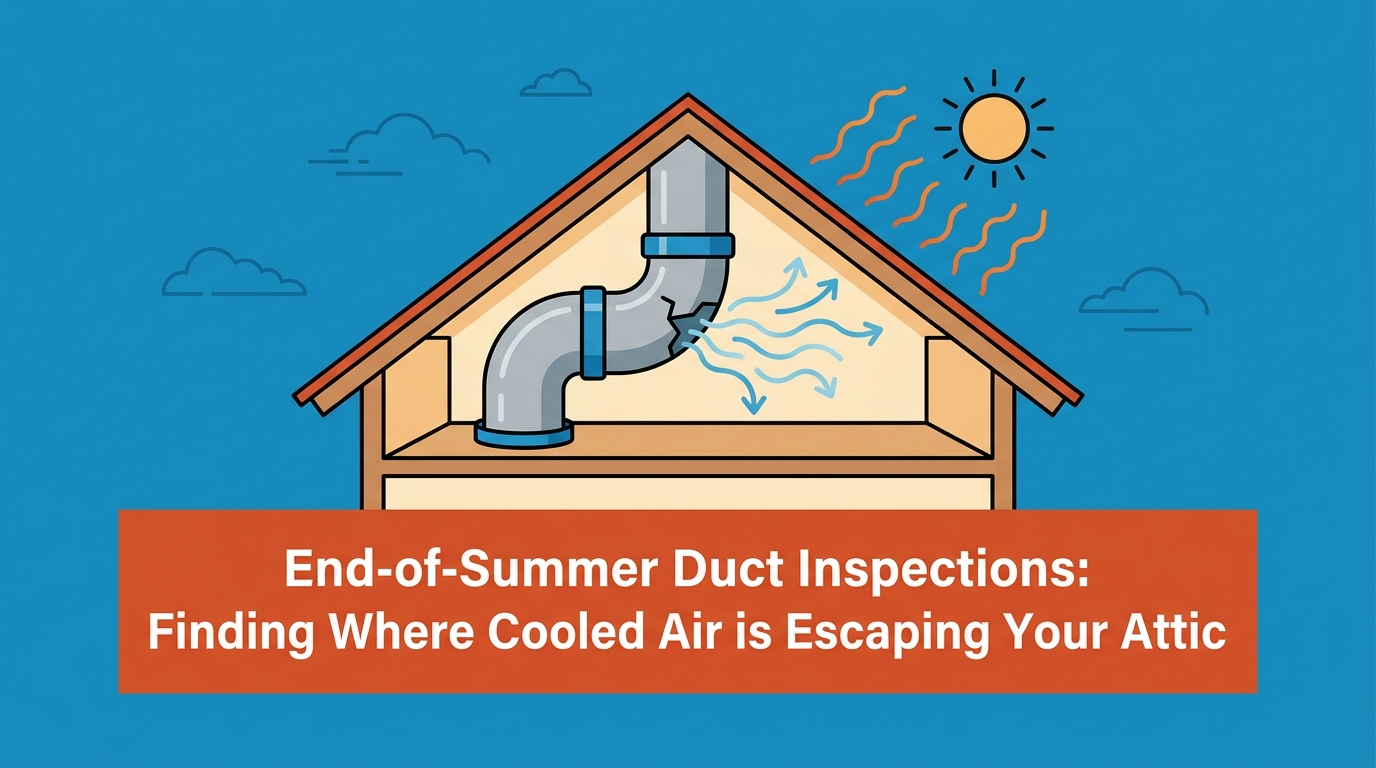
When August in the San Jose Valley brings its relentless, dry heat, scheduling End-of-Summer Duct Inspections: Finding Where Cooled Air is Escaping Your Attic becomes critical to keeping your home comfortable. If your system is running constantly but your living spaces still feel uncomfortably warm, the problem might not be a failing compressor. Instead, it is often a hidden issue sitting right above your ceiling. When the intense, dry late-summer heat bakes your attic space, it creates massive temperature differentials between the 55-degree cooled air inside your ducts and the 130-degree ambient environment outside them.
If you rely on aging air conditioning systems, understanding this thermal degradation is the first step to restoring your home's comfort. Many homeowners assume their equipment is simply undersized or running out of refrigerant. In reality, the unit is working perfectly fine, but a large percentage of that expensively cooled air is spilling out into the sweltering attic before it ever reaches your bedroom vents.
This late summer period, right as families transition into the back-to-school routine, is the ultimate stress test for your home's infrastructure. The frustration of adjusting the thermostat down to 68 degrees, only to watch the indoor temperature stall at 76 degrees, is a clear signal that something in the delivery system has failed. By late August, the cumulative heat stress on your home reaches its peak. Making the decision to schedule a professional inspection now does more than just capture your remaining cooling efficiency for the rest of the summer heatwaves—it acts as a vital diagnostic step to prepare your home for the colder months ahead.
In our years of serving San Jose homeowners at Precision Heating & Cooling, a pattern we see often is the catastrophic failure of traditional adhesives. The term "duct tape" is incredibly misleading when it comes to actual HVAC ductwork. While standard cloth-backed tape might hold together cardboard boxes or temporary repairs, our technicians can tell you firsthand that it is entirely unsuited for the extreme environment of a residential attic. Over the course of a long summer, the physics of thermal stress systematically destroy basic adhesives, leading to massive airflow loss right when you need cooling the most.
To understand why leaks suddenly appear in August, you have to look at the cumulative heat exposure. An attic acts like a giant solar oven. While it might be 95 degrees outside, the trapped air inside a poorly ventilated attic can easily exceed 130 degrees. This extreme heat causes the chemical compounds in older ductwork tape to dry out, turn brittle, and eventually crystallize. The adhesive simply bakes off.
The temperature differential accelerates this failure. You have ice-cold air rushing through the inside of the thin metal or flexible plastic duct, while the outside of the duct is subjected to blistering ambient heat. This constant expansion and contraction of the duct materials forces the brittle tape to crack and pull away from the joints. By the time late August arrives, the tape that was barely holding on in June has completely surrendered, opening wide gaps at every junction and elbow.
Many older homes still have original ductwork sealed with vulnerable cloth-backed tape or early-generation foil tapes that lack high-heat acrylic adhesives. When these fail, the solution is not to apply more tape. Modern professional sealing relies on mastic—a thick, rubbery sealant that is brushed or troweled directly onto the joints.
• Temperature Resistance — Older Cloth-Backed Tape: Adhesive dries out and fails above 100°F. — Professional Mastic Sealant: Remains flexible and intact well over 150°F.
• Flexibility — Older Cloth-Backed Tape: Turns brittle and cracks under expansion/contraction. — Professional Mastic Sealant: Expands and contracts naturally with the ductwork.
• Application Durability — Older Cloth-Backed Tape: Peels away easily as dust and humidity compromise the bond. — Professional Mastic Sealant: Cures into a permanent, hardened rubber shell.
• Lifespan — Older Cloth-Backed Tape: Fails after a few seasons of extreme summer heat. — Professional Mastic Sealant: Designed to last the lifetime of the HVAC system.
Mastic provides a permanent, heat-resistant solution that physically bonds the metal or fiberglass components together. It does not rely on a thin layer of sticky glue; instead, it cures into a tough, flexible shell that easily withstands the bake-oven conditions of a late-summer attic.


Because ductwork is hidden away in dark, inaccessible spaces, homeowners rarely see the physical gaps where air is escaping. Instead, you have to diagnose the problem by observing how your home behaves. The symptoms of degraded duct tape often mimic the signs of a failing air conditioner, which is why proper diagnosis is critical before assuming you need a total system replacement.
The most prominent symptom of compromised ductwork is a system that simply will not stop running. When cold air spills into the attic instead of reaching your living room, the thermostat never registers that the target temperature has been met. This leads to continuous operation. You may also notice stark temperature differences between rooms. A bedroom closest to the indoor air handler might feel like an icebox, while a room at the far end of the house barely receives a trickle of air.
• Weak airflow at the registers: Hold your hand over the vent in the warmest room. If the air is cold but the pressure feels like a faint breath rather than a strong breeze, the air is likely bleeding out somewhere along the duct run in the attic.
• Hot spots and cold spots: Uneven cooling throughout the home is a classic sign that specific branch lines have disconnected or lost their seal.
• Excessive dust around vents: Leaky ducts don't just lose air; they can also disrupt the pressure balance in the room, causing dust to settle rapidly around the registers.
According to Energy Star, about 20 to 30 percent of the air that moves through a typical duct system is lost due to leaks, holes, and poorly connected ducts. When you lose that much volume, your system has to run 20 to 30 percent longer just to achieve a baseline level of comfort. This constant operation directly translates into spiked utility usage.
Furthermore, this overworking drastically increases the wear and tear on your equipment. When a compressor is forced to run continuously during the hottest part of the day, it overheats. This excessive strain is a leading cause of late-summer AC breakdowns. Cooling the neighborhood squirrels in your attic isn't just a waste of energy; it actively shortens the lifespan of your expensive HVAC hardware.
While the loss of temperature control is usually what prompts a homeowner to call for help, the secondary effects of leaky ducts are often more insidious. The ductwork in your home operates as a pressurized closed-loop system. When that loop is broken by degraded tape in late summer, it changes the pressure dynamics of the entire house, leading to significant indoor air quality (IAQ) problems.
When supply ducts (the ones blowing air into your rooms) leak into the attic, it creates a negative pressure environment inside the living space. Because nature abhors a vacuum, the house will attempt to equalize this pressure by sucking air in from anywhere it can. This means your home starts pulling hot, dusty, and contaminated air from the attic, the crawlspace, and the gaps around your windows and doors.
Common IAQ issues caused by duct leaks include:
• Attic dust and insulation fibers: Negative pressure can pull loose fiberglass particles and decades-old dust down through ceiling fixtures and light switches into your breathing air.
• Increased allergen infiltration: During the dry, dusty August conditions, outdoor allergens and pollen are easily drawn into the home through tiny structural gaps.
• Humidity imbalances: Sucking in unconditioned outdoor air makes it incredibly difficult for your AC to dehumidify the home properly, leading to a clammy, uncomfortable indoor environment.
A completely sealed duct system is essential for maintaining overall home health. When your ducts are airtight, the only air circulating through your home is the air that has been properly filtered and conditioned by your HVAC system.
When homeowners discover a disconnected duct or a peeling piece of tape, the temptation is often to grab a roll of heavy-duty tape from the hardware store and attempt a quick patch. However, properly diagnosing and sealing an attic air distribution system is not a weekend DIY project. It requires specialized tools, extensive training, and a deep understanding of airflow dynamics.
Adding more store-bought tape over failed older ductwork tape is a temporary bandage that will almost certainly fail again within weeks. Hardware store tapes, even those labeled for HVAC use, rarely have the acrylic adhesive required to survive extreme attic heat unless applied to a perfectly clean, dust-free metal surface—something that is nearly impossible to achieve in a dusty attic. Furthermore, navigating an attic safely requires knowing exactly where to step to avoid falling through the ceiling drywall, as well as wearing the proper protective equipment to avoid inhaling airborne fiberglass.
The most severe leaks are rarely out in the open. They are usually buried under two feet of blown-in insulation. Professionals use specialized diagnostic techniques, including static pressure testing and thermal imaging, to trace airflow drops along the entire duct run. This allows them to pinpoint exactly where the pressure is dropping without having to blindly dig through the insulation.
This level of diagnostic precision is where experience truly matters. Leveraging our 20 years of local experience inspecting San Jose attic construction, Precision Heating & Cooling technicians are highly adept at identifying the era-specific thermal degradation patterns common in local neighborhoods. We know exactly what materials were used in different decades and exactly how they tend to fail under our specific regional heat stress.
One local homeowner called us late in the summer after their AC was still not working correctly despite being serviced by other companies. Our technician provided an honest and trustworthy assessment, discovering that the issue wasn't the equipment itself, but severely degraded duct connections hidden beneath the insulation. Instead of just throwing parts at a struggling AC unit, we identified the root cause. Once the real problem was properly sealed with mastic, the AC issue was resolved effectively, restoring full airflow to the home.
While the immediate pain point of leaky ducts is a hot, uncomfortable house in August, fixing the problem now offers a massive dual-season benefit. The ductwork is the central highway for your entire HVAC system. The same gaps that are currently bleeding expensive cooled air into your attic will do the exact same thing to your expensive heated air in just a few months.
The first and most obvious benefit of sealing your ducts is the immediate restoration of cooling power. When the system is sealed, 100 percent of the air produced by your air handler is forced into your living spaces.
1. Faster cooling times: The system will satisfy the thermostat much quicker, running for shorter cycles.
2. Balanced room temperatures: Rooms at the far end of the house will finally receive the velocity of air they need to stay comfortable.
3. Reduced compressor strain: By shortening the cooling cycles, you give the outdoor unit a chance to rest and cool down, significantly reducing the risk of a catastrophic mechanical failure during a heatwave.
As the intense late-summer heat begins to fade, San Jose homeowners must look ahead to the colder months. Sealing your ducts now is one of the most effective forms of winter heating preparation available.
When you switch your thermostat to heating mode, the furnace takes over. If the ducts are still compromised, you will be pumping warm air directly into a freezing attic. Because warm air rises naturally, a leak in a ceiling duct during the winter is incredibly inefficient, as the heat escapes upward before it ever has a chance to warm the room below. By taking care of the End-of-Summer Duct Inspections now, you ensure that your system is fully optimized and ready to deliver efficient, reliable heat the moment the first cold front arrives.
Why is my AC running constantly but the house is warm?
This usually means the cooled air is escaping before it reaches your rooms, or the system is severely undersized for the heat load. In San Jose homes, degraded ductwork in a sweltering attic is a leading culprit. The AC is producing cold air, but massive leaks prevent that air from making it out of the vents, forcing the system to run endlessly to satisfy the thermostat.
How does extreme heat affect duct tape?
Extreme heat bakes the moisture and chemical flexibility out of basic adhesives. When attic temperatures exceed 130 degrees, older cloth-backed tapes dry out, become brittle, and lose their grip on the metal duct joints. As the ductwork expands and contracts with temperature changes, the hardened tape simply cracks and falls away.
Is duct sealing worth it before winter?
Absolutely. The same leaks that waste your air conditioning in the summer will waste your heating in the winter. Sealing the ducts ensures that the expensive warm air produced by your furnace actually makes it into your living spaces, rather than escaping into a freezing attic. It is a critical step for year-round energy efficiency.
How do you find an air leak in AC ductwork?
Professionals use a combination of visual inspections, static pressure testing, and sometimes thermal imaging. Because many leaks are hidden beneath thick layers of blown-in insulation, technicians measure the airflow at the equipment and compare it to the airflow at the registers to calculate exactly how much air is being lost along the hidden runs.
Why do older San Jose homes frequently experience duct tape failure?
Many older homes in the area still feature original ductwork installed decades ago, utilizing early-generation tapes that were never designed to withstand modern climate extremes. The intense, dry heat of the local microclimate accelerates the thermal degradation of these outdated materials, leading to widespread failure as the systems age.
Can leaky ducts impact indoor air quality during late summer?
Yes, significantly. When supply ducts leak, it creates negative pressure inside the home, which pulls in unconditioned air from the attic, crawlspaces, and exterior gaps. This introduces dust, fiberglass insulation particles, and seasonal allergens directly into the air you breathe.
Understanding why your ductwork fails under the stress of late-summer heat is the first step to solving uneven cooling and runaway utility bills. If your system is running non-stop but your home still feels warm, do not wait for the compressor to fail from exhaustion. A professional inspection will accurately diagnose the root cause, allowing you to capture your remaining cooling efficiency for the rest of August while perfectly prepping the home for winter heating.
Staying ahead of seasonal wear and tear is the best way to protect your investment. By scheduling a routine HVAC maintenance plan, you ensure that critical components like ductwork are inspected regularly, catching thermal degradation long before it compromises your comfort. End-of-Summer Duct Inspections: Finding Where Cooled Air is Escaping Your Attic is more than just a repair—it is a comprehensive strategy for long-term home health.

Leslie was amazing for her outstanding customer service skills with me the other day. Thanks to her help my air conditioner is now all set up. She answered all my questions and took away all my problems. Leslie broke it down step by step to set it up easier. Now thanks to her my air conditioner is working perfectly. I really appreciate it Leslie and I’ll be sure to ask for you if I ever come back.
I contacted Precision Heating and Cooling for my home's AC repair. They were punctual and very professional. Guillermo was very kind and thorough. I would highly recommend them!
I am writing to express my sincere appreciation for the excellent work performed by Pablo and Alejandro from Precision Heating and Cooling. Their commitment to quality and customer satisfaction is truly commendable. Awesome job guys!
I would like to extend my sincere gratitude to Alejandro for his exceptional hard work. His passion for helping others is evident, and he consistently goes above and beyond in his service. Alejandro's thorough cleaning of my fireplace has truly made a significant difference. His dedication and professionalism are greatly appreciated.
I was very impressed. Came at night (after 9pm) to fix our AC during the middle of a heat wave the day before a national holiday! Technician was very courteous and efficient, got the job done quickly. Will definitely call them again for any AC servicing I need!
Fast and efficient, arrived when scheduled for repairs and replacement parts were ordered and installed quickly. Techs were very friendly and professional. AC system works great now! I highly recommend their services if you need repairs. Tim


.avif)
