


.avif)






Recent Blogs
Stay updated with our latest blog posts.


By the time the calendar turns to the hottest weeks of the year, the relentless heat has already put your cooling equipment through a grueling marathon, which perfectly explains the late-summer AC breakdown: why capacitors fail in August. You rely on your system to keep your home comfortable, but after weeks of continuous, heavy operation, mechanical and electrical components start to reach their physical limits. A bulging, failing capacitor in the middle of an August late-summer heat wave is rarely a case of random bad luck. Instead, it is a highly predictable breaking point resulting from cumulative wear and tear.
If you are already noticing strange noises or feeling warm air coming from your vents, it might be time to have a professional evaluate your air conditioning systems and schedule AC repair service before the system stops entirely.
Many homeowners assume that an air conditioner is either completely broken or perfectly fine, but the reality is much more gradual. Electrical components degrade over time, particularly under the stress of constant thermal cycling. Recognizing the early signs of this electrical strain can save you from a total system shutdown right when you need cooling the most. Rather than waiting for the outdoor unit to go completely silent on a 100-degree afternoon, understanding the timeline of seasonal wear allows you to take proactive steps.
• Early Summer (June) — System Workload: Moderate. Frequent cycling but with adequate rest periods overnight. — Component Stress Level: Low to Normal. Components easily dissipate operational heat.
• Mid-Summer (July) — System Workload: Heavy. Longer run times to combat rising afternoon temperatures. — Component Stress Level: Elevated. Capacitors and motors begin retaining more residual heat.
• Late Summer (August) — System Workload: Extreme. Continuous operation with minimal overnight recovery. — Component Stress Level: High. Maximum thermal and electrical fatigue on aging parts.
As the table illustrates, the burden on your system compounds as the season progresses. By August, the equipment has little opportunity to recover, setting the stage for the most common late-summer failure: the blown capacitor.
Air conditioning systems are designed to handle hot weather, but they are not invincible against the relentless march of time and temperature. From the first hot day in June through the peak of August, your HVAC system runs almost constantly. San Jose CA experiences prolonged late-summer heatwaves that keep outdoor temperatures elevated long after the sun goes down. Because the outdoor temperatures rarely drop low enough to give the system a true break, the outdoor unit hasn't fully rested since early summer, compounding the stress on every internal wire and mechanism.
Capacitors are essentially large, heavy-duty batteries that store and release electrical energy to help the compressor and fan motors start and run efficiently. Over the course of a single summer, these components endure hundreds, if not thousands, of hours of thermal and electrical cycling. Every time the thermostat signals the system to turn on, the capacitor delivers a massive jolt of energy. Over months of continuous use, this constant charging and discharging takes a severe toll.
To understand why August is the danger zone, you have to look at the sheer number of start-and-stop cycles an AC unit goes through by late summer. Early in the season, your unit might cycle on and off a few dozen times a day. By August, that number skyrockets.
• Thousands of start cycles: Each start requires a massive surge of power, stressing the internal materials of the capacitor.
• Lack of recovery time: Back-to-back hot days mean the internal fluids and metals inside the capacitor never fully cool down to ambient temperature.
• Cumulative degradation: The insulating materials inside the component break down microscopically with every high-heat cycle, eventually losing their ability to hold a charge.
Frame the failure as a cumulative result of continuous operation rather than a sudden, unpredictable event. The breakdown you experience in August was likely set in motion weeks earlier. The component fought through July, but the sustained lack of recovery time finally pushed it past its operational limits.
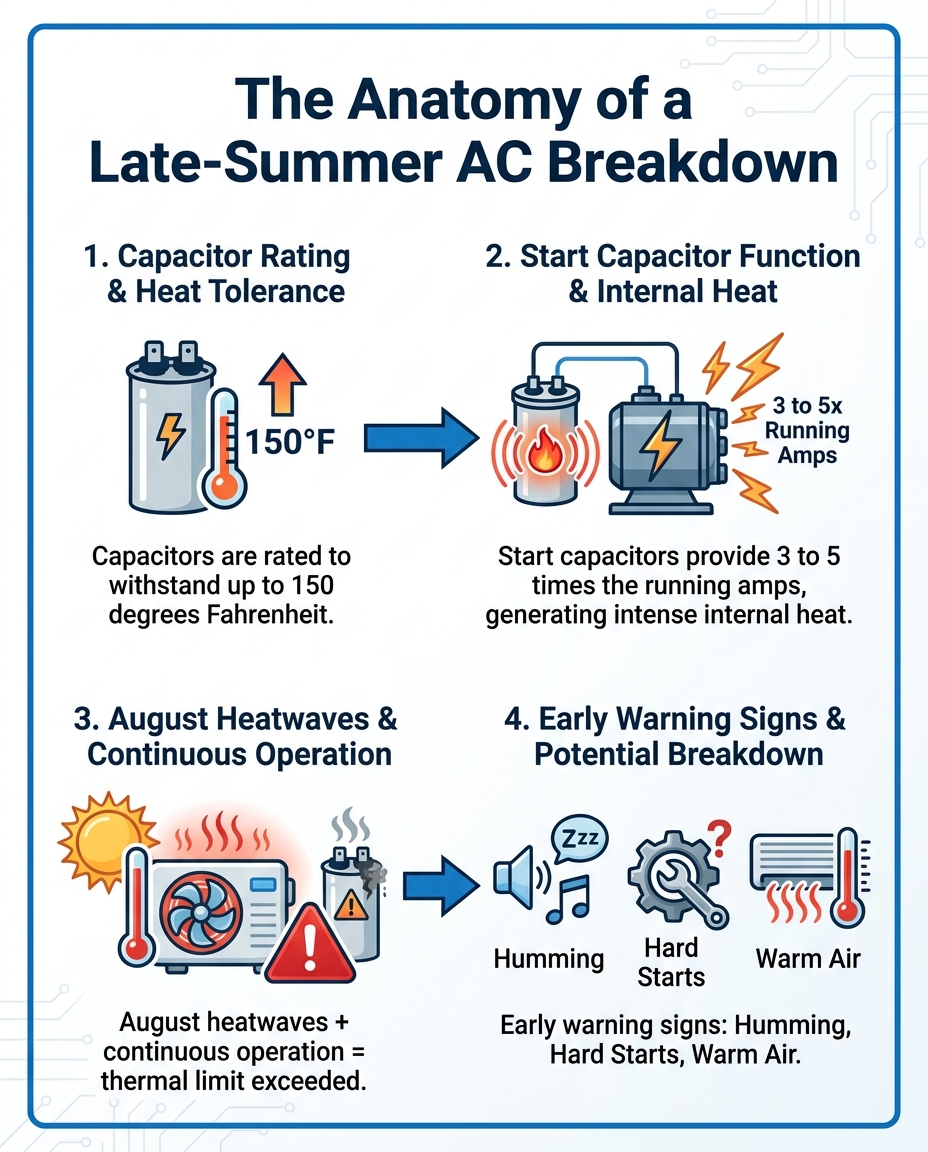
The failure of an AC capacitor is ultimately a story of heat—both from the outside environment and from the inside of the machine. Capacitors are typically rated by manufacturers to withstand up to 150 degrees Fahrenheit. While that sounds incredibly hot, it is surprisingly easy to exceed that threshold when you combine severe local weather with the mechanics of air conditioning.
When local San Jose temperatures spike into the 90s and 100s, the ambient operating conditions for your outdoor condenser unit become severe. The metal cabinet sits in the baking sun, absorbing solar radiation. Inside that hot metal box, the compressor and fan motors are generating their own intense thermal energy as they work to cool your home. If you want to understand the broader impact of this constant workload, you can learn more about what happens to your AC compressor when it runs non-stop.
The external weather is only half of the equation. The internal electrical burden of starting and running the compressor is immense. A start capacitor provides a massive jolt of electricity—often three to five times the normal running amps—just to overcome the inertia of the heavy compressor motor. Pushing that much electrical current through the component generates intense internal heat.
When you add the 100-degree ambient air, the solar heat gain on the metal cabinet, the heat radiating from the running compressor, and the internal electrical heat of the capacitor itself, the combined temperature easily exceeds the component's 150-degree thermal limit. Because continuous operation prevents the capacitor from cooling down between cycles, this intense, non-stop workload leads directly to the physical degradation of the part.

When a capacitor exceeds its thermal limits day after day during the August late-summer heat, the internal physics of the component begin to change. A capacitor is essentially a metal cylinder filled with layers of conductive foils and a dielectric fluid or paste. This fluid helps insulate the internal components and manage the electrical charge.
When the capacitor overheats, that internal fluid begins to boil and expand, creating expanding gases. Because the metal cylinder is sealed, the pressure builds rapidly inside the casing. To prevent the component from violently exploding under this intense pressure, manufacturers design the top of the capacitor (where the electrical prongs are located) to be structurally weaker than the sides. As the pressure builds, this top section expands upward, creating a distinct, visible bulging or mushroom-like shape.
What the bulge actually means:
• Structural failure: The physical deformation is a definitive sign that the internal insulation has ruptured.
• Loss of capacitance: The component can no longer hold or deliver the specific microfarad charge required to start your motors.
• System lockdown: Without that electrical jolt, your compressor and outdoor fan will refuse to start, leaving your home without cooling.
A strict warning for homeowners: While understanding this physical mechanism is helpful, you must never open the outdoor electrical panel to check for a bulging capacitor yourself. Capacitors are designed to store massive amounts of high-voltage electricity. Even if you have turned off the power at the thermostat and flipped the circuit breaker, a failing capacitor can retain a lethal electrical charge. Inspecting, testing, and replacing this component must always be left to a licensed professional equipped with the proper discharging tools and safety gear.
Fortunately, a failing capacitor rarely dies in total silence. Before it bulges and fails completely, it will often give you audible and physical clues that it is struggling to handle the August late-summer heat. By learning to recognize these early warning signs, you can call for professional help before you are completely without air conditioning.
Here are the primary symptoms homeowners can identify externally without ever touching the equipment:
• A distinct humming or buzzing noise: If you hear a loud hum coming from the outdoor condenser unit, it usually means the motor is trying to start but isn't receiving the necessary electrical jolt from the capacitor. The motor is essentially stalled and drawing locked-rotor amps, which causes the buzzing sound.
• Hard starts: If the system shudders, dims the lights in your house momentarily, or takes unusually long to finally kick on, it is experiencing a 'hard start.' The capacitor is losing its stored charge and struggling to overcome the inertia of the compressor.
• Warm air from the vents: The indoor blower fan might still be pushing air through your ductwork, but if the outdoor fan or compressor isn't running due to a dead capacitor, that air will not be cooled.
• Random shut-offs: The AC unit might start up but shut off randomly before reaching the set temperature on the thermostat. This short-cycling happens because the struggling compressor overheats without proper capacitor support, triggering internal safety switches to shut the system down.
Hearing a loud buzz and feeling warm air coming from your vents can easily induce panic, especially when the San Jose CA forecast predicts another week of triple-digit temperatures. Many homeowners immediately fear that their entire compressor has died, which is a major, labor-intensive repair. However, it is highly common that these exact symptoms simply point to a dead capacitor.
During a recent summer heatwave, a local homeowner reached out because their AC unit was completely non-operational and they needed an urgent service call. One of our technicians was dispatched quickly, safely diagnosed a blown capacitor, and got the unit up and running in no time. This is a typical pattern we see in late summer. With 20 years of experience diagnosing and rapidly repairing peak-summer AC electrical failures in the San Jose service area, Precision Heating & Cooling knows exactly how to get your system back online safely and efficiently.
The professional process for resolving this issue is straightforward but requires specialized training. First, the technician will safely discharge the old unit using insulated tools, ensuring no high-voltage energy remains. Next, they will test the electrical draw of the motors to confirm that the capacitor is the sole issue and that the compressor hasn't suffered secondary damage. Finally, they will install a properly rated replacement capacitor that matches the exact microfarad specifications required by your specific condenser model.
Because a trained technician carries a wide variety of standard capacitors on their service truck, this repair can often be completed in a single, fast visit, restoring cooling to your home before the afternoon sun peaks.
Once your immediate cooling crisis is resolved, it is wise to shift your focus from reactive repair to proactive protection. The August late-summer heat will continue to test your equipment, and taking a few simple steps can help the rest of your system survive until the cooler fall weather arrives.
Routine checks by a professional can easily identify weak capacitors before they bulge and fail. A technician uses a multimeter to measure the microfarad output of the capacitor; if it falls below the manufacturer's accepted range, it can be replaced proactively during a tune-up rather than reactively during an emergency breakdown.
Here are a few seasonal steps to protect your system:
1. Clear the perimeter: Keep the outdoor unit entirely clear of debris, tall grass, and overgrown bushes. The system needs at least two feet of clearance on all sides to dissipate heat efficiently. If airflow is blocked, the internal temperature of the cabinet rises, accelerating capacitor wear.
2. Check your air filters: A clogged indoor air filter forces the entire system to run longer to cool the house. Longer run times mean more electrical stress on the outdoor capacitor. Replace your filter every 30 to 90 days.
3. Schedule professional oversight: Recommend scheduling an end-of-season or pre-season tune-up to ensure electrical components are operating within safe limits. Investing in preventative AC maintenance ensures that a trained eye evaluates the electrical load on your system before small weaknesses turn into major meltdowns.
Understanding the signs of a failing capacitor can save you from enduring days without air conditioning in the San Jose CA heat. When you know what to listen for—like that telltale humming or the struggle of a hard start—you can act quickly. The late-summer AC breakdown: why capacitors fail in August is a predictable pattern, but it doesn't have to ruin your week.
Reassurance comes from knowing that a professional capacitor swap is a common, straightforward fix. If you notice humming, hard starts, or warm air blowing from your vents, do not wait for the system to shut down completely. Reach out to a licensed professional to schedule an inspection, secure your comfort, and ensure your system has the electrical support it needs to finish the summer strong.
Your AC capacitor keeps blowing due to the cumulative stress of high ambient temperatures and continuous electrical cycling. During the summer, the unit runs constantly, preventing the capacitor from cooling down. This excessive, trapped heat breaks down the internal insulating fluids. If it happens repeatedly in a single season, you may have an underlying issue like a failing fan motor or an oversized capacitor that a professional needs to evaluate.
The most common sign of a blown AC capacitor is a loud humming or buzzing noise coming from the outdoor unit while the fan blades remain perfectly still. You will also likely notice warm air blowing from your indoor vents because the outdoor compressor cannot start. In some cases, the system will repeatedly try to turn on and immediately shut off, which is a protective response to the electrical failure.
Yes, an exceptionally hot day can be the final trigger that causes an AC capacitor to fail. Capacitors are rated for high temperatures, but when extreme ambient heat is combined with the internal heat generated by the electrical current, the component's thermal limit is exceeded. However, the failure is usually the result of weeks of cumulative wear rather than just one single hot afternoon.
When an AC capacitor goes bad, it loses its ability to store and release the electrical charge needed to start the compressor and fan motors. Without this jolt of energy, the motors stall and draw excessive current, which creates a buzzing sound and generates dangerous heat. Eventually, the internal safety switches will trip, or the circuit breaker will flip to protect the system from further electrical damage.
AC capacitors fail in hot weather because the external heat prevents the component from dissipating its internal operational heat. The fluid inside the capacitor expands under high temperatures, building pressure inside the metal casing. If the unit runs continuously during a heatwave without adequate rest periods, this thermal overload causes the casing to bulge and the internal connections to break.
A start capacitor provides a massive, short burst of energy to help the compressor motor overcome inertia and begin turning. A run capacitor provides a continuous, lower-level electrical current to keep the motor running smoothly and efficiently once it has started. Many modern residential AC units use a dual run capacitor, which supports both the compressor and the outdoor fan motor in one combined unit.
In a hot climate with heavy summer usage, an AC capacitor typically lasts between 5 and 10 years. The lifespan is directly tied to how often the system runs and how effectively the outdoor unit can dissipate heat. Routine maintenance, proper airflow around the condenser, and prompt repairs of other struggling components can help extend the life of the capacitor.

Leslie was amazing for her outstanding customer service skills with me the other day. Thanks to her help my air conditioner is now all set up. She answered all my questions and took away all my problems. Leslie broke it down step by step to set it up easier. Now thanks to her my air conditioner is working perfectly. I really appreciate it Leslie and I’ll be sure to ask for you if I ever come back.
I contacted Precision Heating and Cooling for my home's AC repair. They were punctual and very professional. Guillermo was very kind and thorough. I would highly recommend them!
I am writing to express my sincere appreciation for the excellent work performed by Pablo and Alejandro from Precision Heating and Cooling. Their commitment to quality and customer satisfaction is truly commendable. Awesome job guys!
I would like to extend my sincere gratitude to Alejandro for his exceptional hard work. His passion for helping others is evident, and he consistently goes above and beyond in his service. Alejandro's thorough cleaning of my fireplace has truly made a significant difference. His dedication and professionalism are greatly appreciated.
I was very impressed. Came at night (after 9pm) to fix our AC during the middle of a heat wave the day before a national holiday! Technician was very courteous and efficient, got the job done quickly. Will definitely call them again for any AC servicing I need!
Fast and efficient, arrived when scheduled for repairs and replacement parts were ordered and installed quickly. Techs were very friendly and professional. AC system works great now! I highly recommend their services if you need repairs. Tim


.avif)
