


.avif)






Recent Blogs
Stay updated with our latest blog posts.


When August rolls around and the back-to-school rush begins, deciding between upgrading to a heat pump water heater vs. sticking with a standard gas tank in San Jose is one of the most impactful choices you can make for your home's energy future. At Precision Heating & Cooling, we always remind our customers that late summer offers the perfect window for proactive home utility upgrades. The weather is still warm, schedules are settling into a predictable routine, and the intense demand of the winter heating season hasn't yet arrived. If your current water heater is showing its age—making strange rumbling noises, producing rusty water, or struggling to keep up with morning showers—waiting for it to fail in December usually means making a rushed, stressful decision.
Most homeowners don't realize that a failing water heater gives you a brief but valuable opportunity to rethink how your home uses energy. You are faced with a fundamental choice: do you replace your aging unit with another familiar gas-powered model, or do you make the leap to a high-efficiency electric system? Making this transition requires looking closely at your home's layout, your current electrical capacity, and your long-term energy goals. If you are exploring your water heater solutions or considering a comprehensive heat pump installation, understanding the mechanics behind these systems is the first step toward a confident decision.
When our technicians walk homeowners through this decision, we start by explaining exactly how these two technologies generate hot water. The core difference comes down to one simple concept: creating heat versus moving heat. A standard gas tank relies on the direct combustion of fossil fuels, while a heat pump system uses electricity to transfer ambient heat from the air into your water.
When evaluating a heat pump water heater vs. standard gas tank, the operational mechanics look entirely different:
• Standard Gas Models: These traditional systems use a gas burner located at the bottom of the tank. When the thermostat detects a drop in water temperature, the burner ignites, heating the water directly. The exhaust gases created by this combustion process must be safely vented out of your home through a flue pipe. While reliable, this process is inherently limited in efficiency because a portion of the heat is always lost through the exhaust vent.
• Heat Pump Water Heaters: Think of a heat pump water heater as a refrigerator working in reverse. Instead of burning fuel, it uses a small amount of electricity to power a compressor and a fan. The fan pulls in ambient air from the surrounding room, extracts the heat from that air using refrigerant coils, and transfers that concentrated heat into the water tank. Because it is moving existing heat rather than generating new heat from scratch, the efficiency gains are massive.
This fundamental shift from combustion to high-efficiency electric power changes more than just your utility bill. It alters the physical installation requirements. Gas tanks need proper ventilation for carbon monoxide and a dedicated gas line. Heat pump models, on the other hand, require a specific amount of surrounding airspace to draw from, a condensate drain to manage moisture, and appropriate electrical wiring. Understanding these physical differences is essential when planning your upgrade.
The short answer is that location dictates performance. When you look at national data on heat pump efficiency, you often see warnings about performance drops in freezing weather. However, in our years of installing these systems across the Bay Area, we've seen firsthand that the San Jose region offers a distinct climate advantage that makes this technology exceptionally effective.
With roughly 300 days of sunshine a year and a mild Mediterranean climate, San Jose rarely experiences the deep, prolonged freezes common in other parts of the country. Heat pump water heaters thrive on ambient heat. Because they pull warmth from the air surrounding the tank, the temperature of your garage, basement, or utility room directly impacts how hard the system has to work.
The regional synergy: In colder climates, a heat pump water heater installed in an unheated garage might struggle during winter, forcing the unit to rely heavily on its less-efficient electric resistance backup elements to keep the water hot. In the Bay Area, an unconditioned garage typically stays relatively mild year-round. This means the heat pump can operate in its ultra-efficient "compressor-only" mode for the vast majority of the year.
Furthermore, because heat pumps expel cool, dehumidified air as a byproduct of their operation, they can actually provide a slight cooling effect to the space where they are installed. In a warm San Jose garage during late summer, this byproduct is often a welcome bonus rather than a drawback. By leveraging our specific regional climate, you maximize the unit's efficiency and minimize wear and tear on the system over its lifespan.
One of the most significant hurdles when transitioning from a standard gas tank to a heat pump model is your home's existing electrical infrastructure. Our installation crews frequently encounter this in older San Jose and Bay Area neighborhoods, where many homes were originally built with 100-amp electrical panels. While sufficient for basic lighting and a few appliances, these older panels often lack the capacity to support modern, whole-home electrification.
Traditionally, installing a full-sized heat pump water heater requires a dedicated 240-volt electrical circuit. If your current gas water heater only uses a standard 120-volt outlet for its electronic ignition (or uses no electricity at all), adding a new 240V circuit means running new wire from your main panel to the installation site. If your 100-amp panel is already full, this might trigger the need for a comprehensive heavy panel upgrade to 200 amps.
Assessing your electrical capacity is a critical first step. A professional evaluation by our team will look at your total load calculation and the physical space remaining in your breaker box. Here is what you need to consider:
• Dedicated Circuit Requirements: Most high-efficiency 240V models require a dedicated 30-amp double-pole breaker. This ensures the unit has reliable power without tripping shared circuits.
• The 120V Plug-In Alternative: If a panel upgrade isn't feasible right now, the industry has recently introduced 120V plug-in heat pump water heaters. These units use a standard household outlet and are designed specifically as a bridge for homes looking to move away from gas without the immediate need for extensive electrical rewiring. They operate at a lower wattage, which means recovery times are slower, but they offer a viable path to electrification for older homes.
• Local Building Standards: As California pushes toward decarbonization, local codes are evolving. When planning your project, we highly recommend reviewing the Title 24 requirements for hot water tank installations, which strongly encourage energy-efficient upgrades and dictate specific insulation and installation standards.
When comparing a heat pump water heater vs. standard gas tank, the upfront installation complexity is only half the story. The long-term operational value is where the electric transition truly shines. Because heat pumps move heat rather than creating it, they can be up to three times more energy-efficient than conventional gas or standard electric resistance models.
In California, homeowners constantly balance the fluctuating costs of natural gas against local electricity rates. While electricity rates in the state are notable, the sheer efficiency multiplier of a heat pump—often operating at 300% to 400% efficiency compared to a gas tank's 60% to 70%—frequently tips the scales in favor of electric water heating over the lifespan of the unit.
Incentives and Rebates: To offset the initial installation costs, numerous generic incentive programs exist to encourage homeowners to adopt high-efficiency electric appliances. Depending on your specific situation, general federal tax credits, state-level clean energy incentives, and local utility rebates may apply to qualifying installations. Because these programs update frequently, our team always advises readers to consult with their local utility provider or a qualified tax professional for the most current details on available programs. Exploring these avenues, alongside flexible financing options, can make the transition highly manageable.
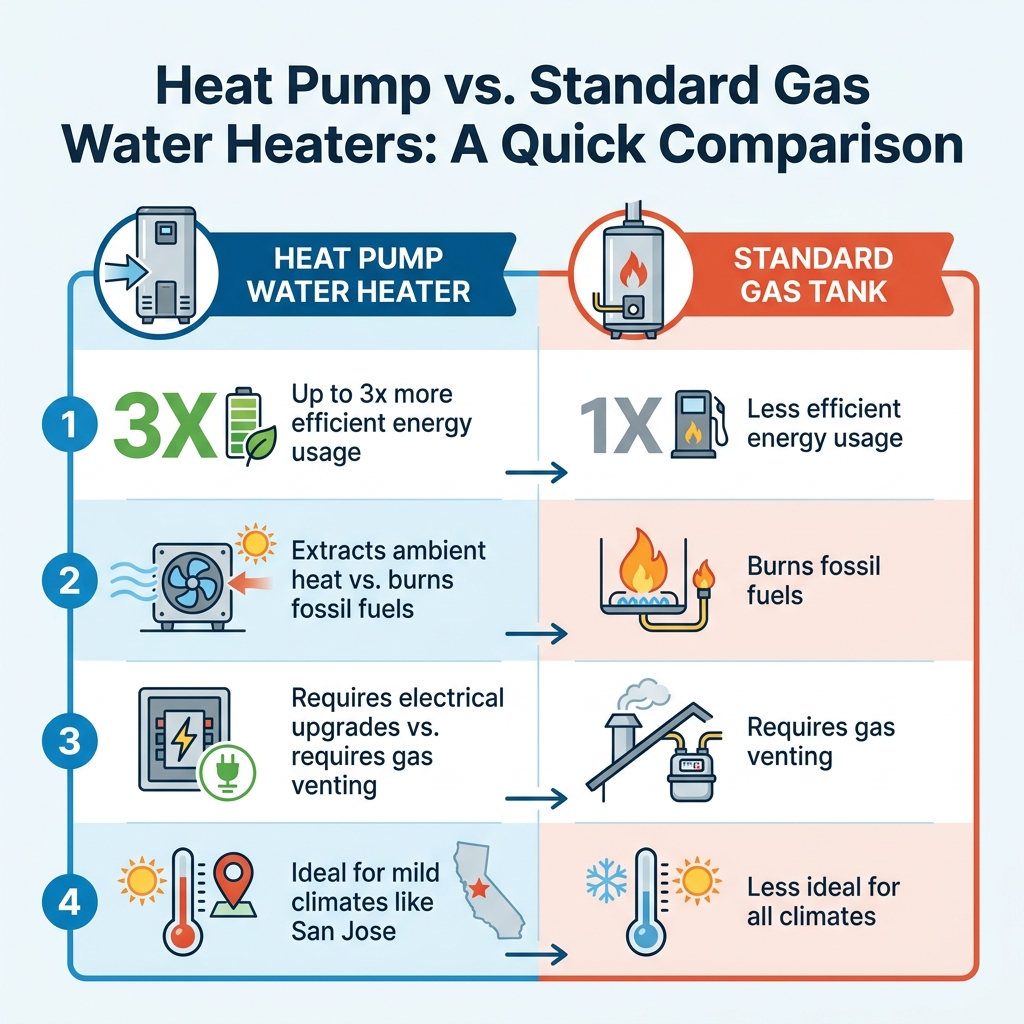
To help clarify the decision, we have broken down the core differences between upgrading to a heat pump water heater vs. standard gas tank into a scannable comparison.
• Energy Efficiency — Heat Pump Water Heater: Up to 3x more efficient; uses electricity to move ambient heat. — Standard Gas Tank: Lower efficiency; loses heat through exhaust venting during combustion.
• Installation Needs — Heat Pump Water Heater: Requires electrical wiring (often 240V), condensate drain, and ample airspace. — Standard Gas Tank: Requires dedicated gas line, combustion air, and safe exhaust venting.
• Space & Noise — Heat Pump Water Heater: Needs roughly 1,000 cubic feet of air; produces a low hum similar to a refrigerator. — Standard Gas Tank: Can fit in tighter closets; operates quietly except for the burner igniting.
• Environmental Impact — Heat Pump Water Heater: Zero on-site emissions; aligns perfectly with home decarbonization goals. — Standard Gas Tank: Burns fossil fuels directly, producing on-site carbon emissions.
• Maintenance — Heat Pump Water Heater: Requires regular air filter cleaning and standard tank flushing. — Standard Gas Tank: Requires standard tank flushing and periodic burner/flue inspections.

Switching your water heating system is not a simple plug-and-play project. It requires a comprehensive understanding of your home's unique architecture. A one-size-fits-all approach often leads to poor performance, code violations, or unexpected secondary costs.
Proper sizing, spatial evaluation, and electrical infrastructure checks are mandatory for a successful upgrade. Heat pump water heaters are typically taller and wider than standard gas tanks, meaning they might not fit in the exact same utility closet without modifications. Furthermore, ensuring proper airflow is critical; if you cram a heat pump into a tiny, sealed closet, it will freeze the surrounding air and completely lose its efficiency advantage.
This is where deep regional experience matters. At Precision Heating & Cooling, our team evaluates both your plumbing layout and your electrical/spatial architecture to recommend the right system for your specific home, avoiding the pitfalls of a one-size-fits-all approach. We understand the nuances of local building codes, Title 24 compliance, and how the San Jose / Bay Area climate impacts system performance. If you are located in San Jose and surrounding service areas, partnering with a team that looks at the whole picture ensures your new system operates safely and efficiently for years to come.
Choosing between a heat pump and a standard gas water heater ultimately comes down to your home's electrical readiness and your long-term efficiency goals. Making the right, climate-appropriate choice provides lasting peace of mind, lower energy consumption, and reliable hot water year-round.
Don't wait for your aging gas tank to fail in the middle of winter. With August and late-summer upon us, now is the time to schedule a professional assessment before the busy fall heating season fully arrives. Reach out to Precision Heating & Cooling today to book an installation estimate, explore your options, and confidently take the next step toward a more efficient home.
Is a heat pump water heater better than gas?
A heat pump water heater is generally much more energy-efficient than a standard gas model, often using up to three times less energy to heat the same amount of water. However, "better" depends on your home's electrical capacity, available space, and upfront budget. For homes looking to decarbonize and lower long-term energy usage, heat pumps are usually the superior choice.
Do heat pump water heaters work well in San Jose?
Yes, heat pump water heaters work exceptionally well in San Jose due to the mild Mediterranean climate. Because these units extract heat from the ambient air, the warm, rarely freezing temperatures in Bay Area garages provide the perfect environment for them to operate at peak efficiency year-round.
What electrical upgrades are needed to switch from gas to a heat pump water heater?
Switching from gas to a standard high-efficiency heat pump typically requires adding a dedicated 240V, 30-amp electrical circuit. If your home has an older 100-amp electrical panel that is already full, you may need a heavy panel upgrade to 200 amps to safely support the new load.
What are the downsides of a heat pump water heater?
The primary downsides include higher upfront installation costs, the potential need for electrical panel upgrades, and larger physical space requirements. Additionally, because they pull heat from the air, they require adequate ventilation and will slightly cool the room they are installed in, which may not be ideal if placed near a living space.
Does a heat pump water heater need a dedicated circuit?
Most standard 240V heat pump water heaters require their own dedicated electrical circuit to prevent overloading your panel and tripping breakers. However, newer 120V plug-in models are now available that can operate on standard shared household circuits, offering a solution for homes unable to upgrade their wiring immediately.
How does the Bay Area climate affect water heater recovery times?
The mild Bay Area climate positively affects heat pump recovery times because the unit doesn't have to work as hard to extract heat from freezing air. In warmer ambient temperatures, the compressor can quickly heat the water without needing to rely on the slower, less efficient backup electric resistance elements.

Leslie was amazing for her outstanding customer service skills with me the other day. Thanks to her help my air conditioner is now all set up. She answered all my questions and took away all my problems. Leslie broke it down step by step to set it up easier. Now thanks to her my air conditioner is working perfectly. I really appreciate it Leslie and I’ll be sure to ask for you if I ever come back.
I contacted Precision Heating and Cooling for my home's AC repair. They were punctual and very professional. Guillermo was very kind and thorough. I would highly recommend them!
I am writing to express my sincere appreciation for the excellent work performed by Pablo and Alejandro from Precision Heating and Cooling. Their commitment to quality and customer satisfaction is truly commendable. Awesome job guys!
I would like to extend my sincere gratitude to Alejandro for his exceptional hard work. His passion for helping others is evident, and he consistently goes above and beyond in his service. Alejandro's thorough cleaning of my fireplace has truly made a significant difference. His dedication and professionalism are greatly appreciated.
I was very impressed. Came at night (after 9pm) to fix our AC during the middle of a heat wave the day before a national holiday! Technician was very courteous and efficient, got the job done quickly. Will definitely call them again for any AC servicing I need!
Fast and efficient, arrived when scheduled for repairs and replacement parts were ordered and installed quickly. Techs were very friendly and professional. AC system works great now! I highly recommend their services if you need repairs. Tim


.avif)
