


.avif)






Recent Blogs
Stay updated with our latest blog posts.


How a maintenance plan extends equipment life comes down to one straightforward idea: small problems caught early never get the chance to become expensive disasters. A neglected system quietly deteriorates — losing efficiency, straining its components, and burning through years of useful life — while a well-maintained one keeps running reliably for decades.
Here is a quick look at what regular maintenance actually delivers:
If your HVAC system is one of those "out of sight, out of mind" appliances, you are not alone — but that mindset tends to be expensive. HVAC systems account for roughly 43% of the average home's energy use, according to ENERGY STAR, which means even a small drop in efficiency hits your wallet every single month. And because your system runs thousands of hours per year, the wear adds up faster than most homeowners realize.
My name is Tony Lara, and I work in the HVAC field where hands-on problem-solving and helping homeowners protect their comfort systems is what I do every day. Understanding how a maintenance plan extends equipment life is something I care about deeply, because I have seen the difference between a system that receives consistent care and one that gets called in only when something breaks.
At its core, a Maintenance Plan is a structured, repeatable schedule of inspections, cleanings, calibrations, and minor repairs designed to keep your heating and cooling systems operating as close to factory-new condition as possible. Think of it as a comprehensive health plan for your home's mechanical heart.
Rather than waiting for your heater to quit on a freezing January night in Los Gatos or your air conditioner to blow warm air during a scorching July afternoon in Clovis, a maintenance plan establishes a consistent routine of proactive checkups.
When you sign up for a professional plan, technicians build a complete asset registry of your home’s systems. We document the exact make, model, serial numbers, and installation dates of your furnace, heat pump, or mini-split. We track the history of every filter change, electrical reading, and component replacement.
This meticulous tracking closes the "asset lifespan gap." While the average neglected HVAC system might only achieve 55% to 65% of its rated design life, a structured maintenance plan ensures that your equipment actually reaches — and often exceeds — its full potential.
The secret behind how a maintenance plan extends equipment life starts with early detection. Many major system failures do not happen overnight; they are the result of tiny, unseen issues that build up over months.
During a routine visit, a technician can spot minor issues like:
By catching these small issues early, we can perform targeted, low-stress repairs. This keeps the system balanced and prevents a tiny problem from creating a domino effect of damage throughout the entire unit. For a deeper look at this process, check out our guide on how to Extend the Life of AC Through Regular Service.
When an HVAC system is dirty or out of calibration, it has to work much harder to do its job. Imagine trying to run a marathon while breathing through a straw — that is exactly what your air conditioner experiences when it is forced to pull air through a clogged, dust-caked filter or a dirty evaporator coil.
Dust acts as both an insulator on delicate electrical components and a physical plug in your system's coils. This restricted airflow forces the blower motor to run hotter and stay on longer. Additionally, poor lubrication in fan motors and bearings creates intense friction. Because friction and heat are the two greatest enemies of mechanical machinery, this extra stress rapidly ages your system's most expensive parts, including the compressor.
Regular maintenance optimizes airflow, eliminates friction through precise lubrication, and cleans away insulating layers of dust. This directly lowers the system's operational runtime, reduces energy consumption, and preserves the structural integrity of your equipment. To learn more about how this works, read our article on why Regular AC Maintenance Extend Your System.
Many people live by the philosophy, "If it isn't broken, don't fix it." While that might work for a squeaky garden gate, it is a financially risky approach to home comfort. Waiting for your system to fail before calling a technician is known as reactive maintenance, and it is almost always more expensive and stressful than a proactive plan.
When you rely on reactive repairs, you are vulnerable to:
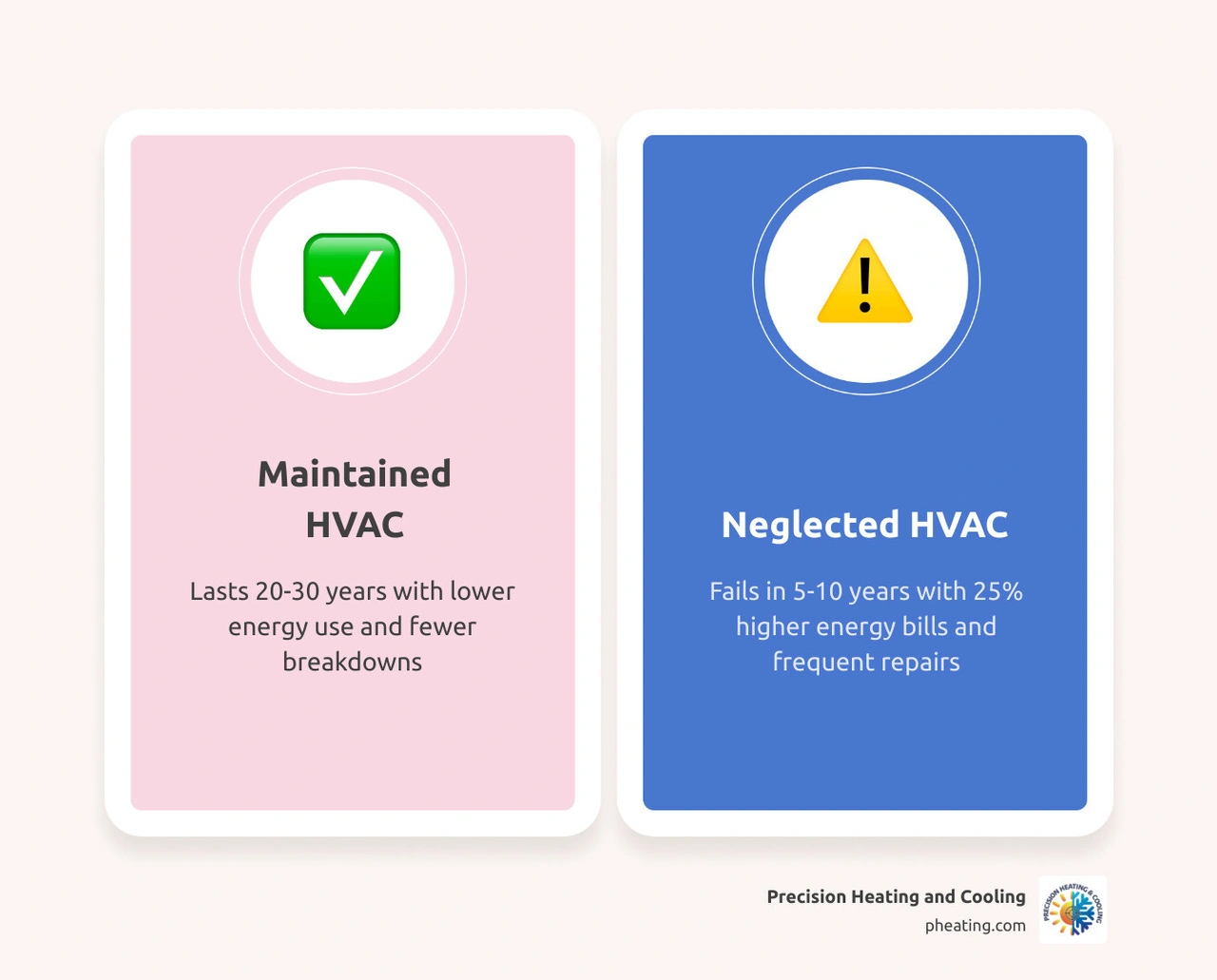
Here is how the two approaches compare over time:
| Feature | Proactive Maintenance Plan | Reactive Repair Approach |
|---|---|---|
| Average Lifespan | 20 to 30 years | 5 to 10 years |
| Annual Breakdown Risk | Under 5% | Over 35% |
| Energy Efficiency | Remains high (95-100% of rating) | Drops 5% to 10% annually |
| Repair Costs | Predictable, low, and planned | High emergency rates and unexpected fees |
| Collateral Damage | Extremely rare due to early detection | Common (minor failures cause major part damage) |
| Warranty Status | Fully protected with documented proof | Often voided due to lack of professional service |
A truly effective maintenance plan is much more than a quick visual inspection and a filter swap. It requires a systematic, multi-point checklist performed by experienced professionals who know exactly what to look for.
Key elements of a comprehensive HVAC maintenance visit include:
To understand why professionals place such a high emphasis on these steps, explore our article on AC Tune-Ups: Why Technicians Recommend Them Yearly.

Our local weather patterns play a massive role in how your heating and cooling equipment ages. In the San Jose Bay Area and Central Valley, our systems face unique environmental challenges.
For instance, homes in Cupertino, Palo Alto, and Sunnyvale often deal with heavy pollen and dust, while properties in Hanford and Clovis experience intense summer heat waves that force air conditioners to run continuously for weeks on end.
Without a customized maintenance plan, these local environmental factors can accelerate wear. High dust and pollen levels clog outdoor condenser coils quickly, forcing the system to work twice as hard to disperse heat. During extreme heat, a dirty coil can cause the system to overheat and shut down entirely, placing immense stress on the compressor.
To maximize the benefits of your maintenance plan, timing is everything. We recommend a bi-seasonal approach: scheduling your cooling system service in the spring and your heating system tune-up in the fall.
To help you prepare your home for these seasonal changes, read our detailed guides on the Spring HVAC Transition From Heating to Cooling and Spring Maintenance to Prevent Summer Breakdowns.
Even with a maintenance plan in place, it is important to pay attention to how your system behaves between scheduled visits. Your HVAC system will usually drop hints when it is struggling.
Some of the most common warning signs include:
If you notice any of these signs with your heating system, do not wait for a complete breakdown. It is highly recommended to schedule a professional Furnace Tune Up immediately to address the issue before it causes permanent damage.
Modern HVAC maintenance is a highly technical field. Today, we utilize advanced diagnostic tools, detailed digital documentation, and even predictive technology to keep your systems running smoothly.
For example, our technicians use thermal imaging cameras to detect overheating electrical connections that are invisible to the naked eye. We measure electrical current down to the microamp to track the exact health of your system's motors and capacitors over time.
By keeping detailed digital logs of these vitals during every visit, we can identify performance trends. If we notice a motor's amperage draw creeping upward over three consecutive visits, we can predict a failure before it actually happens. This level of precision transforms maintenance from a simple chore into a highly strategic advantage for your home.
While having a maintenance plan is incredibly beneficial, many homeowners fall into common traps that limit its effectiveness.
To find out more about setting up the right schedule for your home, take a look at our article on How Often Should You Service Your HVAC System.
Implementing a professional maintenance plan delivers clear, measurable returns for your household:
Yes, absolutely. Most major HVAC manufacturers (including Carrier, Trane, and Lennox) explicitly state in their warranty terms that the system must receive regular professional maintenance to keep the warranty valid. If your compressor fails in year six of a ten-year warranty, but you cannot provide documented proof of annual professional service, the manufacturer may deny your claim, leaving you with a major repair bill. A maintenance plan provides a built-in "medical history" for your system, keeping your warranty fully protected.
For standard systems, we recommend professional maintenance twice a year — once in the spring for your air conditioner and once in the fall for your furnace or heating system. If you use a heat pump or a ductless mini-split system that handles both heating and cooling year-round, these bi-seasonal checks are even more critical because the system never gets a seasonal break.
If you live in Santa Clara, San Jose, or the surrounding Bay Area communities, you can easily schedule your seasonal services with our local experts. Discover more about our targeted services for Furnace Maintenance Santa Clara CA and Furnace Maintenance San Jose CA.
Your heating and cooling system is a major investment in your home's comfort, safety, and value. Protecting that investment does not have to be complicated or stressful. By partnering with a trusted professional team, you can enjoy year-round peace of mind, lower utility bills, and a system that will keep your family comfortable for decades to come.
At Precision Heating and Cooling, we bring over two decades of hands-on experience, reliable service, and competitive pricing to families across Cupertino, Los Gatos, Clovis, Palo Alto, Santa Clara, Sunnyvale, and Hanford. We are dedicated to helping our neighbors protect their home comfort systems with flexible payment options and comprehensive care plans.
Ready to protect your home's comfort and extend the life of your system? Request HVAC Service Today to learn more about our customized maintenance plans and join our family of satisfied homeowners!

Leslie was amazing for her outstanding customer service skills with me the other day. Thanks to her help my air conditioner is now all set up. She answered all my questions and took away all my problems. Leslie broke it down step by step to set it up easier. Now thanks to her my air conditioner is working perfectly. I really appreciate it Leslie and I’ll be sure to ask for you if I ever come back.
I contacted Precision Heating and Cooling for my home's AC repair. They were punctual and very professional. Guillermo was very kind and thorough. I would highly recommend them!
I am writing to express my sincere appreciation for the excellent work performed by Pablo and Alejandro from Precision Heating and Cooling. Their commitment to quality and customer satisfaction is truly commendable. Awesome job guys!
I would like to extend my sincere gratitude to Alejandro for his exceptional hard work. His passion for helping others is evident, and he consistently goes above and beyond in his service. Alejandro's thorough cleaning of my fireplace has truly made a significant difference. His dedication and professionalism are greatly appreciated.
I was very impressed. Came at night (after 9pm) to fix our AC during the middle of a heat wave the day before a national holiday! Technician was very courteous and efficient, got the job done quickly. Will definitely call them again for any AC servicing I need!
Fast and efficient, arrived when scheduled for repairs and replacement parts were ordered and installed quickly. Techs were very friendly and professional. AC system works great now! I highly recommend their services if you need repairs. Tim


.avif)
