


.avif)






Recent Blogs
Stay updated with our latest blog posts.


You step into the shower expecting a warm stream of water, only to be met with a freezing blast. As families across San Jose gear up for the busy back-to-school transition this late summer, losing hot water unexpectedly disrupts your entire routine. After checking your utility closet, you realize the pilot light on your gas water heater has gone out again. If you are dealing with this recurring frustration, you might be tempted to search for a quick DIY workaround online, which is exactly why we never recommend bypassing a failing water heater thermocouple.
Our team at Precision Heating & Cooling sees this scenario often. When relighting the pilot fails to keep the burner going, many homeowners look for ways to force the system to work. Standard atmospheric vent gas tank water heaters rely on a specific sensor to monitor the flame. When that sensor degrades, the system shuts down to protect your home.
The conversion line: If you are tired of dealing with a pilot light that refuses to stay lit, it is time to rely on professional HVAC and water heater services for a safe, permanent solution.
Bypassing this built-in safety sensor is not a clever life hack or a harmless temporary fix. It is a catastrophic risk that removes the only barrier between your family and a massive natural gas leak. Instead of tricking the equipment into running unsafely, the right approach is to understand why the system shut down and to have a licensed expert address the mechanical failure at its source.
To understand why a workaround is so dangerous, you first need to understand the mechanical function of the thermocouple. This small probe sits directly in the path of the pilot flame. It is not just a thermometer; it is a miniature power generator that controls the flow of highly combustible natural gas into your home.
Inside the thermocouple, two different types of metal are joined at the tip. When the pilot flame heats this junction, a scientific process called the Seebeck effect occurs. The heat creates a tiny electrical current, usually measuring between 20 and 30 millivolts.
The magnetic hold: This exact voltage travels down a copper wire to an electromagnet inside the main gas valve. As long as the electromagnet receives that 20 to 30 millivolt charge, it holds a spring-loaded valve open, allowing gas to flow safely to the burner. If you want to ensure this system stays in top working order, scheduling expert water heater repair and replacement is the smartest move.
The brilliance of this design is that it fails safely. If the pilot flame blows out, the sequence reverses immediately to protect your home:
• The sensor cools: Without a flame, the metal tip of the thermocouple rapidly drops in temperature.
• The voltage drops: The electrical current falls below the minimum threshold needed to power the electromagnet.
• The valve snaps shut: The electromagnet releases, and a heavy spring slams the gas valve completely shut in under a minute.
• Gas flow stops: Unburned natural gas is securely blocked from entering the combustion chamber.
This mechanism guarantees that natural gas only flows when there is an active flame ready to burn it.
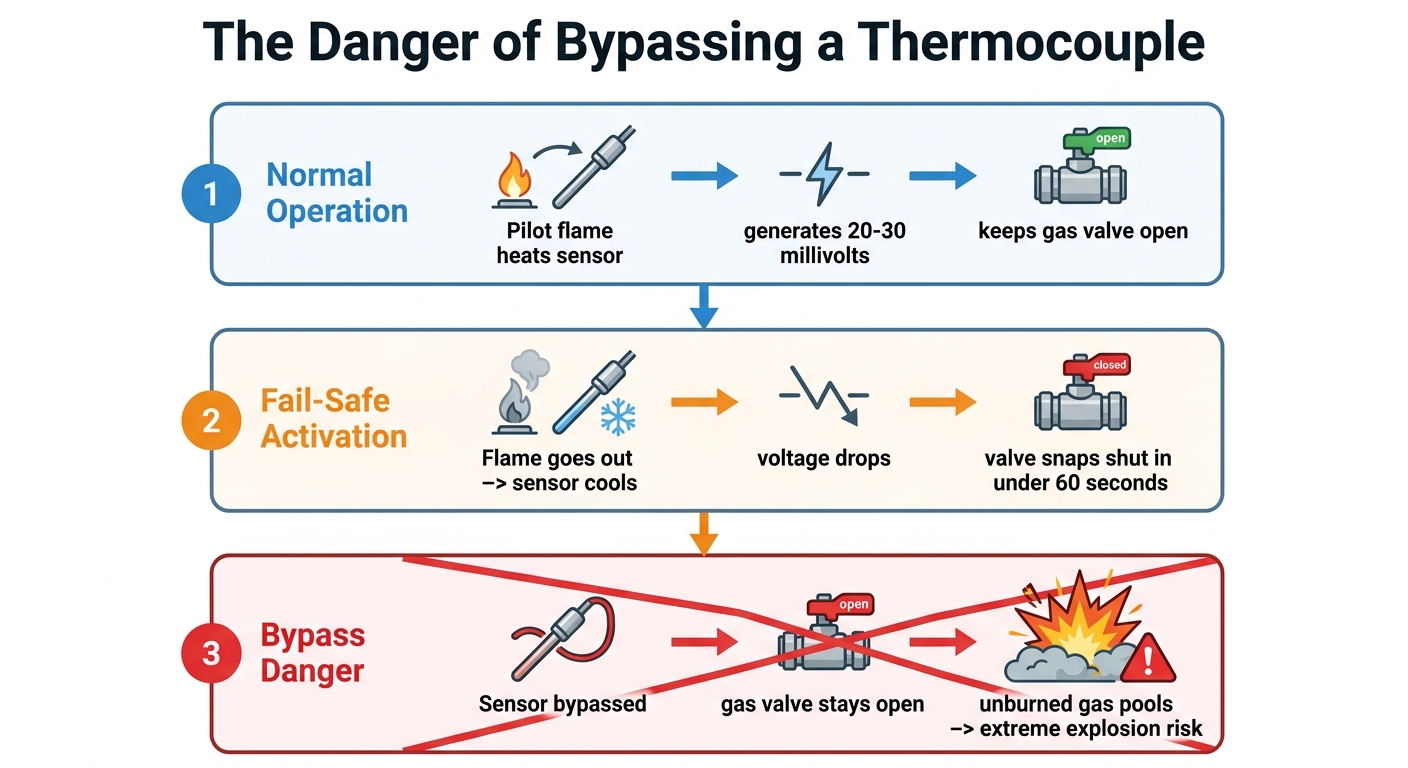

When a homeowner attempts to bypass this sensor, they are manually forcing the gas valve to stay open even without a pilot flame. This action creates an immediate, life-threatening environment inside the home.
A standard gas water heater is designed to heat 40 to 50 gallons of water quickly, which means the gas valve allows a high volume of fuel to flow through the line. If the fail-safe is bypassed and the flame goes out, that gas does not stop. It continuously pours into the combustion chamber, spills out of the draft hood, and begins to pool in the enclosed space around the water heater.
Natural gas is highly flammable. As it fills the utility closet or garage, it mixes with oxygen. All it takes is a single ambient spark to ignite the entire accumulation of gas. That spark does not need to be a lighter or a match. It can come from a neighboring appliance kicking on, a light switch being flipped, or even static electricity from walking across a carpet. The resulting explosion can cause massive structural damage and severe injuries.
The only safe path forward is to leave the safety mechanisms intact. Rather than tricking the system, you must weigh the options of repairing vs. replacing a tripped water heater thermocouple. A licensed technician from our team will diagnose the exact reason the voltage dropped and restore the fail-safe to proper working order. If we determine that an aging unit needs full replacement, we always advise our customers that federal tax credits or utility incentive programs may apply to qualifying high-efficiency installations. We recommend verifying current programs with your utility provider or a tax professional to take advantage of these energy rebates.
• Proper Operation — Gas Valve Behavior: Closes automatically if flame goes out — Safety Outcome: Prevents gas leaks and explosions
• Failing Sensor — Gas Valve Behavior: Shuts down system completely — Safety Outcome: Causes cold water, but keeps home safe
• Bypassed Sensor — Gas Valve Behavior: Stays permanently open without a flame — Safety Outcome: Creates immediate, severe explosion hazard
The dangers of a bypassed thermocouple become even more severe depending on the time of year and the ventilation in your home. In our years of providing HVAC and plumbing services throughout the San Jose area, we've seen how the local climate creates a particularly hazardous environment for indoor gas leaks, especially as residents rely heavily on end-of-season cooling during late summer heat waves.
During a late summer heat wave, homes are typically sealed tight. Windows are locked, doors are shut, and the air conditioning runs constantly to maintain a comfortable indoor temperature. This lack of fresh air ventilation means that if a bypassed water heater starts leaking natural gas into an indoor utility closet, that gas has nowhere to escape. It reaches explosive concentrations much faster than it would in a drafty garage.
Hidden dangers: Furthermore, active AC systems can mask the distinct "rotten egg" smell of mercaptan. Utility companies add mercaptan to natural gas specifically so you can smell a leak before it becomes dangerous. However, when your AC is continuously circulating and filtering indoor air, the rapid airflow can dilute the odor just enough to delay your awareness of the leak. A bypassed water heater in a closed, air-conditioned home is essentially a ticking time bomb.
Because the risks are so high, licensed HVAC and plumbing professionals operate under strict guidelines. You will never find a reputable technician willing to bypass a safety sensor, even as a temporary favor to get you through the weekend.
California building and safety codes strictly prohibit tampering with factory-installed gas safety mechanisms. These regulations exist for a reason. A licensed professional's primary duty is life safety, which always overrides the temporary convenience of having hot water for a shower.
At Precision Heating & Cooling, our uncompromising stance on safety protocols means we will never perform or endorse unauthorized gas valve modifications. When one of our technicians arrives at your home, they perform a comprehensive diagnostic to identify the root cause of the failure rather than just treating the symptom. This is a pattern we see often: a homeowner assumes the sensor is the only problem, but our diagnostics reveal underlying issues like:
• Testing gas pressure: Ensuring the valve is receiving the correct amount of fuel from the main line.
• Checking the pilot tube: Clearing any carbon buildup or debris that might be weakening the flame.
• Drafting inspections: Verifying that the exhaust flue is pulling air correctly and not blowing the flame out.
• Multimeter testing: Measuring the exact millivolt output of the thermocouple to confirm if it has degraded.
Bypassing the sensor ignores all of these critical diagnostic steps and transfers massive liability and extreme danger directly to the homeowner.
If you suspect your water heater's fail-safe is tripping, you must handle the situation with caution. The system is telling you that something is mechanically wrong. Follow these safe, correct steps to protect your home and restore your hot water properly.
1. Shut off the gas supply: Locate the dedicated gas shut-off valve on the pipe leading directly into the water heater. Turn the handle perpendicular to the pipe to stop all gas flow to the unit.
2. Do not attempt to relight: If the pilot has gone out multiple times in a row, stop pressing the igniter. Continuing to flood the chamber with gas while trying to spark a flame is highly dangerous.
3. Ventilate the area: If the water heater is in an indoor closet or basement, open nearby windows or doors to allow any residual gas to dissipate safely.
4. Schedule a professional diagnostic: Contact a licensed technician who has the proper tools, training, and multimeters to safely test the gas valve and replace the faulty sensor.
5. Commit to preventative care: Once the repair is complete, keep the system healthy. Scheduling routine preventative maintenance allows a technician to catch degrading thermocouples and clean dirty pilot tubes before they fail completely.
When hot water stops flowing, homeowners naturally have a lot of questions. Here are the facts you need to know about your system's safety mechanisms.
No, you should absolutely never bypass a water heater thermocouple. Doing so is a critical safety violation that directly disables the system's ability to stop the flow of natural gas. If the flame goes out while the sensor is bypassed, unburned gas will rapidly fill your home and create a massive explosion hazard.
If you bypass a thermocouple, the main gas valve remains open even without a pilot flame present. Natural gas will continuously flood the combustion chamber and spill out into the surrounding room. Any small spark, static electricity, or neighboring appliance turning on can instantly ignite the pooled gas.
A pilot light that keeps going out usually indicates a failing thermocouple that can no longer generate the required 20 to 30 millivolts of electricity to hold the gas valve open. It can also be caused by a dirty pilot tube restricting the gas flow, a failing gas valve, or severe drafts blowing down the exhaust flue.
It is never safe to force a gas valve open manually. Manual forcing disables all built-in factory safety mechanisms and violates local fire and building codes. Gas valves are designed to fail in the closed position specifically to prevent catastrophic leaks.
Depending on the size of the room and the home's ventilation, explosive concentrations can be reached in a matter of minutes. Because standard water heaters are designed to heat large tanks quickly, the gas flow rate is high, meaning a bypassed valve will fill an enclosed utility closet with dangerous levels of fuel very rapidly.
Hot water is a modern necessity, but it is never worth risking a catastrophic home explosion just to avoid a cold shower. Your water heater's fail-safe mechanisms are there to protect you, your family, and your property. When those safety features trip, they are doing exactly what they were engineered to do.
The bottom line: Fixing a faulty thermocouple is a standard, straightforward job for a licensed professional. Do not rely on dangerous internet workarounds. Prioritize your home's safety, leave the gas valves alone, and seek expert help to restore your hot water the right way.

Leslie was amazing for her outstanding customer service skills with me the other day. Thanks to her help my air conditioner is now all set up. She answered all my questions and took away all my problems. Leslie broke it down step by step to set it up easier. Now thanks to her my air conditioner is working perfectly. I really appreciate it Leslie and I’ll be sure to ask for you if I ever come back.
I contacted Precision Heating and Cooling for my home's AC repair. They were punctual and very professional. Guillermo was very kind and thorough. I would highly recommend them!
I am writing to express my sincere appreciation for the excellent work performed by Pablo and Alejandro from Precision Heating and Cooling. Their commitment to quality and customer satisfaction is truly commendable. Awesome job guys!
I would like to extend my sincere gratitude to Alejandro for his exceptional hard work. His passion for helping others is evident, and he consistently goes above and beyond in his service. Alejandro's thorough cleaning of my fireplace has truly made a significant difference. His dedication and professionalism are greatly appreciated.
I was very impressed. Came at night (after 9pm) to fix our AC during the middle of a heat wave the day before a national holiday! Technician was very courteous and efficient, got the job done quickly. Will definitely call them again for any AC servicing I need!
Fast and efficient, arrived when scheduled for repairs and replacement parts were ordered and installed quickly. Techs were very friendly and professional. AC system works great now! I highly recommend their services if you need repairs. Tim


.avif)
