


.avif)






Recent Blogs
Stay updated with our latest blog posts.


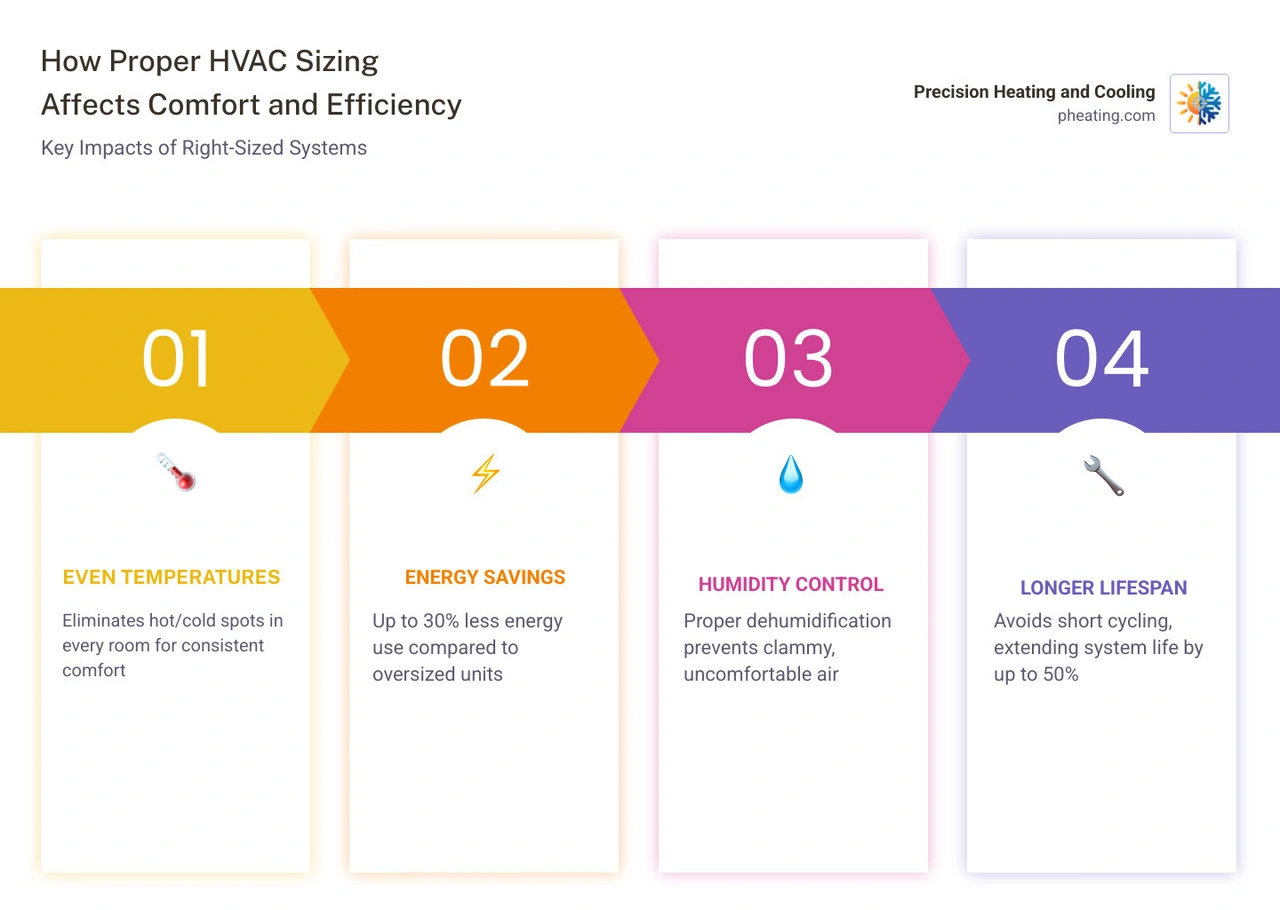
How proper HVAC sizing affects comfort and efficiency is one of the most important — and most overlooked — factors in any heating and cooling system. Here is what you need to know at a glance:
Most homeowners spend hours comparing brands, SEER ratings, and warranty terms when shopping for a new HVAC system. That research is not wasted — but it misses the bigger picture. A high-efficiency unit installed at the wrong capacity will underperform every single day, driving up your energy bills and leaving rooms uncomfortable no matter how new or expensive the equipment is. Whether your home runs warm in the afternoons, feels stuffy even with the AC on, or shows wide temperature swings between rooms, improper sizing is often the hidden culprit.
I'm Tony Lara, an HVAC professional with hands-on experience helping homeowners solve exactly these kinds of comfort problems — including diagnosing how proper HVAC sizing affects comfort and efficiency in real homes with unique layouts, insulation levels, and sun exposure. In the sections below, I'll walk you through everything you need to understand about sizing, from the science behind BTUs and tonnage to the warning signs your current system may be the wrong fit.
When we talk about "sizing" in the HVAC world, we aren't talking about the physical dimensions of the box sitting outside your house. We are talking about the system's capacity to move heat. In the San Jose Bay Area and Central Valley, where temperatures can swing from a chilly morning in Cupertino to a blistering 100-degree afternoon in Hanford, that capacity is everything.
How proper HVAC sizing affects comfort and efficiency comes down to the "Goldilocks Principle": your system needs to be just right. If it’s too large, it’s like trying to use a fire hose to fill a water glass—it’s overkill, messy, and inefficient. If it’s too small, it’s like trying to pull a massive trailer with a moped; the engine will scream, but you won't get where you're going.
Properly sized systems provide:
If you are experiencing uneven temperatures, our team providing HVAC Service San Jose CA can evaluate whether your current setup is truly a match for your home's needs.
To understand sizing, we have to speak the language of HVAC. Capacity is measured in BTUs (British Thermal Units) and tons. One BTU is roughly the amount of energy needed to heat or cool one pound of water by one degree Fahrenheit. In the air conditioning world, we use "tons" as a larger unit of measurement.
One ton of cooling capacity equals 12,000 BTUs per hour. This term actually dates back to the days when people used literal tons of ice to cool buildings! Today, it represents the cooling power of the equipment. A typical 2,000-square-foot home might require a 3.5 to 4-ton system, but that is just a starting point.
The industry gold standard for determining this is the Manual J Load Calculation, developed by the Air Conditioning Contractors of America (ACCA). Unlike a "rule of thumb" that just looks at square footage, a Manual J calculation is a scientific deep dive into your home’s "envelope." It looks at how much heat your home gains in the summer and loses in the winter. For residents needing HVAC Installation Hanford CA, ensuring this calculation is done correctly is the difference between a cool summer and a miserable one.
In places like Palo Alto or Clovis, peak summer temperatures are the true test of an HVAC system. We design systems based on "design temperatures"—the local outdoor temperature that is exceeded only a small percentage of the time.
If a system is sized purely for an average day, it will fail when a Central Valley heatwave hits. However, if it's over-designed for a "once-in-a-century" heatwave, it will be wildly inefficient the other 360 days of the year. How proper HVAC sizing affects comfort and efficiency during these peaks involves balancing:
By getting the sizing right, your system will run almost continuously on the hottest day of the year—which is actually exactly what it is designed to do. If you're worried your system won't hold up this July, our HVAC Service Palo Alto CA can help you prepare.
There is a common misconception that "bigger is better." In HVAC, bigger is often much worse. If your system has too much capacity, it will engage in a behavior called short cycling. This is when the unit turns on, blasts the house with cold air, satisfies the thermostat in five minutes, and shuts off.
This causes several major problems:
If you notice your system clicking on and off every few minutes, it might be time for HVAC Repair Sunnyvale CA to see if the system is oversized or if a component is failing due to the strain.
Preventing short cycling is the key to a healthy home environment. When a system is sized correctly, it runs for longer, steadier periods. This allows the air to circulate through your filters more often, improving indoor air quality. It also ensures that the "latent heat" (humidity) is stripped away.
Properly sized systems, especially modern variable-speed models, can adjust their output to match the demand. This means they can run at a lower, quieter speed for longer periods, maintaining a perfectly steady temperature within half a degree of your setting. If your system is currently "short cycling," a professional HVAC Tune Up San Jose CA can help optimize your current settings, though a replacement may be the only long-term fix for a majorly oversized unit.
On the flip side, an undersized unit is a recipe for frustration. You’ll know your system is undersized if it runs 24/7 on a 90-degree day and the temperature inside never drops below 78 degrees.
The dangers of an undersized unit include:
If your system is struggling to keep up, it might be time to consider an HVAC Replacement Cupertino CA. Modern systems are much more efficient, but only if they are sized to handle your home's actual load.
At Precision Heating and Cooling, we don't guess. We use the science of Manual J to look at your home as a complete system. Here are the factors we evaluate to determine how proper HVAC sizing affects comfort and efficiency in your specific space:
| Factor | Impact on Sizing |
|---|---|
| Square Footage | The base volume of air that needs to be moved. |
| Ceiling Height | Vaulted ceilings can increase air volume by 20% or more. |
| Window Orientation | South-facing windows act like giant heaters in the afternoon. |
| Insulation Levels | Better insulation allows for a smaller, more efficient unit. |
| Occupancy | Each human generates 350-600 BTUs of heat per hour. |
| Lighting & Appliances | Modern LEDs stay cool; old bulbs and big TVs add heat. |
By looking at these factors room-by-room, we can even determine if your ductwork is sufficient. If you have a powerful unit but tiny ducts, it’s like trying to push a fire hose’s worth of water through a straw—it creates "static pressure" that can blow out your motor. Our experts at our HVAC Company Santa Clara CA specialize in these detailed assessments to ensure your system is a perfect fit.
It is a professional protocol used to determine the exact amount of heating and cooling a building needs. It accounts for the local climate, the materials used to build the home, the orientation of the house relative to the sun, and the lifestyle of the occupants. It is the only way to ensure your HVAC system is accurately sized.
No. Using square footage alone is a "rule of thumb" that often leads to errors. For example, a 1,500-square-foot home built in the 1950s with single-pane windows will have a much higher cooling load than a modern, highly insulated 1,500-square-foot home. Using the same size unit for both would leave one home uncomfortable and the other with massive energy bills.
The most common signs are:
At the end of the day, how proper HVAC sizing affects comfort and efficiency is the foundation of a happy home. You can buy the most expensive, high-tech heat pump on the market, but if it isn't sized correctly for your specific layout in Clovis or Sunnyvale, it simply won't do its job.
At Precision Heating and Cooling, we bring over two decades of experience to every home in the San Jose Bay Area and Central Valley. We understand the local microclimates—from the humid mornings to the dry, hot afternoons—and we know how to calculate the perfect fit for your family. Whether you need a simple tune-up or a full HVAC Replacement San Jose CA, we are here to provide reliable, competitive, and expert service.
Don't gamble with your comfort or your wallet. Contact us for expert HVAC solutions today, and let’s make sure your home is "just right" for the years to come.

Leslie was amazing for her outstanding customer service skills with me the other day. Thanks to her help my air conditioner is now all set up. She answered all my questions and took away all my problems. Leslie broke it down step by step to set it up easier. Now thanks to her my air conditioner is working perfectly. I really appreciate it Leslie and I’ll be sure to ask for you if I ever come back.
I contacted Precision Heating and Cooling for my home's AC repair. They were punctual and very professional. Guillermo was very kind and thorough. I would highly recommend them!
I am writing to express my sincere appreciation for the excellent work performed by Pablo and Alejandro from Precision Heating and Cooling. Their commitment to quality and customer satisfaction is truly commendable. Awesome job guys!
I would like to extend my sincere gratitude to Alejandro for his exceptional hard work. His passion for helping others is evident, and he consistently goes above and beyond in his service. Alejandro's thorough cleaning of my fireplace has truly made a significant difference. His dedication and professionalism are greatly appreciated.
I was very impressed. Came at night (after 9pm) to fix our AC during the middle of a heat wave the day before a national holiday! Technician was very courteous and efficient, got the job done quickly. Will definitely call them again for any AC servicing I need!
Fast and efficient, arrived when scheduled for repairs and replacement parts were ordered and installed quickly. Techs were very friendly and professional. AC system works great now! I highly recommend their services if you need repairs. Tim


.avif)
