


.avif)






Recent Blogs
Stay updated with our latest blog posts.


Is a high efficiency furnace worth the extra cost? For most homeowners in colder climates who plan to stay in their home for five or more years, the answer is yes — but it depends on a few key factors.
Quick Answer:
| Your Situation | Is It Worth It? |
|---|---|
| Cold climate, staying 5+ years | Yes — strong ROI |
| Mild climate, staying 5+ years | Likely yes, but slower payback |
| Any climate, moving within 2-3 years | Probably not |
| Replacing a very old 60-70% AFUE furnace | Almost always yes |
| Replacing a newer 80% unit | Evaluate savings vs. upfront cost |
Here's the short version: high-efficiency furnaces (90%+ AFUE) convert up to 97 cents of every dollar of fuel into heat, while a standard 80% model wastes 20 cents of every dollar up the exhaust pipe. That gap adds up over a 15-20 year lifespan — especially as energy prices continue to rise. Heating already makes up roughly 45% of a typical home's utility bill, so even a modest efficiency gain can mean real savings year after year.
That said, the higher upfront price, installation requirements, and how long you plan to stay in your home all play a role in whether the math works in your favor. This guide walks you through everything — from how AFUE ratings work, to payback periods, to rebates and installation considerations specific to the Bay Area.
I'm Tony Lara, an HVAC professional with hands-on experience helping homeowners evaluate whether is a high efficiency furnace worth the extra cost for their specific home and climate. I've seen how the right furnace upgrade can transform a home's comfort and long-term energy costs, and I'm here to give you a straight answer based on real-world experience.
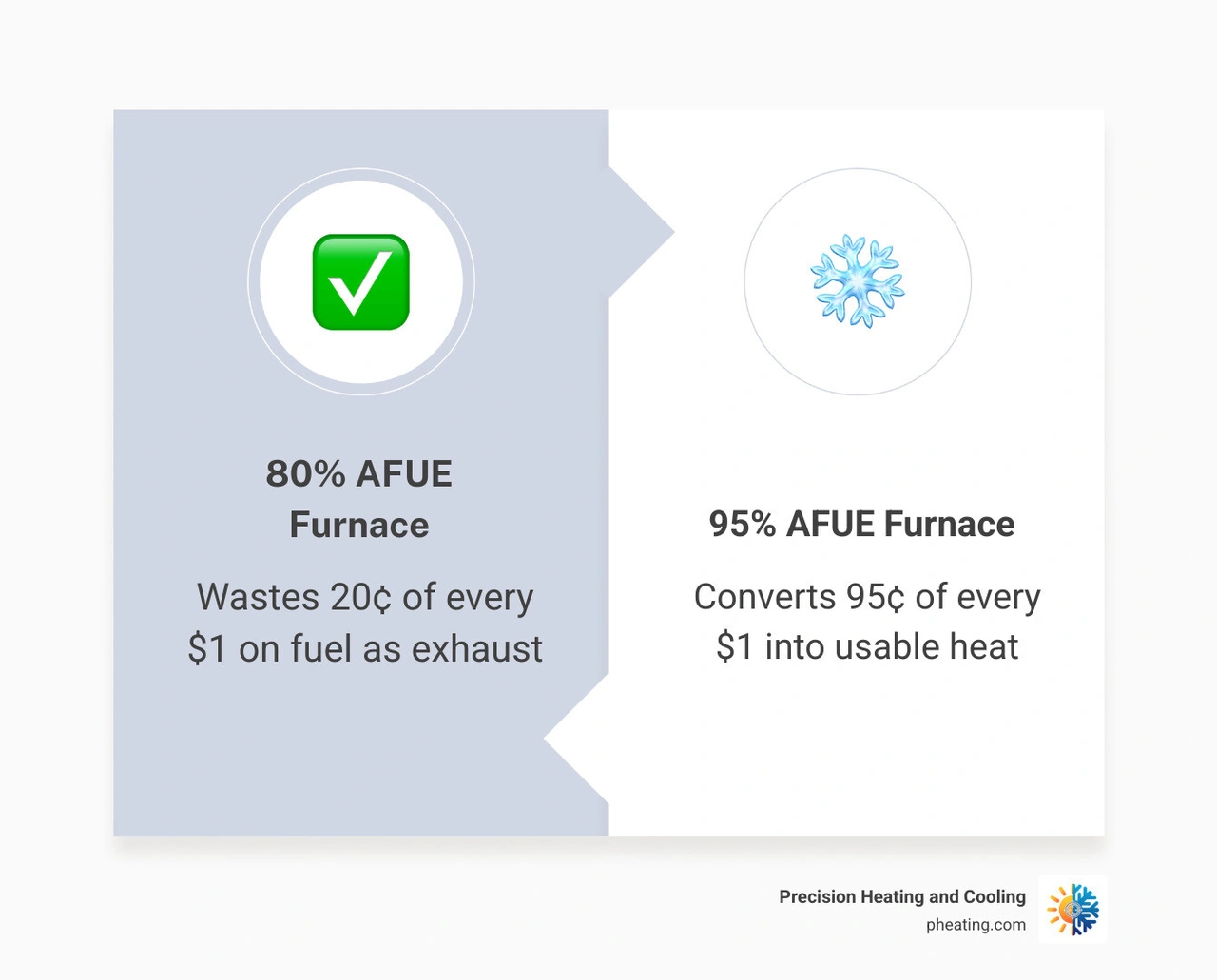
When we talk about furnace efficiency, we use a metric called AFUE, or Annual Fuel Utilization Efficiency. Think of it like the "miles per gallon" rating for your home’s heating system. It tells you exactly how much of the fuel you pay for actually turns into heat for your living room, and how much literally goes up in smoke.
In the HVAC world, we generally categorize furnaces into three buckets:
If you are currently running an older unit with a standing pilot light, you might be working with an AFUE as low as 56% to 70%. Upgrading from that to a 95% model can reduce your heating costs by 20% to 30% almost overnight.
Regardless of the rating, even the best system needs a little love to stay efficient. Regular maintenance, such as a Furnace Tune Up San Jose CA or Furnace Maintenance Clovis CA, ensures that your 95% furnace doesn't drop down to 85% due to dirt, grime, or mechanical wear.
To understand why high-efficiency units cost more, we have to look under the hood. It isn't just "better parts"; it’s a completely different mechanical process.
A standard furnace has one heat exchanger. A high-efficiency furnace has two. After the first heat exchanger does its job, the exhaust gases still contain a lot of "latent heat." The secondary heat exchanger captures this extra energy. In the process, the exhaust gas cools so much that it condenses into a mild acidic liquid.
Because the exhaust is cool, we don't use a traditional metal chimney. Instead, we use PVC venting. This is often easier to route through a side wall, but it does require a dedicated drain line or a condensate pump to whisk that water away.
High-efficiency units typically use "sealed combustion." While a standard furnace sucks in air from your garage or attic to burn the gas, a sealed system pulls fresh air directly from outside through a pipe.
Why does this matter?
If your current system is struggling, it could be a sign of a Heat Exchanger Crack, which is a serious safety hazard. In those cases, a Furnace Replacement Hanford CA is often the smartest move, and choosing a high-efficiency model can help offset the cost of the replacement over time.
Deciding if is a high efficiency furnace worth the extra cost usually comes down to a "break-even" analysis. High-efficiency systems generally cost 25% to 40% more upfront than 80% AFUE models. For a typical home, that "efficiency premium" might be between $1,000 and $3,000.
| Feature | Standard (80% AFUE) | High-Efficiency (95%+ AFUE) |
|---|---|---|
| Waste per Dollar | 20 cents | 2-5 cents |
| Annual Savings | Baseline | $170 - $240+ |
| Venting Material | Metal Flue | PVC Pipe |
| Payback Period | N/A | 4 - 9 Years |
| Estimated Lifespan | 15 - 20 Years | 15 - 20+ Years |
While your mileage may vary, a homeowner spending $1,200 a year on heating can save roughly $240 annually by moving from 80% to 96% AFUE. If the extra cost of the unit was $1,500, you’ve paid off the difference in about six years. If you need a San Jose Furnace Repair on an old, inefficient unit, it’s worth asking if that repair money would be better spent toward the "payback" of a new, efficient system.
Climate is the biggest variable in the ROI equation. In places like Minnesota, where the furnace runs 24/7 for six months, high efficiency is a no-brainer.
In the San Jose Bay Area and Central Valley, our winters are milder, but we still have significant "Heating Degree Days." In Clovis or Hanford, those chilly winter mornings and nights mean the furnace is still a major player in your utility bill. The more you use your heat, the faster that high-efficiency unit pays for itself.
If you plan on selling your home in two years, you likely won't see the full financial return on a high-efficiency upgrade. However, if this is your "forever home," or if you plan to stay for at least 5 to 10 years, the energy savings will eventually cover the initial price gap and then start putting money back in your pocket.
Furthermore, high-efficiency systems are a major selling point. In 2026, savvy home buyers are looking for "green" features and low utility costs. A 97% AFUE furnace on a home inspection report is a badge of quality that can increase your home's resale value.
If we only look at the dollars and cents, we miss half the story. High-efficiency furnaces aren't just cheaper to run; they feel better to live with.
Most high-efficiency units come with advanced technology that standard models lack:
If you find your Furnace Not Turning On or struggling to keep the house at a consistent temperature, it’s often because a single-stage, standard-efficiency unit simply can't keep up with the precise demands of a modern home.
Installing a high-efficiency furnace isn't a "drop-in" replacement. Because these units are condensing, they require specific upgrades that can influence the total cost:
Whether you need a Furnace Installation San Jose CA or a Furnace Installation Cupertino CA, our team handles the permits and technical requirements to ensure your system is code-compliant and running at its peak rated efficiency.
Both types generally last between 15 and 20 years. However, high-efficiency models have more complex components (like the secondary heat exchanger and sensors). This makes annual maintenance even more critical to prevent small issues from becoming expensive repairs.
Yes! Under the Inflation Reduction Act, many homeowners can qualify for a federal tax credit of up to $600 for high-efficiency gas furnaces that meet specific ENERGY STAR requirements. Additionally, local utility programs in the Bay Area and Central Valley often offer "instant rebates" or incentives for upgrading to high-AFUE equipment.
The "fuel-burning" side of the maintenance is similar, but high-efficiency units have a condensate system that needs to be checked. We ensure the drain lines are clear and the condensate pump is functioning so you don't end up with water backing up into your furnace. A regular Furnace Tune Up Santa Clara CA is the best way to protect that investment.
So, is a high efficiency furnace worth the extra cost? If you value lower monthly bills, a smaller environmental footprint, and the superior comfort of modulating heat, the answer is a resounding yes. While the upfront investment is higher, the combination of energy savings, tax credits, and improved home value makes it a smart long-term move for most homeowners in the San Jose and Central Valley regions.
At Precision Heating and Cooling, we’ve spent over two decades helping our neighbors in Los Gatos, Sunnyvale, and beyond find the perfect balance between upfront cost and long-term performance. We offer flexible payment options to help make these energy-efficient upgrades more accessible, ensuring you don't have to sacrifice comfort for your budget.
Ready to see how much you could save? Contact our team for a professional HVAC consultation and let us help you crunch the numbers for your home.

Leslie was amazing for her outstanding customer service skills with me the other day. Thanks to her help my air conditioner is now all set up. She answered all my questions and took away all my problems. Leslie broke it down step by step to set it up easier. Now thanks to her my air conditioner is working perfectly. I really appreciate it Leslie and I’ll be sure to ask for you if I ever come back.
I contacted Precision Heating and Cooling for my home's AC repair. They were punctual and very professional. Guillermo was very kind and thorough. I would highly recommend them!
I am writing to express my sincere appreciation for the excellent work performed by Pablo and Alejandro from Precision Heating and Cooling. Their commitment to quality and customer satisfaction is truly commendable. Awesome job guys!
I would like to extend my sincere gratitude to Alejandro for his exceptional hard work. His passion for helping others is evident, and he consistently goes above and beyond in his service. Alejandro's thorough cleaning of my fireplace has truly made a significant difference. His dedication and professionalism are greatly appreciated.
I was very impressed. Came at night (after 9pm) to fix our AC during the middle of a heat wave the day before a national holiday! Technician was very courteous and efficient, got the job done quickly. Will definitely call them again for any AC servicing I need!
Fast and efficient, arrived when scheduled for repairs and replacement parts were ordered and installed quickly. Techs were very friendly and professional. AC system works great now! I highly recommend their services if you need repairs. Tim


.avif)
