


.avif)






Recent Blogs
Stay updated with our latest blog posts.


At Precision Heating & Cooling, we often remind our customers that when a pilot light refuses to stay lit, choosing between OEM vs. Universal Replacement Thermocouples for Gas Water Heaters is the difference between a permanent fix and another cold shower next month. A failing thermocouple is one of the most common reasons a standard gas water heater suddenly stops producing hot water. The immediate temptation is to rush to a local hardware store, grab the cheapest generic replacement off the shelf, and assume the problem is solved. However, in our experience serving San Jose homes, this "one-size-fits-all" myth often leads to a cycle of repeated failures and mounting frustration.
For support with broader home comfort and temperature control, learn more about our heating systems.
Losing hot water never happens at a convenient time. Our dispatch board typically sees this disruption peak during late summer. As August back-to-school routines kick in across San Jose, households require highly reliable morning hot water to keep everyone on schedule. Waking up to a cold shower throws the entire day off track. When faced with this sudden inconvenience, homeowners and handymen often ask our team for the fastest possible patch.
The hardware store aisle is filled with universal parts that claim to fit almost any brand. The packaging promises a quick, easy fix. But a water heater's gas valve is a highly calibrated piece of safety equipment. Assuming a generic metal probe will communicate perfectly with a brand-specific gas valve is a gamble. While the universal part might thread into place and hold the pilot light for a few weeks, it rarely provides the long-term reliability that busy households depend on.
To understand why our technicians see generic parts fall short so frequently, it helps to know exactly what this component does. A thermocouple is a vital safety device. It sits directly in the pilot light flame and uses that heat to generate a tiny electrical current. This current travels up a copper wire to an electromagnet inside the gas valve. As long as the current is flowing, the valve stays open, allowing gas to reach the main burner. If the pilot blows out, the metal cools, the current stops, and the gas valve snaps shut automatically, preventing raw gas from filling your home.
This is where the engineering matters. A standard gas water heater requires a consistent 20-30 millivolts of direct current to hold the gas valve open safely. If a replacement part generates 18 millivolts, the valve will randomly drop out. You will find yourself constantly trekking out to the garage or basement to relight the pilot.
What the Precision Heating & Cooling team sees in the field:
• Material degradation: Cheap universal parts often use lower-grade dissimilar metals at the sensor tip. These metals oxidize and degrade rapidly under constant heat.
• Premature failure: Within 6 to 12 months, the degraded tip stops generating the required 20-30 millivolts, leading to repeat "no hot water" calls.
• Inconsistent performance: Generic parts may fluctuate in voltage output, causing the burner to short-cycle or shut down during peak demand.
Our commitment to long-term reliability means our technicians refuse to rely on cheap universal parts. We know that installing a subpar component only leads to costly callbacks and frustrated homeowners. For a permanent solution to pilot light issues, professional water heater repair and replacement ensures the correct components are used every time.
The appeal of universal parts is undeniable: they are readily available. If a system goes down on a Sunday afternoon, a big box store will likely have a generic replacement on the shelf. However, in our years of restoring hot water across the South Bay, we've seen how this immediate availability masks several long-term drawbacks that end up costing more time and money.
While a universal probe may physically fit the threading and length requirements of your water heater, the internal construction often differs significantly from manufacturer specifications. This mismatch creates an illusion of a repair.
• Pros of Universal Parts:
— Immediate availability at most local hardware stores.
— Often includes adapter fittings to force a connection with various gas valves.
• Cons of Universal Parts:
— Faster millivoltage degradation: The cheaper metals lose their ability to conduct the necessary current much faster than factory parts.
— Poor fitment: Relying on universal adapters can lead to cross-threading or improper seating at the gas valve connection.
— The "Repeat Fix" tax: The hidden cost of having to replace the same part again within a year, doubling the labor and the disruption.
Because these safety sensors are so critical to the operation of the gas valve, compromising on quality is never worth the risk. This is exactly why we never recommend bypassing a failing water heater thermocouple or trusting a generic substitute to do the job of a specialized factory component.
Original Equipment Manufacturer (OEM) parts are designed, tested, and produced specifically for a particular brand and model of equipment. When it comes to gas water heaters, using the exact part specified by the manufacturer is the only way to guarantee the system operates exactly as engineered.
Across San Jose residential homes, standard gas water heaters are the backbone of daily routines. Even with the mild California climate, our team at Precision Heating & Cooling knows that San Jose residents rely on consistent, uninterrupted hot water year-round. OEM reliability is crucial for maintaining that comfort without sudden drops in performance.
OEM components are built to match the exact millivolt requirements of the specific gas valve they pair with. The thread pitch is cut perfectly, eliminating the need for bulky adapters. This exact fitment is vital for preventing micro-leaks at the connection point, ensuring optimal safety for your property.
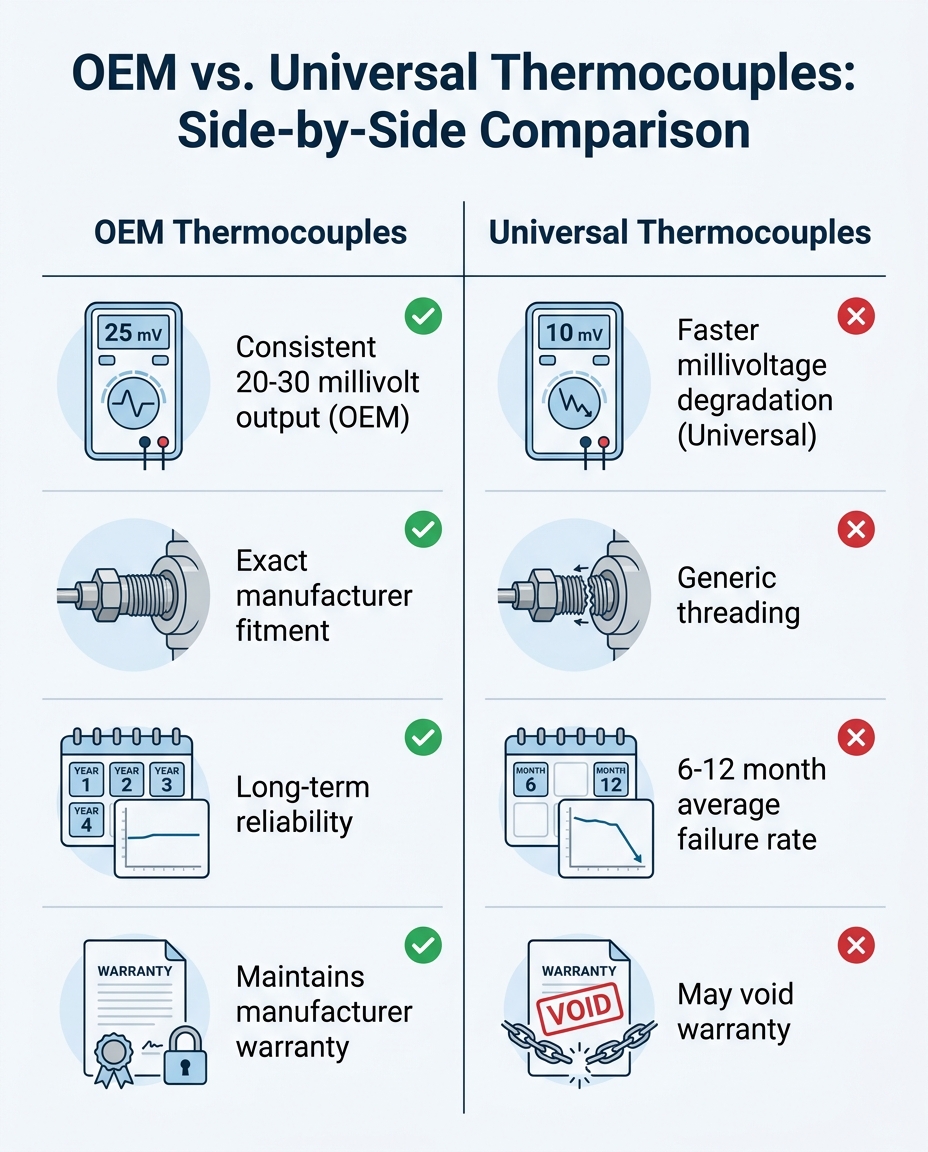
• Millivolt Output — OEM Thermocouple: Consistent 20-30 millivolts over years of use — Universal Thermocouple: Prone to faster degradation and voltage drops
• Fitment — OEM Thermocouple: Exact thread match to the specific gas valve — Universal Thermocouple: Relies on generic threads and extra adapters
• Average Lifespan — OEM Thermocouple: Matches the expected lifespan of the water heater — Universal Thermocouple: High failure rate within the first 6-12 months
• Warranty Impact — OEM Thermocouple: Maintains manufacturer warranty status — Universal Thermocouple: May void the warranty if a failure occurs
Using OEM parts also protects your investment. Most major water heater manufacturers stipulate that their warranties remain valid only when factory-approved replacement parts are used. Installing a generic aftermarket component can void your warranty, leaving you responsible for the total cost if the tank or gas valve fails prematurely.

With tutorials readily available online, many homeowners assume swapping out a small metal probe is a simple weekend project. However, working with gas valves and pilot assemblies carries significant safety risks. This is not a plumbing fix; it is a gas appliance repair involving combustible materials and critical safety sensors.
Even if you purchase a high-quality OEM part, incorrect installation can result in the pilot light failing to stay lit—or worse, a dangerous gas leak. The connection at the gas valve must be tightened to exact torque specifications. Over-tightening can crush the internal insulator, instantly ruining the new part. Under-tightening can result in a poor electrical connection, causing the valve to drop out randomly.
Professional installation requires specialized tools to test the system safely. Technicians use closed-circuit multimeters equipped with specific adapters to read the exact millivolt output while the burner is firing. They also verify gas line integrity and check for proper drafting to ensure carbon monoxide is venting correctly.
Relying on a professional is always faster and safer than struggling through a DIY repair. For example, during a recent late-summer back-to-school rush, one San Jose customer reached out to Precision Heating & Cooling with an urgent issue that left their system completely inoperable. Our technician, Anthony, arrived promptly, accurately diagnosed the root cause, and had the issue safely resolved within 30 minutes. That level of speed and precision is only possible with professional training and the right diagnostic tools.
A failing thermocouple is sometimes just a symptom of a broader problem. If a generic part failed quickly, or even if an older OEM part burned out, the root cause might lie elsewhere in the system. Poor ventilation, restricted combustion air, or heavy dirt buildup in the burner assembly can cause the pilot flame to burn too hot, too cold, or flutter away from the sensor.
Routine professional inspections catch these underlying issues before they result in a cold shower. By evaluating the entire water heater, technicians can ensure that the environment inside the combustion chamber is optimal for long-term performance.
1. Burner Assembly Cleaning: Removing dust, lint, and scale buildup ensures a clean, blue pilot flame that properly engulfs the sensor tip.
2. Ventilation Checks: Verifying that the flue is clear prevents downdrafts from blowing out the pilot or causing the burner to overheat.
3. Voltage Testing: Routinely checking the millivolt output allows technicians to spot a degrading sensor long before it actually fails.
4. Anode Rod Inspection: Checking the sacrificial anode rod protects the tank itself from internal rusting and corrosion.
Ongoing system care is the best way to maximize the lifespan of your entire unit. Enrolling in a comprehensive preventative maintenance plan ensures these vital safety checks are performed on schedule, keeping your equipment running efficiently year after year.
While a universal thermocouple may physically thread into your gas valve and provide a temporary fix, it is not recommended for long-term use. Generic parts often use lower-quality metals that degrade faster under constant heat. This leads to rapid millivoltage drops and repeat failures, usually within 6 to 12 months of installation.
If the pilot light continues to go out with a new replacement part, the issue could be a defective generic part failing to generate enough voltage. Alternatively, the problem might be a dirty pilot orifice, a failing electromagnet inside the gas valve itself, or poor drafting blowing the flame away from the sensor. A professional diagnostic is required to pinpoint the exact cause.
No, they are not universally interchangeable. Different water heater manufacturers design their gas valves to require specific thread pitches, lengths, and millivolt tolerances. Using the exact OEM part ensures the safety sensor communicates correctly with the gas valve and maintains your manufacturer warranty.
In our field experience, a cheap universal replacement typically lasts only 6 to 12 months before the materials degrade enough to cause pilot light failures. In contrast, a high-quality OEM part is engineered to last for many years, often matching the lifespan of the water heater itself.
A standard residential gas water heater requires a consistent output of 20 to 30 millivolts of direct current to hold the safety gas valve open. If the output drops below this threshold due to wear, soot buildup, or a weak pilot flame, the valve will automatically shut off the gas supply as a safety precaution.
Dealing with a broken water heater is stressful enough without having to worry about whether the repair will actually hold up. Settling for a temporary fix with a generic hardware store part only sets the stage for another unexpected breakdown down the road. True peace of mind comes from knowing your equipment was repaired safely, using the exact OEM components engineered for your specific unit.
Don't let a failing pilot light disrupt your daily routine. By choosing professional installation with Precision Heating & Cooling, you ensure the precise millivolt requirements are met, the gas connections are secure, and your system's long-term reliability is restored. Reach out to our expert technicians today to schedule a comprehensive diagnostic visit and get your hot water flowing dependably once again.

Leslie was amazing for her outstanding customer service skills with me the other day. Thanks to her help my air conditioner is now all set up. She answered all my questions and took away all my problems. Leslie broke it down step by step to set it up easier. Now thanks to her my air conditioner is working perfectly. I really appreciate it Leslie and I’ll be sure to ask for you if I ever come back.
I contacted Precision Heating and Cooling for my home's AC repair. They were punctual and very professional. Guillermo was very kind and thorough. I would highly recommend them!
I am writing to express my sincere appreciation for the excellent work performed by Pablo and Alejandro from Precision Heating and Cooling. Their commitment to quality and customer satisfaction is truly commendable. Awesome job guys!
I would like to extend my sincere gratitude to Alejandro for his exceptional hard work. His passion for helping others is evident, and he consistently goes above and beyond in his service. Alejandro's thorough cleaning of my fireplace has truly made a significant difference. His dedication and professionalism are greatly appreciated.
I was very impressed. Came at night (after 9pm) to fix our AC during the middle of a heat wave the day before a national holiday! Technician was very courteous and efficient, got the job done quickly. Will definitely call them again for any AC servicing I need!
Fast and efficient, arrived when scheduled for repairs and replacement parts were ordered and installed quickly. Techs were very friendly and professional. AC system works great now! I highly recommend their services if you need repairs. Tim


.avif)
