


.avif)






Recent Blogs
Stay updated with our latest blog posts.


Your interior closets are packed tight, and that bulky water heater is taking up valuable square footage you desperately need for storage or a remodeling project. Before you start knocking down drywall, you need to understand the strict San Jose Permit Requirements for Relocating a Hot Water Tank to the Garage. Moving this vital piece of equipment is not a simple weekend plumbing swap. It triggers mandatory municipal oversight, requiring proper permits, structural adjustments, and strict safety compliance to protect your home. At Precision Heating & Cooling, we handle these transitions daily, providing the professional home comfort services required to manage the complex integration of water, gas, and venting systems.
Our team frequently helps San Jose homeowners free up interior space by shifting their units outward. We typically see a surge in requests for this project as an early fall pre-heating-season upgrade, right before temperatures drop and the holidays arrive. However, the transition from a conditioned hallway closet to an unconditioned garage introduces a host of new safety variables. The city's building codes exist to mitigate these exact risks.
When a water heater sits inside your home, it is generally protected from vehicles, extreme temperature swings, and certain chemical vapors. Moving it to the garage changes its operating environment entirely. The city of San Jose enforces specific regulations to address these new hazards. In our years of serving the South Bay, we always remind homeowners that understanding these building codes is the mandatory first step to ensure the relocation is safe, legal, and eligible for future real estate transactions.
• Venting modifications: A new location means a new path for exhaust gases, which must safely exit the roofline without back-drafting into the home.
• Utility extensions: Gas lines, electrical wiring, and plumbing pipes must be extended and properly sized for the new distance.
• Environmental exposure: Garages house vehicles, tools, and chemicals, creating a unique risk profile for combustion appliances.
Attempting to bypass the permit process often leads to severe complications down the road, including failed home inspections during a sale or denied insurance claims in the event of an accident. Letting our experts navigate the legal reality of this early fall pre-heating-season upgrade ensures your home remains safe and compliant.
One of the most critical safety codes enforced in California garages focuses on preventing accidental fires. Garages are common storage areas for lawnmowers, paint thinners, gasoline cans, and cleaning solvents. The vapors from these flammable liquids are heavier than air, meaning they settle and pool directly on the concrete floor. If a gas appliance sits at floor level, its pilot light or burner can easily ignite these invisible vapors.
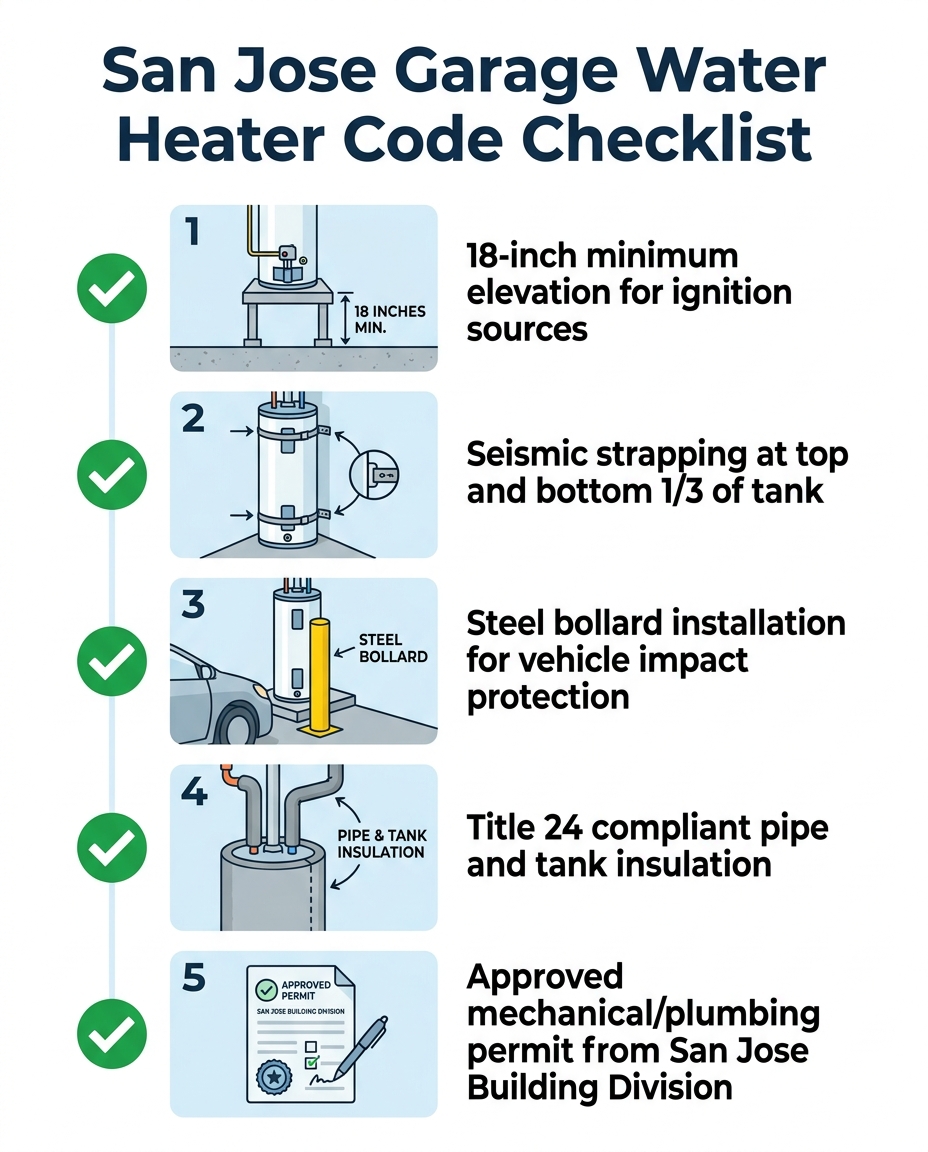
To neutralize this hazard, San Jose enforces a strict 18-inch minimum elevation for ignition sources. This means the combustion chamber of the water heater must sit at least a foot and a half above the garage floor. While this rule applies primarily to gas water heaters with pilot lights or burners, our team has found that local municipal inspectors often check all relocated units for compliance to ensure universal safety standards are met.
Achieving this required height involves more than just stacking some concrete blocks. A specialized, weight-bearing stand must be installed to support the fully loaded tank. A standard 50-gallon water heater weighs well over 400 pounds when full of water. The stand must be structurally sound, firmly anchored, and capable of holding that weight indefinitely.
• Flammable Vapors — Indoor Closet Installation: Low risk (no gasoline or solvents stored) — Garage Installation Risks: High risk (vehicles, lawn equipment, chemicals)
• Ignition Prevention — Indoor Closet Installation: Floor-level installation generally permitted — Garage Installation Risks: 18-inch minimum elevation for ignition sources required
• Weight Support — Indoor Closet Installation: Rests directly on the structural subfloor — Garage Installation Risks: Requires a specialized, engineered steel stand
Proper professional water heater installation and relocation ensures the stand meets all seismic and weight-bearing standards required by the city. Inspectors will look closely at the integrity of this stand during the final permit review, verifying that the 18-inch minimum elevation for ignition sources is achieved without compromising the tank's stability.
When a water heater is relocated to a garage, it enters a potential vehicle impact zone. Garages are active spaces where cars, trucks, and SUVs are parked daily. A simple miscalculation with the gas pedal or a momentary lapse in attention can result in a vehicle striking the equipment. If a car hits a gas water heater, the results can be catastrophic, potentially shearing off the main gas line or rupturing the tank.
To prevent this, the San Jose municipal code requires the installation of a physical barrier if the unit is located in the path of a vehicle. This barrier is commonly known as a bollard. Even with the required 18-inch minimum elevation for ignition sources, the unit's base, the structural stand, and the exposed gas lines remain highly vulnerable to bumper impacts without this heavy-duty steel protection.
Our installation crews always emphasize that a bollard is not a simple wooden post or a decorative barrier. The municipal code dictates specific engineering requirements to ensure the post can actually stop a moving vehicle. Our technicians serving the San Jose service area are intimately familiar with the exact diameter, depth, and placement requirements for these barriers.
• Material strength: Bollards are typically made of heavy-gauge steel pipe, often filled with solid concrete for maximum impact resistance.
• Concrete anchoring: The barrier cannot just be bolted to the surface; it must be installed securely into the concrete floor, often requiring core drilling.
• Strategic placement: The bollard must be positioned far enough away from the tank to prevent the post itself from transferring impact force into the unit, but close enough to block a vehicle's bumper.
During the permit inspection, city officials will verify that the bollard is properly anchored and positioned. In our experience, failing to install this barrier correctly is one of the most common reasons DIY garage relocation permits fail their initial inspection.
California law mandates that all water heaters be braced, anchored, or strapped to resist falling or horizontal displacement during an earthquake. Because water heaters are tall, heavy, and top-heavy, they are highly susceptible to tipping over during seismic events. A tipped tank can easily snap a rigid gas line, creating an immediate fire hazard, or break a water line, causing extensive flood damage.
When moving a tank to the garage, the existing interior straps cannot simply be reused. New wall anchors must be established directly into the garage's structural framing. This process requires precision, as our team must account for the added height of the 18-inch minimum elevation for ignition sources when measuring the strapping.
Our licensed professionals follow a strict sequence of code requirements to ensure the tank remains fully immobilized during an earthquake. The state plumbing code outlines exact specifications for how this bracing must be executed.
1. Verification of structural studs: Anchors must be driven directly into the heavy wooden wall studs. Attaching straps to drywall or thin paneling provides zero structural support and will instantly fail an inspection.
2. Upper and lower placement: Straps must be placed at the top one-third and the bottom one-third of the tank. This dual-point anchoring prevents both tipping and lateral shifting.
3. Elevation adjustments: Because the tank is raised on a stand to meet the 18-inch minimum elevation for ignition sources, the lower strap placement must be carefully calculated to ensure it grips the tank body, not just the hollow base or the stand itself.
4. Approved materials: Only heavy-gauge, code-approved steel strapping materials can be used. Plumbers tape or standard metal banding is generally prohibited.
Having walked through countless final inspections across San Jose, we know firsthand that inspectors are incredibly thorough when checking seismic straps. They will physically test the tension and verify the anchor points. If the strapping is loose, uses improper materials, or misses the structural studs, the permit will be denied until corrections are made.
Bridging the gap between municipal safety codes and California's strict energy efficiency standards is a major part of any garage relocation project. Moving a tank from a conditioned interior closet to an unconditioned garage fundamentally changes its operating environment. While San Jose enjoys a relatively mild climate, unconditioned garages in the South Bay experience wider temperature fluctuations, making proper insulation absolutely critical for cooler winter nights.
As we help homeowners prepare with early fall pre-heating-season upgrades, we ensure that Title 24 energy codes are strictly followed for the new installation. These state-mandated standards ensure that heating equipment does not waste excessive energy combating ambient cold air.
When a water heater sits in a cold garage, the ambient air constantly pulls heat away from the exposed pipes and the tank exterior. This forces the burner to fire more frequently just to maintain the standby water temperature. Compliance with Title 24 requirements for hot water tank installations addresses this specific heat loss.
First, all exposed hot and cold water pipes in the garage must be heavily insulated. The code typically requires thick, high-R-value foam insulation on the first several feet of piping extending from the unit. This prevents thermal loss before the water even enters the home's interior walls.
Second, depending on the specific efficiency rating of the unit being installed, an external insulation blanket may be required to meet state energy mandates. Older or lower-efficiency tanks lose heat rapidly through their thin metal jackets. (Note: Upgrading to a qualifying high-efficiency heat pump or gas model during this relocation may make you eligible for generally available federal tax credits or local utility incentive programs. We always advise checking with your utility provider or a tax professional to verify current programs). The inspector will verify that all required insulation is securely in place during the final review, ensuring the system operates efficiently despite the unconditioned garage environment.
Relocating a water heater is an administrative process just as much as it is a mechanical one. Before any pipes are cut or gas lines moved, a mechanical and plumbing permit must be secured from the San Jose Building Division. At Precision Heating & Cooling, our deep firsthand expertise in San Jose municipal codes and Title 24 compliance ensures that every technical detail is accounted for, allowing the relocation to be safe, legal, and pass inspection the first time.
The permit application must thoroughly detail the scope of work. The city requires a clear explanation of the new location, the venting strategy through the garage roof or wall, the specific gas line extensions, and the implementation of all required safety features.
Once our licensed professionals complete the physical work, a city inspector will visit the property to verify that all municipal codes have been met. This is a rigorous visual and physical check of the entire installation.
The inspector will verify the integrity of the concrete-anchored bollard. They will test the tension on the seismic straps and confirm they are anchored into structural studs. They will measure the stand to ensure the exact 18-inch minimum elevation for ignition sources has been achieved. Finally, they will check the Title 24 insulation on the pipes.
Because achieving total compliance often requires minor structural modifications to the garage framing or concrete floor, the scope of the project can expand beyond a simple plumbing task. Many homeowners explore financing options to cover the comprehensive professional installation required to meet these exacting municipal standards.

Yes, a mechanical and plumbing permit is strictly required by the San Jose Building Division for any water heater relocation. Moving the unit involves altering gas lines, water pipes, and exhaust venting, all of which must be inspected for safety. In our experience, operating without a permit can result in fines, failed real estate inspections, and severe safety hazards.
California plumbing codes mandate an 18-inch minimum elevation for ignition sources when installed in a garage. This rule prevents the pilot light or gas burner from igniting heavy, flammable vapors (like gasoline or paint thinner) that tend to pool on the garage floor. A specialized, weight-bearing stand is required to achieve this height safely.
If your water heater is located in the normal path of a vehicle within the garage, a steel bollard is required. This physical barrier must be anchored securely into the concrete floor to absorb the impact of a vehicle. It protects the fragile gas lines and the tank itself from catastrophic damage in the event of a parking accident.
Yes, you can install a water heater in a California garage, provided the installation complies with all state and local building codes. This includes proper seismic strapping, vehicle impact protection, elevation rules, and proper exhaust venting. All gas, electrical, and plumbing modifications for this project require a licensed professional.
The combustion chamber or ignition source must be at least 18 inches off the garage floor. This applies primarily to gas units, though our installers find that local inspectors often expect all units to be elevated to avoid water damage and maintain universal safety standards. The stand used must be engineered to support the full weight of a flooded tank.
Because unconditioned garages experience wider temperature fluctuations during winter, Title 24 requires heavy insulation on the exposed hot and cold water pipes to prevent heat loss. Depending on the tank's efficiency rating, an external insulation blanket may also be required to ensure the unit meets California's strict energy conservation mandates.
Permit approval times vary depending on the city's current backlog, but mechanical and plumbing permits for standard residential relocations are often processed relatively quickly. Once the permit is issued, our team begins the physical work, followed by scheduling the final inspection where a city official verifies all safety codes have been met.
Reclaiming your interior closet space is an excellent project for early fall pre-heating-season upgrades, provided it is executed legally and safely. Moving complex plumbing and gas equipment into an unconditioned, vehicle-accessible space introduces significant risks that must be managed through strict adherence to the city's building codes. A compliant installation protects your home from fire hazards, safeguards your family, and ensures your property value remains intact.
Navigating the permit application, understanding the engineering behind steel bollards, and correctly implementing the 18-inch minimum elevation for ignition sources requires deep professional expertise. A licensed contractor ensures that every strap, pipe, and vent meets the exact standards enforced by municipal inspectors. Talk to our experts at Precision Heating & Cooling about your specific garage layout to ensure your water heater installation and relocation project satisfies all San Jose municipal requirements the very first time.

Leslie was amazing for her outstanding customer service skills with me the other day. Thanks to her help my air conditioner is now all set up. She answered all my questions and took away all my problems. Leslie broke it down step by step to set it up easier. Now thanks to her my air conditioner is working perfectly. I really appreciate it Leslie and I’ll be sure to ask for you if I ever come back.
I contacted Precision Heating and Cooling for my home's AC repair. They were punctual and very professional. Guillermo was very kind and thorough. I would highly recommend them!
I am writing to express my sincere appreciation for the excellent work performed by Pablo and Alejandro from Precision Heating and Cooling. Their commitment to quality and customer satisfaction is truly commendable. Awesome job guys!
I would like to extend my sincere gratitude to Alejandro for his exceptional hard work. His passion for helping others is evident, and he consistently goes above and beyond in his service. Alejandro's thorough cleaning of my fireplace has truly made a significant difference. His dedication and professionalism are greatly appreciated.
I was very impressed. Came at night (after 9pm) to fix our AC during the middle of a heat wave the day before a national holiday! Technician was very courteous and efficient, got the job done quickly. Will definitely call them again for any AC servicing I need!
Fast and efficient, arrived when scheduled for repairs and replacement parts were ordered and installed quickly. Techs were very friendly and professional. AC system works great now! I highly recommend their services if you need repairs. Tim


.avif)
