


.avif)






Recent Blogs
Stay updated with our latest blog posts.


September is finally here, which means your facility's cooling equipment has just endured its most grueling operational months, making The Pre-Fall Commercial Refrigeration Audit: Preventing Condenser Failures an absolute priority. Throughout July and August, your commercial refrigeration systems ran near continuously to combat peak ambient temperatures, high humidity, and the constant influx of warm air every time a walk-in cooler door opened. This extended runtime takes a massive toll on the mechanical components that keep your inventory safe. For facility managers looking to protect their assets, our team at Precision Heating & Cooling highly recommends scheduling comprehensive commercial HVAC and refrigeration services as a logical next step to address this seasonal wear and tear.
As we transition into the September post-summer recovery period, the most immediate threat to your equipment is not necessarily a sudden mechanical break, but the silent accumulation of airborne contaminants. Over the past several months, your condenser units have acted like giant vacuums, pulling in thousands of cubic feet of air to reject heat. Along with that air comes an invisible payload of environmental debris that settles deep inside the equipment.
The turning point for facility managers is recognizing that this buildup will not resolve itself when the weather cools down. Performing a proactive visual audit right now is the most effective way to identify dangerous restrictions before they cause catastrophic breakdowns later in the year. By taking the time to evaluate the physical condition of your refrigeration assets before ambient temperatures drop and mask underlying efficiency issues, you can stop a costly compressor failure before it ever starts.
To understand why a visual audit is so critical, you have to understand the specific mechanical function of your equipment. The condenser fins on your commercial walk-in cooler condensers are essentially thin aluminum plates designed to maximize surface area. Their sole job is to facilitate heat transfer, releasing the thermal energy absorbed from inside the cooler out into the surrounding air. When these fins are clean, air flows through them effortlessly. When they are blocked, the entire refrigeration cycle begins to break down.
Having serviced San Jose's commercial kitchens for years, we see firsthand how the prolonged dry season—which stretches from June through September—maximizes the amount of dry airborne dust available. This fine particulate matter gets pulled into your facility's HVAC intakes and circulates through the building. In a commercial food service environment, this dry dust eventually collides with vaporized kitchen grease generated by fryers, griddles, and broilers. When these two elements meet on the surface of a cold, metallic condenser fin, they undergo a damaging transformation.
The chemical reaction: The sticky, vaporized grease acts as an adhesive, binding the fine San Jose dust directly to the aluminum fins. Over weeks of continuous summer operation, this mixture hardens into a cement-like coating that severely restricts airflow. It fills the microscopic gaps between the fins, insulating the metal and trapping the heat inside the system.
This buildup forces the compressor to work substantially harder to achieve the same cooling output. Because the system cannot efficiently reject heat, the refrigerant returning to the compressor runs hotter than it should. This dramatically increases the thermal stress on the compressor motor, elevating head pressure and pushing the equipment dangerously close to thermal overload.
Timing your maintenance initiatives correctly is just as important as the maintenance itself. Facility managers must define September not just as a standard seasonal shift on the calendar, but as a critical September post-summer recovery period for all refrigeration assets. The equipment has survived the peak heat, but it is currently operating in a highly vulnerable, compromised state due to the accumulated grime of the busy season.
If you have been preparing your commercial kitchen's refrigeration for the late summer rush, you already know how demanding peak operations can be. We consistently warn our clients that equipment operating with restricted airflow during early fall is highly susceptible to sudden compressor failure. The internal components have already been weakened by months of high-head-pressure operation. Forcing them to continue running through the fall with blocked condenser coils is a recipe for a total system shutdown right when you need reliability the most.
Catching this buildup now stabilizes your facility's energy consumption ahead of the busy holiday quarter. A clean system cycles on, drops the temperature quickly, and cycles off. A blocked system runs endlessly, drawing maximum amperage for hours on end. Stabilizing that energy draw in September protects your operational budget for the rest of the year.
More importantly, you must guard against the false security of cooler fall weather. As ambient temperatures drop in October and November, the air around the condenser becomes cooler, which can temporarily mask a struggling compressor. The internal cooler box might still hit its target temperature, leading you to believe the system is fine. However, the internal strain caused by the grease and dust remains, silently degrading the compressor's lifespan until it finally seizes.
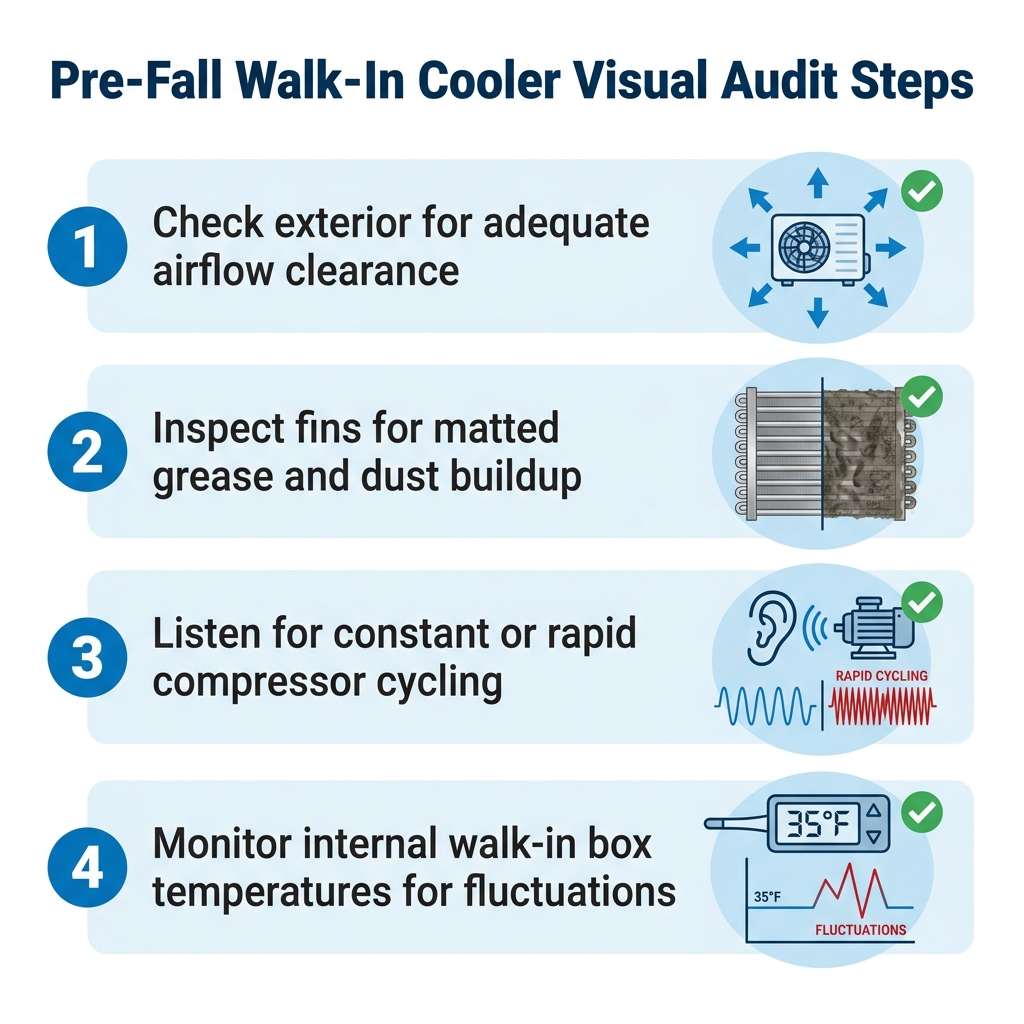
Conducting a visual audit of your commercial walk-in cooler condensers requires strict discipline. This is a non-technical inspection framework optimized for facility managers to identify risks without interfering with the mechanical operation of the equipment. You do not need tools, and you should never attempt to disassemble the unit casing during this process.
The first phase of the audit focuses entirely on the physical environment surrounding the condenser and the visible surface of the coils.
• Check for clearance: Ensure there is a minimum of 36 inches of clear space around the intake and exhaust of the condenser. Remove any stored boxes, crates, or external debris that staff may have stacked near the unit during the summer rush.
• Inspect the casing: Look for greasy residue on the exterior metal casing of the unit. If the outside housing feels slick or sticky to the touch, vaporized grease has already penetrated the internal components.
• The flashlight test: Shine a bright LED flashlight horizontally across the face of the condenser fins. You are looking for depth of grease penetration. If the light does not pass through the fins easily, or if you see a matted, fuzzy layer of grey and brown grime, the coil is severely restricted.
The second phase of the audit relies on your senses of hearing and observation to detect systemic strain.
• Listen to the run cycles: Stand near the unit and monitor how long it takes to cycle off. A compressor that runs constantly without resting, or one that short-cycles (turning on and off rapidly every few minutes), is struggling to reject heat.
• Listen for abnormal noise: A healthy compressor emits a steady, even hum. If you hear loud grinding, aggressive vibrating, or a harsh buzzing sound upon startup, the motor is fighting against high internal pressure.
• Monitor the walk-in box: Check the internal digital thermometer multiple times throughout the day. Slight temperature inconsistencies, or frost buildup forming on the evaporator coils inside the cooler, are secondary symptoms of a choked condenser outside.

Choosing to skip the September visual audit carries severe operational and financial risks for your facility. When commercial walk-in cooler condensers are left to operate with heavy grease and dust buildup, the resulting strain cascades through every part of your business model.
First, dirty coils significantly increase a commercial refrigeration system's energy consumption. When airflow is blocked, the compressor must run longer to achieve the same cooling setpoint. According to guidelines from the Department of Energy (DOE) and the EPA regarding commercial refrigeration efficiency, unmaintained coils can force a system to consume vastly more electricity than a clean counterpart. (It is worth noting that upgrading or repairing failing, inefficient systems may qualify your facility for generic local utility incentives or federal energy tax credits—always verify current programs with your utility provider). Over the course of a fiscal quarter, this phantom energy draw creates a massive, unnecessary drag on your facility's utility budget.
Second, the severe disruption of a sudden compressor failure cannot be overstated. A compressor does not simply fail; it seizes after weeks or months of prolonged system strain from blocked airflow. When this happens, your entire cooling operation stops immediately. Replacing a commercial compressor requires specialized parts, extensive labor, and significant downtime while the system is evacuated and recharged with refrigerant.
Finally, there is the catastrophic risk of inventory loss. In commercial food service environments, a walk-in cooler holds a massive volume of perishable goods. If a compressor fails overnight because the condenser was choked with summer grease, you face total inventory spoilage, potential health code violations, and the inability to serve your customers the next day.
• Heat Rejection — Clean Condenser Operation: Efficient, rapid heat transfer to ambient air — Blocked Condenser Operation: Trapped heat, elevated internal system pressure
• Compressor Cycle — Clean Condenser Operation: Normal on/off cycling with adequate rest periods — Blocked Condenser Operation: Continuous running or aggressive short-cycling
• Energy Draw — Clean Condenser Operation: Stable baseline amperage matching manufacturer specs — Blocked Condenser Operation: Spiking amperage leading to thermal overload
• Inventory Risk — Clean Condenser Operation: Stable holding temperatures, safe food storage — Blocked Condenser Operation: Fluctuating temperatures, high risk of mass spoilage
It is crucial to draw a hard line between auditing and repairing. A visual audit is for identification purposes only. Cleaning commercial condenser fins requires specialized chemical degreasers, precise water pressure calibration, and professional techniques that facility managers should never attempt on their own.
The risks of DIY cleaning: Taking a standard hose or a wire brush to a condenser coil is highly dangerous to the equipment. The aluminum fins are incredibly delicate and will bend or crush under minimal pressure. Once the fins are flattened, airflow is permanently blocked. Furthermore, spraying the wrong type of solvent can push the grease deeper into the center of the coil, creating an impenetrable block of sludge that ruins the unit and voids your manufacturer warranties.
A licensed commercial HVAC/R technician approaches coil cleaning entirely differently. They use foaming, non-acidic chemical cleaners specifically formulated to break down commercial kitchen grease without eating away at the aluminum fins. They know how to isolate the electrical components, apply the correct solvent dwell time, and flush the debris outward rather than pushing it deeper into the system. This is where a routine preventative maintenance plan becomes invaluable for facility managers who want to eliminate the guesswork.
By relying on professional maintenance as a proactive risk management strategy, you protect your infrastructure. Our team at Precision Heating & Cooling focuses heavily on this proactive approach, utilizing our specialized commercial refrigeration expertise to prevent costly downtime. In fact, one San Jose commercial building facility manager recently reached out to us after experiencing ongoing HVAC system issues that were severely impacting their operations. By providing fast, reliable, and highly knowledgeable diagnostic service, our technicians resolved the underlying strain, ultimately becoming the facility's top choice for all ongoing commercial HVAC management. When you prioritize the September post-summer recovery, you secure that same level of operational stability.
Our technicians generally recommend that commercial condenser coils receive professional cleaning at least twice a year, though high-volume kitchens often need quarterly service. The frequency depends heavily on the unit's proximity to exhaust vents, fryers, and ambient environmental dust. Regular visual audits between cleanings help determine if the schedule needs to be accelerated due to heavy grease accumulation.
Dirty condenser coils trap heat inside the refrigeration system, preventing the refrigerant from cooling down before it cycles back inside. This forces the compressor to run continuously at abnormally high pressures and temperatures. Over time, this chronic strain leads to skyrocketing energy consumption, poor internal cooling performance, and eventual compressor failure.
A failing commercial compressor typically presents with loud, irregular noises such as heavy grinding, screeching, or loud clanking upon startup. You may also notice the unit tripping the electrical breaker repeatedly due to excessive amperage draw. If the compressor is running constantly but the internal walk-in box remains warm, the component has likely lost its ability to pump refrigerant effectively.
The most obvious visual sign is a thick, matted layer of grey, brown, or black fuzz coating the aluminum fins on the outside of the unit. You may also see greasy, sticky residue accumulating on the metal casing surrounding the coil. If you shine a flashlight across the fins and the light is entirely blocked by debris, the condenser is severely restricted.
Vaporized kitchen grease acts as a highly effective adhesive when it lands on the cool metal surfaces of a condenser coil. Instead of dry dust simply blowing past or falling off the fins, the grease catches and holds every particle of airborne dirt. This creates a dense, cement-like barrier that is impossible to remove without specialized chemical foaming agents.
The transition into autumn is the most critical time to evaluate the health of your cooling equipment. Conducting a thorough September visual audit allows you to catch the heavy accumulation of summer grease and dust before it hardens into a permanent restriction. By treating this time as a vital September post-summer recovery phase, you take control of your facility's operational readiness.
Remember that identifying the problem early is your absolute best defense against a catastrophic compressor failure and the massive inventory losses that follow. A few minutes spent inspecting the exterior clearance, checking for grease buildup, and listening to the compressor cycle can save your business from thousands in emergency downtime. If your visual inspection reveals concerning buildup or erratic running sounds, it is time to have our experts step in. Schedule professional commercial refrigeration repair with Precision Heating & Cooling to protect your equipment and ensure a flawless transition into the busy holiday quarter.

Leslie was amazing for her outstanding customer service skills with me the other day. Thanks to her help my air conditioner is now all set up. She answered all my questions and took away all my problems. Leslie broke it down step by step to set it up easier. Now thanks to her my air conditioner is working perfectly. I really appreciate it Leslie and I’ll be sure to ask for you if I ever come back.
I contacted Precision Heating and Cooling for my home's AC repair. They were punctual and very professional. Guillermo was very kind and thorough. I would highly recommend them!
I am writing to express my sincere appreciation for the excellent work performed by Pablo and Alejandro from Precision Heating and Cooling. Their commitment to quality and customer satisfaction is truly commendable. Awesome job guys!
I would like to extend my sincere gratitude to Alejandro for his exceptional hard work. His passion for helping others is evident, and he consistently goes above and beyond in his service. Alejandro's thorough cleaning of my fireplace has truly made a significant difference. His dedication and professionalism are greatly appreciated.
I was very impressed. Came at night (after 9pm) to fix our AC during the middle of a heat wave the day before a national holiday! Technician was very courteous and efficient, got the job done quickly. Will definitely call them again for any AC servicing I need!
Fast and efficient, arrived when scheduled for repairs and replacement parts were ordered and installed quickly. Techs were very friendly and professional. AC system works great now! I highly recommend their services if you need repairs. Tim


.avif)
