


.avif)







Recent Blogs
Stay updated with our latest blog posts.


August is officially here, and preparing your commercial kitchen's refrigeration for the late summer rush is the most critical task on your operational calendar. As intense, dry heatwaves settle over the region, your walk-in coolers, freezers, and prep tables are enduring immense environmental strain. These systems have already been running at maximum capacity since May, battling high ambient temperatures and the relentless pace of peak dining hours. Now, as the late-August heatwaves push the mercury higher, the risk of a catastrophic system failure multiplies exponentially.
For restaurant owners and kitchen managers, this creates a high-stakes decision point: knowing exactly what preventative maintenance your staff can safely perform today, and knowing when you must call in a licensed professional. A proactive approach is the only reliable way to prevent thousands of dollars in food spoilage right before a fully booked weekend. If you want to secure your inventory and keep operations running smoothly, partnering with experts for commercial refrigeration services is the best defense against the late summer heat.
Commercial refrigeration systems do not fail overnight; they fail after months of compounding stress. By the time late summer arrives, your equipment has already processed massive volumes of hot air, cooled thousands of pounds of fresh inventory, and battled fluctuating ambient temperatures. This months-long marathon leaves critical components—like compressors, fan motors, and condenser coils—highly vulnerable just as the hottest weather of the year strikes.
The specific climate of the region exacerbates this wear and tear. San Jose's dry summer climate is notorious for kicking up significant amounts of dust, dirt, and particulate matter. For outdoor condensing units located on sun-baked rooftops or tucked into narrow, poorly ventilated alleyways, this dry environment is a worst-case scenario. Dust rapidly accumulates on the condenser coils, acting as a thick insulating blanket. When coils are coated in debris, the system cannot effectively release the heat it absorbs from inside your walk-in cooler. This severe reduction in efficiency is a regional hazard that many generic maintenance plans overlook, but it is a primary cause of equipment failure across the San Jose service area.
The financial impact of a struggling refrigeration system extends far beyond potential repair bills. Commercial refrigeration is incredibly energy-intensive, often accounting for up to 40% of a restaurant's total energy consumption. When condenser coils are dirty or ambient temperatures soar, the compressor must run longer and work harder to achieve the same cooling effect.
This prolonged cycle time consumes exponentially more power. A system that is fighting against heavy dust buildup and intense ambient heat will drive up your monthly utility bills significantly, all while failing to maintain safe holding temperatures during your busiest service hours. You end up paying a premium for electricity while simultaneously risking your valuable food inventory.
Ignoring the signs of late-summer wear and tear is a massive gamble, especially when regulatory compliance is on the line. The FDA Food Code explicitly mandates that all refrigerated, potentially hazardous foods must be held at an internal temperature of 41 degrees Fahrenheit or below. This is not merely a suggestion; it is a strict legal threshold designed to prevent the rapid multiplication of foodborne pathogens.
During a busy Friday night shift in San Jose / South Bay commercial kitchens, the door to the walk-in cooler is constantly opening and closing. Every time that door opens, a wave of hot, humid kitchen air rushes into the box. A healthy, fully optimized refrigeration system can quickly recover from this thermal shock and pull the temperature back down safely. However, a system weakened by late-summer strain will struggle to recover. The internal temperature can quickly drift above the 41-degree mark, putting your entire inventory in the danger zone.
The compounding financial impact of a failure during these hours is staggering. Beyond the immediate loss of high-value inventory like steaks, seafood, and dairy, you face disrupted service, forced menu limitations, and deeply frustrated customers. Furthermore, if a health inspector arrives while your walk-in is struggling to hold temperature, you risk severe health code violations, mandatory closures, and permanent damage to your restaurant's reputation. Framing preventative maintenance as an operational expense is a mistake; it is essential risk management that protects the very foundation of your business.
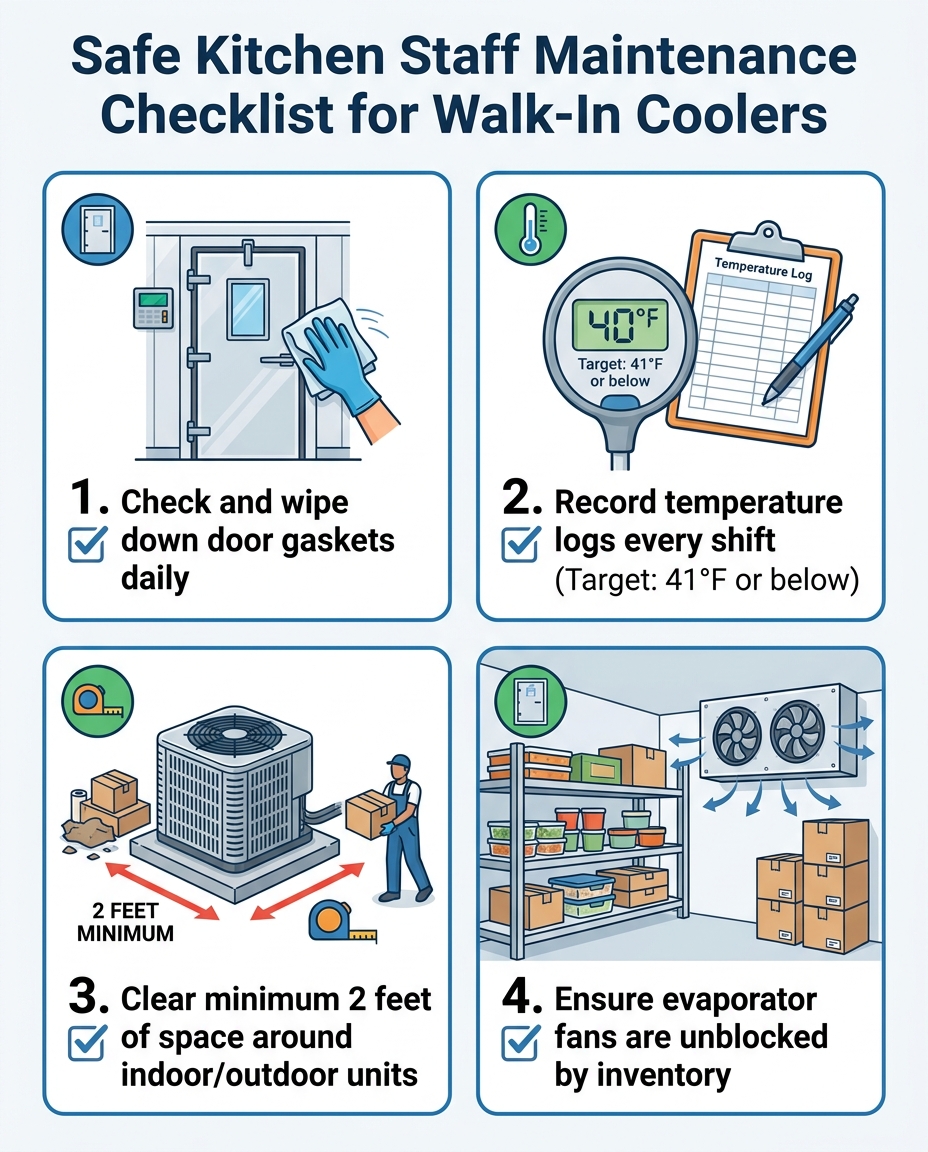
While deep technical maintenance requires a licensed professional, there are several highly effective, non-technical steps your kitchen staff can execute immediately to protect your equipment. Implementing these daily checks will dramatically reduce unnecessary strain on your walk-in coolers during late-August heatwaves.
• Inspect and clean door gaskets daily: The rubber seals around your walk-in doors are the first line of defense against hot air infiltration. Have staff wipe down the gaskets daily with mild soapy water to remove sticky food residue. Inspect them for cracks, tears, or areas where the seal is pulling away from the frame. A compromised gasket forces the compressor to run constantly.
• Maintain meticulous temperature logs: Do not rely solely on the external digital thermometer, as these can occasionally fall out of calibration. Place a secondary appliance thermometer deep inside the cooler. Have staff physically check and record the temperature multiple times per shift, especially during peak ambient heat periods in the late afternoon.
• Clear all physical obstructions: Condensing units require massive amounts of unrestricted airflow to operate correctly. Ensure that staff have not stacked cardboard boxes, milk crates, or broken equipment near the indoor or outdoor units. Maintain a minimum clearance of two feet around all mechanical components.
• Protect evaporator fan airflow: Inside the walk-in, the evaporator fans must circulate cold air evenly across the entire space. Never allow staff to stack inventory directly in front of or immediately below the fan guards. Blocking this airflow creates warm pockets inside the box and can cause the internal coils to freeze over completely.

Refrigeration systems rarely fail without warning. They usually exhibit specific symptoms for days or weeks before a catastrophic breakdown occurs. Training your management team to recognize these early warning signs can mean the difference between a minor scheduled repair and an emergency weekend shutdown in San Jose / South Bay commercial kitchens.
One of the most obvious indicators is a change in the system's acoustic profile. If you hear unusual noises—such as a loud grinding sound, a harsh metallic rattling, or a deep, vibrating hum coming from the compressor—the system is in distress. Grinding often points to failing motor bearings, while a loud hum can indicate an electrical issue where the compressor is struggling to start.
Visual cues inside the walk-in are equally important. Look for excessive condensation dripping from the ceiling or thick ice buildup on the evaporator coils. Ice on the coils is a major red flag; it acts as an insulator, preventing the system from absorbing heat, and usually indicates an airflow restriction, a failing defrost timer, or a low refrigerant charge. Additionally, pay attention to the system's cycle times. If the unit runs constantly without ever cycling off, it is desperately trying—and failing—to reach the thermostat's setpoint. Watch for fluctuating temperatures that bounce dangerously close to the 41-degree FDA limit, as this instability precedes total failure.
• Loud grinding or squealing noises — Potential Underlying Cause: Failing fan motor bearings or compressor stress — Required Action: Call for professional diagnostics immediately
• Ice buildup on indoor evaporator coils — Potential Underlying Cause: Blocked airflow, failed defrost cycle, or low refrigerant — Required Action: Check for blocked fans; call a licensed technician
• System runs constantly without cycling off — Potential Underlying Cause: Dirty condenser coils, hot air leaks, or failing compressor — Required Action: Clean gaskets, check clearance; schedule professional service
• Temperatures hovering near 42°F - 45°F — Potential Underlying Cause: Overloaded box, severe ambient heat strain, or failing parts — Required Action: Limit door openings; request an urgent system inspection
While your kitchen staff plays a vital role in daily upkeep, there is a strict boundary between operational checks and technical repairs. Handling refrigerants, troubleshooting high-voltage electrical components, and performing deep chemical coil cleaning requires a licensed HVAC/R professional. Attempting to bypass this requirement is not only dangerous, but it can also lead to permanent equipment damage.
Professional diagnostics go far beyond what is visible to the naked eye. A certified technician uses specialized gauges and multimeters to identify hidden wear on critical components like contactors, relays, and capacitors long before they fail completely. A comprehensive end-of-summer inspection resets your system's efficiency, ensuring that the electrical draw is normal, the refrigerant charge is precise, and the defrost cycles are operating on the correct schedule. Leveraging over 20 years of local experience, we understand the severe financial stakes of food spoilage and know exactly how to fortify your equipment against the late-August heatwaves.
Responsiveness is everything when dealing with commercial building HVAC/R issues. One local commercial building manager reached out during a particularly brutal summer heatwave when their system started failing and threatening their operations. Our team was dispatched quickly, providing fast, reliable, and highly responsive service to get the commercial system back in good working order before any inventory was lost. That level of professional backup is exactly what you secure when you invest in a preventative maintenance plan.
Attempting DIY repairs on commercial refrigeration systems is a massive liability. Unlicensed interference can instantly void expensive manufacturer warranties, leaving you entirely responsible for the cost of replacement parts. More importantly, it creates severe safety hazards. Only EPA-certified technicians are legally permitted to handle refrigerant charge adjustments, and only trained professionals have the expertise to safely navigate the complex electrical panels that power commercial compressors.
In today's maintenance landscape, the urgency of scheduling service is compounded by ongoing supply chain realities. The commercial refrigeration industry is currently navigating significant delays for specific, high-demand components, including OEM compressors, specialized fan motors, and proprietary electronic control boards.
Because of these logistical hurdles, waiting until a Friday afternoon to report a failing walk-in cooler is a recipe for disaster. If your system breaks down heading into the weekend and the required part is back-ordered at the local supply house, your equipment will remain down until the following week. No amount of emergency labor can fix a system if the critical replacement part is sitting on a freight truck three states away.
Restaurant owners must address minor performance issues early in the week. If you notice temperature fluctuations on a Tuesday, calling for service immediately allows the technician time to diagnose the issue, source the necessary parts, and complete the repair before your Friday dinner rush begins. Proactive service acts as a vital buffer against supply chain unpredictability. For more insights on this specific challenge, we highly recommend navigating commercial refrigeration parts shortages to better prepare your operations.
The most common warning signs include fluctuating internal temperatures, constant running without cycling off, and unusual grinding or loud humming noises from the compressor. You may also notice excessive condensation inside the box or thick ice forming on the evaporator coils. If your walk-in struggles to stay below 41 degrees Fahrenheit during late-August heatwaves, failure is likely imminent and requires immediate professional diagnostics.
Kitchen staff should inspect and wipe down commercial refrigerator door gaskets every single day. Daily cleaning prevents sticky food residue from degrading the rubber, which leads to cracks and poor sealing. A compromised gasket allows hot kitchen air to flood the cooler, forcing the system to work overtime and drastically reducing the lifespan of the compressor.
During the summer, intense ambient heat puts massive strain on your condenser coils, especially if they are located outdoors or in a hot kitchen. If these coils are coated in dust, dirt, or grease, the system cannot release heat effectively, causing a severe drop in cooling capacity. Other common culprits include blocked airflow around the units, low refrigerant levels, or failing fan motors.
Commercial refrigeration systems should receive comprehensive professional maintenance at least twice a year, ideally in the spring before the summer heat hits, and again in the fall. However, high-volume kitchens with heavy grease output or outdoor condensers exposed to severe dust may require quarterly professional cleanings to maintain optimal efficiency and prevent sudden breakdowns.
A commercial walk-in cooler must maintain an internal temperature of 41 degrees Fahrenheit or below to comply with FDA Food Code regulations for potentially hazardous foods. To provide a safe buffer during busy shifts with frequent door openings, most industry professionals recommend setting the thermostat so the internal temperature hovers steadily between 35 and 38 degrees Fahrenheit.
No, kitchen staff should not attempt to clean condenser coils themselves. While staff can and should clear boxes and debris away from the unit to improve general airflow, physically cleaning the delicate aluminum fins requires specialized chemical cleaners and techniques. Improper cleaning can bend the fins, damage electrical components, or push dirt deeper into the coil, which is why this task must be left to a licensed HVAC/R professional.
Surviving the peak of summer requires a coordinated effort between your kitchen staff and your local refrigeration experts. By combining daily operational checks—like monitoring temperature logs and cleaning gaskets—with timely professional diagnostics, you create a robust defense against catastrophic equipment failure. Do not gamble your valuable inventory on struggling equipment during the hottest, busiest weekends of the year in San Jose / South Bay commercial kitchens. The risk to your product, your revenue, and your reputation is simply too high. Take action today to secure your operations; schedule service with a licensed professional and ensure your walk-in coolers are fully prepared to handle the late summer rush.

Leslie was amazing for her outstanding customer service skills with me the other day. Thanks to her help my air conditioner is now all set up. She answered all my questions and took away all my problems. Leslie broke it down step by step to set it up easier. Now thanks to her my air conditioner is working perfectly. I really appreciate it Leslie and I’ll be sure to ask for you if I ever come back.
I contacted Precision Heating and Cooling for my home's AC repair. They were punctual and very professional. Guillermo was very kind and thorough. I would highly recommend them!
I am writing to express my sincere appreciation for the excellent work performed by Pablo and Alejandro from Precision Heating and Cooling. Their commitment to quality and customer satisfaction is truly commendable. Awesome job guys!
I would like to extend my sincere gratitude to Alejandro for his exceptional hard work. His passion for helping others is evident, and he consistently goes above and beyond in his service. Alejandro's thorough cleaning of my fireplace has truly made a significant difference. His dedication and professionalism are greatly appreciated.
I was very impressed. Came at night (after 9pm) to fix our AC during the middle of a heat wave the day before a national holiday! Technician was very courteous and efficient, got the job done quickly. Will definitely call them again for any AC servicing I need!
Fast and efficient, arrived when scheduled for repairs and replacement parts were ordered and installed quickly. Techs were very friendly and professional. AC system works great now! I highly recommend their services if you need repairs. Tim


.avif)
