


.avif)






Recent Blogs
Stay updated with our latest blog posts.


Is your walk-in cooler actually dead, or does it just need a new heart? When facing a sudden equipment failure, the choice between replacing a walk-in cooler compressor vs. upgrading the entire condensing unit is one of the most critical decisions you will make for your facility. At Precision Heating & Cooling, we know firsthand that if you manage San Jose commercial food service and retail facilities, a compromised refrigeration system threatens thousands of dollars in perishable inventory. After enduring the heavy operational strain of a long summer, we frequently see aging units give out right when our clients need them most.
This failure forces an immediate decision. Do you authorize a fast, component-level swap to get the cooler chilling again by tomorrow? Or do you take a step back and invest in a comprehensive condensing unit upgrade that secures your long-term operational stability? Making the right choice requires evaluating your total system age, the extent of component wear, and upcoming regulatory changes that affect commercial refrigerants. If you need immediate guidance on your specific situation, explore our commercial HVAC and refrigeration services.
The stakes are incredibly high for commercial facilities. A quick patch might seem appealing in the heat of the moment, but it can sometimes mask deeper systemic exhaustion. On the other hand, a full upgrade requires planning and capital. Let our team break down both paths so you can make a strategic choice that protects your inventory and your bottom line.
When a commercial compressor fails, the immediate instinct is often to replace the broken part and move on. A compressor swap is a targeted, component-level repair. This process requires a licensed professional to safely handle refrigerant recovery, remove the faulty component, integrate the new compressor into the existing piping, and properly recharge the system. The initial appeal of this route is obvious: it is generally a faster turnaround, aiming to get your walk-in cooler back down to safe holding temperatures as quickly as possible.
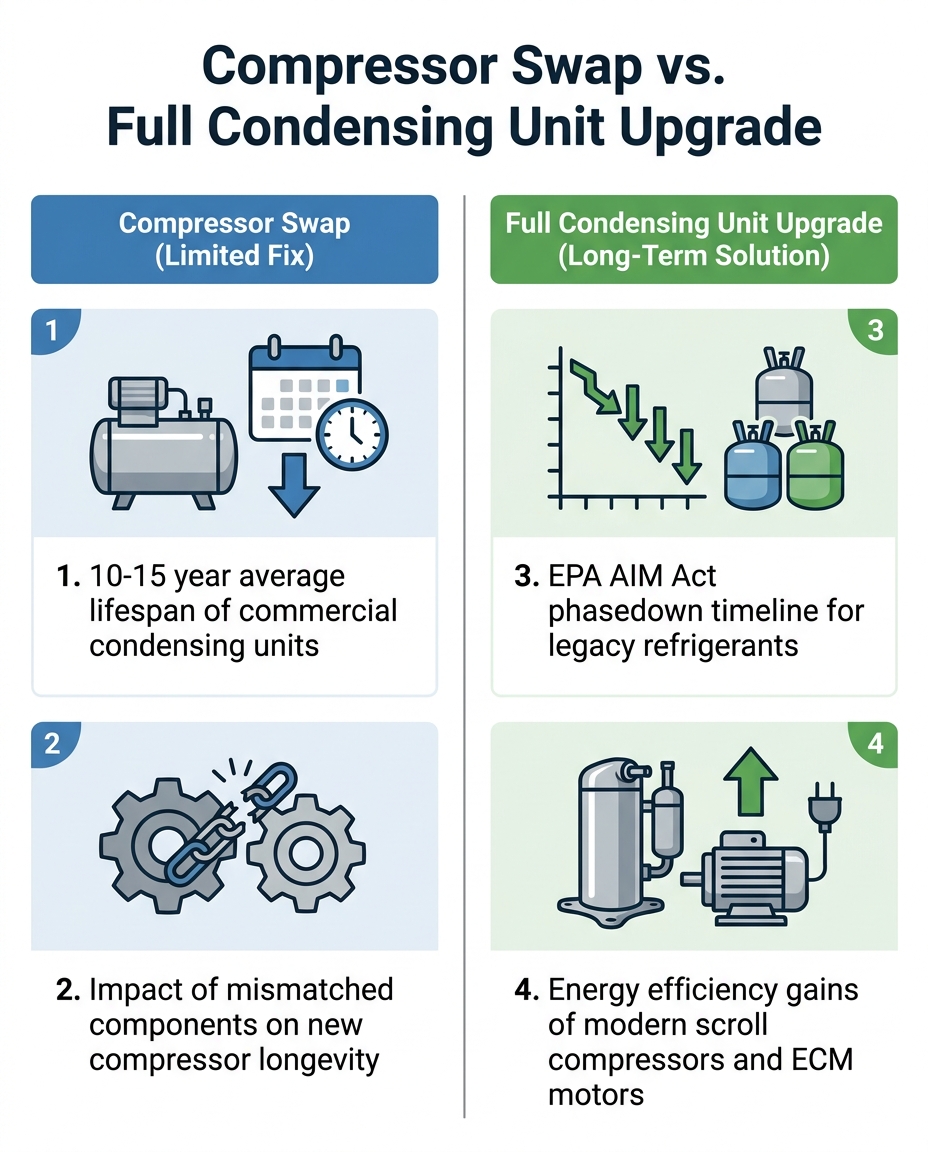
However, this approach carries significant hidden risks, especially for aging commercial condensing units running on phased-out refrigerants. The primary danger is mismatched system stress. When you install a brand-new, powerful compressor into an old, degraded condensing unit, that new compressor will pump refrigerant at full capacity. If the surrounding condenser coils are corroded or the fan motor is weak, the system cannot reject heat fast enough. This forces the new compressor to work against abnormally high head pressures, frequently leading to premature failure of the brand-new part.
Our commercial refrigeration technicians at Precision Heating & Cooling see this pattern often across San Jose. In one recent instance, we were called out to a local business that had an older, discontinued system stop working during the peak of summer. A previous technician had repaired the older unit by swapping the failed component. When the underlying system stress caused it to fail again shortly after, the service warranty was honored to get the system running twice. While reliable warranty service is crucial, repeated downtime is exactly what facility managers want to avoid. Furthermore, the labor time required for a complex compressor swap can sometimes rival the labor hours required for a completely new unit installation. If you are trying to determine which component is actually causing the trouble, knowing how to go about identifying failing walk-in cooler parts is a critical first step.
Despite the risks, our team recognizes that a targeted compressor replacement is sometimes the most logical choice. We typically recommend this route under specific conditions:
• The unit is relatively young: The condensing unit is under five to seven years old and remains in excellent structural condition.
• Isolated electrical events: The failure was caused by an isolated power surge or electrical short, rather than systemic wear and tear.
• Modern refrigerants: The system utilizes modern, compliant refrigerants that are not subject to imminent phase-outs.
• Clean maintenance history: The condenser coils have been routinely cleaned and the fan motors are operating at optimal RPMs.
To understand why a compressor failure is rarely an isolated event, you have to look at the environment where the equipment lives. Commercial condensing units have an average operational lifespan of 10 to 15 years, according to ASHRAE standards. However, that lifespan assumes ideal conditions and rigorous maintenance. In reality, San Jose's intense summer heatwaves place massive continuous loads on outdoor commercial condensing units. When the ambient temperature climbs, the system has to work significantly harder to reject heat from the walk-in cooler.
This prolonged, continuous strain degrades outdoor unit components far beyond just the compressor. Over years of heavy operation, the condenser coils endure microscopic pitting and corrosion. Dust, grease, and urban debris coat the aluminum fins, acting as an insulating blanket that traps heat inside the system. The condenser fan motors run for thousands of hours under extreme thermal stress, slowly baking their internal windings until they lose efficiency. Electrical contactors become pitted and scarred from repeatedly engaging and disengaging under heavy electrical loads.
By the time a compressor finally locks up or shorts to ground, it is often just the most visible symptom of a structurally exhausted unit. Fixing the compressor does not reverse the wear on the coils, nor does it restore the efficiency of the fan motor. In our years of servicing San Jose commercial food service and retail facilities, we've found that ignoring this hidden wear and tear often leads to a frustrating cycle of cascading repairs, where fixing one major component simply transfers the operational stress to the next weakest link in the chain.
Beyond mechanical wear, regulatory compliance is now a major driving factor in the repair versus replace decision. The Environmental Protection Agency (EPA) is actively enforcing the AIM Act, which mandates a strict phasedown of high-Global Warming Potential (GWP) hydrofluorocarbons (HFCs). For the commercial refrigeration industry, this means that legacy refrigerants like R-404A are being heavily restricted in production and importation.
These regulations directly impact the long-term viability and servicing costs of older commercial refrigeration systems. As the supply of virgin legacy refrigerants shrinks, the market relies increasingly on reclaimed supplies, which drives up the cost of servicing older units. If you are operating aging commercial condensing units running on phased-out refrigerants, investing heavily in a major repair—like a compressor swap—locks your facility into an increasingly obsolete and expensive ecosystem.
When an old compressor burns out, it often contaminates the existing refrigerant charge with acid, requiring the entire system to be flushed and recharged. Paying a premium to recharge a patched system with a fading refrigerant is a significant financial risk. In contrast, new condensing units are engineered specifically for modern, compliant refrigerants. Upgrading ensures that your equipment will remain easily serviceable and fully compliant with environmental regulations for its entire operational lifespan, protecting your facility from future supply bottlenecks.
When the risks of a component swap outweigh the benefits, completely replacing the condensing unit becomes the most strategic move. Upgrading to a modern condensing unit introduces advanced technology that older systems simply cannot match. Today's commercial units are frequently equipped with highly efficient scroll compressors and Electronically Commutated Motors (ECM) for the condenser fans. Scroll compressors have fewer moving parts, offering smoother operation and greater tolerance to liquid slugging, while ECM motors adjust their speed based on demand, leading to significant reductions in commercial energy consumption.
Another major advantage of a full upgrade is comprehensive warranty protection. A replacement compressor typically comes with a limited parts warranty that only covers that specific component. If the old fan motor fails a month later, you are paying out of pocket. A new condensing unit comes with a robust manufacturer warranty that covers the entire outdoor assembly, providing genuine operational security. Furthermore, high-efficiency upgrades often qualify for generally applicable energy rebates or utility incentive programs designed to reduce grid strain. While you should always verify current program availability with your local utility provider, these incentives can help offset the initial capital investment.
Timing is also critical. Securing an installation during the early fall transition (September) before Q4 holiday inventory peaks is the ideal way to protect your facility. For example, our installation team recently helped a commercial business that needed a complete system upgrade after a brutal summer. We set up the new unit, provided continuous operational updates, and followed up after the installation to ensure the system was holding temperature perfectly. That level of comprehensive service is what you get with a full upgrade. If you are ready to explore your options, look into commercial refrigeration replacement and repair.
Based on our field experience, a full condensing unit replacement is usually the most sound business decision under the following circumstances:
1. The unit age exceeds 10 years: Once a commercial system passes the decade mark, it is nearing the end of its ASHRAE-rated operational lifespan.
2. Reliance on phased-out refrigerants: The system uses R-404A or other legacy HFCs targeted by the EPA AIM Act phasedown.
3. Extensive coil deterioration: The condenser coils are heavily corroded, flattened, or incapable of being thoroughly cleaned.
4. History of frequent breakdowns: The unit has required multiple service calls over the past two years for various electrical or mechanical issues.
Making a decision of this magnitude requires an objective framework. Facility managers must weigh the immediate Capital Expenditure (CapEx) against long-term Operational Expenses (OpEx). While a compressor swap has a lower initial CapEx, it often results in higher OpEx due to continued inefficiency and the likelihood of future repairs. A full condensing unit upgrade demands a higher upfront CapEx, but significantly lowers OpEx through energy efficiency gains and reduced maintenance calls.
You must also evaluate the hidden cost of potential downtime. If a patched system fails during peak seasons, the loss of perishable inventory can easily exceed the cost of a new condensing unit. Investing in a full upgrade yields a much stronger long-term Return on Investment (ROI) by eliminating these risks. At Precision Heating & Cooling, our commercial expertise lies in helping businesses calculate this long-term ROI and mitigate risk. We act as strategic operational partners rather than just reactive parts-swappers, ensuring your facility is protected during the early fall transition (September) before Q4 holiday inventory peaks.
• Upfront Capital Expenditure (CapEx) — Immediate Compressor Swap: Lower initial investment; focuses strictly on the failed component. — Full Condensing Unit Upgrade: Higher initial investment; covers complete outdoor equipment replacement.
• Long-Term Operational Expenses (OpEx) — Immediate Compressor Swap: Higher; older components continue to draw more energy and require frequent service. — Full Condensing Unit Upgrade: Lower; modern ECM motors and scroll compressors significantly reduce energy draw.
• Risk of Future Downtime — Immediate Compressor Swap: High; aging coils and fan motors remain in place and are prone to failure. — Full Condensing Unit Upgrade: Low; all outdoor components are brand new and engineered to work together.
• Warranty Coverage — Immediate Compressor Swap: Limited; covers only the replacement compressor part for a short duration. — Full Condensing Unit Upgrade: Comprehensive; covers the entire condensing unit under a full manufacturer warranty.
• Refrigerant Compliance — Immediate Compressor Swap: Poor; often locks the facility into maintaining an obsolete, phased-out refrigerant. — Full Condensing Unit Upgrade: Excellent; utilizes modern, EPA-compliant refrigerants that are readily available.
To keep whichever path you choose running at peak performance, implementing a proactive strategy is essential. Consider enrolling in a commercial maintenance plan to protect your equipment year-round.

In our professional experience, the best choice depends entirely on the age and condition of your current system. If the condensing unit is under seven years old and uses modern refrigerant, a compressor swap is usually the right move. However, if the unit is over ten years old, has deteriorating coils, or runs on a phased-out refrigerant, replacing the whole unit provides better long-term reliability. Upgrading the entire unit eliminates the risk of mismatched system stress and protects your facility from cascading component failures.
A commercial walk-in cooler compressor typically lasts between 10 and 15 years when properly maintained. This lifespan can be significantly shortened by poor airflow, dirty condenser coils, or a lack of routine maintenance. Continuous operation in extreme summer heat without proper cleaning forces the compressor to work against high head pressures, which wears out internal components rapidly. Regular professional maintenance is the single best way to ensure your compressor reaches its maximum lifespan.
Yes, replacing just the compressor is a standard commercial repair procedure. A licensed professional will safely recover the old refrigerant, remove the broken compressor, integrate a new one, replace the filter drier, and recharge the system. While technically possible, we don't always recommend it for older units. Placing a powerful new compressor into a degraded system can overwork the new part, leading to early failure.
The most obvious sign is a walk-in cooler that struggles to maintain its set holding temperature, running constantly without ever fully chilling. You might also notice unusually loud grinding, clanking, or buzzing noises coming from the outdoor condensing unit. Frequent tripping of the dedicated electrical breaker is another major red flag, indicating the compressor is pulling too much amperage as it struggles to start. If you observe any of these symptoms, immediate professional diagnostics are required.
Refrigerant phase-outs, driven by the EPA's AIM Act, severely restrict the production of older, high-GWP refrigerants like R-404A. As the supply shrinks, the cost to recharge an older system skyrockets. If your older compressor fails and contaminates the refrigerant charge, paying to flush and refill the system with an obsolete refrigerant is a poor financial investment. Upgrading to a new unit ensures you are using compliant, readily available refrigerants.
Yes, a modern condensing unit will drastically improve your facility's energy efficiency compared to a system built a decade ago. New units utilize advanced scroll compressors that operate much more smoothly and require less electricity. They also feature Electronically Commutated Motors (ECM) for the condenser fans, which adjust their speed based on cooling demand rather than running at full blast continuously. This combined technology translates to noticeably lower monthly operational expenses.
Making a strategic, long-term equipment choice is the only way to truly protect your perishable inventory from unexpected downtime. A temporary patch might solve today's crisis, but it leaves your facility vulnerable to future failures. By choosing a full condensing unit upgrade, you secure reliable uptime, comprehensive warranty protection, and significantly better energy efficiency.
The timing of this decision is critical. The early fall transition (September) before Q4 holiday inventory peaks is the perfect window to finalize major equipment upgrades. Do not wait for a patched system to fail when your walk-in cooler is packed with holiday stock. Take a proactive approach to your facility's operational health. Schedule a professional consultation with the Precision Heating & Cooling team today to evaluate your specific refrigeration needs and ensure your business is fully prepared for the busy season ahead.

Leslie was amazing for her outstanding customer service skills with me the other day. Thanks to her help my air conditioner is now all set up. She answered all my questions and took away all my problems. Leslie broke it down step by step to set it up easier. Now thanks to her my air conditioner is working perfectly. I really appreciate it Leslie and I’ll be sure to ask for you if I ever come back.
I contacted Precision Heating and Cooling for my home's AC repair. They were punctual and very professional. Guillermo was very kind and thorough. I would highly recommend them!
I am writing to express my sincere appreciation for the excellent work performed by Pablo and Alejandro from Precision Heating and Cooling. Their commitment to quality and customer satisfaction is truly commendable. Awesome job guys!
I would like to extend my sincere gratitude to Alejandro for his exceptional hard work. His passion for helping others is evident, and he consistently goes above and beyond in his service. Alejandro's thorough cleaning of my fireplace has truly made a significant difference. His dedication and professionalism are greatly appreciated.
I was very impressed. Came at night (after 9pm) to fix our AC during the middle of a heat wave the day before a national holiday! Technician was very courteous and efficient, got the job done quickly. Will definitely call them again for any AC servicing I need!
Fast and efficient, arrived when scheduled for repairs and replacement parts were ordered and installed quickly. Techs were very friendly and professional. AC system works great now! I highly recommend their services if you need repairs. Tim


.avif)
