


.avif)





Recent Blogs
Stay updated with our latest blog posts.


You might not notice it when you turn on the tap, but understanding how hard water in San Jose accelerates hot water tank corrosion is the key to preventing sudden plumbing failures. Across the San Jose metro area, our team at Precision Heating & Cooling regularly sees a silent chemical process steadily eating away at the core components of residential water heaters. While the outside of your tank looks perfectly fine, the inside is battling a daily influx of dissolved minerals that harden, coat, and ultimately destroy vital heating elements.
If you are already experiencing reduced hot water capacity or strange noises from your utility closet, it is time to explore professional plumbing and HVAC services to evaluate the damage before total failure occurs. Recognizing this chemical reaction early is the key to preventing sudden appliance breakdowns. Homeowners often assume their hot water supply is endless, right up until the morning the shower runs ice cold. The reality is that scale buildup is an invisible threat that compounds silently over time.
As we approach the cooler months and ambient temperatures begin to drop, your water heater has to work significantly harder to raise the temperature of incoming groundwater. This extra thermal stress on a compromised system frequently leads to ruptured tanks or burned-out electric elements. Addressing these invisible threats proactively is essential for protecting your home's infrastructure. By understanding the science behind the scale, you can take the necessary steps to protect your plumbing appliances before the heavy winter demand arrives.
To understand why plumbing appliances degrade so quickly in this region, you have to look directly at the municipal water supply. The San Jose metro area relies heavily on local groundwater sources, which creates a unique set of challenges for residential plumbing. Water is considered "hard" when it contains high concentrations of dissolved minerals, primarily calcium and magnesium. While perfectly safe for human consumption, these minerals are incredibly harsh on metal plumbing fixtures and water heating appliances.
The geological journey of the region's municipal water is the root cause of this hardness. As rainwater falls and percolates through the earth to reach local aquifers, it passes through dense layers of limestone and other mineral-rich rock formations. Because water is a universal solvent, it absorbs calcium and magnesium ions along the way. By the time this groundwater is pumped up, treated, and delivered to residential homes, it is heavily saturated with these dissolved minerals.
The groundwater impact: Unlike regions that rely primarily on surface water from lakes or snowmelt reservoirs, communities drawing from deep aquifers consistently deal with highly mineralized water. In our years of servicing San Jose homes, we've found that this heavy reliance on local groundwater sources results in water that is exceptionally hard, directly impacting the lifespan of local plumbing appliances.
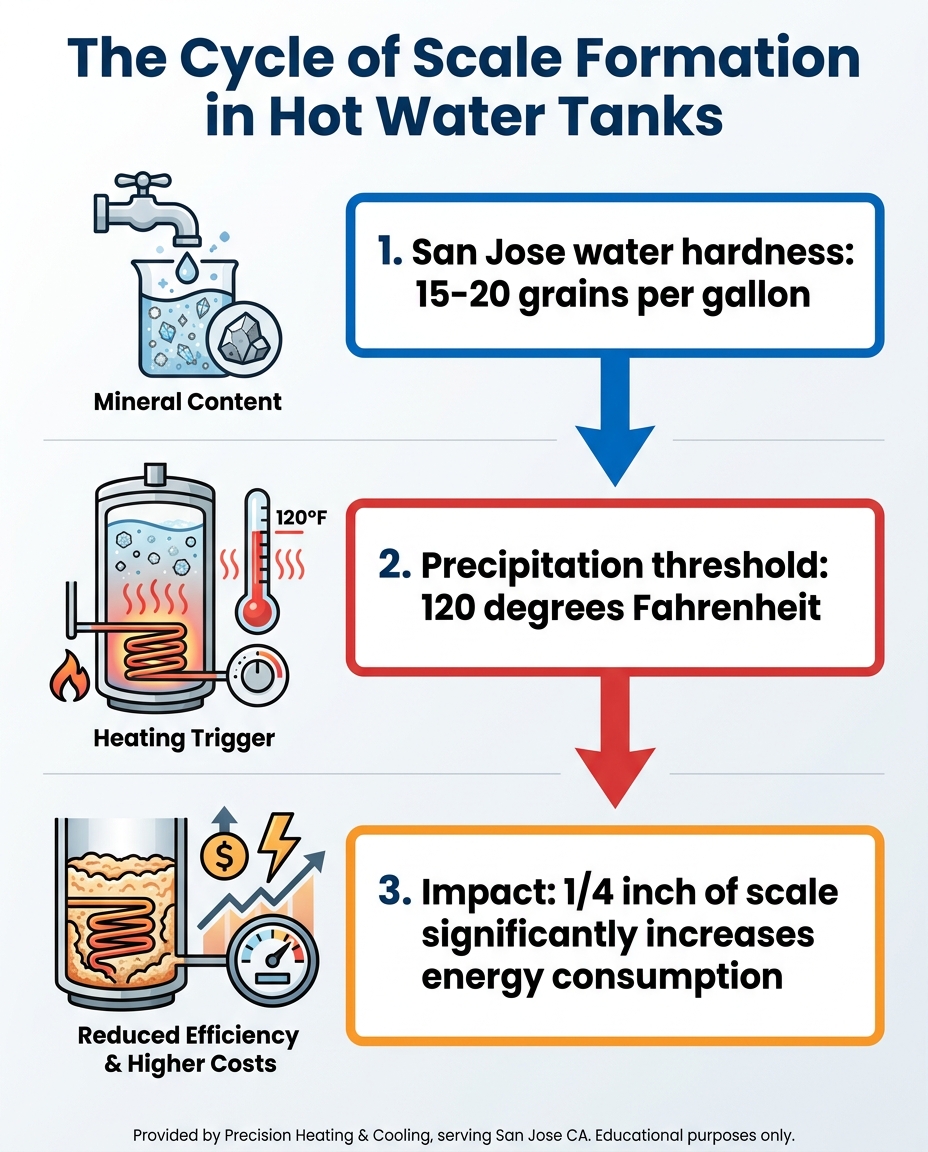
Water hardness is scientifically measured in grains per gallon (gpg). To put this into perspective, water containing 1 to 3 gpg is considered slightly hard, while anything over 10.5 gpg is classified by the USGS as "very hard." When our plumbers test water quality in San Jose, we frequently see hardness exceeding 15 to 20 gpg. This is an exceptionally high concentration of dissolved minerals.
What this means for your home:
• Daily accumulation: A typical household uses dozens of gallons of hot water daily, meaning massive amounts of calcium are constantly cycling through the heater.
• Rapid crystallization: At 15-20 gpg, the water is so saturated that minerals drop out of solution and crystallize at a highly accelerated rate.
• Appliance lifespan: Without intervention, water heaters operating in 15+ gpg conditions often fail years before their manufacturer-estimated lifespan.
The high mineral content of the local water is only half of the equation. The real damage occurs when that hard water meets the extreme heat inside your hot water tank. This triggers a chemical reaction where dissolved calcium and magnesium precipitate out of the water, transforming from invisible dissolved ions into solid, rock-like calcium carbonate scale.
Unlike most substances, which dissolve easier in hot water (think of stirring sugar into hot tea), calcium carbonate has what chemists call "inverse solubility." This means that as water gets hotter, it actually loses its ability to hold dissolved calcium. The critical threshold for this chemical reaction is 120 degrees Fahrenheit.
The thermodynamics of scale:
1. Cold groundwater enters the tank carrying a heavy load of dissolved minerals.
2. The thermostat triggers the heating elements or gas burner to activate.
3. As the water temperature crosses the 120-degree mark, the calcium carbonate rapidly precipitates out of the liquid.
4. The higher the thermostat is set (such as 130 or 140 degrees), the faster and heavier the scale production becomes.
Once the calcium carbonate becomes a solid, it has to go somewhere. Because it is heavier than water, it sinks to the bottom of the tank. In a gas water heater, this mineral rock coats the bottom of the tank, sitting directly between the gas burner below and the water above. In an electric water heater, the scale clings directly to the submerged copper or stainless steel heating elements, encasing them in a hard, white crust.
As this scale accumulates, it can severely impact the combustion process in gas-fired units. The heavy mineral layer forces the burner to run longer and hotter, which can disrupt proper drafting and ventilation. In some cases, this poor drafting is accompanied by a faint gas smell when your water heater ignites. This is a clear indicator that the internal chemical process is beginning to affect the external mechanical safety of the appliance.

Because the chemical precipitation happens entirely inside a sealed steel tank, homeowners cannot visually inspect the damage. However, the physical symptoms of severe scale buildup are highly noticeable if you know what to look and listen for. Connecting the scientific explanation to the physical symptoms is crucial for catching the problem before a catastrophic leak occurs.
When our dispatch center receives calls about a loud popping, knocking, or rumbling sound coming from the utility closet, we usually know exactly what to expect. Many homeowners mistake this for a mechanical failure, but it is actually a thermodynamic reaction caused by the calcium carbonate layer.
The boiling process:
• Trapped water: As the scale layer thickens on the bottom of a gas tank, small pockets of water become trapped underneath the porous mineral crust, right next to the intense heat of the burner.
• Flash boiling: Because this trapped water is so close to the heat source and insulated from the cooler water above, it flash-boils into steam.
• Violent escape: The steam bubbles violently burst through the heavy calcium crust to escape to the top of the tank. The popping sound you hear is the physical force of steam breaking through rock.
Calcium carbonate is an incredibly effective thermal insulator. While you want insulation on the outside of your tank, having an insulator inside the tank is disastrous. A mere quarter-inch of scale acts as a thermal blanket, actively blocking heat transfer from the burner or electric element into the water.
According to Department of Energy (DOE) efficiency guidelines, a water heater must transfer heat rapidly to maintain energy standards. Scale forces the system to violate these guidelines. The unit must burn more gas or draw more electricity to push heat through the mineral barrier. This thermal blanketing causes electric heating elements to trap their own heat, eventually causing them to overheat, split open, and short out completely. The resulting increase in energy consumption means you are paying significantly higher utility bills for a fraction of the hot water.
The timing of water heater failures is rarely a coincidence. While scale builds up year-round, a pattern we see often is that negative effects are heavily amplified during seasonal transitions. As we enter the September pre-heating season, the environmental conditions begin to shift, placing immense strain on already compromised plumbing appliances.
During the peak of summer, the groundwater traveling through municipal pipes is relatively warm. Your water heater only has to raise the temperature by a few dozen degrees to reach the 120-degree target. However, as the fall season approaches, groundwater temperatures begin to drop significantly. The water entering the bottom of your tank is much colder, which creates a larger temperature differential (delta-T) for the appliance to overcome.
This colder incoming water forces the tank to run much longer heating cycles to reach the target temperature on the thermostat. These extended cycles mean the heating elements are glowing hot for longer durations, which in turn accelerates further scale precipitation on elements that are already coated in minerals. It becomes a destructive feedback loop: scale causes longer run times, and longer run times create more scale.
When the thermal stress becomes too great, the glass lining of the tank can crack, or the heating elements can fail entirely. This is why our team highly recommends considering water heater repair and replacement before the heaviest winter demand sets in. Waiting until the middle of December to address a struggling, scale-filled tank almost guarantees an emergency breakdown when you need hot water the most.
If you search online for water heater advice, the most common recommendation is to perform a standard annual flush. While this generic advice might work in regions with soft surface water, it is wholly insufficient for the highly mineralized water of the South Bay. At Precision Heating & Cooling, we've learned firsthand that applying generic maintenance schedules to San Jose's unique groundwater chemistry leaves appliances vulnerable to early failure.
A simple DIY draining of the tank will remove loose sediment floating at the bottom, but it does absolutely nothing to remove the calcified layers of calcium carbonate that have baked onto the heating elements and tank walls. Furthermore, attempting a DIY flush on an older, unmaintained tank carries significant risks. The plastic drain valves on older units often become brittle or jammed with scale. Forcing them open can cause the valve to snap, resulting in a flooded garage and severe scalding hazards. Maintenance on this level requires professional tools and expertise.
Specialized technicians proactively identify and mitigate hard water damage that out-of-town contractors applying generic schedules might miss. Because of the deep local expertise required in Silicon Valley and San Jose, our team utilizes advanced, professional-grade methods to safely descale elements.
This includes the use of specialized chemical neutralizers that safely dissolve calcium carbonate without damaging the tank's interior glass lining. Additionally, local experts know to inspect and replace the sacrificial anode rod with materials specifically suited for high-GPG water, such as an powered titanium anode or a specialized aluminum-zinc rod, rather than relying on standard magnesium rods that deplete too rapidly in hard water.
• Flush Frequency — Generic Maintenance Approach: Once per year — San Jose Specialized Maintenance: Bi-annual professional flushing for 15+ GPG water
• Anode Rod Inspection — Generic Maintenance Approach: Checked every 3-4 years — San Jose Specialized Maintenance: Checked annually due to rapid mineral depletion
• Descaling Method — Generic Maintenance Approach: Basic gravity draining of loose sediment — San Jose Specialized Maintenance: Professional chemical neutralization of baked-on scale
• Diagnostic Focus — Generic Maintenance Approach: Checking for external leaks and pilot lights — San Jose Specialized Maintenance: Evaluating thermal transfer loss and element encasement
To combat these aggressive local water conditions, homeowners need more than a reactive approach. Enrolling in a routine preventative maintenance plan designed specifically for the region's chemistry is the safest way to ensure your equipment survives the winter.
Yes, hard water significantly accelerates the deterioration of water heaters. When water with high calcium and magnesium content is heated, those minerals precipitate out and form a rock-like scale inside the tank. Over time, this scale coats the heating elements and the bottom of the tank, blocking heat transfer. This forces the system to overwork, eventually leading to burned-out electric elements or a cracked tank lining.
In areas with very hard water (over 15 grains per gallon), an unmaintained water heater can fail in as little as five to seven years. The rapid accumulation of calcium carbonate forces the appliance to run longer cycles, which degrades the internal components much faster than the manufacturer's estimated 10-to-15-year lifespan. Regular professional descaling is required to slow this rapid deterioration.
A popping or rumbling sound indicates that a thick layer of mineral scale has formed on the bottom of the tank. Water becomes trapped underneath this porous calcium crust and flash-boils against the extreme heat of the burner. The popping noise is actually the sound of pressurized steam bubbles violently bursting through the mineral layer to escape to the top of the tank.
The most effective protection requires professional intervention, starting with routine tank flushing and chemical descaling to remove hardened minerals. Additionally, a licensed technician can monitor and replace the sacrificial anode rod, which protects the tank's steel core from corrosion. For long-term protection, we often recommend installing a whole-home water softening system to remove the calcium and magnesium before it ever reaches the heater.
The municipal water supply in San Jose is classified as "very hard," frequently measuring between 15 and 20 grains per gallon (gpg). Because the region relies heavily on local groundwater aquifers that percolate through mineral-rich geology, the water absorbs high levels of calcium and magnesium. This high concentration requires proactive plumbing maintenance to prevent rapid appliance scale buildup.
Understanding the chemistry of scale is the first and most crucial step to protecting your plumbing appliances. The silent precipitation of calcium carbonate is an ongoing threat that degrades efficiency and destroys heating elements from the inside out. As we move through the September pre-heating season, the incoming cold groundwater will only force your compromised system to work harder.
Do not wait until the first freezing morning to discover your hot water tank has failed. By acting now, before the cold weather forces the system to overwork, you can extend the life of your equipment. Consult with our local professionals at Precision Heating & Cooling for an accurate, chemistry-based assessment of your tank's health to ensure your home remains comfortable and protected all winter long.

Leslie was amazing for her outstanding customer service skills with me the other day. Thanks to her help my air conditioner is now all set up. She answered all my questions and took away all my problems. Leslie broke it down step by step to set it up easier. Now thanks to her my air conditioner is working perfectly. I really appreciate it Leslie and I’ll be sure to ask for you if I ever come back.
I contacted Precision Heating and Cooling for my home's AC repair. They were punctual and very professional. Guillermo was very kind and thorough. I would highly recommend them!
I am writing to express my sincere appreciation for the excellent work performed by Pablo and Alejandro from Precision Heating and Cooling. Their commitment to quality and customer satisfaction is truly commendable. Awesome job guys!
I would like to extend my sincere gratitude to Alejandro for his exceptional hard work. His passion for helping others is evident, and he consistently goes above and beyond in his service. Alejandro's thorough cleaning of my fireplace has truly made a significant difference. His dedication and professionalism are greatly appreciated.
I was very impressed. Came at night (after 9pm) to fix our AC during the middle of a heat wave the day before a national holiday! Technician was very courteous and efficient, got the job done quickly. Will definitely call them again for any AC servicing I need!
Fast and efficient, arrived when scheduled for repairs and replacement parts were ordered and installed quickly. Techs were very friendly and professional. AC system works great now! I highly recommend their services if you need repairs. Tim


.avif)
