


.avif)






Recent Blogs
Stay updated with our latest blog posts.


September in the South Bay offers a brief, comfortable window before the weather shifts, making right now the perfect time for sealing ductwork leaks before the October chill sets in. The local climate follows a very specific pattern: mild September days quickly give way to noticeably chilly October evenings. During this September transition and early fall period, your heating system is still mostly dormant. However, lurking just above your ceiling is a hidden threat that can silently drain warmth from your home the moment you switch your thermostat to heat.
Disconnected or leaky attic ductwork is one of the most common, yet frequently ignored, sources of energy waste in a home. When your furnace kicks on during that first real cold snap, compromised ducts force the system to work overtime. Instead of delivering cozy, heated air to your bedrooms and living spaces, the system pumps that valuable warmth straight into the unconditioned attic. Acting now, before the evening temperatures plummet, prevents your furnace from struggling right out of the gate. Securing your ductwork during this mild transition doesn't just protect your overall comfort; it also safeguards your indoor air quality by ensuring dusty, stagnant attic air isn't pulled into your living spaces.
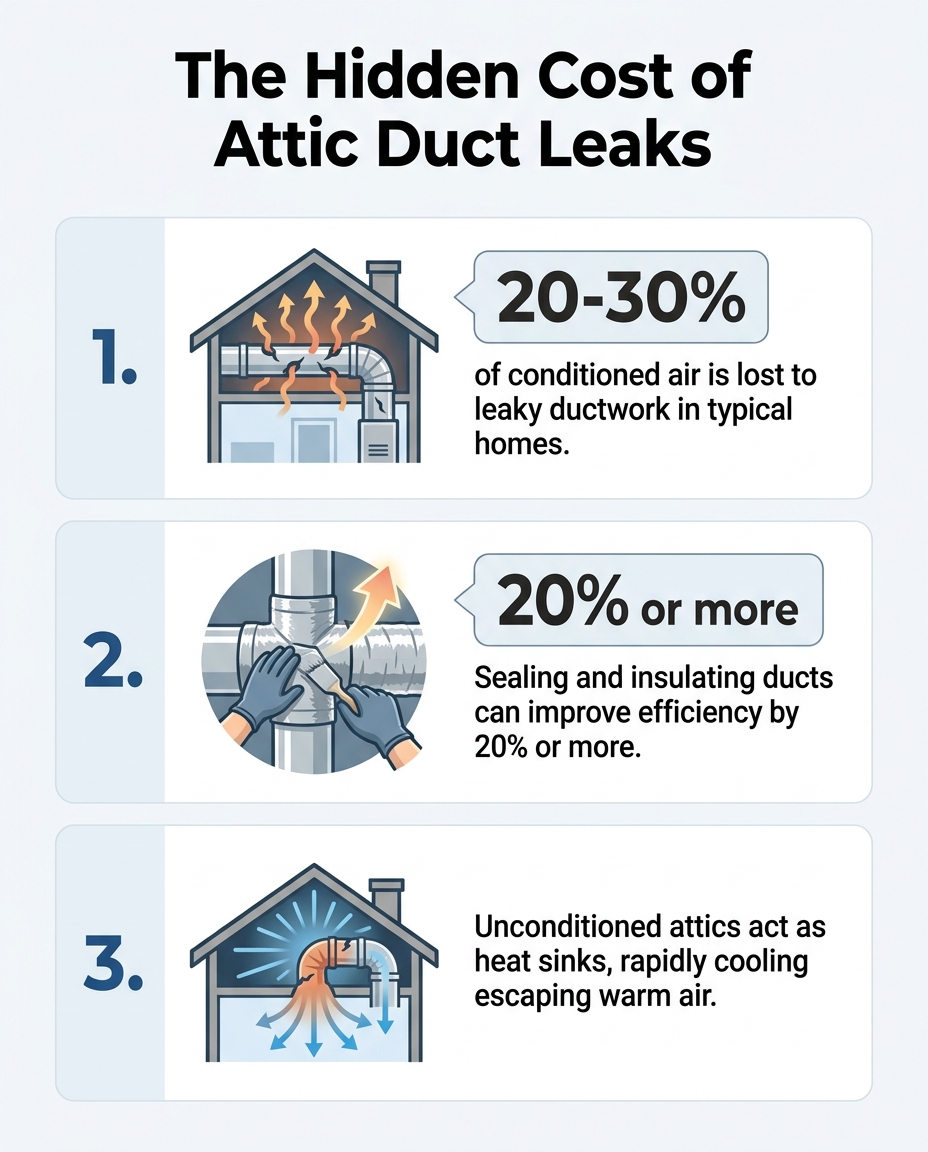
To understand why leaky ducts are so detrimental, you have to look at the environment where they reside. Unconditioned attics act as massive heat sinks during crisp autumn nights in the San Jose and South Bay Area. Because these spaces lack insulation at the roof deck, their temperature drops rapidly as the sun goes down. When your furnace generates hot air and pushes it through a duct system routed through this freezing space, the laws of thermodynamics take over.
Your heating system relies on specific pressure dynamics to move air efficiently. Heated air is forced through the supply ducts under positive pressure. If there are holes, cracks, or disconnected joints in the sheet metal or flex duct, that pressurized warm air takes the path of least resistance—escaping directly into the cold attic. According to ENERGY STAR data, in typical houses, about 20 to 30 percent of the air that moves through the duct system is lost due to leaks, holes, and poorly connected ducts.
This lost heat never reaches your living space. As a result, your furnace has to run significantly longer to satisfy the thermostat setting in your hallway. The longer the system runs, the more energy you consume, and the more wear and tear your equipment endures. Furthermore, when the system eventually cycles off, negative pressure can draw particulates from the attic back into the ductwork, which is why addressing these leaks is a cornerstone of effective indoor air quality solutions.

There is a significant difference between minor pinhole leaks and major duct disconnects, though both will actively sabotage your early-season heating efforts. Minor leaks, often found at the seams where two pieces of metal join, act like small punctures in a tire. They slowly bleed out warm air, reducing the force of the air coming out of your vents. Major disconnects, however, occur when entire sections of ductwork separate completely, often due to poor initial installation, deteriorating tape, or physical disruption in the attic.
When a major disconnect happens, the cascading effect on your home is immediate. The furnace is essentially heating the attic rather than the bedrooms. You might notice that one specific room is freezing while the rest of the house is warm, simply because the duct supplying that room is blowing hot air into the rafters. This severely impacts your overall HVAC system performance, as the disrupted airflow throws the entire system out of balance.
A typical pattern we see involves poorly optimized airflow causing chronic comfort issues. For example, one homeowner reached out when their system and airflow design needed optimization. Certain rooms were never reaching the target temperature. A thorough evaluation revealed that by providing the perfect system and airflow design across multiple zones—and securing the hidden pathways—the home finally achieved consistent, reliable temperatures. Fixing these issues during the September transition and early fall ensures that when you actually need the heat, it arrives exactly where it is supposed to.
Homes in the San Jose and South Bay Area feature a wide variety of architectural styles, from mid-century modern builds to extensive recent remodels. These complex layouts often result in equally complex attic spaces. Vaulted ceilings, tight crawlspaces, and multiple rooflines create significant blind spots for ductwork. When ducts are routed through these tricky areas, they are much more susceptible to hidden damage.
Visual inspections by homeowners often miss structural disconnects because the compromised joints are buried under thick layers of blown-in insulation or tucked away in tight, inaccessible corners. You might look up into the attic hatch and see intact silver tubes, completely unaware that ten feet away, behind a structural beam, a main trunk line has collapsed. Tracing airflow paths without specialized diagnostic tools is nearly impossible for the average person.
This is where deep local expertise becomes invaluable. Precision Heating & Cooling's deep understanding of local San Jose home architectures allows technicians to navigate these specific local layouts efficiently. Professionals know exactly which architectural quirks tend to hide the worst ductwork problems. They use advanced tools like thermal imaging and pressure testing for finding where air is escaping your attic, ensuring no hidden disconnect is left behind to waste your heat.
You do not have to wait for a freezing night to find out your heating system is compromised. During the September transition and early fall, there are several subtle indicators that your ductwork needs attention. Keep an eye out for these common warning signs:
• Uneven room temperatures: If certain bedrooms feel noticeably colder than the rest of the house despite the thermostat setting, the duct supplying that specific room may be leaking or disconnected.
• Excessive dust accumulation: If you find a thick layer of dust on your furniture shortly after cleaning, your return ducts might be pulling dusty attic air into the system and distributing it throughout your home.
• Constant short-cycling: If your heating system turns on and off constantly during mild evening temperature drops, it may be struggling to satisfy the thermostat due to massive heat loss in the attic.
• Strange whistling noises: Unusual whistling, rushing, or hissing air sounds coming from the ceiling or attic space usually indicate highly pressurized air forcing its way through a narrow crack or hole in the ductwork.
• Spikes in energy usage: While harder to spot until the bill arrives, a sudden increase in energy consumption compared to the previous fall is a strong indicator of wasted heating.
Timing is everything when it comes to HVAC preparation. September serves as the critical window for attic work because the temperatures inside the unconditioned space are still safe for technicians to work extensively. By the time summer peaks, attics can reach dangerous temperatures, and by late winter, the space is freezing. The mild daytime conditions of September contrast sharply with the urgent need for heat in late October, making early fall the perfect time to act.
Fixing ductwork now prevents the financial sting of wasted energy once the October chill hits. Waiting until winter can turn a simple fix into a major, stressful overhaul. One homeowner discovered this when their old duct work needed replacement along with their failing furnace and AC during the dead of winter. The crew had to remove the old furnace, relocate it, and replace the duct work and AC unit, modernizing the residential heating and cooling system within two days. While the outcome was successful, handling ductwork evaluations proactively during the September transition and early fall avoids the stress of an emergency mid-winter breakdown.
Proactive duct sealing fits seamlessly into a broader routine maintenance plan. When a technician is already at your home to tune up the furnace, evaluating and sealing the ductwork is a natural next step. Sealing and insulating ducts can improve the efficiency of your heating and cooling system by as much as 20 percent or more, ensuring your equipment runs smoothly all season long.
With the abundance of online tutorials, it can be tempting to grab a roll of tape and head into the attic to fix a disconnected duct yourself. However, duct sealing in unconditioned spaces requires professional materials and expertise to ensure a permanent, safe solution.
Despite its name, standard cloth-backed duct tape is highly ineffective for sealing HVAC ducts. The extreme temperature fluctuations in a San Jose and South Bay Area attic cause the adhesive on standard tape to dry out, turn brittle, and peel away within a matter of months. Professionals use specialized mastic sealant—a thick, gooey substance that hardens into a permanent, flexible bond—along with UL-listed foil tapes designed specifically for extreme temperature variations.
• Standard Duct Tape — Durability in Attics: Poor (Adhesive dries and peels) — Effectiveness on Leaks: Fails quickly under pressure
• Foil HVAC Tape (UL-Listed) — Durability in Attics: Excellent (Reflects heat) — Effectiveness on Leaks: Strong hold for straight seams
• Mastic Sealant — Durability in Attics: Permanent (Hardens and flexes) — Effectiveness on Leaks: Best for joints and irregular gaps
Beyond the materials, there are serious safety risks involved in navigating unconditioned attics. These spaces are filled with exposed joists, hidden electrical wiring, roofing nails, and deep insulation that can easily hide structural hazards. One wrong step can result in a foot through the ceiling drywall—or worse. Furthermore, professionals guarantee the system's static pressure is balanced after sealing. Sealing a major leak changes how air flows through the entire system; if not properly balanced, this can cause the furnace blower motor to overwork and fail prematurely.
A heating system running constantly during mild weather is a strong indicator of severe heat loss. During the September transition and early fall, your furnace should only need to run in short cycles to take the chill out of the air. If it runs non-stop, large portions of your heated air are likely escaping into the attic through disconnected ducts before ever reaching your living space.
Finding a leak requires a combination of visual inspection and specialized diagnostic tools. Technicians look for flattened sections, torn insulation, and disconnected joints hidden in dark corners. They also use tools like thermal imaging cameras and duct blaster tests to measure pressure drops and pinpoint exactly where air is escaping invisibly.
When a duct completely disconnects, the conditioned air dumps directly into the unconditioned attic space. This means the room that duct was supposed to serve will receive zero airflow, making it freezing cold in the winter. Additionally, the negative pressure created can pull dusty, stagnant attic air back into the main system, spreading debris throughout your home.
The energy loss from compromised ductwork is substantial. According to ENERGY STAR, typical homes lose between 20 and 30 percent of the air moving through the duct system due to leaks, holes, and poor connections. This forces your equipment to consume significantly more energy to achieve the temperature set on your thermostat.
Yes, professional sealing yields immediate and measurable results. By using mastic sealant and proper foil tapes, professionals create an airtight seal that standard tape cannot match. Sealing and insulating ducts can improve the efficiency of a heating and cooling system by up to 20 percent or more, resulting in better airflow and consistent room temperatures.
An unconditioned attic is essentially exposed to the outside weather, meaning it gets freezing cold on autumn and winter nights. If your ducts run through this freezing space and have poor insulation or leaks, the attic acts as a heat sink, rapidly cooling the warm air inside the ducts. This forces your furnace to burn more fuel to compensate for the rapid heat loss.
The mild weather of the early fall won't last forever. Preparing your home now ensures that you aren't caught off guard when the evening temperatures in the San Jose and South Bay Area finally plummet. Sealing your ductwork is one of the most effective ways to protect your early-season heating efficiency, ensuring that every bit of warmth your furnace generates actually makes it into your living spaces. Don't wait for a freezing night to discover that you've been heating your attic instead of your home. Take a proactive step today and schedule a professional inspection of your heating services before the October chill forces your system into overdrive. A properly sealed system delivers reliable comfort, improved indoor air quality, and the peace of mind you need heading into the winter months.

Leslie was amazing for her outstanding customer service skills with me the other day. Thanks to her help my air conditioner is now all set up. She answered all my questions and took away all my problems. Leslie broke it down step by step to set it up easier. Now thanks to her my air conditioner is working perfectly. I really appreciate it Leslie and I’ll be sure to ask for you if I ever come back.
I contacted Precision Heating and Cooling for my home's AC repair. They were punctual and very professional. Guillermo was very kind and thorough. I would highly recommend them!
I am writing to express my sincere appreciation for the excellent work performed by Pablo and Alejandro from Precision Heating and Cooling. Their commitment to quality and customer satisfaction is truly commendable. Awesome job guys!
I would like to extend my sincere gratitude to Alejandro for his exceptional hard work. His passion for helping others is evident, and he consistently goes above and beyond in his service. Alejandro's thorough cleaning of my fireplace has truly made a significant difference. His dedication and professionalism are greatly appreciated.
I was very impressed. Came at night (after 9pm) to fix our AC during the middle of a heat wave the day before a national holiday! Technician was very courteous and efficient, got the job done quickly. Will definitely call them again for any AC servicing I need!
Fast and efficient, arrived when scheduled for repairs and replacement parts were ordered and installed quickly. Techs were very friendly and professional. AC system works great now! I highly recommend their services if you need repairs. Tim


.avif)
