


.avif)







Recent Blogs
Stay updated with our latest blog posts.


When you schedule a September pre-heating season tune-up with Precision Heating & Cooling, you expect a quick check, only to find out that a tiny, vital part of your furnace is completely stuck. The sequential steps our technicians take to safely remove a seized thermocouple are what stand between a simple professional repair and a dangerous, expensive system failure. When our team discovers that a thermocouple is severely corroded and fused to the gas valve manifold, the situation requires immediate professional restraint. A thermocouple is a critical safety device that senses the pilot light flame and controls the gas flow; if it is mishandled during removal, the consequences can be disastrous.
For reliable solutions that protect your home, explore our professional HVAC and plumbing services and learn more about our water heater repair and replacement options.
Applying brute force to a stuck gas component is incredibly dangerous. The gas valve manifold is typically made of soft metals like aluminum or brass. If someone attempts to forcefully wrench a seized copper thermocouple out of its housing, the excessive torque will easily crack the manifold. This guide provides a transparent, behind-the-scenes look at the specialized tools and careful, sequential steps our San Jose technicians use to extract a bound thread. By understanding this process, you can see exactly why handling gas appliance components is strictly a job for our licensed professionals, rather than a weekend DIY project.
To understand why a component gets stuck in the first place, you have to look at the science of galvanic corrosion. This chemical reaction occurs when two dissimilar metals—such as the copper of a thermocouple and the aluminum or brass of a gas valve—remain in continuous physical contact while exposed to ambient moisture. Over time, an electrical exchange between the metals causes intense oxidation, effectively welding the threaded connections together. This is a highly common issue our team at Precision Heating & Cooling frequently encounters when servicing older gas furnaces in San Jose neighborhoods that have been in operation for many years.
San Jose's mild climate plays a surprising role in this process. Because our region experiences relatively warm weather for much of the year, older gas furnaces often sit completely unused for six to eight months at a time. This long period of dormancy allows ambient moisture to settle on the metal components, accelerating the galvanic corrosion process without the heat of the furnace to dry the internal cabinet. Early last fall, a local homeowner experienced a complete unit failure; our technicians found that long periods of disuse had locked up critical components, but we were able to get the system up and running safely by applying these exact mechanical principles. The same scientific process also affects gas water heaters, where the municipal water supply and naturally humid environments contribute to similar thread-binding issues.
When a heating system sits idle, the natural defense mechanisms against moisture are paused. Here is what happens inside the cabinet:
• Continuous oxidation: Without regular heat cycling to evaporate condensation, moisture sits on the dissimilar metals, allowing rust and corrosion to build up inside the microscopic grooves of the threads.
• Micro-expansion and contraction: Even while dormant, the system experiences daily temperature fluctuations. The metal expands during the heat of the day and contracts at night, grinding the oxidized particles deeper into the threads and locking them in place.
• Loss of factory lubrication: Any anti-seize compounds applied at the factory degrade over long periods of inactivity, leaving bare metal grinding against bare metal.
There is an exact moment during a service call when our trained technicians know a standard repair has turned into a delicate extraction. As the technician applies initial pressure with a standard wrench, they feel specific tactile feedback—a rigid, unyielding resistance that indicates the threads have fused. During a recent early fall tune-up, one of our lead technicians diagnosed a seemingly minor HVAC issue and fixed it safely, largely because they knew exactly when to stop wrenching and switch to specialized tools, avoiding a major breakdown. Recognizing this resistance is the critical decision point that separates our professional restraint from dangerous DIY brute force.
Gas valve manifolds have strict torque limits established by manufacturers. They are designed to hold low-pressure gas securely, not to withstand heavy mechanical force. When a wrench encounters a seized thread, continuing to apply pressure transfers all that rotational force directly into the soft aluminum body of the valve.
Pushing past the manufacturer's torque limits creates immediate safety hazards for the home. The soft metals in gas valves simply cannot flex; they snap.
• Applying heavy wrench torque — Mechanical Result: Hairline fractures in aluminum body — Safety Consequence: Slow, hard-to-detect gas leaks behind the panel
• Using locking pliers on the nut — Mechanical Result: Crushing the copper capillary tube — Safety Consequence: Debris falls into the gas valve, causing blockages
• Forcing the thread to turn — Mechanical Result: Stripping the internal manifold threads — Safety Consequence: Requires a complete, costly gas valve replacement
Once our technicians identify a seized thermocouple, they immediately shift into a specialized extraction protocol. The very first phase is ensuring the environment is completely safe for invasive mechanical work. Our licensed professionals at Precision Heating & Cooling never skip these preparatory steps.
1. Total power and fuel isolation: The technician begins by shutting off the electrical breaker to the furnace and closing the primary gas shutoff valve located on the exterior pipe. This guarantees no live voltage or active gas pressure is present inside the cabinet.
2. Bleeding residual gas lines: Even with the main valve closed, gas remains trapped in the internal lines. The technician safely bleeds this residual pressure. If you ever notice a faint gas smell when your water heater ignites, it is a reminder of how easily residual gas can accumulate, making professional line bleeding a mandatory safety step.
3. Comprehensive visual inspection: Before applying any chemicals or tools, the technician uses high-intensity lighting and inspection mirrors to examine the back side of the gas valve. They are looking for pre-existing stress cracks or secondary damage that might change the extraction approach.
With the system safely isolated, our technicians move to a chemical approach to break the galvanic bond. Standard household lubricants like WD-40 are highly flammable and largely ineffective on heavy oxidation, making them dangerous and useless near gas appliances. Instead, we use specialized, industrial-grade penetrating solvents designed specifically for HVAC applications.
The role of dwell time: Applying the solvent is only half the process; patience is the other. The technician carefully applies the agent directly to the base of the seized nut and allows a specific "dwell time." This waiting period allows the low-viscosity liquid to seep into the microscopic fissures of the oxidized threads, chemically eating away at the rust without damaging the surrounding brass or aluminum.
Professional solvents work through capillary action, pulling themselves upward against gravity into the tightest spaces of the thread block. As the solvent reaches the fused metals, it breaks down the crystalline structure of the oxidation. This chemical breakdown reduces the friction coefficient of the threads, allowing the next mechanical phase to proceed with significantly less force than would otherwise be required.
After the penetrating agent has done its job, the technician proceeds with the actual mechanical extraction. This is where specialized training truly matters. At Precision Heating & Cooling, our transparent, step-by-step professional process utilizes these specialized tools specifically to protect the unit's manifold from damage, ultimately saving our customers from needing a full, costly replacement.
Instead of using standard crescent wrenches that apply uneven, side-loading pressure, our technicians deploy specialized micro-extractors and balanced thread tools. These tools are designed to grip the stripped or seized copper nut perfectly on center. By applying perfectly vertical, balanced rotational force, the tool turns the seized component without pushing sideways against the fragile aluminum manifold walls.
The millimeter-by-millimeter technique: The extraction is not a single continuous twist. The technician uses a "rocking" method—turning the tool a fraction of a millimeter counter-clockwise, then slightly clockwise, over and over. This careful technique breaks the remaining rust free bit by bit, clearing the debris out of the thread path so it does not bind up and strip the internal grooves as the nut backs out.
Successfully removing the seized component is a victory, but the job is not finished. The internal threads of the gas valve must be prepared to receive the new part securely.
1. Chasing the internal threads: The technician uses a specialized thread-chasing tap to clean out the internal grooves of the gas valve. This removes any leftover rust flakes or solvent residue, ensuring the new thermocouple will seat perfectly without cross-threading.
2. Installing the new component: The new copper thermocouple is hand-threaded into place, then tightened to the exact torque specifications outlined by the manufacturer. This precise tension ensures a proper seal without risking future thread binding.
3. Restoring system power: The technician reopens the gas supply and restores electrical power, preparing the system for its final, crucial safety tests.
Before leaving your home, our technician performs rigorous testing to verify the system is safe. They apply a specialized liquid leak detector over the newly installed connections, watching closely for the formation of bubbles that would indicate a micro-leak. Next, they use a multimeter to measure the millivolt output of the new thermocouple while the pilot is lit, ensuring it is generating the exact electrical current required to keep the main gas valve safely open. Keeping up with routine preventative maintenance is the best way to ensure these components are checked regularly before they have a chance to seize.
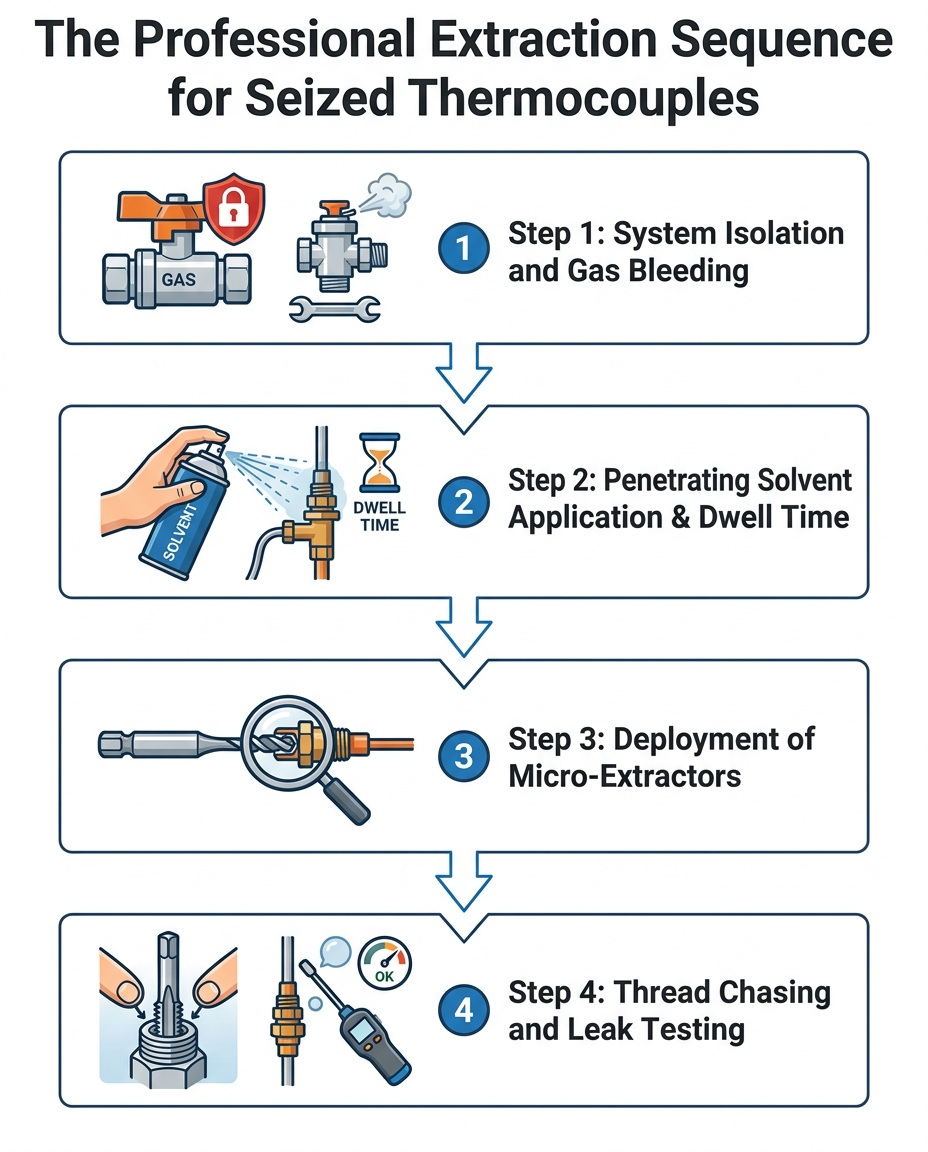

A stuck thermocouple is removed using professional penetrating solvents and specialized micro-extraction tools. Licensed technicians begin by isolating the gas supply and applying a chemical agent to dissolve the internal rust. After allowing the solvent to dwell, they use balanced extraction tools to carefully back the seized nut out without cracking the surrounding gas valve manifold. Brute force with standard wrenches should never be used.
If a thermocouple breaks off inside the gas valve, the entire manifold is compromised and usually requires a complete replacement. The broken copper pieces block the threading, making it impossible to install a new safety sensor securely. Furthermore, the force required to break the component often causes hairline fractures in the soft aluminum of the valve, leading to dangerous, hidden gas leaks.
Replacing a thermocouple is not recommended as a DIY project due to the significant safety risks involving natural gas lines. While the part itself is small, installing it incorrectly or cross-threading the connection can result in highly dangerous gas leaks or carbon monoxide exposure. A licensed professional ensures the component is torqued to manufacturer specifications and thoroughly leak-tested before the system is turned back on.
Your thermocouple likely won't unscrew because it has suffered from galvanic corrosion, a process where dissimilar metals fuse together over time. When the copper thermocouple sits tightly against the aluminum or brass gas valve in a humid environment, oxidation acts like a permanent glue. Long periods of system dormancy, particularly in mild climates like San Jose's, accelerate this binding process.
Gas valve manifolds require very specific, low-torque applications, usually outlined strictly in the manufacturer's engineering guidelines. These soft metal housings are designed to hold low-pressure gas, not to withstand heavy mechanical wrenching. Exceeding these exact limits easily strips the internal threads or cracks the valve body, destroying the equipment.
The most common sign of a failing thermocouple is a pilot light that repeatedly goes out or refuses to stay lit after you release the gas control knob. You may also notice the furnace struggling to cycle on, or the pilot flame appearing weak and yellow instead of a strong, sharp blue. If you experience these symptoms, it indicates the sensor is no longer generating enough millivolts to keep the main gas valve safely open.
While discovering a seized thermocouple during a routine inspection is a frustrating setback, the right professional techniques prevent it from becoming a catastrophic system failure. The sequential steps our technicians take to safely remove a seized thermocouple ensure that your gas valve manifold remains intact, protecting both your equipment and your home from dangerous leaks. Specialized tools and expert restraint always outperform brute force when it comes to delicate gas appliances. To ensure your system operates safely and efficiently all season long, schedule a service call with our qualified team at Precision Heating & Cooling today.

Leslie was amazing for her outstanding customer service skills with me the other day. Thanks to her help my air conditioner is now all set up. She answered all my questions and took away all my problems. Leslie broke it down step by step to set it up easier. Now thanks to her my air conditioner is working perfectly. I really appreciate it Leslie and I’ll be sure to ask for you if I ever come back.
I contacted Precision Heating and Cooling for my home's AC repair. They were punctual and very professional. Guillermo was very kind and thorough. I would highly recommend them!
I am writing to express my sincere appreciation for the excellent work performed by Pablo and Alejandro from Precision Heating and Cooling. Their commitment to quality and customer satisfaction is truly commendable. Awesome job guys!
I would like to extend my sincere gratitude to Alejandro for his exceptional hard work. His passion for helping others is evident, and he consistently goes above and beyond in his service. Alejandro's thorough cleaning of my fireplace has truly made a significant difference. His dedication and professionalism are greatly appreciated.
I was very impressed. Came at night (after 9pm) to fix our AC during the middle of a heat wave the day before a national holiday! Technician was very courteous and efficient, got the job done quickly. Will definitely call them again for any AC servicing I need!
Fast and efficient, arrived when scheduled for repairs and replacement parts were ordered and installed quickly. Techs were very friendly and professional. AC system works great now! I highly recommend their services if you need repairs. Tim


.avif)
