


.avif)






Recent Blogs
Stay updated with our latest blog posts.


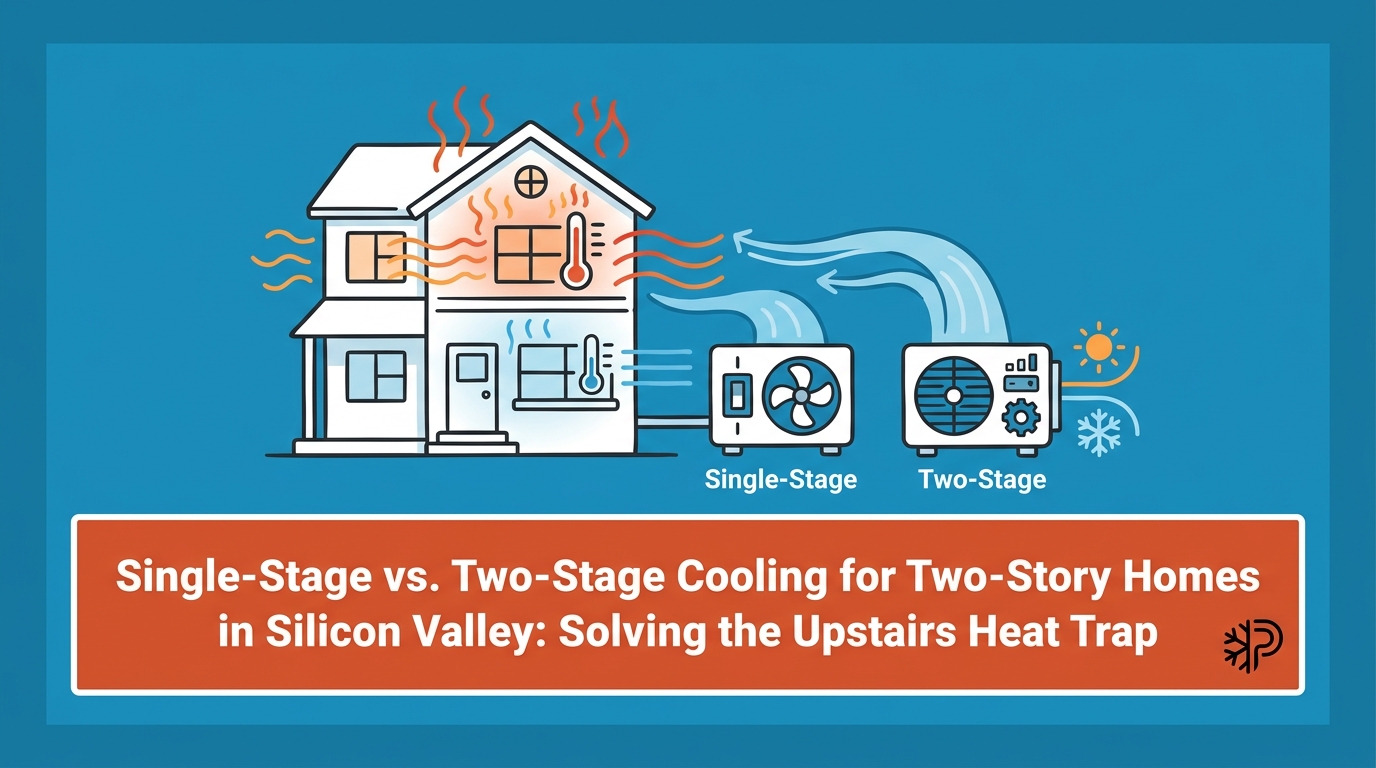
At Precision Heating & Cooling, a common misconception we see among homeowners is that installing a massive, oversized air conditioner will finally push cold air into those sweltering second-floor rooms, but when evaluating Single-Stage vs. Two-Stage Cooling for Two-Story Homes in Silicon Valley, our team quickly helps them learn that raw power is rarely the answer. Closing vents in unused rooms or buying a larger unit doesn't solve the underlying airflow issues—it actually makes your system work harder and fail faster. The concrete problem remains the same: the downstairs living room turns into a freezing icebox while the upstairs bedrooms remain uncomfortably hot, especially during the intense August late-summer heat.
This stark temperature disparity leaves many homeowners at a critical decision point when replacing an aging system. You have to determine whether a two-stage compressor is a necessary upgrade over a standard single-stage replacement to finally achieve even temperatures across multiple floors. We always tell our clients that the core issue is not a lack of cold air, but rather a lack of sustained air circulation physics required to move that air against gravity. If you are tired of sweating through the night before the kids head back to school, exploring modern HVAC solutions is the first step toward balancing your home's temperature and securing lasting comfort.
To understand why the second floor of your home always feels warmer, you have to look at the environmental and architectural realities of multi-level properties. Over our many years of local experience at Precision Heating & Cooling diagnosing airflow issues in specific regional housing styles, we have seen firsthand that overcoming these physical realities requires sustained air pressure, not just a blast of freezing temperatures.
1. The Stack Effect: Warm air naturally rises. In a sealed home enclosure, the ambient heat generated by appliances, bodies, and sunlight pushes upward, pooling in the highest points of your house.
2. Thermal Roof Gain: The intense, dry solar radiation in Silicon Valley beats down on your roof all day. This continuous exposure maximizes thermal gain in upper bedrooms, essentially baking the second floor from the top down.
3. Ductwork Distance: Central air units are usually located on the ground floor or side yard. Pushing conditioned air all the way up to the furthest second-story vents requires navigating long, winding duct runs.
4. Friction and Pressure Loss: Every turn, bend, and vertical climb in your ductwork creates friction. By the time the air reaches the upstairs master suite, the velocity has naturally dropped.
Thermal dynamics at play: The stack effect is a continuous cycle of rising heat. As cooler air settles on the ground floor, it displaces the warmer air, forcing it upstairs. Because the thermostat is almost always located on the first floor, our technicians often find it registers a false sense of overall home comfort. The sensor reads a pleasant 72 degrees downstairs and tells the system to shut off, completely ignoring the 82-degree heat trap accumulating in the bedrooms directly above.
Overcoming gravity: Pushing air vertically is physically demanding for any blower motor. San Jose and Silicon Valley two-story homes often feature complex duct layouts that snake through walls and between joists. This structural reality means that air velocity drops significantly before reaching the furthest upstairs vents. To push through this resistance, we've found the system needs to maintain steady, prolonged static pressure rather than short, aggressive bursts of air.
The Problem: When our team inspects struggling systems, we note that standard single-stage air conditioners are built with a very simple operational logic. They have one speed: 100 percent capacity. When the downstairs thermostat detects that the room has crossed the set temperature, the single-stage unit kicks on at full blast. It pumps a massive volume of freezing air into the home as quickly as possible.
The Cause: Because the thermostat is on the first floor, it gets satisfied very quickly by this intense "blast effect." The downstairs cools down in just ten or fifteen minutes, prompting the thermostat to shut the entire system down. This short, intense cycle fails to sustain enough pressure in the ductwork to force the cold air all the way up to the second floor. Furthermore, when our customers try to compensate for upstairs heat by installing an oversized single-stage unit, we notice it only worsens the problem. An oversized unit cools the downstairs even faster, leading to a phenomenon known as short cycling, where the system turns on and off rapidly without ever completing a full circulation cycle.
The Solution: Single-stage units ultimately leave stagnant, unmixed air in the upper levels of San Jose and Silicon Valley two-story homes once the cycle ends. To solve this, the home requires a system that runs long enough to physically push the conditioned air up the vertical duct runs and displace the trapped heat. This is exactly where our experts recommend advanced compressor staging.
We consistently recommend a two-stage compressor because it fundamentally changes how your home handles the August late-summer heat. Instead of operating solely at 100 percent capacity, a two-stage unit has a lower, energy-efficient gear. It runs at roughly 65 to 70 percent capacity for the vast majority of the time. This lower speed is the secret to solving the upstairs heat trap.
Sustained static pressure: By running at a lower capacity, the system operates for much longer cycles—often 30 to 45 minutes instead of 10. In our experience, this extended run time allows the blower motor to maintain steady static pressure inside the ductwork. Because the system isn't blasting the downstairs with freezing air all at once, the first-floor thermostat doesn't shut the system off prematurely. This gives the cold air the time and pressure it needs to travel all the way up the vertical duct runs and out of the second-story vents.
Breaking up stagnant heat: The primary benefit for two-story homes is continuous air mixing. Longer run cycles constantly cycle the air throughout the entire house, breaking up the stagnant heat pockets in upper bedrooms. The system acts like a giant whisk, blending the warm upstairs air with the cool downstairs air until the temperature differential between the floors is evened out. The second stage—the full 100 percent capacity—only kicks in automatically during extreme temperature spikes when the lower gear needs a temporary boost.
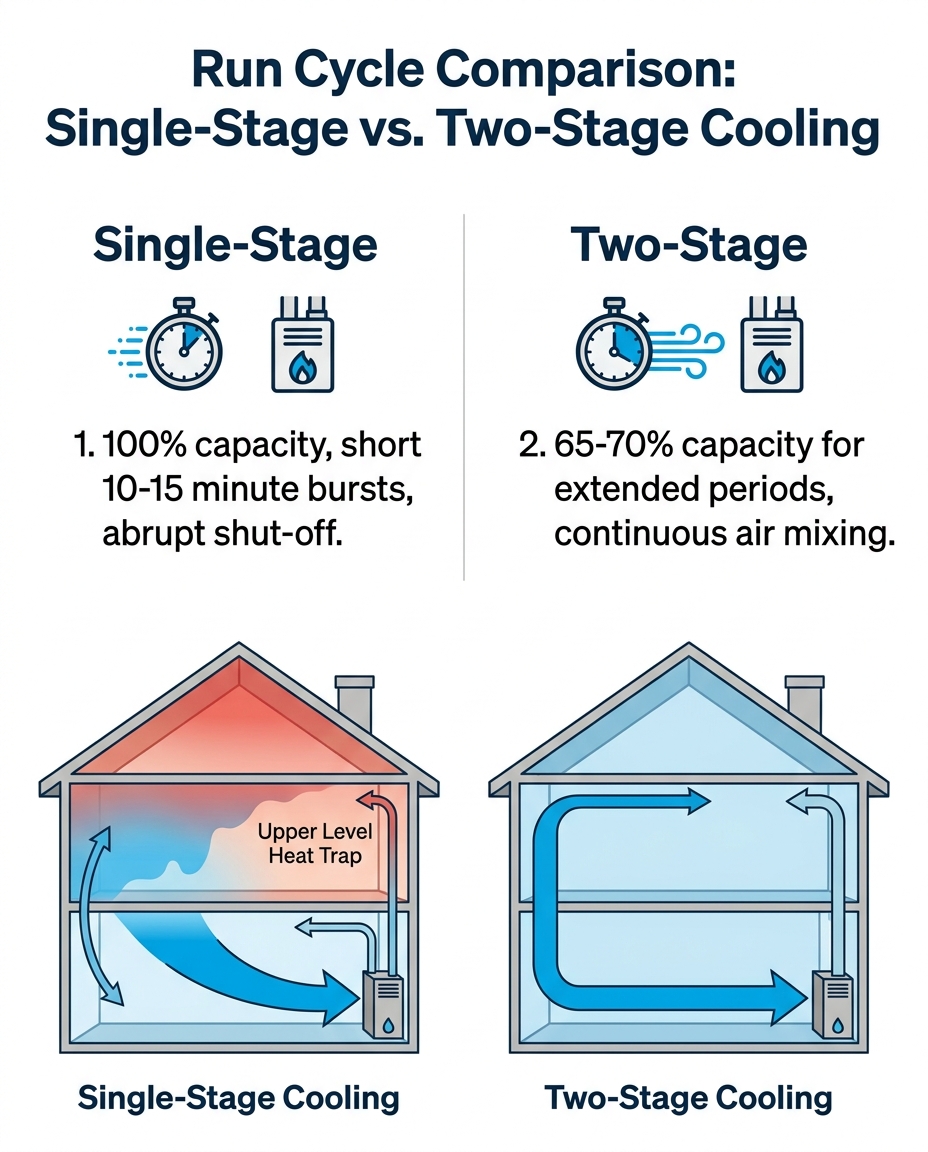

When we walk our Silicon Valley customers through an informed upgrade decision, we look at how these two technologies perform under the specific demands of multi-level architecture. When comparing the two, the differences in run cycle lengths, temperature consistency, and long-term wear become glaringly apparent in San Jose and Silicon Valley two-story homes.
• Run Cycle Length — Single-Stage Cooling: Short, intense blasts (10-15 minutes). — Two-Stage Cooling: Long, sustained circulation (30-45+ minutes).
• Temperature Consistency — Single-Stage Cooling: High disparity; cold downstairs, hot upstairs. — Two-Stage Cooling: Even temperatures across multiple floors.
• Energy Consumption — Single-Stage Cooling: High power draw from constant stopping and starting. — Two-Stage Cooling: Lower, steady energy draw during the 70% capacity stage.
• System Wear-and-Tear — Single-Stage Cooling: Increased strain on the compressor from frequent on/off cycling. — Two-Stage Cooling: Reduced mechanical stress due to fewer start-up sequences.
• Air Filtration — Single-Stage Cooling: Minimal; air is only filtered during short cycles. — Two-Stage Cooling: Maximum; air passes through the filter continuously for longer periods.
The analytical takeaway: While single-stage units are standard, our technicians see firsthand how their frequent on/off cycling creates significant wear-and-tear on the compressor. Every time a heavy motor starts up, it draws a massive surge of electricity and puts mechanical stress on the components. Two-stage systems avoid this by starting up less often and running at a gentle, sustained pace, which also allows your home's air filter to capture more dust and allergens due to the increased circulation time.
While a two-stage compressor is highly effective, our installation crews encounter scenarios where centralized ductwork is severely compromised or simply insufficient by design. Poorly designed legacy ductwork, uninsulated attic runs, or recent home additions can create bottlenecks that even the best compressor cannot push through.
Sometimes, the foundational issue isn't the compressor staging but the controls themselves. One San Jose homeowner reached out this past spring when their thermostat was completely non-functioning, preventing their furnace from turning on at all. After their utility provider identified the issue, Guillermo from our team responded and quickly replaced the thermostat so the system could operate. Proper controls are the brain of your HVAC system, and without them, no amount of cooling power will help.
For homes with stubborn upstairs master suites or converted garages, ductless cooling options offer a targeted solution. Ductless mini-splits bypass the central ductwork entirely, delivering precise, localized cooling directly to the room that needs it most. Additionally, modern heat pump systems serve as an energy-efficient, versatile upgrade path. Most high-end heat pumps feature variable or multi-stage compressors natively, providing both heating and cooling while seamlessly addressing the temperature disparities in San Jose and Silicon Valley two-story homes. Always rely on a professional load calculation from our team before choosing a supplemental alternative to ensure the new equipment matches your home's exact thermal profile.
If you research two-stage cooling online, you will likely find national HVAC resources highlighting these systems for their incredible dehumidification capabilities. While that is a major selling point in the humid Gulf Coast or the Midwest, our team knows that standard HVAC advice doesn't perfectly align with our local climate realities.
Sensible heat vs. latent heat: In the dry heat of the Silicon Valley climate, latent heat (humidity) removal is a secondary concern. Our late-summer air is typically very dry, especially as we approach the back-to-school transition. Therefore, the true value of two-stage cooling locally is pure air distribution and overcoming sensible heat gain (actual temperature increases).
During extreme mid-summer dry heatwaves, the sun relentlessly bakes your roof. This is exactly why AC units struggle during mid-July heatwaves and into August. A single-stage unit simply cannot push enough air upstairs to fight off that radiant heat. A two-stage unit, however, acts as a continuous shield, constantly moving the air to prevent that top-down heat from settling into your bedrooms. By focusing on air mixing rather than just moisture removal, we find two-stage systems directly combat the specific environmental challenges of the August late-summer heat.
Yes, at Precision Heating & Cooling, we generally consider a two-stage AC to be one of the best investments for a multi-level home. Because it runs at a lower capacity for longer periods, it continuously pushes conditioned air up to the second floor, eliminating hot spots. This steady operation also reduces energy spikes and lessens the mechanical wear-and-tear on the system over time. For San Jose and Silicon Valley two-story homes, it directly solves the problem of freezing ground floors and sweltering upstairs bedrooms.
Your upstairs is hotter due to a combination of the stack effect and thermal roof gain. Warm air naturally rises, displacing cooler air and pooling on the second floor of your home. Additionally, your roof absorbs intense solar radiation throughout the day, radiating that heat directly down into your upper bedrooms. Standard air conditioners often shut off once the downstairs thermostat reaches the set temperature, leaving that trapped heat upstairs untouched.
A two-stage AC does not run constantly, but it does run for much longer cycles than a single-stage unit. It typically operates at about 65 to 70 percent capacity for 30 to 45 minutes at a time. We assure our customers that this longer run cycle is completely normal and is actually by design; it uses less energy to maintain a steady temperature than it does to constantly stop and start at 100 percent power.
The primary difference lies in the compressor's operating speeds. A single-stage AC has only one speed: 100 percent capacity, meaning it is either fully on or fully off. A two-stage AC has a lower gear (usually around 70 percent capacity) for mild days and continuous air mixing, and a high gear (100 percent capacity) that automatically kicks in during extreme temperature spikes to quickly cool the home.
No, installing a larger single-stage AC will usually make the problem worse. As we frequently explain to homeowners, an oversized unit will cool the first floor incredibly fast, satisfying the downstairs thermostat and shutting the system down before the cold air ever has a chance to reach the second floor. This leads to short cycling, which increases humidity, spikes energy bills, and leaves your upstairs bedrooms just as hot as before.
The stack effect forces your cooling system to fight against natural thermal dynamics. As heat rises to the upper levels, it creates a significant temperature disparity between floors. If your system cannot maintain enough static pressure to push cold air up and displace that rising heat, your AC will run inefficiently, wasting energy cooling the downstairs while failing to condition the rest of the home.
As we've seen on countless service calls at Precision Heating & Cooling, achieving true comfort in a multi-level home requires the right technology, not just a bigger unit. As we've explored, the physics of air stratification mean that single-stage systems will always struggle to push cold air upstairs before the downstairs thermostat shuts them off. By upgrading to a system designed for continuous air mixing, you can finally eliminate the upstairs heat trap. Stop suffering through the August late-summer heat with a system that only does half the job. Reach out to our team today to schedule an assessment for an air conditioning system upgrade, and let us provide a clear, technically accurate solution that ensures every room in your home stays perfectly comfortable.

Leslie was amazing for her outstanding customer service skills with me the other day. Thanks to her help my air conditioner is now all set up. She answered all my questions and took away all my problems. Leslie broke it down step by step to set it up easier. Now thanks to her my air conditioner is working perfectly. I really appreciate it Leslie and I’ll be sure to ask for you if I ever come back.
I contacted Precision Heating and Cooling for my home's AC repair. They were punctual and very professional. Guillermo was very kind and thorough. I would highly recommend them!
I am writing to express my sincere appreciation for the excellent work performed by Pablo and Alejandro from Precision Heating and Cooling. Their commitment to quality and customer satisfaction is truly commendable. Awesome job guys!
I would like to extend my sincere gratitude to Alejandro for his exceptional hard work. His passion for helping others is evident, and he consistently goes above and beyond in his service. Alejandro's thorough cleaning of my fireplace has truly made a significant difference. His dedication and professionalism are greatly appreciated.
I was very impressed. Came at night (after 9pm) to fix our AC during the middle of a heat wave the day before a national holiday! Technician was very courteous and efficient, got the job done quickly. Will definitely call them again for any AC servicing I need!
Fast and efficient, arrived when scheduled for repairs and replacement parts were ordered and installed quickly. Techs were very friendly and professional. AC system works great now! I highly recommend their services if you need repairs. Tim


.avif)
