


.avif)






Recent Blogs
Stay updated with our latest blog posts.


If you are sizing a hot water tank for San Jose's typical mid-century modern homes, you might quickly discover a frustrating reality: modern replacement units simply will not fit inside your original utility closet. Your aging water heater might be showing signs of failure—rumbling noises, inconsistent temperatures, or small puddles forming at the base—but swapping it out is no longer a simple one-to-one exchange. For homeowners living in San Jose South Bay Eichler homes, the architectural beauty of the 1950s and 1960s comes with the hidden challenge of highly constrained mechanical spaces.
Standard sizing charts fail these unique properties because they focus entirely on gallon capacity while ignoring physical footprint limits. A chart might tell you that a 50-gallon tank is perfect for your family size, but it will not warn you that the new tank cannot physically squeeze through your utility door. As you map out your September fall-prep before the colder months arrive, addressing this sizing dilemma becomes urgent. You are faced with a crucial decision point: do you hunt for a specialized compact tank, invest in a tankless retrofit, or reconfigure your utility space altogether?
For professional guidance on navigating these spatial challenges, explore our water heater installation and replacement solutions tailored for older homes.
To understand why your current utility closet is suddenly too small, you have to look at how appliance manufacturing has changed over the last decade. The Department of Energy implemented strict National Appliance Energy Conservation Act (NAECA) standards to improve the energy efficiency of residential water heaters. While these regulations successfully lower utility bills and reduce standby heat loss, they also drastically changed the physical shape of standard hot water tanks.
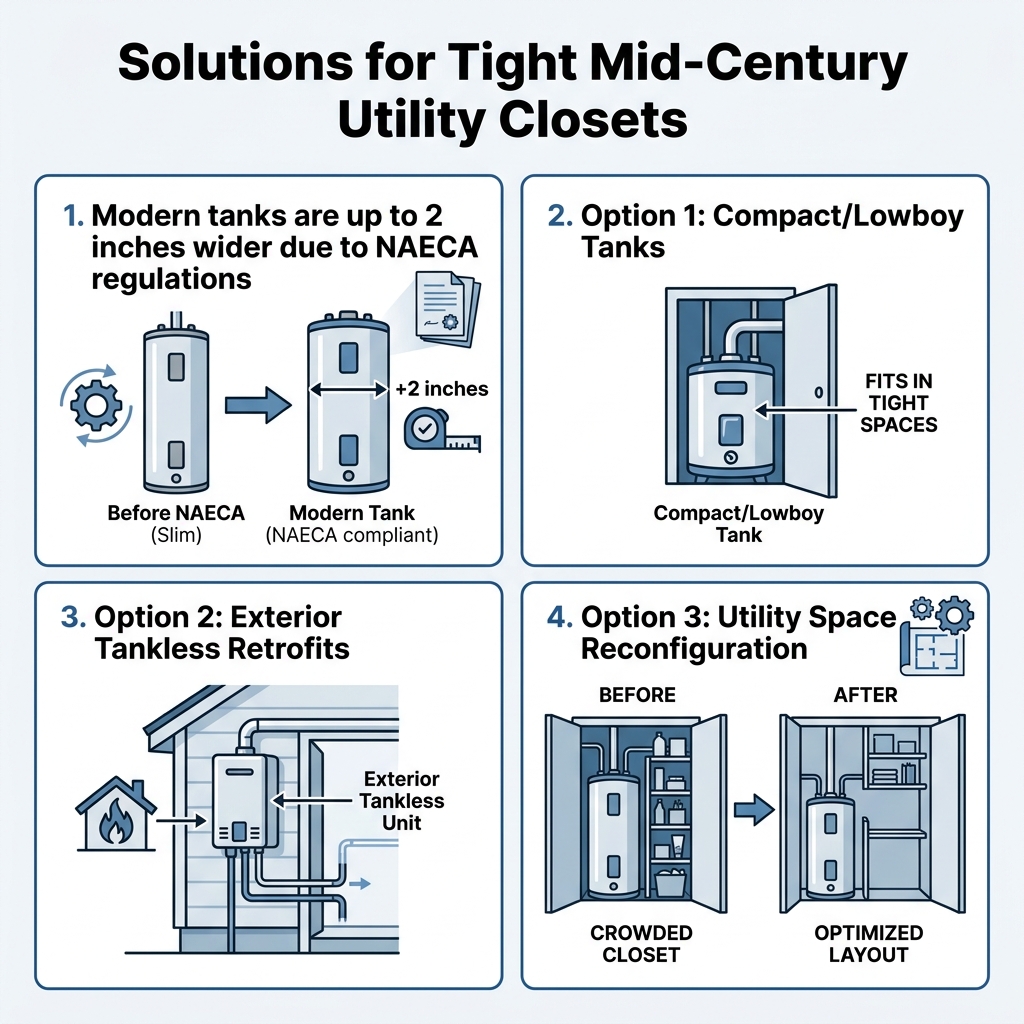
To meet the new NAECA efficiency mandates, manufacturers had to add significantly more insulation to the walls of standard water heaters. This extra layer of foam insulation makes modern tanks up to two inches wider and two inches taller than older models of the exact same gallon capacity. A 40-gallon tank installed twenty years ago fit perfectly into a tight corner of a San Jose South Bay Eichler home. Today, a new 40-gallon tank might be too wide to pass through the closet door frame, let alone leave enough room for proper safety clearances.
When sizing a new system, you must measure physical dimensions just as carefully as you calculate your household's hot water demand. You cannot rely on the old unit's footprint as a guide. If you attempt to force a modern standard tank into a 1960s utility closet, you risk damaging the appliance, violating building codes, and creating a serious fire hazard. This is why securing comprehensive HVAC and plumbing services is critical; a licensed professional will evaluate your first-hour rating requirements alongside the hard tape-measure limits of your home's architecture.
• Insulation Thickness — Pre-2015 Standard Tanks: Minimal (often 1 inch or less) — Modern NAECA-Compliant Tanks: Enhanced (up to 2-3 inches thick)
• Overall Width — Pre-2015 Standard Tanks: Narrow profile designed for tight fits — Modern NAECA-Compliant Tanks: Up to 2 inches wider than older models
• Overall Height — Pre-2015 Standard Tanks: Standard height — Modern NAECA-Compliant Tanks: Up to 2 inches taller, impacting top clearance
• Closet Compatibility — Pre-2015 Standard Tanks: Easily fits original 1950s footprints — Modern NAECA-Compliant Tanks: Often requires door frame or closet modification
The problem: Many San Jose South Bay Eichler homes were constructed with innovative radiant floor heating systems embedded directly into the concrete slab. While these systems provide comfortable, even heat during the winter, they often complicate the water heater replacement process. In many of these original configurations, the domestic hot water supply and the radiant heating system are closely integrated, drawing from the same heat source or sharing tight mechanical quarters.
The cause: These integrated systems place dual demands on your water heating equipment. The unit must generate enough hot water for your morning showers and dishwashing while simultaneously supplying enough thermal energy to warm the concrete slab of your entire home. When standard standard tanks grew in size due to NAECA regulations, homeowners suddenly found that the high-capacity units required to run both systems no longer fit in the original boiler room or utility closet.
The solution: Upgrading this equipment requires meticulous sizing to ensure both domestic hot water and home heating needs are met without overloading the unit. There is a real danger in undersizing your equipment just to make it fit physically into the existing closet. If you install a smaller capacity tank simply because it clears the door frame, your radiant floors will struggle to heat the home, and you will quickly run out of hot water at the tap. A professional assessment separates the BTU requirements of the floor heating from the domestic hot water demand, often leading to a dual-system approach or high-output compact solutions that satisfy both needs safely.
Replacing a gas appliance in a constrained space is not just a matter of physical geometry; it is a matter of strict legal compliance and safety. San Jose local building codes dictate specific physical clearance requirements around gas-fired water heaters to prevent fire hazards and ensure technicians can safely access the unit for future maintenance. You cannot simply wedge a tank against the drywall.
Code requirements generally mandate a specific number of inches of clearance between the water heater and any combustible materials, including wooden studs, drywall, and closet doors. Additionally, there must be adequate working space (typically 30 inches) in front of the unit's controls. In a tight mid-century utility closet, a tank that is two inches wider can easily violate these clearance codes, rendering the installation illegal and unsafe.
Older 1960s tanks often relied on natural draft flues, pulling ambient air from the leaky utility closet for combustion. Modern high-efficiency units operate differently. They require dedicated combustion air intake and specialized PVC venting to exhaust cooler, acidic gases safely outdoors. Tightly sealed, constrained utility closets often lack the volume of air required to support a modern gas appliance safely. If a unit is starved for air, it can produce dangerous levels of carbon monoxide. Professional installation is absolutely required to ensure proper venting, adequate combustion air, and strict adherence to municipal safety codes, completely ruling out any DIY approaches for this level of retrofit.
When the tape measure confirms that a standard modern tank will not fit, you still have excellent options. Addressing footprint constraints usually comes down to three primary strategies, each impacting your upfront planning and long-term energy efficiency.
1. Install Compact or Lowboy Tanks: Manufacturers produce specialized shorter, wider tanks known as "lowboys." These are designed specifically for low-clearance areas like under staircases or inside tight closets. While they solve vertical height constraints, you must still verify that the wider diameter meets the horizontal clearance codes of your closet space.
2. Transition to Exterior Tankless Retrofits: Moving the heating unit completely outside the home is often the most effective solution. San Jose's moderate climate is a major advantage here, as it safely allows for exterior tankless installations that completely bypass indoor spatial constraints without the risk of deep freezes. Tankless units provide continuous hot water and free up valuable square footage inside your home.
3. Execute Utility Space Reconfiguration: If you prefer to stick with a traditional tank system, safely adapting or expanding the existing closet footprint may be necessary. This involves moving non-load-bearing walls or widening door frames to accommodate modern standard tanks while maintaining legal safety clearances.
By exploring these options, you can find a path forward for retrofitting older San Jose homes for modern hot water tanks that balances capacity needs with spatial reality.

One of the greatest concerns for owners of mid-century properties is maintaining the clean lines and original design intent of their architecture. A mechanical upgrade should never destroy the aesthetic value of your home. Our team has deep local expertise in retrofitting Silicon Valley mid-century properties, ensuring that essential heating and plumbing upgrades respect the home's architectural heritage.
Strategic Equipment Relocation: When the central utility closet is no longer viable, professional teams can relocate equipment entirely. Moving units to the attic, the garage, or the exterior walls modernizes the home's heating and cooling capabilities without cluttering the living space. This process involves safely rerouting plumbing lines, gas pipes, and venting systems to support the new location, requiring significant technical skill to hide the infrastructure within the existing framework.
One local homeowner reached out last fall when their aging system required a complete overhaul. The original setup was failing, and the tight spatial constraints made a standard swap impossible. Our team carefully removed and relocated the old furnace to the attic, replaced the aging ductwork, and installed a new AC unit within two days. The heating and cooling system was completely modernized, solving the footprint issue while preserving the home's original aesthetic.
Major retrofits are an investment in your property's longevity. To help secure your home's value and safety without compromising its design, we offer flexible financing options that make comprehensive mechanical upgrades more accessible.
Timing is everything when dealing with complex mechanical retrofits. Discovering a sizing or footprint issue during an emergency winter breakdown is the worst-case scenario. When your heater fails on a freezing January night, your options are severely limited. You are forced into rushed decisions, often settling for whatever equipment is currently sitting on a supplier's shelf, rather than the unit that best fits your home's unique architecture.
The Advantage of September Fall-Prep: Early fall assessments allow you the luxury of time. If your utility closet requires a specialized lowboy tank, time permits you to custom-order the exact model you need. If you decide that an exterior tankless retrofit is the best path forward, fall weather provides ideal conditions for a complex installation before the winter rains arrive.
Proactive Protection: Proactive inspections do more than just plan for the future; they identify failing tanks before they rupture. A leaking water heater can cause devastating water damage to original mid-century flooring and baseboards. By scheduling an assessment now, you protect the structural integrity of your home. We highly recommend establishing a routine schedule through a preventative maintenance plan to keep older, integrated systems running smoothly and to catch footprint-related upgrade needs long before they become emergencies.
In most Eichler homes, the water heater is usually found in a central utility closet located near the kitchen or a main hallway. Because these homes prioritize open floor plans, mechanical spaces were built as compactly as possible. The water heater often shares this very tight space with the home's original boiler or furnace, making modern equipment upgrades highly constrained.
Fitting a modern unit into an old closet often requires utilizing lowboy or compact tanks designed specifically for restricted spaces, or switching entirely to a wall-mounted tankless system. The process begins with careful measurement of the door frames and internal clearances to ensure the new, thicker-insulated tanks can pass through. If standard units fail to fit, modifying the doorframe or relocating the unit are the safest alternatives.
Yes, tankless water heaters are highly recommended for mid-century homes because they save a tremendous amount of interior space. By mounting the unit on a wall—often on the exterior of the house—you completely bypass the tight utility closet constraints. However, this retrofit may require upgrading your home's gas line to handle the higher BTU demand that a tankless unit draws when heating water on demand.
Local building codes require specific inches of clearance between the water heater and any combustible materials, including the closet walls and doors. Proper ventilation and combustion air intake must also be maintained per local San Jose regulations to prevent fire hazards and carbon monoxide buildup. A licensed professional must verify that the installation meets all municipal safety codes before the unit is fired up.
The right size depends entirely on the specific closet dimensions rather than just the gallon capacity your family needs. Because modern tanks are wider due to enhanced insulation, a 40-gallon tank today has a larger footprint than a 40-gallon tank from twenty years ago. A professional assessment is required to match your physical footprint limits with your household's daily hot water demand.
Standard sizing charts simply are not enough for San Jose South Bay Eichler homes. When you are dealing with the rigid footprint constraints of mid-century architecture, relying on gallon capacity alone will leave you with an appliance that physically cannot be installed safely. Upgrading your system requires a careful balance between meeting your family's hot water needs, supporting potential radiant heating demands, and adhering strictly to local clearance codes.
There is immense peace of mind that comes from a perfectly sized, code-compliant installation. You do not have to compromise the beauty of your home or risk safety hazards to enjoy reliable hot water. We encourage you to consult with local experts who understand the unique architecture of your property and can design a retrofit solution that fits flawlessly.

Leslie was amazing for her outstanding customer service skills with me the other day. Thanks to her help my air conditioner is now all set up. She answered all my questions and took away all my problems. Leslie broke it down step by step to set it up easier. Now thanks to her my air conditioner is working perfectly. I really appreciate it Leslie and I’ll be sure to ask for you if I ever come back.
I contacted Precision Heating and Cooling for my home's AC repair. They were punctual and very professional. Guillermo was very kind and thorough. I would highly recommend them!
I am writing to express my sincere appreciation for the excellent work performed by Pablo and Alejandro from Precision Heating and Cooling. Their commitment to quality and customer satisfaction is truly commendable. Awesome job guys!
I would like to extend my sincere gratitude to Alejandro for his exceptional hard work. His passion for helping others is evident, and he consistently goes above and beyond in his service. Alejandro's thorough cleaning of my fireplace has truly made a significant difference. His dedication and professionalism are greatly appreciated.
I was very impressed. Came at night (after 9pm) to fix our AC during the middle of a heat wave the day before a national holiday! Technician was very courteous and efficient, got the job done quickly. Will definitely call them again for any AC servicing I need!
Fast and efficient, arrived when scheduled for repairs and replacement parts were ordered and installed quickly. Techs were very friendly and professional. AC system works great now! I highly recommend their services if you need repairs. Tim


.avif)
