


.avif)






Recent Blogs
Stay updated with our latest blog posts.


Upgrading to a tankless system means you will never run out of hot water again—or so the common myth goes. When evaluating tankless vs. traditional hot water tanks for large families in San Jose, the reality of the morning rush tells a different story. "Endless" hot water simply means the heater will run continuously without emptying a storage tank. It does not automatically mean the system can produce enough hot water for three simultaneous showers, a running dishwasher, and a load of laundry all at exactly the same time.
Large households face a daily battle during these peak morning routines. You are faced with a critical decision: choosing between the endless but flow-limited supply of a tankless system versus the high-volume but finite initial draw of a traditional tank. As the September pre-heating season approaches and incoming municipal water temperatures begin to drop, getting this decision right becomes even more critical for your family's daily comfort.
Looking for comprehensive home comfort solutions? Explore our expert Heating Services to keep your entire home running smoothly this season.
Most homeowners assume that a newer, more expensive system automatically guarantees a better experience. However, water heating is entirely about matching mechanical capabilities to human habits. In our years of serving San Jose, the team at Precision Heating & Cooling has seen firsthand that if your household staggers showers throughout the day, your needs are vastly different from a household where four people need to get ready for work and school between 6:30 AM and 7:30 AM. Understanding this distinction is the first step in solving the morning rush once and for all.
To make an informed decision, you have to look past the marketing terminology and understand the basic math of water heating. The core mechanical difference between how these systems operate comes down to two measurements: Gallons Per Minute (GPM) and total stored capacity.
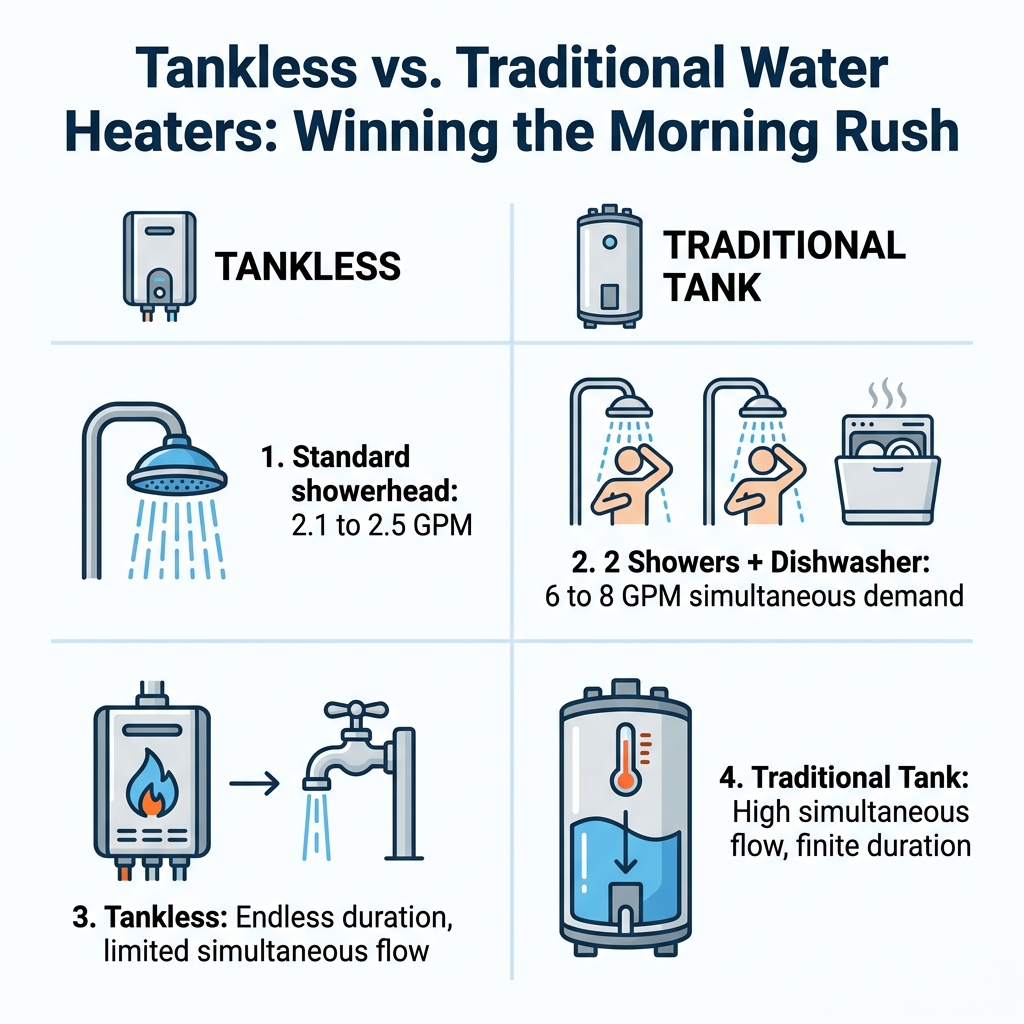
When you turn on a faucet, water flows at a specific rate. Standard modern showerheads use about 2.1 to 2.5 GPM. A typical bathroom sink uses about 1.5 GPM, and a dishwasher might pull another 1 to 2 GPM when filling. If you have a high-volume simultaneous morning draw—say, two showers running while the dishwasher is started—your home instantly demands a flow rate of 6 to 8 GPM.
Ready to upgrade your system? Learn more about our professional Water Heater Installation & Service tailored for heavy-use households.
Tankless systems and traditional tanks handle this 8 GPM demand in completely different ways:
• The Tankless Approach: These systems heat water on demand as it passes through a heat exchanger. They are strictly limited by their maximum GPM capacity. If your unit is rated for 5 GPM but your home demands 8 GPM, the system simply cannot keep up. The result is a noticeable drop in water pressure, a drop in water temperature, or both.
• The Traditional Tank Approach: A storage tank holds 50 to 75 gallons of water that is already heated and ready to go. Because the water is already hot, the tank can deliver it at whatever GPM your home's plumbing allows. It easily handles that 8 GPM demand without a drop in pressure or temperature—until the tank runs empty.
Evaluating these systems based on peak morning flow rate versus total stored capacity is the only way to ensure your family gets the performance they expect.
Water heaters do not operate in a vacuum. Their performance is directly tied to the temperature of the water entering your home from the municipal supply. The amount of work your water heater must do to bring incoming groundwater up to a comfortable 120 degrees Fahrenheit is known as "Temperature Rise" or Delta T.
San Jose family households enjoy a distinct regional advantage. Our technicians regularly measure incoming groundwater temperatures that are relatively moderate year-round. In the middle of summer, groundwater might enter your home at 65 or even 70 degrees. This means your water heater only needs to achieve a temperature rise of about 50 to 55 degrees to hit that 120-degree target. Because the required temperature rise is small, tankless systems can operate at their maximum GPM capacity highly efficiently.
However, the climate does shift. As September brings cooler weather, those incoming municipal water temperatures drop slightly. In the winter, incoming water might drop to 55 degrees or lower. Suddenly, your water heater needs a temperature rise of 65+ degrees.
The climate impact: When a tankless water heater has to work harder to achieve a higher temperature rise, it automatically slows down the flow of water to ensure it gets fully heated. This means a tankless unit that provides 7 GPM in July might only provide 5.5 GPM in December. Fortunately, because San Jose's moderate groundwater temperatures allow tankless systems to achieve required temperature rises more efficiently than in colder climates, we do not see the drastic flow reductions experienced in regions with freezing winter pipes. Still, this seasonal shift must be factored into your load calculations.
For many large families, tankless water heaters feel like a technological miracle. They offer distinct advantages, but they also come with specific limitations and installation requirements that must be carefully considered.
1. Endless Duration: The primary advantage is continuous hot water. Whether you are the first person to shower at 6:00 AM or the fourth person showering at 7:30 AM, the water stays hot. The last person in line never gets a cold shower.
2. Flow Rate Limitations: As discussed, the major limitation is simultaneous use. If your simultaneous demand exceeds the unit's GPM limit, performance suffers.
3. Energy Efficiency: Because they do not keep 50 gallons of water hot 24 hours a day, tankless units eliminate "standby heat loss." This makes them highly energy-efficient over the long term.
4. Space Savings: These units are compact and mount directly to the wall, freeing up significant square footage in your garage or utility closet.
Installing a tankless system in San Jose family households is rarely a simple swap. Traditional tanks use a relatively small gas burner (around 40,000 BTUs). Tankless units heat water instantly, requiring massive burners (up to 199,000 BTUs). This often means your home's gas lines must be upsized to handle the high BTU demand safely. Additionally, specialized venting is required to handle the exhaust safely.
Because these units pull a large amount of gas quickly, homeowners sometimes have operational questions. For example, is it normal to smell gas when a water heater ignites? Having a licensed professional handle the installation ensures all gas lines, venting, and combustion requirements meet strict local safety codes. We also remind our customers that federal energy tax credits may apply to qualifying high-efficiency tankless installations, helping offset the initial upgrade costs.
Despite the popularity of tankless technology, traditional storage tanks remain the workhorse of many large homes. For households with a high-volume simultaneous morning draw, a large-capacity tank often provides the most reliable performance.
1. Massive Initial Dump: A traditional tank's greatest strength is its ability to deliver a massive initial dump of hot water. It can easily support multiple showers, a washing machine, and a dishwasher simultaneously without any flow restriction or pressure drop.
2. Finite Supply: The obvious limitation is the finite supply. Once those 50 or 75 gallons are depleted, the tank runs out of hot water entirely.
3. Recovery Period: After the tank is emptied, it requires a recovery period to heat the next batch of incoming cold water. Depending on the BTU rating of the burner and the size of the tank, this can take anywhere from 30 to 60 minutes.
4. Physical Footprint: Traditional tanks are large, heavy cylinders that require significant dedicated floor space in your home.
Because traditional tanks store hot water 24/7, minerals from the municipal water supply constantly settle at the bottom of the tank. Over time, this creates a layer of sediment that forces the burner to work harder, reducing efficiency and eventually causing the tank to leak or fail. A pattern we see often is that neglected tanks fail prematurely, which is why traditional tanks benefit greatly from routine flushing to maintain efficiency. Enrolling in a routine maintenance plan ensures this vital task is handled annually by professionals, protecting your investment and keeping recovery times fast.
To help San Jose family households visualize the differences, here is how the two technologies stack up across the most critical metrics for large families.
• Simultaneous Flow Capacity — Tankless Water Heater: Limited strictly by maximum GPM rating — Traditional Storage Tank: High (No restriction; limited only by plumbing)
• Endless Supply — Tankless Water Heater: Yes (Runs continuously without emptying) — Traditional Storage Tank: No (Subject to 30-60 minute recovery time)
• Energy Efficiency — Tankless Water Heater: Higher (No standby heat loss) — Traditional Storage Tank: Lower (Keeps water hot 24/7)
• Physical Space Requirements — Tankless Water Heater: Compact, wall-mounted design — Traditional Storage Tank: Large footprint, requires dedicated floor space
• Best Fit For... — Tankless Water Heater: Families who take back-to-back showers — Traditional Storage Tank: Families who take simultaneous showers

One of the biggest mistakes homeowners make is guessing their water heater size based on the square footage of their home. Square footage does not take showers. People do. Guessing capacity based on floor space is a guaranteed recipe for cold showers.
Professional load-calculation is a precise science. When evaluating your home, an expert technician looks at several specific factors:
• Fixture Count: Analyzing the total number of bathrooms, sinks, and hot-water appliances in the home.
• Peak Demand Times: Determining exactly when the highest volume of water is needed (e.g., 6:00 AM to 7:00 AM).
• Simultaneous GPM: Calculating the maximum Gallons Per Minute required if your highest-use fixtures run at the exact same time.
• Incoming Water Temperature: Factoring in San Jose's seasonal groundwater shifts to ensure the system can achieve the necessary Delta T year-round.
At Precision Heating & Cooling, our expert load calculations are designed to give large families peace of mind so they never have to fear a cold morning shower again. We do not guess; our technicians measure. Matching your specific household habits to the mechanical capabilities of the system is the only way we guarantee comfort. Once we help you identify the proper size and type of system, upgrading to a high-capacity unit can be made easier with flexible financing options, ensuring you get the performance your family needs without compromise.
Yes, a tankless water heater can be excellent for a family of 5, provided it is properly sized. The key is ensuring the unit has a high enough GPM rating to handle the family's morning routine. If the family takes showers back-to-back, a tankless system is perfect because it will never run out of hot water. However, if multiple family members need to shower at the exact same time, a high-capacity unit or even dual units may be required to maintain pressure.
Most modern, high-capacity tankless water heaters can easily run two showers at the same time. Two standard showerheads will draw roughly 4.2 to 5.0 GPM combined. As long as the tankless unit is rated for at least 5.5 to 6.0 GPM (accounting for the specific temperature rise needed in your area), you will not experience a drop in pressure or temperature. Professional sizing ensures the unit meets this simultaneous demand.
For a family of 6 using a traditional storage tank, a 75-gallon high-recovery unit is typically recommended to handle heavy morning use. If opting for a tankless system, you will need a unit capable of delivering 7 to 9 GPM or more, depending on how many bathrooms are used simultaneously. A professional load calculation is essential for households this large to prevent cold showers during peak hours.
No, tankless water heaters do not run out of hot water because they do not store water in a tank. They heat water on demand as it flows through the unit's heat exchanger. As long as you have a steady supply of gas and water, the unit will produce hot water continuously. The only limitation is how much water it can heat at one specific moment (the flow rate).
The best water heater depends entirely on whether that heavy demand is simultaneous or staggered. If everyone needs hot water at the exact same time (simultaneous demand), a large 75-gallon traditional tank often performs best by providing massive initial flow. If the family takes turns showering over a two-hour period (staggered demand), a tankless system is superior because it provides an endless supply without a recovery period.
As fall approaches, San Jose's incoming municipal groundwater gradually becomes cooler. This means your water heater has to work harder to raise the water temperature to 120 degrees. For tankless systems, this larger required "temperature rise" can cause the unit to slightly reduce its maximum flow rate (GPM) to ensure the water gets fully heated. Proper sizing accounts for these seasonal temperature drops.
Choosing between tankless vs. traditional hot water tanks for large families in San Jose ultimately comes down to understanding your morning routine. The best choice depends entirely on whether your family prioritizes simultaneous high-volume flow or endless duration. A traditional tank gives you the massive initial draw needed for everyone to shower at once, while a tankless system guarantees the last person in line never suffers through cold water.
A clear, practical load-calculation based on your actual household habits is the best path forward. Don't rely on guesswork when your daily comfort is on the line. As the September pre-heating season transitions into cooler fall weather, our team at Precision Heating & Cooling is ready to secure your home's hot water supply. Book an expert assessment today to ensure your family enjoys reliable, efficient hot water all winter long.

Leslie was amazing for her outstanding customer service skills with me the other day. Thanks to her help my air conditioner is now all set up. She answered all my questions and took away all my problems. Leslie broke it down step by step to set it up easier. Now thanks to her my air conditioner is working perfectly. I really appreciate it Leslie and I’ll be sure to ask for you if I ever come back.
I contacted Precision Heating and Cooling for my home's AC repair. They were punctual and very professional. Guillermo was very kind and thorough. I would highly recommend them!
I am writing to express my sincere appreciation for the excellent work performed by Pablo and Alejandro from Precision Heating and Cooling. Their commitment to quality and customer satisfaction is truly commendable. Awesome job guys!
I would like to extend my sincere gratitude to Alejandro for his exceptional hard work. His passion for helping others is evident, and he consistently goes above and beyond in his service. Alejandro's thorough cleaning of my fireplace has truly made a significant difference. His dedication and professionalism are greatly appreciated.
I was very impressed. Came at night (after 9pm) to fix our AC during the middle of a heat wave the day before a national holiday! Technician was very courteous and efficient, got the job done quickly. Will definitely call them again for any AC servicing I need!
Fast and efficient, arrived when scheduled for repairs and replacement parts were ordered and installed quickly. Techs were very friendly and professional. AC system works great now! I highly recommend their services if you need repairs. Tim


.avif)
