


.avif)






Recent Blogs
Stay updated with our latest blog posts.


Are you constantly wiping down the outside of your walk-in cooler, wondering if the solution comes down to Patching a Walk-In Cooler Seal vs. Replacing the Entire Door Assembly? That persistent moisture is more than just a frustrating slip hazard for your kitchen staff; it is a glaring warning sign that warm ambient air is actively infiltrating your refrigerated space. In our years of providing commercial refrigeration services across San Jose, our team at Precision Heating & Cooling has seen firsthand how guessing wrong on this diagnosis can lead to spoiled inventory, skyrocketed energy bills, and catastrophic equipment failure right in the middle of the August late-summer heat.
If you are managing other climate control needs across your facility, exploring comprehensive commercial HVAC and cooling systems can prevent similar building-wide breakdowns, while targeted commercial refrigeration repair services will address this immediate threat to your perishable goods.
The underlying physics: Condensation forms when warm, humid air collides with a cold surface. If your walk-in cooler door is dripping with sweat, it means the airtight barrier has been compromised. The refrigeration cycle relies on a perfectly sealed envelope to maintain internal temperatures. When that seal is broken, the heavy lifting falls entirely on your compressor, which must run continuously to fight a battle it can never win.
Before you order a roll of universal gasket material and hope for the best, you need to understand exactly what is failing. A superficial patch over a structural problem is like putting a bandage on a broken bone. To protect your inventory, you must determine whether you are dealing with a simple torn piece of rubber or a door that has physically warped beyond repair.
San Jose's warm climate, especially when combined with the sweltering ambient temperatures of a bustling commercial kitchen, creates a worst-case scenario for refrigeration equipment. This environment accelerates wear and tear on every mechanical component, making rapid condensation buildup significantly more severe than it would be in a milder setting.
When the seal around your cooler door fails, the consequences ripple throughout your entire operation. Here is exactly what happens when warm kitchen air continuously bleeds into your walk-in cooler:
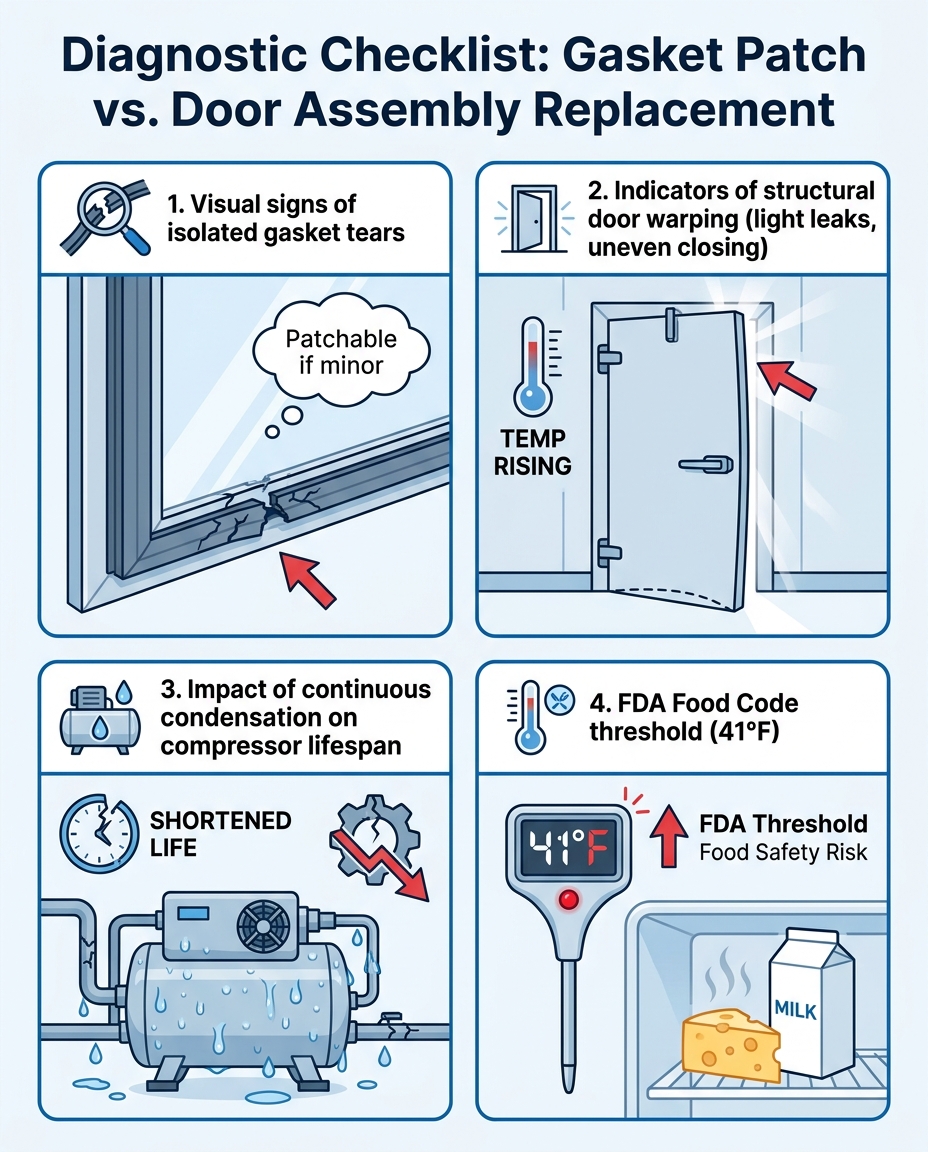
• Continuous Compressor Strain: Your compressor is designed to cycle on and off. When warm air leaks in, the thermostat constantly reads a higher-than-desired temperature, forcing the compressor to run non-stop. This continuous operation dramatically shortens the lifespan of the motor and increases the risk of sudden burnout.
• Severe Energy Waste: Refrigeration is already one of the largest energy expenses in any commercial kitchen. Forcing your system to cool the ambient air from the kitchen alongside your actual inventory causes your utility bills to spike unnecessarily.
• Critical Inventory Risk: The FDA Food Code mandates that refrigerated perishable food must be maintained at a health-code safe temperature threshold (41°F) or below. A compromised door barrier makes it nearly impossible for the system to hold this temperature during peak service hours, putting you at immediate risk of failing health inspections and losing thousands of dollars in spoiled meat, dairy, and produce.
• Ice Buildup on the Evaporator: As warm, moist air enters the cooler, that moisture eventually freezes on the evaporator coils. A frozen coil chokes off airflow, further reducing the system's cooling capacity and accelerating the temperature rise inside the box.
Understanding these high-stakes consequences bridges the gap between seeing a puddle on the floor and realizing the urgent need for accurate diagnostics. You cannot afford to delay a fix, but you also cannot afford to apply the wrong fix.
There are specific, limited scenarios where replacing or patching just the rubber door gasket is the appropriate and highly effective action. Gaskets naturally degrade over time. They are subjected to heavy foot traffic, constant opening and closing cycles, spills, and harsh cleaning chemicals. Understanding the components of a commercial walk-in cooler helps clarify why this flexible rubber seal is so vital to the overall system.
During the intense August late-summer heat, a brittle or torn gasket will quickly reveal itself as condensation forms directly over the breach. However, a gasket replacement is only a viable operational decision if the metal door frame itself remains completely unwarped and structurally sound.
If you suspect the issue is limited purely to the rubber seal, look for these specific indicators:
1. Visible cracks or missing chunks: Inspect the entire perimeter of the gasket. If you see physical tears, missing sections of rubber, or areas where the material has become hard and brittle, the seal has failed locally.
2. The door closes completely flush: Stand back and observe the door as it shuts. If the metal edges of the door align perfectly parallel with the metal frame of the cooler, the structure is likely sound.
3. Highly localized condensation: If the sweating is isolated to one specific corner or a six-inch strip along the edge—matching exactly where a tear in the gasket is located—you are likely dealing with an isolated seal failure.
4. The dollar bill test passes elsewhere: If you close the door on a dollar bill in an area where the gasket looks healthy, and you feel firm resistance when pulling it out, the overall alignment is still functioning correctly.
If your diagnostic check aligns with these signs, a professional gasket replacement will restore the airtight environment, alleviate the strain on your compressor, and stop the condensation in its tracks.
In our daily service calls, the most costly mistake our technicians see facility managers make is assuming every condensation problem is a gasket problem. Commercial walk-in cooler doors endure massive amounts of physical abuse. They are kicked open, slammed shut, and frequently struck by heavy supply carts, kegs, and hand trucks. Over time, these impacts, combined with extreme temperature differentials between the freezing interior and the hot kitchen exterior, can cause the metal door itself to physically warp.
If the door assembly is structurally compromised, placing a brand-new, factory-fresh gasket on it will accomplish absolutely nothing. The new rubber will simply fail to make contact with the frame, leaving a massive gap for warm air to enter and threatening your ability to maintain the required health-code safe temperature threshold (41°F).
Diagnostic signs of a warped door assembly include:
• Light leaking through the edges: Turn off the lights in the kitchen while the walk-in cooler light is on. If you can see a sliver of light escaping between the closed door and the frame, the door is warped.
• Uneven resistance on the handle: If the door feels strangely heavy, requires extra force to latch, or springs back slightly after being pushed shut, the hinges and the door panel are no longer aligned.
• Continuous sweating despite a recent gasket replacement: If you just replaced the seal last month and the door is already sweating heavily again, the gasket was never the root problem. The door itself is bowing outward.
• Sagging hinges: Look closely at the hinges. If the door appears to be leaning downward or scraping the floor sweep unevenly, the structural integrity of the assembly has failed.
A critical safety note: Do not attempt to re-hang, adjust, or replace a heavy commercial door assembly yourself. This procedure requires precise leveling, specialized tools, and a deep understanding of structural alignment to ensure a perfect, airtight fit. Improper installation will leave you in the exact same compromised position you started in.
When we walk clients through this decision, directly comparing these two options reveals why misdiagnosing a warped door as a simple gasket issue is a massive financial risk. While a patch seems highly efficient and budget-friendly, applying it to a structurally compromised door guarantees catastrophic inventory loss during peak operational hours, especially during the punishing August late-summer heat.
The table below breaks down the operational realities of both approaches to help you evaluate the long-term impact on your business.
• Best Application — Gasket Patch / Replacement: Structurally sound doors with isolated rubber tears or brittleness. — Full Door Assembly Replacement: Warped, sagging, or physically damaged doors that no longer sit flush.
• Long-Term Reliability — Gasket Patch / Replacement: Temporary to moderate; gaskets will eventually wear out again from traffic. — Full Door Assembly Replacement: Permanent solution; restores factory-level airtight integrity to the unit.
• Impact on Compressor — Gasket Patch / Replacement: Relieves strain only if the door is perfectly flush. — Full Door Assembly Replacement: Immediately stops short-cycling and continuous running, saving the motor.
• Risk of Inventory Loss — Gasket Patch / Replacement: High, if applied incorrectly to a warped door that continues to leak air. — Full Door Assembly Replacement: Minimal; secures the environment to easily hold below 41°F.
Framing a door replacement as a necessary capital expenditure changes the perspective. You are not just buying a piece of metal; you are purchasing an insurance policy for your perishable inventory and your highly expensive compressor. A new door assembly stops the bleeding immediately, ensuring your system operates exactly as the manufacturer intended.

It is easy to develop tunnel vision when staring at a sweating door, but that door is just one component of a much larger, highly sensitive refrigeration system. The failure of the physical barrier directly dictates the mechanical health of the condenser, the evaporator, and the compressor.
Proactive inspections are the only way to catch minor warping or slight gasket degradation before they escalate into a total system meltdown. By integrating daily door and seal checks into your kitchen's closing routines, your staff can spot a sagging hinge or a torn seal weeks before the compressor starts struggling to maintain the health-code safe temperature threshold (41°F).
To truly protect your bottom line, ongoing professional oversight is required. Enrolling in a preventative refrigeration maintenance plan ensures that an experienced technician is regularly evaluating the structural integrity of your hardware. During these visits, technicians check the alignment of the door, test the flexibility of the gaskets, clear the evaporator coils of any early ice buildup, and measure the electrical draw of the compressor to ensure it isn't overworking. This proactive approach extends the lifespan of your heavy equipment by years, turning massive emergency repair bills into predictable, manageable operational expenses.
When the temperature in your cooler starts creeping upward, time is your worst enemy. You do not have days to deliberate over repair options while your inventory sits in the danger zone. This is where dedicated commercial refrigeration expertise becomes invaluable. A trained professional can instantly assess whether a door is warped or just needs a seal, ensuring the correct repair path is chosen the very first time.
Our team at Precision Heating & Cooling brings dedicated commercial refrigeration expertise to every service call, emphasizing the reliability and fast response times necessary to protect your inventory. We understand from years of working with San Jose restaurants that in the food service and commercial sectors, a breakdown isn't just an inconvenience—it is an active threat to your business.
One San Jose customer recently experienced a critical operational failure when a non-functioning thermostat suddenly prevented their primary heating system from turning on. Because time was of the essence, a technician was dispatched rapidly, diagnosed the faulty component on the spot, and replaced the thermostat to completely resolve the problem before the building's climate was severely impacted. That exact same commitment to rapid, reliable scheduling and definitive resolution applies directly to your commercial cooling and refrigeration needs. When the August late-summer heat is pushing your equipment to the absolute limit, having a proven local expert on speed dial is the ultimate safety net.
The clearest sign of a warped door is light escaping through the edges when the door is closed and latched. You can test this by turning off the exterior kitchen lights and looking for a glow from the interior cooler light. Additionally, if the door feels unusually heavy, requires you to lift it slightly to latch it, or continues to sweat heavily even after a brand-new gasket has been installed, the physical structure of the door has bowed.
Sweating, or condensation, occurs when warm, humid ambient air comes into contact with the freezing surface of the cooler. If the outside of the door is sweating, it means the airtight seal has failed, allowing the cold interior air to bleed out and chill the exterior metal. This is a definitive warning sign that your compressor is working overtime to compensate for the air leak.
A full door assembly replacement is necessary when the door is physically warped, the hinges are permanently sagging, or the metal frame is dented from impact. In these scenarios, the door will never sit perfectly flush against the frame again. Applying a new gasket patch to a warped door is useless, as the rubber will not be able to bridge the uneven gap to create an airtight seal.
In a high-traffic commercial kitchen, walk-in cooler gaskets typically need to be replaced every 12 to 18 months. However, this timeline can be much shorter if the door is subjected to heavy abuse, frequent spills, or harsh cleaning chemicals that dry out the rubber. Regular visual inspections are the best way to determine when a gasket has become too brittle or torn to function.
Yes, a failing door seal is one of the leading causes of premature compressor death. When the seal is broken, warm air constantly enters the cooler, preventing the system from reaching its target temperature. This forces the compressor to run continuously without its designed resting cycles, eventually causing the motor to overheat and burn out entirely.
Beyond condensation and light leaks, look for heavy ice buildup on the interior evaporator coils, which indicates excess moisture is entering the space. You should also monitor your internal thermometers closely; an inability to consistently hold the health-code safe temperature threshold (41°F) during normal operations is a major red flag that the door assembly is failing to insulate the space.
Ultimately, deciding between patching a walk-in cooler seal vs. replacing the entire door assembly shouldn't be left to guesswork. Misdiagnosing the root cause of continuous condensation puts your perishable inventory at immense risk, especially when the August late-summer heat places maximum strain on your refrigeration systems.
You don't have to navigate these critical equipment decisions alone. A local expert can quickly provide the right diagnostic framework, ensuring you invest in a solution that actually restores your system's airtight integrity. Protect your compressor and secure your inventory by reaching out for an inspection with professional commercial refrigeration repair services today.

Leslie was amazing for her outstanding customer service skills with me the other day. Thanks to her help my air conditioner is now all set up. She answered all my questions and took away all my problems. Leslie broke it down step by step to set it up easier. Now thanks to her my air conditioner is working perfectly. I really appreciate it Leslie and I’ll be sure to ask for you if I ever come back.
I contacted Precision Heating and Cooling for my home's AC repair. They were punctual and very professional. Guillermo was very kind and thorough. I would highly recommend them!
I am writing to express my sincere appreciation for the excellent work performed by Pablo and Alejandro from Precision Heating and Cooling. Their commitment to quality and customer satisfaction is truly commendable. Awesome job guys!
I would like to extend my sincere gratitude to Alejandro for his exceptional hard work. His passion for helping others is evident, and he consistently goes above and beyond in his service. Alejandro's thorough cleaning of my fireplace has truly made a significant difference. His dedication and professionalism are greatly appreciated.
I was very impressed. Came at night (after 9pm) to fix our AC during the middle of a heat wave the day before a national holiday! Technician was very courteous and efficient, got the job done quickly. Will definitely call them again for any AC servicing I need!
Fast and efficient, arrived when scheduled for repairs and replacement parts were ordered and installed quickly. Techs were very friendly and professional. AC system works great now! I highly recommend their services if you need repairs. Tim


.avif)
