


.avif)






Recent Blogs
Stay updated with our latest blog posts.


If you find yourself constantly adjusting the thermostat because the living room is freezing while the upstairs bedrooms feel like a sauna, you are likely experiencing the exact reason why older Almaden Valley homes struggle with uneven cooling in September. At Precision Heating & Cooling, we hear this exact complaint every fall: the thermostat reads a comfortable 72 degrees, yet certain rooms simply refuse to cool down. You might have tried closing vents in unused rooms, running ceiling fans at maximum speed, or leaving bedroom doors open, but the hot spots remain stubbornly persistent.
This is a common and incredibly frustrating reality for many homeowners we serve in Almaden Valley, San Jose. When late-season heatwaves strike, they expose the hidden weaknesses in your home's airflow distribution. In our experience, the problem usually goes much deeper than a dirty air filter or a slightly low refrigerant charge. Instead, the root cause lies in the unique combination of San Jose's late-summer climate and the specific architectural constraints of aging residential properties.
Resolving these persistent hot spots requires looking beyond the air conditioning unit itself and addressing the structural airflow issues hidden in your walls, ceilings, and attic. If you are deciding whether to simply endure the heat or finally fix the underlying problem, a professional approach is the only way to achieve whole-home comfort. To address these bottlenecks permanently, you need comprehensive HVAC services that include targeted air conditioning solutions and ductwork assessments.
San Jose is famous for its mild climate, but as local HVAC professionals, we know that the end of summer often brings a harsh sting. During September late-season warm spells, it is entirely normal to see temperatures spike into the high 90s. This "Indian Summer" weather pattern places an enormous burden on cooling equipment right at the moment it is most vulnerable.
By the time September arrives, your air conditioning system has likely been running continuously for three or four months. This prolonged operation leads to a phenomenon known as system fatigue. Just like a car that has been driven across the country without an oil change, an AC unit at the end of summer is not operating at its peak efficiency. The components have endured hundreds of hours of thermal stress, vibration, and general wear.
When system fatigue sets in, the first casualty our technicians typically see is air pressure. Your blower motor may struggle to push conditioned air with the same force it had in June. As a result, the air simply runs out of momentum before it reaches the vents furthest from the indoor unit. That is why the rooms at the end of the hallway or on the second floor suddenly become uncomfortably warm, even if they were fine earlier in the summer.
The drop in performance during September late-season warm spells rarely happens overnight. It is the result of cumulative degradation over the summer months. Here is what we consistently find happening inside your system:
• Blower motor strain: Continuous operation causes the motor to run hotter and less efficiently, reducing the cubic feet per minute (CFM) of air it can move.
• Coil buildup: Even with regular filter changes, microscopic dust bypasses the filter over months of use, coating the evaporator coil and restricting airflow.
• Capacitor wear: The electrical components that start your compressor and fan motors degrade slightly with every cycle, leading to sluggish start-ups and reduced output.
During a mild July day, you might not notice these minor inefficiencies. But when a September heatwave demands maximum cooling capacity, these minor restrictions compound into major airflow bottlenecks, leaving your distant bedrooms starved for cold air.
The housing stock in Almaden Valley, San Jose, is highly desirable, featuring beautiful properties built largely between the 1960s and the 1980s. However, the architectural styles popular during that era—specifically sprawling single-story ranches and multi-level floor plans—were not designed with modern central air conditioning in mind. Because our team has deep local expertise in navigating the specific architectural styles and original ductwork layouts native to this neighborhood, we know exactly what to look for when diagnosing airflow issues.
When many of these homes were constructed, heating was the primary concern. The original ductwork was often sized and routed for gravity furnaces or low-velocity heating systems. Hot air naturally rises and moves easily through large, uninsulated ducts. Modern air conditioning, however, requires high-velocity airflow to push heavy, dense, cold air into every corner of the house.
In a sprawling ranch-style home, we often find duct runs that easily stretch 40 to 60 feet from the central blower. By the time cold air travels that distance through a hot attic, it loses both its velocity and its low temperature. In a two-story home, the challenge is thermal dynamics. The system must fight gravity to push heavy cold air up to the second floor, while the heat from the lower levels naturally rises to the upstairs bedrooms.
• Sprawling Single-Story Ranch — Primary Airflow Challenge: Excessively long duct runs through unconditioned attic spaces. — Impact on Indoor Comfort: Rooms furthest from the HVAC unit receive little to no air pressure.
• Traditional Two-Story — Primary Airflow Challenge: Fighting natural thermal dynamics (heat rises, cold air sinks). — Impact on Indoor Comfort: The upstairs remains 5 to 10 degrees hotter than the ground floor.
• Split-Level Design — Primary Airflow Challenge: Complex duct routing with multiple sharp turns and elbows. — Impact on Indoor Comfort: Uneven temperatures across different mid-level living spaces.
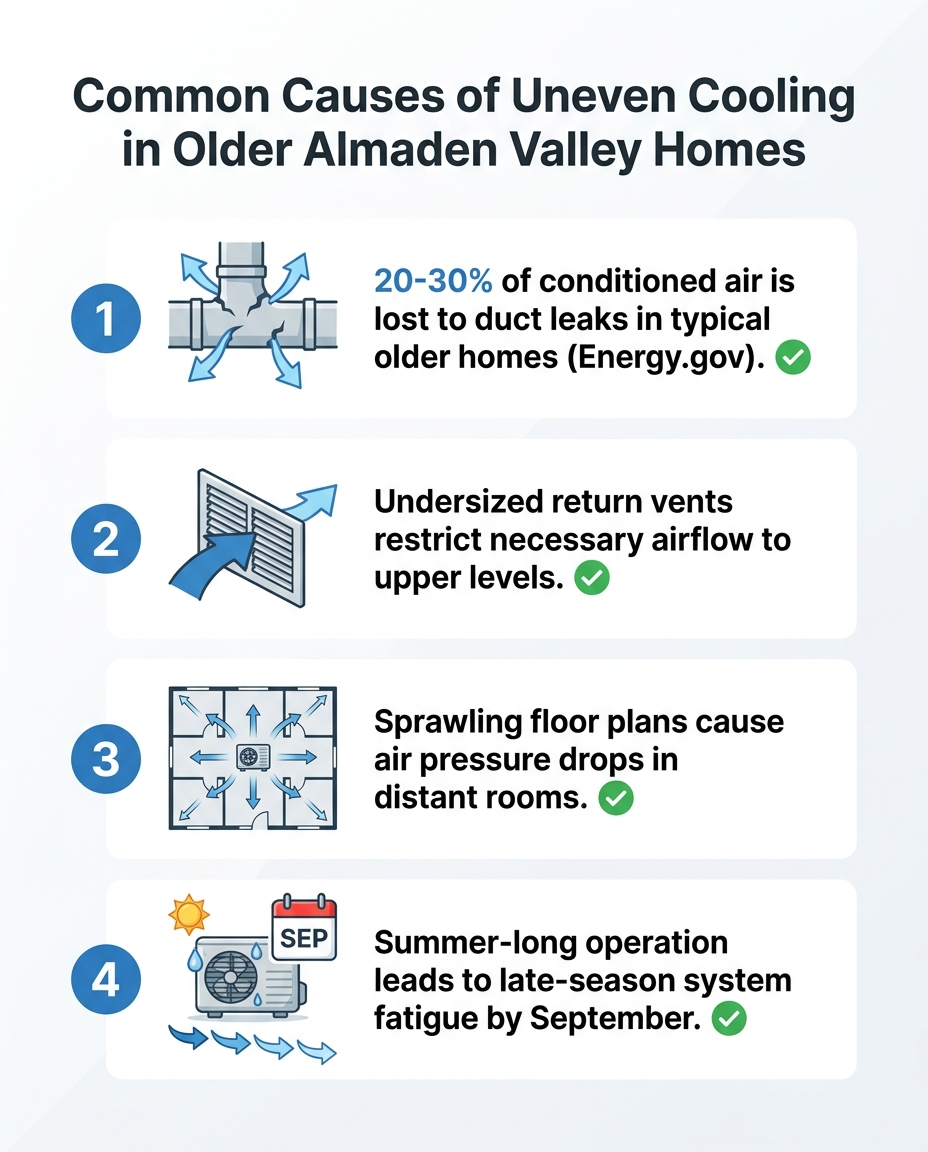
Even if you have upgraded your air conditioning unit recently, pairing a brand-new, high-efficiency compressor with 40-year-old ductwork is like putting a sports car engine on a bicycle frame. According to the Department of Energy (Energy.gov), typical older homes lose 20 to 30 percent of the air that moves through the duct system due to leaks, holes, and poorly connected joints.
Take, for example, an Almaden Valley family our team recently assisted who experienced a complete system shutdown in the spring. The utility company identified a non-functioning thermostat preventing the furnace from turning on. One of our technicians responded quickly and replaced the unit, solving the issue instantly. But while a broken thermostat is an obvious problem that completely stops your system, failing ductwork is much more insidious—it slowly and silently bleeds your conditioned air into the attic or crawlspace.
Over decades, the original mastic sealant dries out and crumbles. Fabric duct tape loses its adhesive. The physical shifting and settling of the house can actually pull duct joints apart. When this happens, your system pumps perfectly cooled air directly into your attic instead of your bedroom. Furthermore, these leaks create negative pressure, pulling unconditioned, dusty air from the attic back into your living space, which severely impacts your indoor air quality and airflow.
Another major flaw we consistently repair in mid-century Almaden Valley, San Jose homes is a lack of return air pathways. Air conditioning is a closed-loop system; it can only push out as much air as it pulls in.
• Centralized returns: Older homes often feature only one large return vent in the main hallway, rather than dedicated returns in every bedroom.
• Closed doors: When you close a bedroom door at night, you cut off that room's air supply from the central return, creating a pressurized bubble that prevents new cold air from entering.
• System starvation: Undersized returns starve the blower motor of air, forcing it to work harder while delivering less cooling to the house.

When the upstairs gets too hot, the natural reaction is to walk over to the thermostat and drop the temperature by a few degrees. While this might eventually force some cold air upstairs, it turns the main floor into an icebox and forces your system to run non-stop. Running the AC harder does not fix a distribution problem; it only accelerates wear and tear on your equipment.
Consider a local client whose heater went out unexpectedly on a Saturday morning during the winter. Our technicians arrived ahead of schedule on Sunday to service the system professionally and restore comfort. We want to secure that same level of proactive, professional care for your airflow bottlenecks now, rather than waiting for an unexpected breakdown when the system is pushed beyond its limits.
The correct solution is professional air balancing. This involves a comprehensive assessment of how air moves through your home and making mechanical adjustments to ensure even distribution. Scheduling one of our end-of-summer duct inspections is the best way to identify exactly where you are losing pressure.
The Air Balancing Process:
1. Static Pressure Testing: Our technicians measure the air pressure inside your ductwork to determine if the blower motor is facing too much resistance or if pressure is dropping due to leaks.
2. Damper Adjustments: Professional-grade dampers inside the ductwork can be adjusted to direct more airflow to distant rooms and slightly restrict flow to rooms closest to the blower.
3. Duct Sealing and Repair: Identifying disconnected joints in the attic and sealing them permanently restores the lost 20 to 30 percent of your cooling capacity.
4. System Modifications: In cases of severe architectural constraints, we may recommend adding a dedicated return vent to the master bedroom or installing a multi-zone control system.
September late-season warm spells are not just the end of the cooling season; they are the critical transition window before winter heating demands begin. The airflow bottlenecks causing your upstairs to bake in the summer will cause those same rooms to freeze in December.
If your ductwork is leaking cold air into the attic in September, it will leak expensive, heated air into the attic in January. The physics of poor airflow do not change with the seasons. By addressing the architectural constraints of your older home now, you prepare your system for the heavy lifting required during the winter months.
At Precision Heating & Cooling, we strongly advise our customers to include a comprehensive ductwork evaluation as a standard part of their routine AC maintenance and fall preparation. A system that breathes easily operates more efficiently, breaks down less frequently, and provides a perfectly balanced temperature in every room of the house. Do not let another season pass while living with uncomfortable hot and cold spots.
Heat naturally rises, while cold, dense air from your AC tends to sink to the lower levels. In older homes, the HVAC system must fight this natural thermal dynamic to push conditioned air to the second floor. If your ductwork is leaky or your return vents are undersized, the system simply lacks the pressure required to overcome the rising heat, leaving the upstairs uncomfortably warm.
Fixing uneven cooling requires addressing the air distribution network rather than just the AC unit. A professional technician from our team will perform air balancing, which involves adjusting internal dampers, sealing leaks in the ductwork, and ensuring proper static pressure. In some cases, adding dedicated return vents to distant rooms or installing a zoning system is the most effective permanent solution.
Yes, ductwork is the most common cause of uneven temperatures in a home. If the ducts are undersized, crushed, or disconnected in the attic, the conditioned air escapes before it ever reaches your living space. According to energy experts, typical older homes lose up to 30 percent of their airflow through compromised ductwork.
By late summer, your air conditioning system has been running continuously for months, leading to cumulative wear and system fatigue. The blower motor may become less efficient, and microscopic dust can build up on the evaporator coil. When a late-season heatwave hits, this accumulated fatigue prevents the system from delivering peak airflow to the furthest rooms.
Duct cleaning primarily improves indoor air quality by removing dust, debris, and allergens from the system. While removing a severe, physical blockage can marginally improve airflow, cleaning alone will not fix leaks, disconnected joints, or poorly designed duct layouts. If you have significant hot spots, we recommend a structural ductwork assessment, not just a cleaning.
Signs of leaking ductwork include noticeably weak airflow from certain vents, rooms that are consistently hotter or colder than the rest of the house, and unusually high energy bills. You might also notice excessive dust in the home, as leaky ducts can pull unfiltered air from the attic or crawlspace into your living areas. A professional static pressure test can confirm the presence and severity of leaks.
Living with persistent hot spots during September late-season warm spells is a clear indicator that your home's air distribution system needs professional attention. The architectural challenges of older properties in Almaden Valley, San Jose, combined with aging ductwork, make it nearly impossible for a fatigued AC unit to cool every room evenly. Turning down the thermostat only wastes energy and accelerates wear on your equipment.
The most effective path forward is to address the structural airflow constraints directly. By investing in a professional ductwork assessment and air balancing with Precision Heating & Cooling, you can permanently resolve these bottlenecks. Take action now to ensure your system is perfectly balanced and ready to deliver seamless, reliable comfort before the transition into the winter heating season.

Leslie was amazing for her outstanding customer service skills with me the other day. Thanks to her help my air conditioner is now all set up. She answered all my questions and took away all my problems. Leslie broke it down step by step to set it up easier. Now thanks to her my air conditioner is working perfectly. I really appreciate it Leslie and I’ll be sure to ask for you if I ever come back.
I contacted Precision Heating and Cooling for my home's AC repair. They were punctual and very professional. Guillermo was very kind and thorough. I would highly recommend them!
I am writing to express my sincere appreciation for the excellent work performed by Pablo and Alejandro from Precision Heating and Cooling. Their commitment to quality and customer satisfaction is truly commendable. Awesome job guys!
I would like to extend my sincere gratitude to Alejandro for his exceptional hard work. His passion for helping others is evident, and he consistently goes above and beyond in his service. Alejandro's thorough cleaning of my fireplace has truly made a significant difference. His dedication and professionalism are greatly appreciated.
I was very impressed. Came at night (after 9pm) to fix our AC during the middle of a heat wave the day before a national holiday! Technician was very courteous and efficient, got the job done quickly. Will definitely call them again for any AC servicing I need!
Fast and efficient, arrived when scheduled for repairs and replacement parts were ordered and installed quickly. Techs were very friendly and professional. AC system works great now! I highly recommend their services if you need repairs. Tim


.avif)
