


.avif)






Recent Blogs
Stay updated with our latest blog posts.


Your lower level feels distinctly damp and smells musty, yet there hasn't been a drop of rain in weeks. If you are managing humidity in San Jose basements when your AC is overworked, you are experiencing a common but highly misunderstood mechanical issue. In our experience serving the South Bay, many homeowners immediately suspect a hidden plumbing leak or foundation seepage when they notice condensation forming on baseboards or a heavy, clammy feeling in their sunken living rooms. However, as we transition into the back-to-school season and the peak of late summer hits, the true culprit is often sitting right in your backyard or attic: your cooling system.
When outdoor temperatures soar in August, upper-level cooling demands skyrocket. Your thermostat, usually located on the main or upper floor, commands the air conditioner to run continuously to combat the heat. While the upper floors might finally reach a comfortable temperature, the lower levels of your home become unintended condensation zones. This stark contrast creates a critical decision point for homeowners: distinguishing between a genuine structural water leak and an overworked cooling system that has lost its ability to regulate indoor moisture.
The mechanical connection between continuous upper-level cooling demands and lower-level humidity is a matter of thermal dynamics and system capacity. When your system runs without appropriate cycling, it disrupts the delicate balance of your home's air quality. Addressing this requires more than just masking the symptoms; it requires comprehensive indoor air quality solutions that address the root mechanical failure.
To understand why your lower level feels like a swamp while your upper level feels like a refrigerator, you have to look at the primary function of your cooling system. An air conditioner does not simply blow cold air into your home. It is designed to perform two simultaneous jobs: sensible cooling (lowering the actual temperature of the air) and latent cooling (removing moisture and humidity from the air). When the system is operating optimally, it achieves a perfect balance between these two functions.
During extreme heatwaves, this balance is destroyed. The system is forced to run continuously without the proper off-cycles needed to manage moisture effectively. When you rely on our professional air conditioning services to evaluate your system, our Precision Heating & Cooling technicians are often looking at how well your equipment handles this specific sensible-to-latent heat ratio under heavy late-summer loads.
The evaporator coil inside your indoor unit is responsible for extracting heat and moisture from your home's air. Warm, humid air blows across the freezing cold coils, causing the moisture in the air to condense into water droplets—much like water forming on the outside of a cold glass of iced tea. This condensation drips into a drain pan and is carried safely out of your home.
However, our technicians frequently see that when your system runs continuously during a San Jose heatwave, these coils become excessively cold. Because the system never cycles off, the moisture extraction rate paradoxically begins to drop. The coil gets so cold that it struggles to efficiently shed the water it collects, and the constant blast of the blower fan can actually begin to re-evaporate that moisture, pushing excess humidity straight back into your home's air circulation.
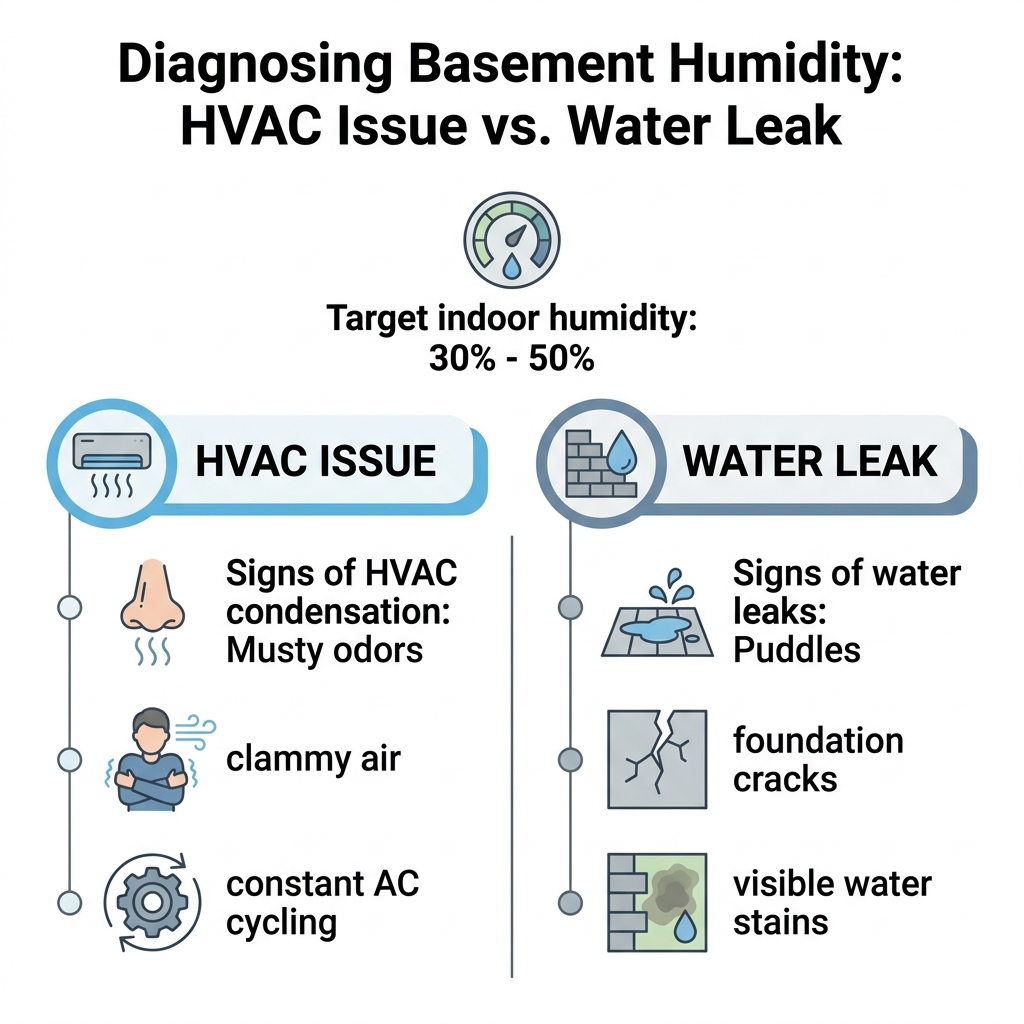
The Environmental Protection Agency (EPA) recommends maintaining indoor relative humidity between 30 and 50 percent to prevent mold growth, structural damage, and discomfort. When mechanical dehumidification fails due to constant system operation, your indoor humidity can easily spike past 60 percent.
In this state, your system focuses entirely on sensible cooling to satisfy the thermostat's temperature setting, completely abandoning its latent cooling responsibilities. This mechanical imbalance creates a deeply uncomfortable, muggy, heavy feeling in the air. The air blowing from your vents might feel freezing cold, but because it is loaded with unextracted moisture, your skin cannot evaporate sweat efficiently, leaving you feeling sticky and uncomfortable despite the low temperature.
At Precision Heating & Cooling, our team has learned that when discussing basement humidity, it is vital to address the specific architectural realities of the South Bay. Traditional, deep subterranean basements are relatively rare in California architecture due to soil composition and historical building trends. However, this does not mean San Jose homes are immune to lower-level moisture problems.
Instead of traditional basements, many local homes feature sunken living rooms, split-level designs, and deep lower floors built on concrete slabs. These spaces face the exact same moisture challenges as traditional basements. In fact, the unique airflow patterns of multi-level homes often exacerbate the problem.
San Jose enjoys a dry-summer Mediterranean climate. From June through September, the region experiences very little rainfall and relatively low outdoor humidity. Because the ground outside is bone-dry during late summer, dampness in your lower levels is almost never caused by environmental groundwater seepage. If you feel dampness in August, it is a system-induced, internally generated mechanical issue.
Split-level homes present unique airflow challenges. Thermostats are typically installed on the main living floor or the upper hallway. Because warm air naturally rises to the highest points of the house, the upper-level thermostat registers high temperatures and commands the cooling system to keep running.
Meanwhile, the lower levels are receiving a constant supply of cold air. The thermostat has no way of knowing that the sunken living room or lower-level bedroom has already dropped to 65 degrees. It continues to pump cold, damp air into a space that is already over-cooled, creating a perfect storm for condensation to form on walls, windows, and ductwork—a pattern we see frequently in local homes.
To fully grasp why your lower levels become so damp when the AC is overworked, we must look at the neutral, expert physics of thermal dynamics. The way air behaves inside your home directly dictates where moisture will settle. Condensation does not form randomly; it follows strict rules of temperature and air density.
If you want to know what happens when your AC compressor runs non-stop, you only need to look at the lowest point in your house. Here is exactly how continuous operation creates unintended condensation zones:
1. Cold air is denser and heavier: When your system pumps out chilled air, it naturally sinks. In a multi-level home, this heavy air cascades down staircases and settles in the lowest rooms, creating a pool of cold air.
2. Cold air holds less moisture: Warm air acts like a sponge, capable of holding a significant amount of water vapor. As air cools, it loses this capacity. When the heavy, cold air settles in your lower levels, its relative humidity spikes because it can no longer hold the moisture suspended within it.
3. The dew point is reached: When warm, unconditioned air from the upper levels or outside inevitably meets the over-cooled surfaces of your lower level (like drywall, vents, or slab floors), the air rapidly cools and drops its moisture directly onto those surfaces.
4. Poor return airflow traps the moisture: Many split-level homes lack adequate return air vents in their lowest rooms. Without a return vent to pull that heavy, humid air back into the HVAC system for re-conditioning, the damp air simply sits stagnant, compounding the musty odors and condensation.
This process is known as temperature stratification. It describes the stark temperature difference between top floors and bottom floors. When an AC runs constantly to cool a hot upper floor, the stratification becomes extreme. You might have a 78-degree upper floor and a 62-degree lower floor. This massive differential guarantees that the lower level will reach its dew point, transforming your sunken living room into an unintended condensation zone.
Diagnosing the source of your lower-level humidity is the first step toward resolving it. Because the symptoms of an overworked AC often mimic those of a plumbing leak or foundation issue, knowing exactly what to look for can save you from costly and unnecessary waterproofing treatments. Our team recommends looking for these specific signs that your air conditioner, rather than a structural leak, is creating your moisture problems:
• Visual condensation on vents: Water droplets forming specifically on lower-level supply vents, exposed ductwork, or the metal casing of your indoor unit.
• Localized musty odors: Damp, earthy smells that are confined strictly to the basement, sunken rooms, or lowest levels of the home, without any visible standing water.
• Continuous system operation: The air conditioning unit runs constantly for hours on end without ever satisfying the thermostat's set temperature.
• A clammy, cold environment: The air in the lower level feels distinctively wet and chilling to the bone, rather than providing crisp, dry comfort.
• No evidence of water intrusion: A complete absence of plumbing leaks, dripping pipes, or visible water stains seeping through the concrete foundation or drywall.
Mechanical Condensation vs. Structural Intrusion
• Timing of Moisture — Mechanical Condensation (HVAC): Peaks during late-summer heatwaves (August) — Structural Intrusion (Leak): Peaks during or immediately after heavy rainfall
• Location of Dampness — Mechanical Condensation (HVAC): On metal vents, ductwork, and cold surfaces — Structural Intrusion (Leak): Pooling on the floor, seeping from wall cracks
• Air Quality Feeling — Mechanical Condensation (HVAC): Cold, clammy, and heavily humid — Structural Intrusion (Leak): Localized dampness, often with visible mold growth
• System Behavior — Mechanical Condensation (HVAC): AC is running non-stop without cycling off — Structural Intrusion (Leak): AC cycles normally; moisture persists regardless

When faced with a damp lower level, many homeowners rush to purchase a portable dehumidifier. While a standalone dehumidifier will pull water out of the air, placing one in the basement only masks the symptom of an overworked AC. It forces you to pay for electricity to run a dehumidifier to fix a problem that your primary air conditioner is actively creating. To truly resolve the issue, you must address the mechanical imbalance at its source.
During a recent late-summer heatwave, one local homeowner noticed their AC was not working correctly and leaving the house feeling heavy and damp, especially after being serviced by other companies. Our technician, Guillermo, was dispatched and provided an honest, comprehensive assessment of the system's airflow and sizing. By properly diagnosing the root mechanical failure, the underlying AC issue was completely resolved, restoring proper dehumidification without unnecessary up-sells.
With over 20 years of experience serving the South Bay, our team at Precision Heating & Cooling understands how local architectural quirks interact with prolonged cooling loads. A thorough diagnostic visit assesses system sizing, ductwork integrity, and airflow balance across all levels of your home. Sometimes, the solution is as simple as adjusting blower fan speeds to improve latent cooling, while other times it requires enrolling in a preventative HVAC maintenance plan to ensure your coils are clean and capable of proper moisture extraction.
One of the most common mechanical causes of poor dehumidification is an improperly sized AC unit. If a system is too large for the home, it will cool the air too quickly (short cycling) and shut off before it has time to remove humidity. Conversely, if it is too small, it will run constantly, over-cooling the coils and failing to extract moisture as described earlier.
Furthermore, duct modifications can often restore proper airflow and moisture balance. Adding a dedicated return air vent to a sunken living room allows the HVAC system to pull that heavy, damp air back into the unit, condition it, and redistribute it evenly, eliminating the stagnant condensation zone entirely.
Addressing system-induced humidity is not just about comfort; it is about protecting your home from the long-term consequences of poor air quality. When an overworked cooling system is allowed to pump excess moisture into your lower levels, it creates the perfect environment for musty odors, damaged drywall, and poor respiratory comfort.
Fortunately, mechanical moisture imbalances can be expertly corrected. You do not have to live with a clammy, uncomfortable lower level just because it is August. By scheduling a professional assessment with our team to evaluate your system's performance, airflow balance, and dehumidification capacity, you can restore whole-home comfort and ensure your air conditioner operates exactly as it was designed to.
Your basement becomes humid because cold, dense air naturally sinks to the lowest level of your home. When the AC runs continuously, it over-cools the lower level. Because cold air cannot hold as much moisture as warm air, the relative humidity spikes, causing the air to feel heavy, damp, and clammy.
Yes, an overworked AC directly contributes to high indoor humidity. When a system runs non-stop without properly cycling off, the evaporator coils become too cold to efficiently shed water. Instead of draining away, the moisture is often blown right back into the home's ductwork by the continuous fan operation.
Under normal conditions, an AC removes humidity from the entire home. However, if the thermostat is located on a hot upper floor, the AC will run too long for the basement's needs. The basement becomes over-cooled, reaching its dew point, which actually increases the relative humidity and causes condensation rather than dehumidifying the space.
Your house feels muggy because the system is focusing entirely on sensible cooling (lowering the temperature) rather than latent cooling (removing moisture). When an AC runs constantly during a heatwave, it struggles to balance moisture extraction, leaving you with cold but heavily saturated air that prevents your skin from evaporating sweat.
You can usually tell by the location and timing of the moisture. AC-induced humidity typically peaks during summer heatwaves and causes condensation on metal vents, ductwork, and cold surfaces. A structural leak usually occurs during or after rainfall and presents as visible puddles, foundation seepage, or localized water stains.
Adjusting your thermostat can provide temporary relief by forcing the system to cycle off, giving the coils time to drain collected moisture. However, if your multi-level home suffers from severe temperature stratification, you will likely need professional ductwork balancing or airflow adjustments to permanently resolve the condensation issue.

Leslie was amazing for her outstanding customer service skills with me the other day. Thanks to her help my air conditioner is now all set up. She answered all my questions and took away all my problems. Leslie broke it down step by step to set it up easier. Now thanks to her my air conditioner is working perfectly. I really appreciate it Leslie and I’ll be sure to ask for you if I ever come back.
I contacted Precision Heating and Cooling for my home's AC repair. They were punctual and very professional. Guillermo was very kind and thorough. I would highly recommend them!
I am writing to express my sincere appreciation for the excellent work performed by Pablo and Alejandro from Precision Heating and Cooling. Their commitment to quality and customer satisfaction is truly commendable. Awesome job guys!
I would like to extend my sincere gratitude to Alejandro for his exceptional hard work. His passion for helping others is evident, and he consistently goes above and beyond in his service. Alejandro's thorough cleaning of my fireplace has truly made a significant difference. His dedication and professionalism are greatly appreciated.
I was very impressed. Came at night (after 9pm) to fix our AC during the middle of a heat wave the day before a national holiday! Technician was very courteous and efficient, got the job done quickly. Will definitely call them again for any AC servicing I need!
Fast and efficient, arrived when scheduled for repairs and replacement parts were ordered and installed quickly. Techs were very friendly and professional. AC system works great now! I highly recommend their services if you need repairs. Tim


.avif)
