


.avif)






Recent Blogs
Stay updated with our latest blog posts.


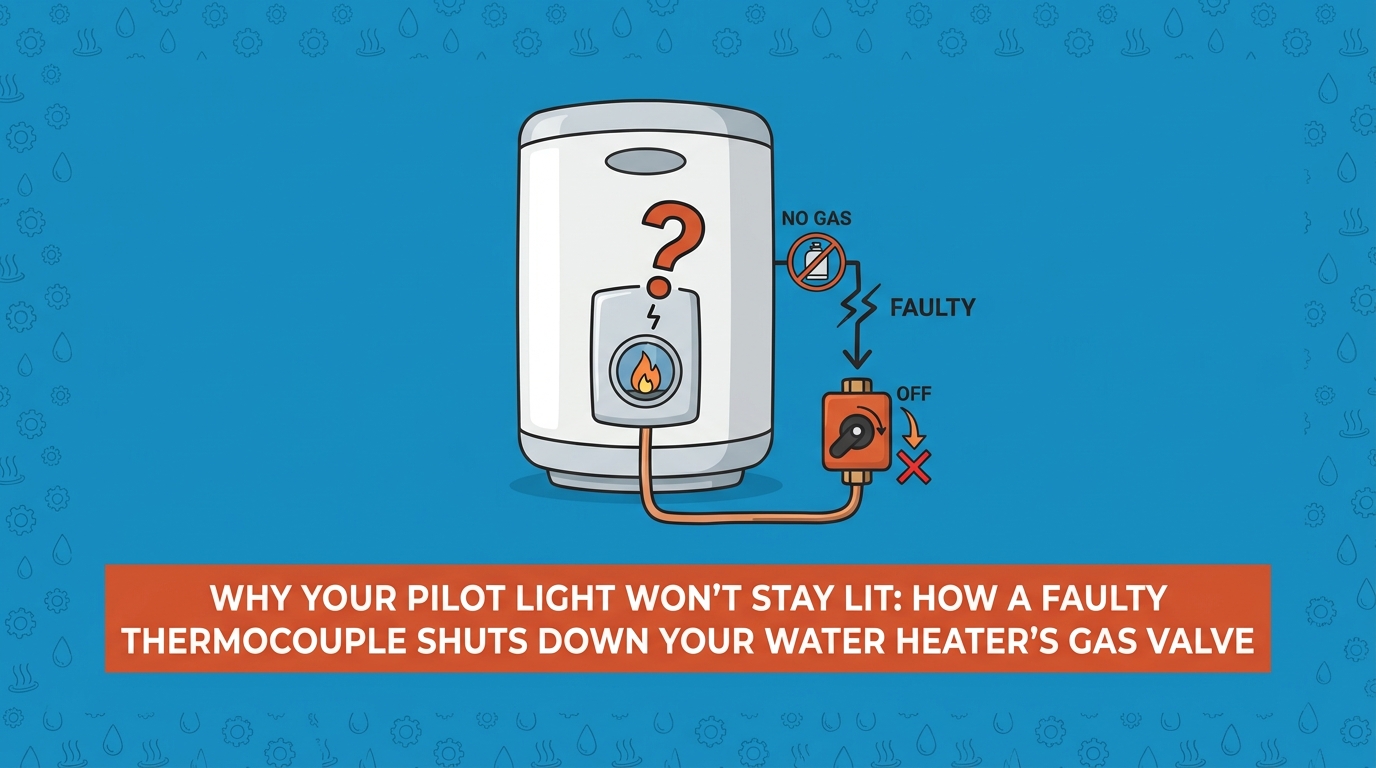
You step into the shower during the chaotic late-summer back-to-school morning routines, expecting a blast of warmth, but instead you are met with freezing water—and you quickly realize you need to know how a faulty thermocouple shuts down your water heater's gas valve. That sudden, icy shock sends you straight to the garage or utility closet to investigate. You locate the water heater, read the relighting instructions printed on the side of the tank, and attempt the most common troubleshooting step: relighting the pilot flame.
For professional help, learn more about our HVAC services and water heater repair and installation.
You hold down the gas control knob, strike the igniter, and a small blue flame springs to life. You hold the button for a minute, assuming the system is primed and ready to go. But the exact second you release the button, the flame vanishes. You try it again, holding the knob down even longer this time, only to watch the pilot die the moment you let go. This specific cycle of hope and immediate failure is incredibly frustrating, especially when you are racing against the clock.
Here's the thing: this is not a random malfunction or a broken knob. The flame dying the moment you release the button is a deliberate safety lockout initiated by the thermocouple and the gas control valve. Your water heater is intentionally shutting itself down to protect your home. To understand why this happens, you have to look past the pilot light and examine the invisible safety mechanisms working behind the scenes.
Most homeowners view the thermocouple as just a small metal rod sitting next to the pilot light, assuming it acts as a simple spark plug or igniter. In reality, the thermocouple is a critical safety sensor that dictates whether your water heater is allowed to operate. It relies on a fascinating scientific principle known as the thermoelectric effect to communicate with the main gas control valve.
The thermoelectric effect occurs when two dissimilar metals are joined together at one end and exposed to a heat source. Inside the tip of the thermocouple (the end sitting in the pilot flame), there are two different types of metal wire welded together. When the pilot flame heats this welded junction, the temperature difference between the hot tip and the cooler base of the sensor forces electrons to move. This movement creates a small, continuous electrical current.
The conversion of thermal energy into electrical energy happens entirely independently of your home's main electrical grid. This is why a standard gas water heater can still provide hot water during a neighborhood power outage. The process follows a strict sequence:
1. Heat Application: The pilot flame continuously engulfs the upper half-inch of the thermocouple probe.
2. Electron Excitation: The intense heat causes electrons within the two dissimilar metals to become active and flow toward the cooler end of the sensor.
3. Current Generation: This flow generates a steady stream of direct current (DC) electricity.
4. Signal Transmission: The electrical current travels down the copper wire casing to the main gas control valve.
This tiny electrical current is the only thing communicating to the gas valve that a flame is present and safely burning. Without this electrical signal, the gas valve assumes the flame has blown out and takes immediate action.
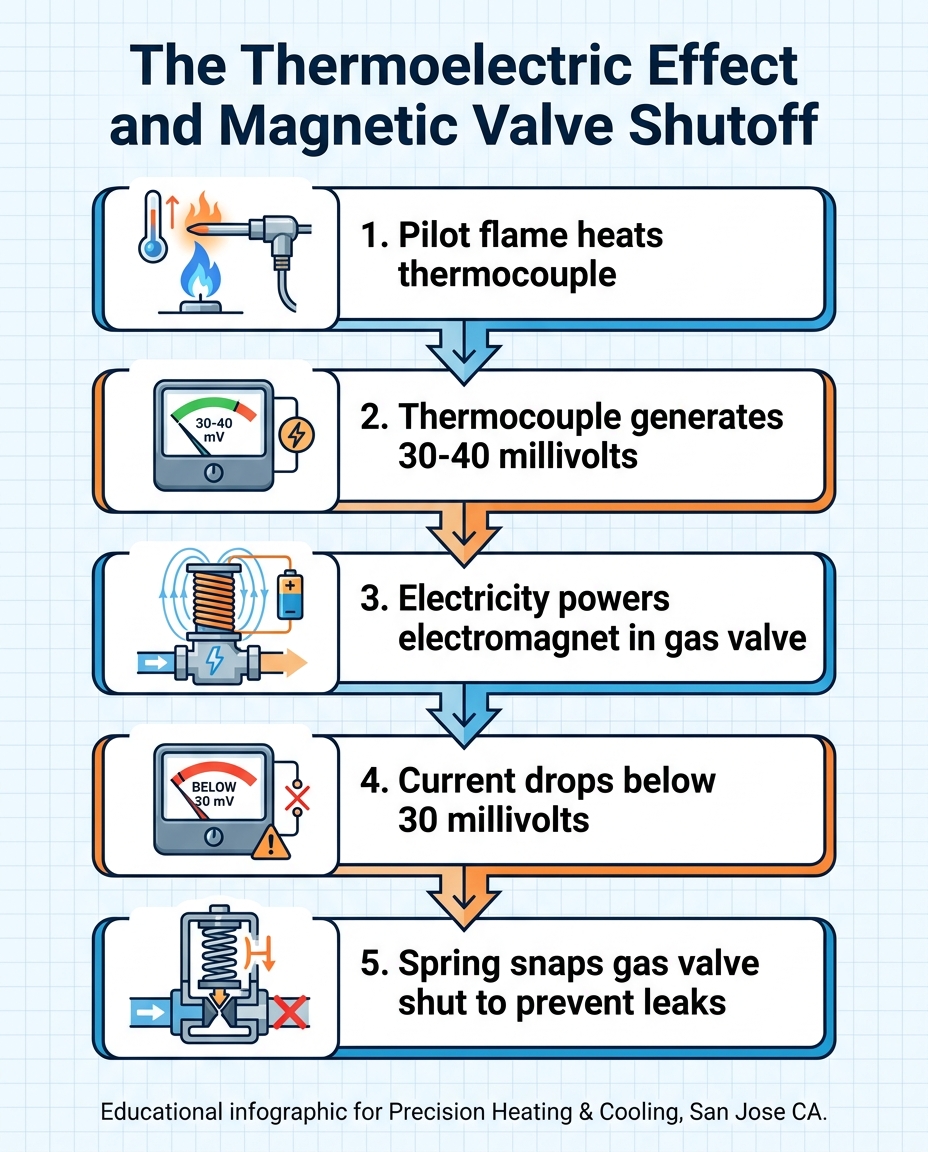
To understand why the system locks you out, you have to look at the specific electrical threshold required to keep the gas flowing. A healthy, properly functioning thermocouple generates between 30 and 40 millivolts of electricity. To put that into perspective, a standard AA battery produces 1,500 millivolts. The water heater operates on a microscopic fraction of that power, but it is exactly enough to do one specific job.
That 30 to 40 millivolt current travels down the copper wire and enters the gas control valve, where it powers a small electromagnet. This electromagnet pulls back a spring-loaded metal disc, opening the pathway for gas to flow to the pilot and the main burner. The system is designed with a strict mechanical fail-safe: when the current drops below 30 millivolts, the electromagnet weakens. The moment it loses its magnetic grip, a heavy tension spring instantly overpowers the weak magnet and snaps the gas valve completely shut, cutting off all fuel.
When you manually press and hold the pilot button down during the lighting process, you are physically pushing that spring-loaded valve open with your thumb. You are completely bypassing the electromagnet. As long as you hold the button, gas flows, and the pilot flame burns.
However, the moment you release the button, you are transferring the job of holding that valve open back to the electromagnet. If the thermocouple is damaged, degraded, or not hot enough, it will not generate the required 30 millivolts. The electromagnet will fail to hold the spring, and the valve will snap shut, instantly killing the flame you just lit.
• Healthy Pilot Flame — Millivolt Output: 30 to 40 millivolts — Gas Valve Position: Electromagnet holds valve open — Result: Continuous hot water
• Degraded Sensor — Millivolt Output: Drops below 30 millivolts — Gas Valve Position: Spring snaps valve shut — Result: Total safety lockout

If the system is locking you out because the electrical current is too low, the next logical question is why the sensor stopped generating enough power in the first place. Thermocouples operate in a harsh environment, constantly exposed to an open flame and extreme temperatures. Over time, several factors can cause their millivolt output to plummet.
• Carbon Buildup (Soot): As natural gas burns, it can leave behind a microscopic layer of carbon on the thermocouple probe. Over months and years, this soot acts as a thick thermal insulator. The flame might be burning hot, but the soot prevents that heat from reaching the dissimilar metals inside the probe, resulting in a weak electrical charge.
• Material Degradation: Constant exposure to a direct flame slowly degrades the outer casing and the internal metals of the sensor. The constant expansion and contraction from heating and cooling cycles eventually wear the metals down until they can no longer conduct electricity efficiently.
• Pilot Tube Clogs: Sometimes the sensor itself is perfectly fine, but the pilot tube delivering the gas is clogged with dust or lint. This creates a weak, lazy, yellow flame that isn't physically hot enough to generate 30 millivolts. A healthy pilot flame should be sharp, blue, and directly engulfing the top third of the thermocouple.
Any of these issues will trigger a safety shutdown. If you ever wonder, Is That Faint Gas Smell Normal When My Water Heater Ignites?, it is important to remember that the thermocouple is your primary defense against that raw gas accumulating in your home. The lockout is intentional.
The strict 30-millivolt shutdown rule is especially critical based on where your water heater is located. Because the San Jose area enjoys a generally moderate climate, building layouts frequently place water heaters in unconditioned garages or exterior utility closets rather than indoor basements. While this saves interior square footage, it heavily changes the safety dynamics of the home.
If a water heater pilot light were to blow out in an unconditioned garage, and the gas valve did not have a mechanical fail-safe to snap shut, raw natural gas would pour into the enclosed space continuously. Because garages are disconnected from the main living areas, this gas accumulation could go entirely undetected for hours. A single spark from a garage door opener or a light switch could result in a catastrophic event.
Furthermore, the ambient temperature fluctuations in these unconditioned spaces—sweltering heat in the late summer and cold drops overnight—can accelerate wear and tear on adjacent home heating solutions and plumbing systems. The thermocouple's zero-tolerance shutoff is the only thing standing between a simple blown-out pilot light and a severe hazard in these hidden areas.
When faced with a cold shower and a pilot light that refuses to stay lit, it is incredibly common for homeowners to pull out their phones and search "how to replace thermocouple on water heater." While the internet is full of quick tutorial videos, attempting to manipulate your water heater's gas control valve is a significant risk that should not be taken lightly.
Replacing a thermocouple is not like changing a lightbulb. It requires extreme precision to seat the new copper line into the bottom of the gas control valve. If the soft metal threads are cross-threaded even slightly, or if the connection to the magnetic seal is over-tightened, the electromagnet will fail to engage properly, or worse, the gas valve itself will be permanently damaged.
Licensed technicians carry specialized multimeters designed to test the exact millivolt output of the system under a live load. They also carry the exact OEM parts required to ensure the magnetic valve seals perfectly. Tampering with safety lockout mechanisms, loosening gas fittings, or failing to perform a calibrated electronic leak test post-installation introduces severe risks to your property.
There is a clear line between homeowner diagnostics and dangerous DIY repairs. Observing a dead pilot light, noting the color of the flame, and testing the button release are all acceptable and helpful diagnostic steps. You can gather this information safely. However, the moment the repair requires opening the sealed combustion chamber, unthreading gas lines, or bypassing safety sensors, you have crossed the line into work that requires a licensed professional.
Thermocouples rarely fail overnight. They degrade slowly over many months, gradually dropping from 40 millivolts, to 35, to 32, before finally dipping below the 30-millivolt threshold that triggers the lockout. Often, it takes a shift in household routines to expose this weakness.
For example, the sudden increase in hot water demand during late-summer back-to-school morning routines forces the water heater to run longer and more frequently. A weakened thermocouple that was barely holding on during the lighter summer months is suddenly pushed past its breaking point under the continuous operation, leading to that frustrating cold shower.
The most effective way to prevent these sudden shutoffs is through routine professional inspections. During a comprehensive tune-up, a technician will use a multimeter to test the exact electrical output of the thermocouple. If it is reading at 31 millivolts, they know it is on the verge of failure and can replace it proactively. Enrolling in a preventative maintenance plan ensures that carbon buildup is cleaned away, weak pilot flames are adjusted, and failing sensors are caught long before they ruin your morning.
Your pilot light goes out when you release the button because the thermocouple is not generating enough electrical current to hold the gas valve open. When you hold the button down, you manually bypass the safety valve. Once released, an electromagnet takes over, and if the current drops below 30 millivolts, a spring snaps the valve shut instantly.
No, a bad thermocouple will not cause a gas leak; in fact, its failure prevents one. The system is designed as a fail-safe, meaning that if the sensor breaks, degrades, or loses connection, it defaults to a closed, locked position. This ensures no unburned gas can escape into your home.
A thermocouple generates electricity through the thermoelectric effect. It contains two dissimilar metal wires joined at the tip. When the pilot flame heats this junction, the temperature difference between the hot tip and the cooler base forces electrons to flow, creating a small direct current of 30 to 40 millivolts.
Determining whether the issue is the gas valve or the thermocouple requires testing the sensor with a specialized multimeter under a load. If the thermocouple is producing more than 30 millivolts but the valve still won't stay open, the electromagnet inside the gas valve has likely failed. If the reading is below 30, the sensor is the culprit.
A healthy water heater thermocouple should produce between 30 and 40 millivolts of continuous direct current. If the output drops below 30 millivolts, the electromagnet inside the gas control valve will lose its grip, triggering a mechanical spring to shut off the gas supply.
No, you can never safely bypass a water heater thermocouple. Bypassing this critical sensor removes the only safety mechanism preventing raw natural gas from flooding your utility space if the pilot light blows out. Any attempt to rig or bypass the sensor is a severe safety hazard.
Finding yourself without hot water right when you need it most is never a good start to the day. However, recognizing that a faulty thermocouple shutting down the gas valve is actually a sign that your safety systems are working exactly as designed can provide some reassurance. The lockout proves your home is protected from undetected gas leaks.
Restoring your hot water requires properly diagnosing whether the root cause is soot buildup, a degraded sensor, or a failing magnetic valve. Because this involves manipulating the main gas control block and verifying proper combustion, homeowners should rely on licensed professionals to handle the replacement safely. For expert assistance, reach out for professional water heater repair and installation to get your morning routine back on track.

Leslie was amazing for her outstanding customer service skills with me the other day. Thanks to her help my air conditioner is now all set up. She answered all my questions and took away all my problems. Leslie broke it down step by step to set it up easier. Now thanks to her my air conditioner is working perfectly. I really appreciate it Leslie and I’ll be sure to ask for you if I ever come back.
I contacted Precision Heating and Cooling for my home's AC repair. They were punctual and very professional. Guillermo was very kind and thorough. I would highly recommend them!
I am writing to express my sincere appreciation for the excellent work performed by Pablo and Alejandro from Precision Heating and Cooling. Their commitment to quality and customer satisfaction is truly commendable. Awesome job guys!
I would like to extend my sincere gratitude to Alejandro for his exceptional hard work. His passion for helping others is evident, and he consistently goes above and beyond in his service. Alejandro's thorough cleaning of my fireplace has truly made a significant difference. His dedication and professionalism are greatly appreciated.
I was very impressed. Came at night (after 9pm) to fix our AC during the middle of a heat wave the day before a national holiday! Technician was very courteous and efficient, got the job done quickly. Will definitely call them again for any AC servicing I need!
Fast and efficient, arrived when scheduled for repairs and replacement parts were ordered and installed quickly. Techs were very friendly and professional. AC system works great now! I highly recommend their services if you need repairs. Tim


.avif)
