


.avif)







Recent Blogs
Stay updated with our latest blog posts.


You flip your thermostat to "heat" for the first time this season, expecting a rush of warm air to take the edge off the evening chill. Instead, the vents blow cold, or nothing happens at all. When you go to investigate your equipment, you discover a pilot light that simply refuses to hold a flame. This is a common and incredibly frustrating scenario during the September pre-heating season, especially when your system has been sitting dormant all summer. In many of these cases, the root cause comes down to one specific interaction: the mechanical relationship between your thermocouple and the pilot orifice.
Most homeowners immediately assume a major component has failed when the pilot will not stay lit. They start researching replacement parts or worrying about replacing the entire unit. However, the issue is often much smaller and more localized. The two main suspects in this scenario are the thermocouple, which acts as a vital safety sensor, and the pilot orifice, which delivers the fuel. While this breakdown focuses specifically on early fall furnace and wall heater start-ups, it is important to note that the exact same mechanical relationship applies to standing pilots across all of your HVAC systems and gas appliances.
Understanding how these two parts communicate can save you hours of troubleshooting frustration. When a pilot light drops out, it is not just a nuisance; it is a built-in safety mechanism doing exactly what it was designed to do. Before you jump to conclusions about broken equipment, you need to look closer at how the fuel delivery and the safety sensors interact within the combustion chamber.
To understand why your pilot will not stay lit, you first need to understand the individual roles of the parts involved. Older gas furnaces and wall heaters with standing pilots rely on a beautifully simple, yet highly precise, set of components to operate safely. Even though modern systems use electronic ignition, these classic standing pilot assemblies are still incredibly common in homes today, operating on the exact same principles as the pilot assemblies you might find requiring water heater services.
The Pilot Orifice: This is not just a simple metal tube. The pilot orifice is a precision-drilled, microscopic nozzle designed to deliver a highly specific volume of natural gas or propane. Its job is to create a small, continuous, and perfectly shaped pilot flame. The size of the hole in the orifice is calibrated to microscopic tolerances to ensure the flame burns at the correct temperature and height.
The Thermocouple: Positioned directly in the path of that pilot flame is the thermocouple. This component looks like a small copper rod or probe, but it is actually a sophisticated safety sensor. The thermocouple's sole purpose is to detect the presence of the pilot flame. It does not measure the temperature of your home; it only cares about the heat coming directly from the pilot orifice.
The gas valve, which controls the main flow of fuel to your furnace burners, relies entirely on the signal it receives from the thermocouple. If the thermocouple does not send a continuous "all clear" signal, the gas valve will snap shut. It will not allow the main burners to ignite, and it will shut off the flow of gas to the pilot assembly to prevent raw fuel from leaking into your home.
The interaction between these two components is where the real science happens. The mechanical relationship between your thermocouple and the pilot orifice is entirely dependent on a phenomenon known as the thermoelectric effect. This is the process of turning physical heat directly into electrical energy, and it is the only way older gas furnaces and wall heaters with standing pilots can operate without being plugged into a wall outlet.
Inside the tip of the thermocouple, two dissimilar metals are welded together. When the pilot flame heats this welded junction, the difference in temperature between the hot tip and the cooler base of the thermocouple generates a small direct current (DC) of electricity. This electrical current is measured in millivolts (thousandths of a volt). It is a tiny amount of power, but it is exactly enough to energize a small electromagnet inside the main gas valve, holding it open against a strong spring.
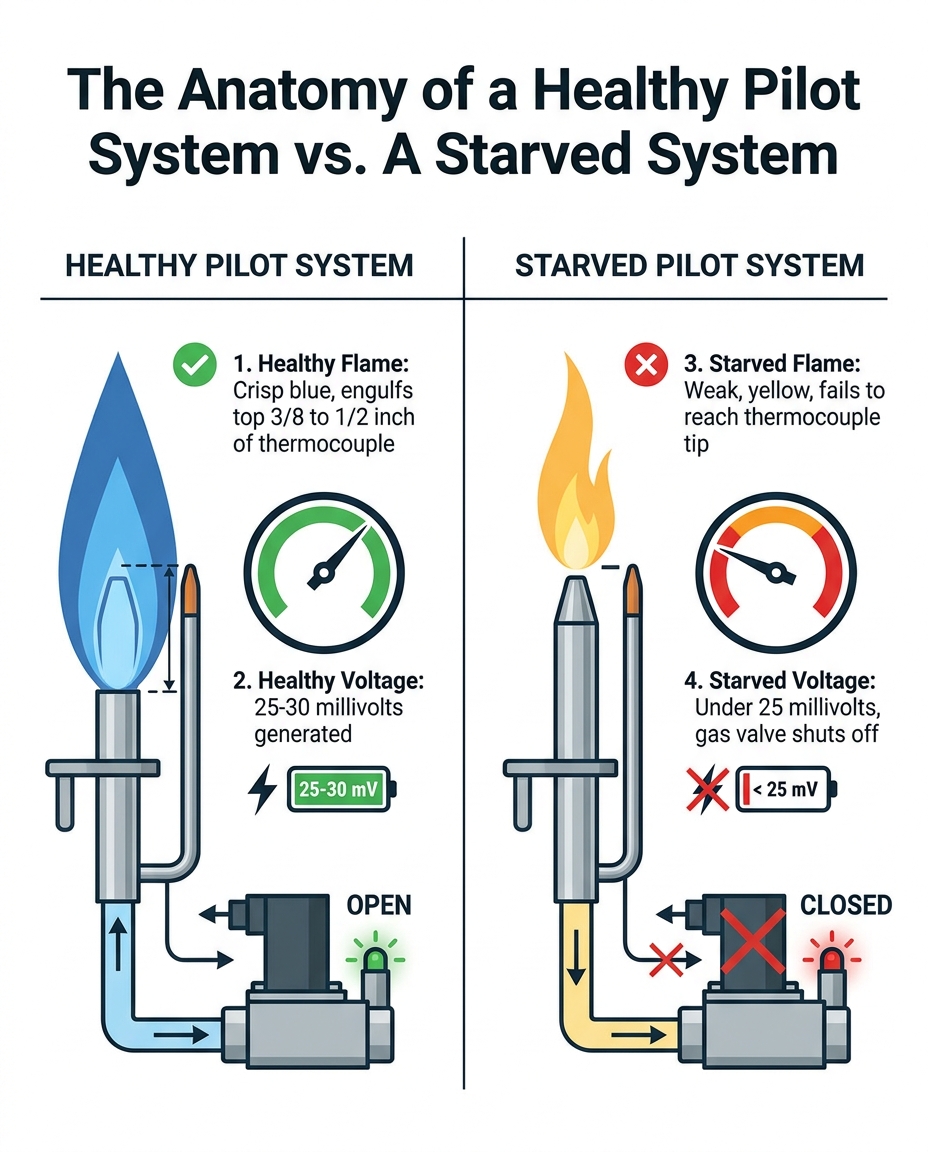
For this millivoltage magic to work, the physical alignment must be perfect. The pilot flame cannot just be near the thermocouple; it must physically engulf the top 3/8 to 1/2 inch of the thermocouple tip. If the flame is too short, too weak, or blowing in the wrong direction, it will not heat the junction adequately. A healthy, well-aligned system typically generates between 25 and 30 millivolts. If the voltage drops below a certain safety threshold (often around 15 to 18 millivolts, depending on the valve), the electromagnet loses its grip, the spring snaps the valve shut, and your pilot light goes out.
When everything is working correctly, the system operates in a continuous, self-sustaining loop. Here is exactly what happens during a healthy chain reaction:
• Precision fuel delivery: Gas flows cleanly through the unobstructed pilot orifice at the exact right pressure.
• Perfect flame contact: A strong, blue flame emerges and directly hits the exact top portion of the thermocouple tip.
• Electrical generation: The heat activates the dissimilar metals, and millivoltage is generated.
• Valve operation: The 25 to 30 millivolts travel down the copper wire to the gas valve, keeping the safety electromagnet energized and the gas flowing.
If any single step in this chain is interrupted, the entire system shuts down safely.
When a pilot light drops out during the September pre-heating season, the most common advice you will hear from neighbors or read online is to "just replace the thermocouple." Because the thermocouple is the part that actually signals the gas valve to shut off, it takes the blame. Homeowners assume the sensor has failed and can no longer generate electricity. While thermocouples do wear out over time, they are often wrongly accused.
In many cases, the true culprit is a dirty pilot orifice. During San Jose's dry summer months, airborne particulate matter, dust, and lint levels increase significantly. Because your heating equipment sits completely dormant from spring until early fall, this fine dust settles directly into the exposed, microscopic hole of the pilot orifice. Even a tiny spider web spun inside the pilot assembly over the summer is enough to cause a major disruption.
This creates a mechanical failure that perfectly mimics a bad thermocouple. The clog restricts the flow of gas through the orifice. With less gas flowing, the pilot flame shrinks and becomes weak. Because the flame is no longer large enough to engulf the top 3/8 to 1/2 inch of the thermocouple, the temperature at the sensor drops. When the temperature drops, the millivoltage drops below the 25-volt threshold, and the gas valve shuts off. The thermocouple was working perfectly fine—it simply was not receiving the heat it needed from your home heating equipment to do its job.
You do not always need specialized testing equipment to tell the difference between a broken thermocouple and a dirty orifice. Often, a visual inspection of the pilot flame itself will reveal exactly what is going wrong inside older gas furnaces and wall heaters with standing pilots. By observing the shape, color, and reach of the flame, you can determine if the thermocouple is being starved of heat.
A healthy pilot flame is crisp, strong, and predominantly blue. It should look like a miniature blowtorch, shooting straight out of the orifice and wrapping cleanly around the upper tip of the thermocouple. A healthy flame burns hot and clean, ensuring maximum millivoltage generation and preventing any soot buildup on the sensor.
A starved pilot flame looks entirely different. When microscopic debris partially blocks the orifice, the flame becomes weak, lazy, and often yellow at the tip. A yellow flame indicates incomplete combustion, which can also be related to a faint gas smell when your water heater ignites or when your furnace tries to start. Most importantly, a starved flame will visually fail to reach the thermocouple tip. It might flicker just below the sensor or split and wrap around the sides without heating the core. When you see this weak, lazy flame, you are watching the safety mechanism in action: the flame drops, the millivoltage drops, and the gas valve snaps shut to keep you safe.
• Flame Color — Healthy Pilot System: Crisp, bright blue with a slight yellow tip — Starved Pilot System (Dirty Orifice): Lazy, predominantly yellow or orange
• Flame Shape — Healthy Pilot System: Strong, sharp, and focused like a small torch — Starved Pilot System (Dirty Orifice): Weak, flickering, easily moved by drafts
• Thermocouple Contact — Healthy Pilot System: Engulfs the top 3/8 to 1/2 inch of the tip — Starved Pilot System (Dirty Orifice): Barely touches the tip or misses it entirely
• System Behavior — Healthy Pilot System: Pilot holds steady when the button is released — Starved Pilot System (Dirty Orifice): Pilot immediately goes out when button is released

The biggest mistake homeowners make with older gas furnaces and wall heaters with standing pilots is relying on the "parts cannon" approach. This means blindly buying and installing a new thermocouple, hoping it fixes the problem. If the true issue is a dirty pilot orifice, the brand-new thermocouple will fail to keep the pilot lit for the exact same reason the old one did: it is not getting enough heat. You waste time, you waste money on unnecessary parts, and your house remains cold.
Professional diagnosis eliminates this guesswork. When Precision Heating & Cooling technicians evaluate a failing pilot system, they use specialized multimeters to test the actual millivoltage being generated. By performing both closed-circuit and open-circuit millivolt tests, a technician can see exactly how much electricity the thermocouple is producing under load. If the multimeter reads low voltage, but the flame looks weak, the technician knows immediately that the orifice needs cleaning, not that the thermocouple needs replacing.
This exact diagnostic precision applies across all HVAC issues. For example, during a sudden spring breakdown, one local homeowner called us when their system failed to operate. Rather than throwing parts at the problem, our technician Anthony used precise diagnostic testing to pinpoint the exact root cause, resolving the issue quickly and accurately within 30 minutes. Accurate diagnosis saves time, prevents unnecessary part purchases, and restores your heat faster and more reliably.
Once you realize that a dirty orifice is causing your pilot light to fail, it can be tempting to try and clean it yourself. However, working on the gas delivery components of older gas furnaces and wall heaters with standing pilots carries significant hidden dangers. These are highly sensitive, precision-engineered parts that require a delicate touch and professional knowledge to handle safely.
The danger of enlarging the orifice: The hole in a pilot orifice is microscopic. A common, highly dangerous DIY mistake is attempting to clear a clog by poking a needle, a pin, or a piece of wire into the hole. Because the orifice is made of soft brass or aluminum, poking it with steel wire will permanently enlarge or misshape the hole. An oversized orifice delivers too much gas, causing improper combustion, dangerous soot buildup, and elevated carbon monoxide risks. Once the hole is damaged, the entire orifice must be replaced.
The fragility of old pilot tubes: Older systems require extremely careful handling. The aluminum or copper tubing that delivers gas to the pilot assembly becomes incredibly brittle after years of heating and cooling cycles. If you bump or bend this tubing during a DIY cleaning attempt, it can easily kink or crack, causing an invisible gas leak. We frequently see the value of professional care on aging equipment; recently, we helped a customer whose age-old, discontinued HVAC system stopped working. Our technicians were able to safely repair the delicate components and back the work with a service warranty—a level of protection and safety a DIY attempt can never offer.
A pilot light usually goes out because the gas valve shuts it off for safety. This happens when the thermocouple stops sending the required electrical signal to the valve. The most common causes are a dirty pilot orifice starving the flame of fuel, a draft blowing the flame away from the sensor, or a genuinely worn-out thermocouple that can no longer generate millivoltage.
A dirty pilot orifice restricts the flow of natural gas, which directly shrinks the size of the pilot flame. When the flame shrinks, it can no longer reach the top of the thermocouple to heat it properly. Without sufficient heat, the thermocouple cannot generate the electricity needed to hold the gas valve open.
Yes, a weak pilot flame is the primary reason a gas valve will shut off. The gas valve relies on a steady 25 to 30 millivolts of electricity from the thermocouple to keep its internal electromagnet energized. A weak flame drops the temperature, which drops the voltage, causing the spring-loaded valve to snap shut instantly.
A healthy, properly heated thermocouple should produce between 25 and 30 millivolts of direct current (DC) under an open-circuit test. Under load (when connected to the gas valve), it must maintain enough voltage to overcome the valve's drop-out threshold, which is typically around 15 to 18 millivolts depending on the specific valve model.
You can usually tell by looking closely at the pilot flame itself. If the flame is strong, crisp, blue, and fully engulfing the top half-inch of the thermocouple, but the pilot still won't stay lit, the thermocouple is likely bad. If the flame is weak, yellow, lazy, and failing to reach the thermocouple tip, the orifice is dirty.
No, cleaning a pilot orifice is a job for a licensed professional. The orifice hole is precision-drilled, and attempting to clear it with household items like needles or wire can permanently enlarge the opening, leading to dangerous soot buildup and improper combustion. Additionally, the surrounding gas tubes are often brittle and prone to cracking if mishandled.
A reliable pilot light depends entirely on a perfectly balanced mechanical relationship between your fuel delivery and your safety sensors. When the September pre-heating season arrives, that balance is often disrupted by months of accumulated summer dust. Understanding that a dirty orifice can perfectly mimic a bad thermocouple empowers you to make smarter decisions about your heating system, rather than guessing with unnecessary replacement parts.
Because these components are highly sensitive and critical to the safe operation of your furnace, professional cleaning and testing is always the safest route. A licensed technician has the tools to measure exact millivoltage and the expertise to clean precision orifices without causing damage. To ensure your system is ready for the cold weather ahead, schedule your routine preventative maintenance before the deep chill sets in. A properly tuned pilot assembly means consistent warmth and total peace of mind all season long.

Leslie was amazing for her outstanding customer service skills with me the other day. Thanks to her help my air conditioner is now all set up. She answered all my questions and took away all my problems. Leslie broke it down step by step to set it up easier. Now thanks to her my air conditioner is working perfectly. I really appreciate it Leslie and I’ll be sure to ask for you if I ever come back.
I contacted Precision Heating and Cooling for my home's AC repair. They were punctual and very professional. Guillermo was very kind and thorough. I would highly recommend them!
I am writing to express my sincere appreciation for the excellent work performed by Pablo and Alejandro from Precision Heating and Cooling. Their commitment to quality and customer satisfaction is truly commendable. Awesome job guys!
I would like to extend my sincere gratitude to Alejandro for his exceptional hard work. His passion for helping others is evident, and he consistently goes above and beyond in his service. Alejandro's thorough cleaning of my fireplace has truly made a significant difference. His dedication and professionalism are greatly appreciated.
I was very impressed. Came at night (after 9pm) to fix our AC during the middle of a heat wave the day before a national holiday! Technician was very courteous and efficient, got the job done quickly. Will definitely call them again for any AC servicing I need!
Fast and efficient, arrived when scheduled for repairs and replacement parts were ordered and installed quickly. Techs were very friendly and professional. AC system works great now! I highly recommend their services if you need repairs. Tim


.avif)
