


.avif)






Recent Blogs
Stay updated with our latest blog posts.


Understanding chimney cleaning frequency for safe operation is one of the most important things you can do to protect your home and family. Most homeowners know they should clean their chimney — but far fewer know exactly how often, or what happens when they wait too long.
Here is a quick answer based on expert guidelines:
| Situation | Recommended Cleaning Frequency |
|---|---|
| Any chimney, any fuel type | Inspect at least once per year (NFPA 211) |
| Wood-burning fireplace, moderate use | Clean once per year minimum |
| Wood stove used as primary heat source | Clean once to twice per year |
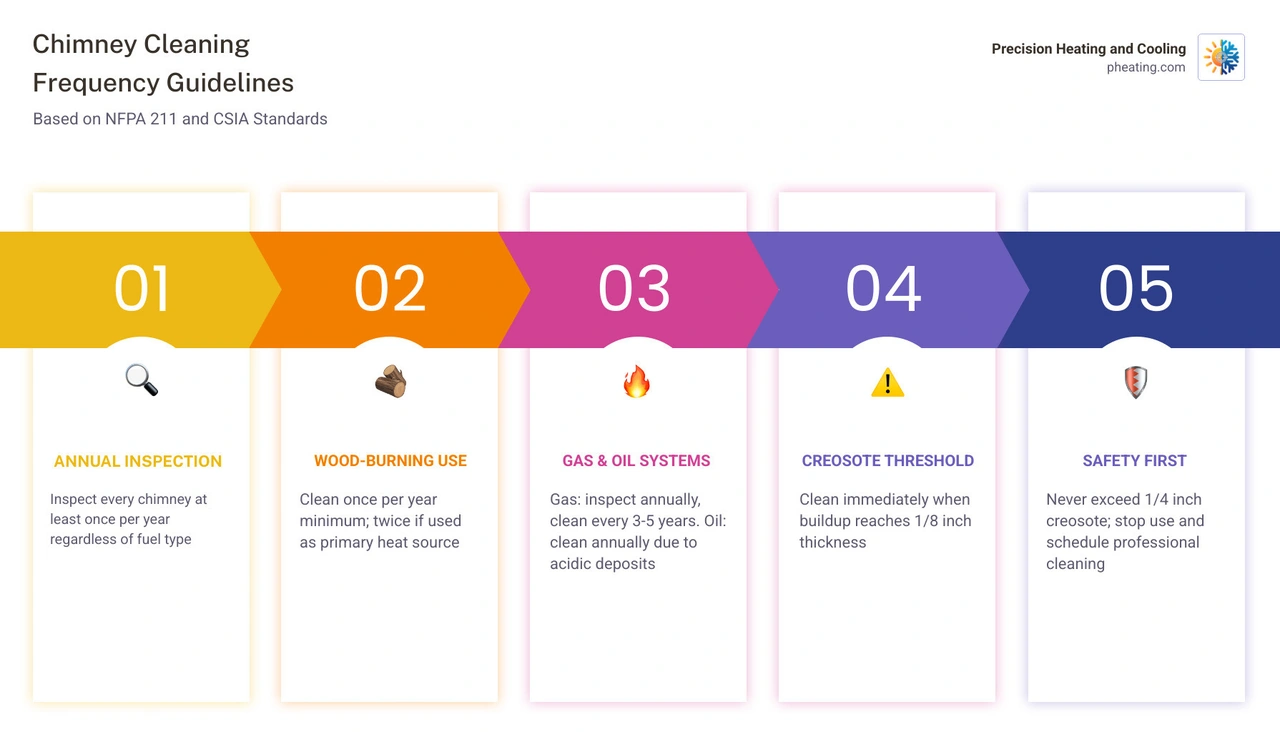
| Gas fireplace | Inspect annually; clean every 3-5 years or as needed |
| Oil furnace flue | Clean annually due to acidic deposits |
| Creosote reaches 1/8 inch thick | Clean immediately regardless of schedule (CSIA) |
| Creosote reaches 1/4 inch thick | Stop using fireplace until professionally cleaned |
The short version: the National Fire Protection Association (NFPA) requires an inspection every year for all chimneys, and the Chimney Safety Institute of America (CSIA) says cleaning is needed as soon as creosote or soot buildup reaches 1/8 inch — whichever comes first.
Skipping this maintenance is not just a minor oversight. A chimney fire can exceed 2,000 degrees Fahrenheit, enough to crack your flue liner and ignite the framing inside your walls. And because creosote builds up silently, many homeowners have no idea there is a problem until something goes wrong.
My name is Tony Lara, and through my work in the HVAC field I have seen how neglected chimneys create serious safety hazards that could have been avoided with a consistent chimney cleaning frequency for safe operation schedule. Whether you use your fireplace every night or just a few times a season, this guide will help you understand exactly what your chimney needs — and when.
When it comes to keeping your fireplace safe, two major organizations set the gold standards: the National Fire Protection Association (NFPA) and the Chimney Safety Institute of America (CSIA). While they approach the topic from slightly different angles, their guidelines work together to keep your home safe.
The NFPA 211 standard establishes that all chimneys, fireplaces, and vents must be inspected at least once a year. This rule applies even if you rarely use your fireplace. Why? Because issues like moisture damage, settling masonry, and animal nests can occur without you ever lighting a match.
The CSIA, on the other hand, bases its cleaning recommendations on actual usage and the physical buildup inside your flue. According to the CSIA, you should schedule a cleaning as soon as soot and creosote reach a thickness of 1/8 inch. If you burn wood frequently, you will likely hit this threshold long before your annual inspection is due.
Understanding these triggers helps you avoid the trap of waiting for an arbitrary date on the calendar. To make things simple, we can look at the core differences between how these two organizations evaluate your system:
| Feature | NFPA Guidelines | CSIA Guidelines |
|---|---|---|
| Primary Focus | System integrity and safety codes | Creosote buildup and functional sweep triggers |
| Inspection Interval | Mandated at least once per year | Recommended annually to assess sweeping needs |
| Cleaning Trigger | Determined during the annual inspection | When creosote or soot thickness reaches 1/8 inch |
| Critical Limit | Immediate action if structural defects are found | Stop all use if creosote reaches 1/4 inch thickness |
By combining both perspectives, you get the safest possible setup. You inspect annually to catch hidden defects, and you sweep whenever your burning habits cause creosote to pile up. There are many compelling Reasons to Schedule a Chimney Cleaning beyond just clearing soot, including improving your indoor air quality and ensuring proper draft performance throughout the winter.
The speed at which your flue accumulates dangerous soot and creosote depends heavily on what you burn and how you burn it. Different heating appliances have vastly different maintenance needs:
The quality of your wood also plays a massive role. Burning seasoned hardwood (wood that has dried for at least six to twelve months and has a moisture content below 20%) burns hot and clean. Conversely, burning wet, unseasoned "green" wood or softwoods like pine creates massive amounts of smoke. This cool, moisture-heavy smoke condenses rapidly inside your flue, producing up to three times more creosote than dry hardwood.
No matter what fuel type you use, keeping the passage clear is vital. Regular Chimney Liner Cleaning protects the critical barrier between hot exhaust gases and the combustible wooden framing of your home.
To make informed decisions about your fireplace safety, you need to understand the 1/8-inch creosote threshold. This measurement is the point of no return for safe operation. Once creosote reaches this thickness, it is highly flammable and acts as fuel just waiting for a stray spark to ignite a chimney fire.
Creosote does not just appear overnight; it progresses through three distinct, increasingly dangerous stages:
If you let creosote reach 1/4 inch, you must stop using your fireplace immediately. To learn more about identifying these stages and managing them safely, consult our Ultimate Chimney Cleaning Safety Guide.
Skipping your regular chimney maintenance is a gamble where the stakes are incredibly high. The most immediate threat is a chimney fire. When creosote ignites inside the flue, it burns with a roaring sound often described as resembling a freight train. These fires reach temperatures over 2,000 degrees Fahrenheit. At this heat level, clay flue tiles crack, metal liners warp or melt, and the heat can easily transfer through masonry to ignite the wood framing of your home.
But fire is not the only hazard. A blocked or restricted chimney draft can cause carbon monoxide (CO) to backdraft into your living space. Because carbon monoxide is invisible, odorless, and tasteless, it is often called the silent killer. A chimney clogged with creosote, soot, or animal nests prevents these toxic combustion byproducts from escaping safely out of your roof.
Additionally, neglecting your chimney can lead to severe structural damage. Moisture is a masonry chimney’s worst enemy. When rainwater mixes with acidic soot deposits inside an uncleaned chimney, it creates a corrosive paste that eats away at mortar joints and clay liners. During cold winter months, this trapped moisture freezes and expands, causing brickwork to crack, crumble, and eventually fail.
Ensuring your home is protected from these hidden dangers involves looking at your venting systems holistically. Many of the same nesting and blockage issues that plague chimneys also affect dryer exhausts, which is why coordinating Regular Dryer Vent and Chimney Cleaning is a smart way to protect your property from multiple fire hazards at once.
Many homeowners use the terms "chimney inspection" and "chimney cleaning" interchangeably, but they are actually two distinct services. An inspection is a diagnostic process used to assess the health of your system, while a cleaning is the physical removal of soot, creosote, and blockages.
The NFPA categorizes chimney inspections into three distinct levels:
Physical sweeping is only performed when an inspection reveals that the creosote or soot has reached the cleaning threshold. If you have an older home in our service area, maintaining these old brick flues requires specialized care. Check out our Old Chimney Cleaning Complete Guide to understand the unique structural challenges and safety requirements of vintage fireplaces.
While professional inspections are the most reliable way to assess your chimney, there are several clear warning signs you can watch out for between visits. If you notice any of the following symptoms, you should schedule a cleaning immediately:
To help you keep track of potential issues, here is a checklist of common chimney problems that every homeowner should look out for:
If you are experiencing any of these issues and live in the South Bay, scheduling a professional Chimney Cleaning San Jose CA is the fastest way to restore proper ventilation and ensure your home remains safe.
The worst time to schedule a chimney sweep is in late autumn. As soon as the first cold snap hits, chimney companies are flooded with calls from homeowners who realized too late that they need an inspection before lighting their first fire of the season. This "fall rush" makes it incredibly difficult to secure a convenient appointment, and if the technician discovers structural damage, you may have to wait weeks for repairs while your fireplace sits cold.
Instead, the best time of year to schedule your chimney sweep is during the spring or early summer.
Scheduling during the off-season offers several major advantages. First, you will have your choice of appointment times. Second, cleaning out acidic soot right after the burning season ends prevents those deposits from reacting with summer humidity and corroding your flue liner over the warm months. Finally, if any repairs are needed — such as tuckpointing brickwork or replacing a damaged liner — the warm, dry summer weather provides the perfect conditions for masonry and construction work to cure correctly.
If you live in the East Bay or South Bay, planning ahead with a professional Chimney Cleaning Sunnyvale CA during the spring or summer ensures your heating system is safe, efficient, and completely ready to go the moment winter arrives.
With DIY guides and chimney brush kits readily available online, many homeowners wonder if they can tackle this job themselves. While it is technically possible to clean your own chimney, it is a highly challenging, messy, and potentially dangerous task.
DIY chimney cleaning is typically done using one of two methods:
If you attempt DIY cleaning, you must wear proper Personal Protective Equipment (PPE), including a high-quality respirator (to avoid inhaling carcinogenic soot particles), safety glasses, and heavy gloves. You also need to purchase correctly sized brushes that match the exact dimensions and material of your flue liner.
However, the biggest drawback of DIY cleaning is that a homeowner cannot replicate a professional inspection. A brush might clear away soft soot, but it will not tell you if your clay liner has hairline cracks that leak carbon monoxide, or if your chimney crown is eroding. Certified sweeps have specialized video cameras to inspect the entire length of your flue, catching hidden hazards before they turn into disasters.
For homeowners in the Peninsula, hiring a professional Chimney Cleaning Palo Alto CA ensures the job is done cleanly, safely, and in compliance with all local fire codes.
Keeping your home safe means staying informed. Here are some of the most common questions we receive from homeowners about maintaining their chimneys and fireplaces.
A standard, professional chimney cleaning and inspection typically takes between 45 and 90 minutes.
When a professional technician arrives at your home, they do not just start shoving a brush up the flue. First, they will lay down protective drop cloths to completely seal off your hearth and protect your flooring and furniture from soot. Next, they will perform a Level 1 visual inspection to check for blockages or structural damage.
Once the setup is complete, they will use specialized brushes and a high-powered HEPA vacuum system to sweep the flue walls, firebox, smoke shelf, and damper without letting a single speck of dust escape into your living room. Finally, they will provide you with a detailed report on the condition of your system.
If you are located in the Santa Clara Valley, booking a professional Chimney Cleaning Los Gatos CA is a quick, hassle-free process that gives you complete peace of mind before the winter burning season begins.
Yes, gas fireplaces absolutely need regular maintenance. While it is true that gas burns incredibly clean and does not produce highly flammable creosote, these systems still require annual professional attention.
Over time, gas fireplaces can develop several issues that threaten your safety and indoor air quality:
An annual inspection ensures that your gas lines, safety valves, pilot assembly, and venting systems are working flawlessly. If you are in the South Bay, scheduling a professional Chimney Cleaning Santa Clara CA is the best way to keep your gas fireplace operating safely.
The short answer is no. Chimney cleaning logs (often called chemical sweep logs) are not a replacement for a professional, mechanical sweeping.
These logs contain chemical additives that release a gas when burned. This gas reacts with the creosote inside your chimney, drying it out and making it brittle. The goal is to make the creosote flake off and fall down into the firebox.
While these logs can be useful as a pre-treatment to loosen stubborn Stage 2 or Stage 3 creosote before a professional sweep arrives, they do not actually remove the debris from your system. The loose flakes often pile up on your smoke shelf or damper, creating a major fire hazard right above your firebox. Only physical brushing with professional tools can safely scrape and remove creosote from your flue walls.
If you live in the Central Valley, relying on chemical logs is a dangerous shortcut. Instead, schedule a thorough, mechanical Chimney Cleaning Clovis CA to ensure your fireplace is truly safe to use.
Maintaining the proper chimney cleaning frequency for safe operation is not just a routine chore — it is a vital part of protecting your home, your family, and your peace of mind. By combining annual professional inspections with timely sweeps whenever creosote approaches the 1/8-inch mark, you can enjoy the cozy warmth of your fireplace without worrying about the silent threats of chimney fires or carbon monoxide poisoning.
At Precision Heating and Cooling, we have spent over two decades helping homeowners throughout the San Jose Bay Area and Central Valley keep their heating systems in peak condition. We are proud to serve our local communities, including Cupertino, Los Gatos, Clovis, Palo Alto, Santa Clara, Sunnyvale, and Hanford.
If you live in the Central Valley and want to ensure your wood stove or fireplace is operating safely, reach out to us for a professional Chimney Cleaning Hanford CA. Don't wait for the cold weather to catch you off guard — Schedule professional indoor air quality services today and let our experienced team keep your home warm, comfortable, and safe all year long.

Leslie was amazing for her outstanding customer service skills with me the other day. Thanks to her help my air conditioner is now all set up. She answered all my questions and took away all my problems. Leslie broke it down step by step to set it up easier. Now thanks to her my air conditioner is working perfectly. I really appreciate it Leslie and I’ll be sure to ask for you if I ever come back.
I contacted Precision Heating and Cooling for my home's AC repair. They were punctual and very professional. Guillermo was very kind and thorough. I would highly recommend them!
I am writing to express my sincere appreciation for the excellent work performed by Pablo and Alejandro from Precision Heating and Cooling. Their commitment to quality and customer satisfaction is truly commendable. Awesome job guys!
I would like to extend my sincere gratitude to Alejandro for his exceptional hard work. His passion for helping others is evident, and he consistently goes above and beyond in his service. Alejandro's thorough cleaning of my fireplace has truly made a significant difference. His dedication and professionalism are greatly appreciated.
I was very impressed. Came at night (after 9pm) to fix our AC during the middle of a heat wave the day before a national holiday! Technician was very courteous and efficient, got the job done quickly. Will definitely call them again for any AC servicing I need!
Fast and efficient, arrived when scheduled for repairs and replacement parts were ordered and installed quickly. Techs were very friendly and professional. AC system works great now! I highly recommend their services if you need repairs. Tim



.avif)
